In December 1939, on the snow-covered plains of Finland’s Karelian Isthmus, troops of the Red Army cautiously advanced on a massively outnumbered foe. Seconds later, in what appeared to be a deserted landscape, a single shot rang out and yet another invader fell dead. They didn’t know it, but hidden to their front and stalking their every move was the most successful sniper in the history of warfare.
In this video, using modern technology, the latest historical research, and rare witness testimony, we’ll explore the life and map out the war path of the legendary Simo Häyhä, the White Death.
Born on the 17th of December 1905 on a farm near the town of Rautjärvi in the Russian Grand Duchy of Finland, Simo was the seventh child in the Häyhä family. Quiet and reserved, he completed four years of school and pursued no further education, opting for a simple life of farmwork, forestry, fishing, and hunting in the countryside.
By the time he came of age, his home country of Finland had gained its independence from the collapsing Russian Empire and fought a brutal civil war of its own. But here, in contrast to Russia, the Whites had won. Simo joined the Finnish White Guard, now renamed the Civil Guard, at the age of 17. It was a trained citizen militia composed of old Civil War veterans, volunteers, and reservists. His friends called him Simuna, a play on his name meaning ‘Sim egg’ in Finnish.
In 1925, Simo was conscripted into the Finnish army proper, serving until 1927, after which he remained an active reservist in the Civil Guard. It was around this time when the Finnish army adopted as its standard-issue rifle the M/27, a domestically produced improved version of the standard Russian Mosin-Nagant. But the Civil Guard, trained by German Jägers, opted for an even better rifle, the M/28-30. It was nicknamed the ‘Pystykorva’ after the Finnish Spitz, a hunting dog whose ears resembled the excellent front sights of the rifle. Those thick ears were very useful for calculating the wind at long distances, while the new rear sight sported two separate adjustment settings: the quick one for hundreds of meters distance and the precise one for exact target range estimation. Something that Simo Häyhä would prove himself unsurpassed at.
But the Finnish government could not afford to mass-produce such an expensive rifle. So, it offered willing citizens the option to pay a portion of the cost and be allowed to take the rifle home and use it for hunting, recreation, and home defense. Simo, along with some 30,000 other civil guardsmen, took this deal and bought his own Mosin M/28-30, serial number 60974.
The Civil Guard hosted regular shooting competitions, which Simo, an avid hunter and recreational shooter, regularly attended. The competition’s prizes, though, were very modest—in which Simo, the regular top-scoring champion and certified master marksman, would often win just a pair of teaspoons. But he didn’t mind. The value of the Civil Guard shooting competitions was enormous. “All of us guardsmen were well trained, very familiar with our weapons and with each other. Without them, Finland would perhaps not have survived to win the war.” He was in love with his rifle, cleaning it obsessively every day. In Simo and many others, Finland had forged a peacetime citizenry of excellent marksmen whom she was about to call upon in her time of greatest need.
In the autumn of 1939, the Third Reich and the USSR invaded and crushed Poland, signing a treaty which divided Eastern Europe into each power’s respective spheres of influence. The Molotov-Ribbentrop Pact, as it would become known, gave the Soviet Union a free hand to occupy and annex the Baltic states and then in November to set its sights on Finland.
After the Civil War, the Finnish territory included the strategically vital Karelian Isthmus, which stretched up to a mere 40 km from Leningrad, Russia’s second-largest city, home of the Baltic Soviet fleet, and the cradle of the 1917 Communist Revolution. Such close proximity of Leningrad to a potentially hostile state was ruled unacceptable by Stalin. And Soviet foreign minister Vyacheslav Molotov proposed to settle the matter through a territorial exchange. But the Finns, distrustful of Stalin and afraid of further Soviet demands, gave Molotov a resolute ‘nyet’.
Recalled the Soviet response: “It’s the last day of November 1939. I was on the training grounds. We’d been doing an anti-tank course since the last night we slept well. In the morning, we learned that the Soviet artillery had hit the villages on our side of the border and the infantry had crossed the demarcation line. Well, this is it then. We all thought the war had begun.”
Simo immediately rushed to get back to his unit, which was assembling some 60 km north of Lake Ladoga. With his own personal rifle over his shoulder, he was assigned as a corporal to the sixth company of the 34th Infantry Regiment. When he arrived, he and his comrades were greeted by the imposing figure of the company’s commander, Lieutenant Aarne Juutilainen, a veteran of the French Foreign Legion, known to his men as ‘Marokon kauhu’—the Terror of Morocco. On our very first meeting, in his typical style, Lieutenant Juutilainen said, “We’re about to fight the Russians. Remember, they’re our neighbors, so don’t be hitting them too hard. Hit them just hard enough to blow off their heads.”
The 34th Regiment, as part of the Finnish 12th Division, was ordered to the Kollaa River area, located here in the Finnish Kainuu region. A single road and railway line passed through this heavily wooded area, connecting the Soviet border with the town of Lieksa, where the division had set up its headquarters—a single traversable route in the vast frozen wasteland of forests, marshes, and lakes through which 120,000 men, 400 tanks, and 600 artillery pieces of the Soviet 8th Army were preparing to advance.
Against them stood the 40,000-strong Finnish IV Corps, whose 12th Division stretched 60 km along the Kollaa River and would receive the brunt of the attack. The Soviet objective: sweep around Lake Ladoga and outflank the heavily fortified Mannerheim Line, the main line of defense protecting the Karelian Isthmus and Finland from invasion. The danger was apparent to every Finn, with arguably the outcome of the war and the fate of the entire country at stake. Kollaa simply had to hold.
The vanguard of the Soviet juggernaut was the 56th Rifle Division, which after a short fight captured the border town of Suvilahti and then pursued the retreating Finns westwards. They fought several sharp delaying actions, but the situation was becoming desperate. The mass of Soviet infantry and their fairly ubiquitous brown coats appeared to be endless, and the red wave, it seemed, was about to overrun them. ‘Kollaa will hold’ became the collective cry of the entire nation.
On the 4th of December, Simo’s regiment made a stand in the defensive positions on the Kollaa River here. The temperature was minus 25°C during the day, dropping to a horrifying minus 40 during the night. The Soviet infantrymen, many of whom hailed from the southern, warmer parts of the country like Ukraine, were completely unaccustomed to such severe elements. Whilst the Finns felt right at home. Here’s Simo:
“The Russians were sitting around four large campfires, completely oblivious to our presence. There were no sentries, no real security behind their lines. Everyone gathered around the fires, trying to get warm. We managed to crawl up very close and then we unleashed fire on them with everything we had and scattered them into the freezing wilderness.”
The Finns employed the tactic of active defense, stubbornly holding on to the well-dug-in positions on the main line while constantly harassing the enemy with ambushes, daring raids deep behind the lines, and of course, sniping. The Soviets were stunned by the tenacity of the resistance. Their advantage in tanks, artillery, and air power was all but completely neglected by the terrain and the weather. The Red Army, fresh out of Stalin’s purges, seemed to lack any tactical flexibility and opted to simply throw more and more men at the exhausted but determined Finnish defenders over and over again with the same results.
In these actions, Lieutenant Juutilainen immediately took notice of Simo’s superb marksmanship. An enemy sniper located about 450 m away had shot and killed four of their comrades. Simo searched for him for hours when, at sunset, the sunlight carried by the snow reflected off his scope and betrayed his position. Simo took aim, only for the Russian sniper to stand up and try to walk away—no doubt satisfied with his day’s work and feeling safe in the dim evening and at such long range. A mistake he and many others learned the hard way.
As a corporal, he acted as a squad leader when needed, armed with the Finnish KP/-31 submachine gun. But first and foremost, he was a sniper. “I had to go on many recon patrols with my men and lead many attacks, but sniping was the everyday duty. We would observe the enemy activity during the day and would determine the most target-rich environment. Then I would go out at night and prepare a good firing position from which it was easy to shoot, but not so easy for the enemy to spot. I was happy with the results.”
Using the latest technology, rare historical documents, and Simo’s own testimony, we were able to pinpoint the exact location of several of his sniping positions. As we can see here, one was right in front of the Soviet lines, while others, such as this one, were located on the flanks of the expected attack. Perfect for shooting officers, NCOs, and machine gun crews from unexpected directions.
The short winter days lasted only about 3 to 5 hours, and maps of the area were very scarce, so Simo had to create his own one in his head, taking care to memorize every detail of the terrain. At about 160 cm tall and an experienced trekker, he moved through the snowy woodlands with relative ease, often using skis to maximize his speed.
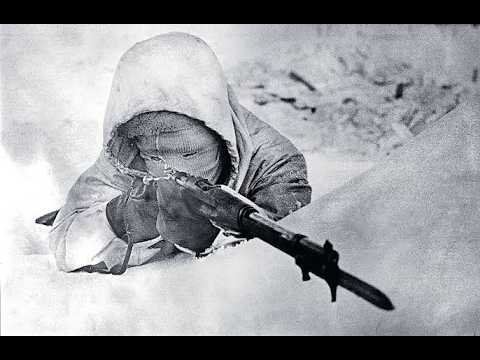
As we can see in these postwar photos of Simo’s shooting positions, he always picked a spot next to a boulder or a tree which he would use as cover and concealment. Then he would heap snow to the back of his position, creating an all-round white background against which his layered snowsuit and gorilla-wrapped rifle would blend perfectly in and give no silhouette. He poured water from his canteen in front of the position, soaking the powdery snow so it wouldn’t burst into the air and reveal his position once the rifle was fired. And to prevent his own warm breath from betraying him, he would keep snow in his mouth at all times, consuming it only once melted, sometimes with lumps of sugar or rye crisps to sustain himself.
With his sights pre-zeroed at the optimal 150 m, Simo waited for the sun to rise and then reveal fresh targets. He would spot a sentry being relieved at his post and walking away, then a machine gun firing on his comrades in the main line. Sometimes a trench periscope looking for him. And as per usual, the Soviets replied with heavy guns in a desperate attempt to silence the hidden menace.
Almost every day, mortar and artillery fire would erupt like an earthquake, with shells of all calibers blowing up the tall trees, sending white-hot shrapnel and wood splinters across the landscape and kicking up large clouds of powdery snow into the air. But the tarkka-ampuja—or the ‘magic shooter’ as he became known—remained motionless and unscathed in his position, killing on average 5 to 10 Russians a day. All the while the Battle of Kollaa was raging, with heavy losses on the Finnish side and far more for the Soviets, who were losing tens of thousands of men every week.
Estimates suggest that during the First World War it took roughly 7,000 bullets to kill a single enemy. By the time of the 21st century, that number had reached up to 100,000. While in stark contrast to both figures, the bullets required to kill an enemy for a trained, skillful sniper during the Second World War came down on average to about 1.3. And Simo did this using iron sights.
The optical sights on the rifle were not ideal, he used to say. They tended to fog up in the cold, glimmer from the sunlight reflected off the snow, and worst of all, he’d have had to raise his head way up high to aim through them. Nothing short of a death sentence during the Winter War.
On the 21st of December 1939, Simo Häyhä would score a personal record of 25 kills in a single day, bringing his personal tally up to 138 confirmed kills since the start of the fighting. This incredible number turned Simo into a celebrity. He was already called the ‘magic shooter’ by his comrades, but the enemy would soon brand him by a different, far more jarring nickname.
But the Red Army had reorganized and learned from its mistakes. A new offensive was unleashed along the whole front line. The Finnish army began to give way. On March 6th, Simo was struck by an explosive bullet that shattered his left jawbone. Unconscious, he was presumed dead and dumped on a pile of corpses.
His cousin found him among the fallen. “I turned myself onto my stomach so that the blood would stop filling my lungs,” Simo recalled. He awoke seven days later on March 13th—the day of the armistice. The war was over.
After 26 surgeries, Simo made a full recovery. He returned to a quiet life of farming and hunting, living to 96. His final tally: 542 confirmed kills. “I did what I was ordered to as well as I could. Had everyone else not done the same, there would be no Finland.”
Today, the White Death is remembered as the most lethal sniper in history. What would you have done in his boots?






