For over four decades, the F-117 Nighthawk has been shrouded in secrecy, its angular silhouette a symbol of American stealth supremacy. But in 2008, the world watched as the ‘Black Jet’ was retired from frontline service—or so we were told. Yet today, sightings of the Nighthawk are becoming increasingly common, flying over the Mojave Desert and beyond. Why has this iconic aircraft returned? The answer lies in a web of classified missions, evolving threats, and a design so advanced it remains relevant today.
The story begins in the shadows of the Cold War, when Soviet radar systems threatened to overwhelm NATO’s air forces. DARPA’s Project Have Blue was born out of desperation, a bold attempt to create an aircraft invisible to radar. Lockheed’s Skunk Works, led by the legendary Kelly Johnson, took on the challenge. Their radical design, with its flat, faceted surfaces, deflected radar waves like nothing before. The result was the F-117, a stealth bomber that would change aerial warfare forever.
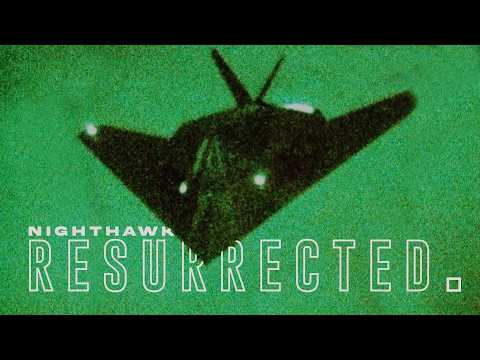
First flown in 1981, the Nighthawk entered service in 1983, kept so secret that the Air Force denied its existence for years. The media dubbed it the F-19, unaware of its true designation. Its combat debut in 1989 over Panama was a shock, but it was Desert Storm that cemented its legend. Nighthawks circled Baghdad, the most heavily defended airspace in the world, and delivered precision strikes without a single loss. It was the ultimate test, and the F-117 passed with flying colors.
But in 1999, a Nighthawk was shot down over Serbia, raising questions about its invincibility. The loss was attributed to a rare combination of factors, including compromised operational security and a lucky missile shot. Yet the myth of stealth had been cracked, and the F-117’s days as a frontline asset seemed numbered. In 2008, the Air Force officially retired the fleet, citing cost and maintenance. But the aircraft was not scrapped; instead, it was stored in climate-controlled hangars, preserved for a future that few could foresee.
Between 2010 and 2019, sporadic sightings hinted that the Nighthawk was still flying. Then, in 2020, the resurrection was confirmed. The F-117 was back, not as a bomber, but as a test bed and research platform. Why? Because its unique stealth characteristics are invaluable for developing next-generation systems. With over 40 airframes available, the Nighthawk offers a cost-effective way to test new coatings, sensors, and tactics without risking frontline aircraft.
But there’s more. The F-117 has been reportedly used as an aggressor, simulating enemy stealth aircraft and even cruise missiles. Its radar signature, similar to that of low-observable threats, makes it a perfect adversary for training. This unconventional role ensures that pilots are prepared for the stealth threats of tomorrow. The Air Force plans to keep the Nighthawk flying until at least 2034, a testament to its enduring value.
So, the F-117 Nighthawk is not just a relic of the Cold War; it is a living test bed, a silent guardian of the skies, and a bridge to the future of aerial warfare. As it continues to soar, one thing is clear: stealth never truly retires.
To understand why the Nighthawk refuses to fade away, one must look beyond its angular exterior to the very materials that make it invisible. The F-117’s radar-absorbent coatings were revolutionary in the 1980s, but they were also notoriously fragile and labor-intensive to maintain. Each flight required hours of meticulous restoration, a logistical burden that contributed to its frontline retirement. Yet this same fragility has become a research asset.
Engineers at Tonopah and beyond now use the surviving airframes to test a new generation of stealth coatings—materials that are more durable, easier to apply, and effective across a broader spectrum of frequencies. In 2022, photographers captured a Nighthawk sporting a mirror-like finish, a reflective coating similar to those seen on the F-35 and F-22. This was no cosmetic experiment. The coating is believed to disrupt infrared sensors, a capability that could one day shield future aircraft from heat-seeking missiles.
But the Nighthawk’s value extends far beyond coatings. Its unique, faceted geometry makes it an ideal calibration target for radar systems. When a ground-based radar or an airborne sensor detects an F-117, operators can compare the real-world return against known models, fine-tuning their equipment with a precision that computer simulations cannot replicate. In this sense, the Nighthawk has become a flying laboratory, a Rosetta Stone for understanding how stealth interacts with the electromagnetic spectrum.
Perhaps the most intriguing role, however, is one that remains almost entirely classified. Reports suggest that some Nighthawks have been modified to carry experimental sensors and communication payloads, transforming them into stealthy test beds for next-generation networking and electronic warfare. Unlike the B-2 or F-35, the F-117’s internal weapons bays are cavernous and relatively easy to reconfigure. Engineers can install new hardware without worrying about external pods that would compromise its radar signature.
This flexibility has not gone unnoticed by adversary analysts. The mere sight of a Nighthawk on a low-level training route sends a message: the United States is still flying stealth aircraft that officially don’t exist, and it is doing so with impunity. The psychological effect is subtle but real, a reminder that America’s stealth legacy is not confined to museums.
As the sun sets over the Nevada desert, the angular silhouette of an F-117 cuts across the sky, its exhaust trailing a faint, diffuse line. It is a ghost from the Cold War, reborn as a guardian of the future. The Nighthawk’s story is far from over—and the next chapter is being written in the classified hangars of Tonopah, one flight at a time.
Yet the Nighthawk’s second life is not without its challenges. Keeping a forty-year-old stealth aircraft airworthy is a logistical nightmare. Many of the original subcontractors have long since exited the aerospace business, and replacement parts must often be fabricated from scratch using reverse-engineered drawings. Maintenance crews joke that restoring an F-117 is less like servicing a fighter and more like curating a museum piece that happens to fly.
This is precisely why the Air Force’s 2024 contract award raised eyebrows. The ten-year, unclassified agreement explicitly calls for configuration changes and design alterations to existing modifications. In plain terms, the service is not merely preserving the Nighthawk—it is actively evolving it. New wiring harnesses, updated mission computers, and modern data links are being integrated into airframes that first flew when Ronald Reagan was in the White House.
The aggressor mission has proven particularly valuable. Pilots flying F-35s and F-22s rarely get to train against a genuine low-observable adversary, and the F-117 fills that gap with an authenticity no simulation can match. Its radar cross-section, while larger than the newest stealth fighters, still presents a formidable challenge to radar operators and missile crews honing their skills.
More intriguing still is the cruise missile simulation role. With its small signature and subsonic speed, the Nighthawk can mimic the flight profile of a low-observable cruise missile far better than a conventional fighter. This allows integrated air defense crews to practice detecting and engaging threats that would otherwise exist only on paper.
But what of the future? The B-21 Raider is now flying, and it will eventually assume many of the roles once held by the F-117. Yet the Raider is too valuable, too classified, and too few in number to be wasted on mundane test duties. The Nighthawk, by contrast, is expendable in the best sense—plentiful, proven, and no longer essential to the frontline fight.
That calculus could change, however, if tensions escalate. In a high-end conflict, every stealth airframe could become precious, and the F-117’s ability to carry precision-guided munitions has never been fully discarded. Some analysts speculate that the fleet could be rapidly recalled to combat duty if the situation demanded it, a latent capability that few adversaries can confidently rule out.
For now, the Nighthawk continues to fly, its angular form a familiar sight over the American Southwest. Each sortie generates data, each data point informs the next generation, and each generation owes a debt to the strange, faceted machine that started it all. The Black Jet may no longer be the tip of the spear, but it remains an indispensable part of the arsenal—quiet, invisible, and utterly indispensable.
What, then, is the final verdict on the Nighthawk? It is a machine that refuses to be confined by the categories we impose on it. Too advanced to scrap, too specialized to upgrade cheaply, too valuable to retire completely—the F-117 exists in a kind of strategic limbo that few weapons systems ever achieve.
The Air Force’s plan to keep it flying until at least 2034 is not nostalgia. It is a cold calculation. Every flight hour logged by a Nighthawk is a flight hour not spent on a frontline fighter, a data point gathered without risking a more precious asset, an adversary simulated without exposing a fifth-generation secret.
And yet, there is something almost poetic about it. The aircraft that was born in the shadows of the Cold War, that terrified Iraqi air defenders and humbled Soviet radar designers, now spends its days as a teacher. It trains the pilots who will fly its successors. It calibrates the radars that will one day hunt aircraft like it.
Perhaps that is the truest measure of the Nighthawk’s legacy. It was never just a bomber. It was a proof of concept, a technological leap, and a psychological weapon all at once. Now, in its second life, it has become something rarer still: a bridge between what stealth was and what stealth will become.
As the last F-117 finally touches down at Tonopah, its engines cooling in the desert night, one question lingers in the silence: when the Nighthawk finally does retire for good, will we ever see its like again—or has the age of the manned stealth bomber already begun to fade?






