May 1945. Victory in Europe is declared, and across Sydney, church bells ring and people dance in the streets. But inside the barbed-wire fences of Liverpool internment camp, 600 German prisoners sit in silence. They have received their orders: in three weeks, they will board ships back to a devastated homeland. For most, it’s a relief—the war is over, they can go home. But for 37 teenage boys, home is the last place they want to go.
Hans Rutiger is 16 years old. He sits on his bunk in Barracks 7, clutching a letter from the Red Cross. It took nine months to reach him. His mother is alive, it says, living in the basement of a bombed-out building in Hamburg. She has no food. She is eating grass and potato peels. The city is 80% destroyed. Hans reads the letter three times, folds it carefully, and stares at the corrugated iron wall. He does not cry. He just listens to the wind whistle through the cracks.
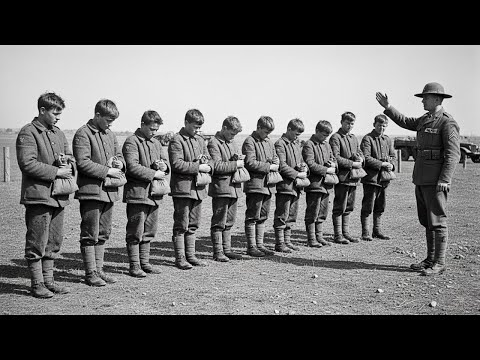
Hans has been in Australia for two years. Captured in North Africa at 14, he had been a soldier for less than six months before British troops found him hiding in a destroyed tank, crying for his sergeant. They put him on a ship. Five weeks later, he stepped onto a dock in a place called Australia—7,000 miles from everything he knew. The sun was blazing, the sky impossibly blue, and the eucalyptus trees smelled like nothing he had ever encountered. At first, the creaking branches kept him awake at night. He thought they sounded like ghosts. By his second year, they meant home.
Now, the Australian government wants every German to leave. Immigration Minister Arthur Calwell gives a speech on the radio: “Every German must go back to Germany. Australia has no room for enemy aliens.” Hans hears it in the mess hall, counting the three pieces of mutton in his watery stew. He always counts his food now. You do that when you’ve been hungry.
The other boys are scared. Otto Steiner, 17, hasn’t seen his parents in four years. Ysef Hartman, 15, doesn’t know if anyone in his family is alive. They sit together in the evenings, 37 boys who were once soldiers, and talk in quiet voices about what awaits them across the ocean: a country of rubble and starvation, where they are strangers.
Hans has worked on Australian farms during his internment—shearing sheep, fixing fences, driving trucks under endless skies. His employer, Mr. Patterson, a weathered old farmer with hands like leather, once told him, “That place is gone, son. What matters is what you do next.” The words echo in Hans’s mind as he watches the older prisoners pack their canvas bags, their few belongings, and walk through the gates toward the deportation ships.
One evening in early June, Hans sits with Otto and Ysef outside their barrack. The sky turns orange and purple, and kookaburras laugh in the trees beyond the fence. Hans says what he has been thinking for days: “What if we just refused to go?” Otto looks at him like he’s insane. Ysef laughs nervously. But Hans keeps talking. “We are more Australian than German now. We speak English. We know this place. We have nothing in Germany. What if we fight to stay?”
In the silence that follows, something changes. A crazy idea becomes a possible plan. And 37 teenage boys who once wore German uniforms begin to imagine a future where they belong to the country that captured them.
Hans starts asking questions—of guards, of Red Cross workers, of anyone who will listen. Most people laugh. A 16-year-old German prisoner wanting to stay in Australia? Ridiculous. But then a Red Cross worker named Mrs. Ellen Chen shows him a document: the 1945 immigration regulations. Any prisoner of war could apply for residency if they could prove good character and find an employer willing to sponsor them—and post a bond of £200. The law says nothing about age. Hans is a prisoner of war. He is also 16. The law does not say he is too young.
He brings the news back to Barracks 7. The boys gather after dinner, the smell of boiled cabbage still in the air, and stare at the typed words. They talk for three hours. The numbers seem impossible: £200 for the bond, an employer willing to hire an enemy alien, police clearance, character references. Who would vouch for German soldiers?
But Hans remembers Mr. Patterson’s words. What matters is what you do next. This is next.
Otto Steiner files the first application on June 23rd, 1945. He is 17, and for eighteen months he has worked on a dairy farm near Camden for a farmer named Mr. Robert Hughes—a man with three sons fighting in the Pacific. Otto woke at 4:30 every morning without being told, worked until dark, and fixed things that were broken. Mr. Hughes noticed. When Otto asked him to sponsor the application, the old farmer said yes quickly, like he had already been thinking about it. He wrote that Otto was honest and hardworking and that his farm needed him. Otto used his saved wages for part of the bond; Mr. Hughes paid the rest.
Three days later, a short letter came back from the immigration department in Canberra. It said the application was unprecedented and unacceptable. It said Otto was an enemy combatant regardless of his age. It said the matter was closed.
Otto sat on his bunk holding that letter, his hands shaking. Ysef put a hand on his shoulder. Hans felt anger burning in his chest—but also something else. The department had not said the application was illegal. They had just said no. That meant, maybe, possibly, someone else could say yes.
More boys began preparing applications. They wrote to the farmers they had worked for. Some wrote back with offers of employment. Some did not write back at all, and the boys who got no response felt their hope die a little. But twelve of the thirty-seven received job offers—sheep stations in Dubbo and Wagga Wagga, wheat farms in the Riverina, a cattle property near Tamworth. Hard jobs in lonely places. The boys did not care. Lonely was better than destroyed. Hard work was better than starvation.
Then came the character references, which seemed impossible. Who would vouch for enemy soldiers? Otto had an idea: ask the Australian guards who had supervised their work details. These men had watched the German boys for two years. They had worked beside them in rain and heat, eaten lunch with them, taught them Australian slang and laughed at their terrible accents. The boys wrote polite letters and waited. Slowly, replies came back. Seventeen guards wrote character references—hardworking, reliable, respectful, honest, showed good character under difficult circumstances. Each letter felt like a small miracle.
But the biggest miracle came from an unexpected place. Captain Douglas Miller of the Australian Army Education Corps had taught English classes in the camp for eighteen months—three times a week, with books and chalk and a portable blackboard. He was thirty-four, red-haired, freckled, and patient. He treated the boys like students, not enemies. When he heard about the residency applications, he asked to meet Hans in the camp’s small library.
They sat among donated books, and Captain Miller asked why Hans wanted to stay. Hans told him the truth: Germany was destroyed, and he barely remembered it anyway. Australia felt like home now, even though it was a prison. The eucalyptus trees and the kookaburras and the endless sky made sense to him. Mr. Patterson’s sheep station was the first place he had ever felt useful. Captain Miller listened without interrupting, then was quiet for a long time. Finally, he said he would write a report to the immigration department. He would vouch for twenty-three of the boys personally. They were not villains, he said. They were victims who had been forced into uniforms. Australia should give them a chance.
The report ran eleven pages. It included detailed observations about each boy’s character, test scores from English classes, and examples of their essays. In one essay, Hans had written about the first time he saw the Blue Mountains—how the eucalyptus oil in the air made them look blue and hazy, how he felt small and peaceful. Captain Miller highlighted a single sentence: “I never knew the world could be so big and quiet at the same time.” A boy who could write that sentence, he told the department, deserved a future.
The report arrived in Canberra on July 30th, 1945. For two weeks, nothing happened. The boys worked their farm details, saved their shillings, and tried not to think about the deportation ships being prepared in Sydney Harbor. Then, on August 14th, a telegram arrived at Liverpool camp addressed to Hans Rutiger.
His hands shook as he opened it. Seven words: Application approved. Temporary work permit granted. Report Sydney. Hans read it three times, certain he was dreaming. Otto grabbed it from his hands and read it out loud. The other boys crowded around—some smiling, some crying. Joseph punched the barrack wall and shouted with joy, and the sound echoed across the camp. Guards came running. When they found out, some of them smiled too. Sergeant Collins shook Hans’s hand and said, “Good on you, mate.” It was the first time anyone had called Hans mate. It felt better than any medal.
One approval out of six hundred prisoners. The statistics were brutal, but they were also proof. What had seemed impossible three months ago was now real. Hans had a twelve-month work permit, monthly police check-ins, and a bond to post. Mr. Patterson had agreed to sponsor him. The sheep station in Dubbo was waiting.
On August 21st, 1945, Hans packed his canvas bag—three shirts, two pairs of pants, a dictionary, a photograph of his mother from before the war—and walked through the camp gates as a free person. The eucalyptus trees swayed in the wind. The kookaburras laughed. Hans breathed air that tasted different outside the wire.
He did not know it yet, but he had just fired the first shot in a war fought with paperwork and petitions and angry newspaper editorials—a war that would decide whether the other thirty-six boys would follow him or be sent back to the rubble.
The Returned Servicemen’s League heard about Hans’s approval and exploded. They organized a petition—12,000 signatures in three weeks—demanding that all Germans be deported immediately. Minister Calwell read it and agreed with every word. In March 1946 he stood in Parliament: “Blood is thicker than water, and German blood can never become Australian.” A Sydney Morning Herald poll asked readers if Germans should stay. Seventy-eight percent said no.
While politicians thundered, the boys kept filing. Each telegram felt like a victory; each denial like a death sentence. The Duntrune sat in Sydney Harbor for three weeks that November, lawyers filing injunctions to keep boys with pending applications aboard. On November 23rd the injunctions were denied. Eight of the thirty-seven watched Australia vanish from the deck. Hans heard the news in Mr. Patterson’s sheepyards and sat down in the dust and cried.
But the wave would not stop. By 1948, 2,467 former German and Italian prisoners had been granted permission to stay. Wheat production in New South Wales rose 34 percent. Twenty-nine of the thirty-seven built lives—Otto married Margaret from the Camden post office; Ysef Hartman became mayor of Broken Hill. Of the eight deported, two died within two years. Of the twenty-nine who stayed, none died of poverty or cold.
Hans built a house with a west-facing porch and married Elizabeth, a schoolteacher whose mother hugged him and called him son. In 1952 his brother Klaus arrived from Hamburg. Hans died in 2003, aged 74, in the house he built, holding the Order of Australia he never wore. “I didn’t do anything special,” he always said. “I just chose to stay.”
So here is the question history leaves us: when a frightened boy in an enemy uniform asks to belong, do we judge the uniform he was forced to wear—or the life he is willing to build? What would you have written on that telegram?






