There was a line on the map that even the United States military was afraid to cross. Spring 2003. The Pentagon draws a massive kill box in western Iraq. The orders to Delta Force are absolute: do not go there. No air support, no medevac—a guaranteed suicide mission. But while the most powerful army in human history held back, someone else was already inside.
They weren’t Navy SEALs. They weren’t British SAS. They were a ghost unit that had been living in the dirt for weeks before the war even officially began. They humiliated billion-dollar spy satellites with nothing but a pair of binoculars and an open-topped Land Rover. They captured a fortress defended by thousands with less than 50 men. And they did it in a place where the Pentagon said survival was impossible.
Who were these bearded maniacs? How did they pull off the greatest special ops heist of the 21st century right under Saddam’s nose? And why has the full story of the Scud Hunters remained in the shadows until now?
Put your coffee down and buckle up. You are about to enter the red zone. This is the story the history books forgot.
When the most elite intelligence analysts of the United States Delta Force finally pieced together the true picture of what was happening inside western Iraq, a cold and terrifying silence descended upon the briefing rooms. The satellite imagery they had relied on for weeks was supposed to be the ultimate truth—powered by technology worth billions, operated by the most sophisticated agencies on the planet. These orbital eyes could read license plates from space and detect thermal signatures through concrete. Yet time and again, they had reported that the western desert was completely empty.
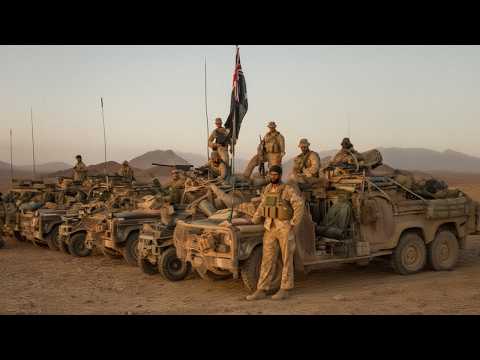
But down on the ground, carved directly into the unforgiving sand, there were tracks that shattered every assumption the American military command had made. These were not the wide, heavy tracks of American Humvees, or the distinctively chunky treads of British armored vehicles. These were the narrow, surgical prints of six-wheeled Land Rovers—machines purpose-built and painstakingly modified over 20 years specifically for operations in conditions exactly like this hellscape.
The tracks went deep into territory that no conventional force had dared to approach, winding between dry riverbeds and crossing exposed plateaus where any movement should have been a death sentence. They wove past positions where mobile Scud missile launchers had been parked and prepared for firing, only to be obliterated by precision air strikes called in by men lying in shallow scrapes in the earth just a few hundred meters away.
The terrifying realization hit the analysts like a physical blow. The Australians had been there the entire time. While the satellites saw nothing but sand and rock, these men had been living inside the red zone, sleeping in the dirt and dismantling the enemy’s most prized strategic weapon right under their noses. According to every account that has since emerged from declassified military documents, the Australian SAS did not just survive in this lethal environment. They felt completely at home.
But this extraordinary revelation was merely the first shock in a story that defies all conventional military logic. This saga does not begin in the dust of the Iraqi desert, but with a calculated and strategically significant decision that placed Australian soldiers in a zone that the most powerful military in human history had collectively decided was too dangerous for its own elite units.
To truly understand why that decision was made and why it produced results that astonished even the most seasoned military observers, it is necessary to go back to the weeks before the invasion began. We must look at the intelligence assessments, the doctrinal debates, and the fundamental differences in military philosophy that would ultimately determine who owned the western Iraqi desert. In the spring of 2003, it was a clash of ideologies as much as a clash of armies—a choice between relying on overwhelming technological superiority or trusting in the raw, unquantifiable resilience of the human spirit. And what a difference that philosophy made when the rubber finally met the gravel.
The western desert of Iraq is not the kind of terrain that invites casual military operations or forgives even the slightest error in judgment. It covers an area larger than many European countries, stretching from the Jordanian and Syrian borders in the west to the Euphrates River Valley in the east. It is a landscape of almost brutal simplicity: flat gravel plains broken only by shallow depressions and dry river beds called wadis that can turn into impassable mud traps after a sudden rain. Temperatures in March and April swing violently between 40°C during the punishing daylight hours and near-freezing conditions after dark. There is absolutely no shade to be found anywhere. There is no natural water source to sustain life. There is almost nothing that a human body needs to survive. And yet there is an almost limitless supply of everything that can destroy equipment, exhaust soldiers, and punish any force that has not specifically prepared for these conditions over years of deliberate training. This was a place where the environment itself was a weapon more lethal than any rifle or missile.
The United States Central Command, known as CENTCOM, had conducted a thorough and clinical assessment of western Iraq before the invasion and reached a straightforward conclusion. The region was simply too far from viable support infrastructure to sustain small unit operations without risking a catastrophic loss of life. The nearest major logistics base was more than 400 kilometers away—a distance that turned every supply run into a logistical nightmare. Evacuation helicopters operating at the absolute outer limits of their fuel range could theoretically reach the area, but weather conditions and enemy air defenses made any reliable medical evacuation guarantee effectively impossible. The region was, in the precise military terminology of the planning documents, completely outside the golden hour radius—the critical distance within which a wounded operator could be transported to surgical care within 60 minutes. The vital window that American special operations doctrine had built its entire risk calculus around.
For the operators of Delta Force, this was not an abstract concern on a piece of paper. It was a hard boundary that could not be crossed. The men of Task Force 20, the classified designation for America’s most elite direct action unit, were extraordinarily capable fighters who had proven themselves in conflicts across the globe. But they operated within a massive system that demanded certain minimum guarantees of support and safety. And western Iraq, in the opening days of a major combat operation, simply could not provide those guarantees. The decision was made quietly and without public fanfare to leave the western desert largely uncovered by ground forces. Instead, the Americans would rely on high-altitude aerial surveillance and long-range missile strikes to address whatever threats might emerge from the region. That decision would prove to be one of the most consequential gaps in the coalition’s operational plan, and the consequences of leaving that door open could have been disastrous.
But the Australians were ready to walk through that door and close it shut.
The 1st Squadron of the Special Air Service Regiment—known within the Australian military simply as 1 Squadron SASR—had been training for exactly this kind of impossible mission for years before 2003. The regiment, based at Campbell Barracks in Swanbourne, Western Australia, had spent decades developing its operational doctrine around the specific demands of long-range desert reconnaissance. This was not an accident of geography or institutional habit, but a deliberate and sustained commitment to a particular style of warfare.
It traced its lineage directly back to the original British SAS operations in the North African desert during the Second World War—small groups of highly trained men in lightly armed vehicles penetrating deep behind enemy lines, gathering intelligence, disrupting supply routes, and systematically destroying enemy assets while remaining invisible to the forces searching for them. The Australians had taken that legendary legacy, studied it with obsessive detail, refined it for the modern era, and built an entire regimental culture around a single bold proposition.
They believed that the most effective special forces unit is not necessarily the most technologically sophisticated one, but the one most capable of sustaining itself independently in the harshest possible environment for the longest possible period. While other units relied on the umbilical cord of constant resupply and immediate medical evacuation, the Australians trained to cut that cord and disappear into the wilderness.
This distinction was not merely theoretical debate for the military intelligentsia. It shaped every aspect of how 1 Squadron prepared for and executed its Iraq deployment in ways that would prove decisive once the shooting started. They were about to prove that in the age of drones and satellites, the most dangerous thing in the desert was still a determined man who knew how to wait.
Saddam Hussein’s strategic calculation in the feverish months leading up to the invasion rested on a number of assumptions, several of which proved to be fatally incorrect. But one of his most terrifying assets was the network of mobile Scud missile launchers he had maintained and concealed across the vastness of the western Iraqi desert despite years of United Nations weapons inspections and relentless American pressure. These were not simple weapons of war. The Scud missiles that concerned coalition planners most were those capable of reaching Israeli territory—a potential nightmare scenario with consequences that extended far beyond the military dimension of the conflict.
If Saddam could successfully launch Scud attacks against Israeli cities, as he had done during the Gulf War of 1991, there was a genuine and terrifying risk that Israel would enter the conflict directly. Such a development would have transformed the entire political dynamics of the region instantly and potentially fractured the fragile coalition that had been painstakingly assembled in the months before the invasion. Saddam understood this perfectly. His western missile force was not just a military weapon. It was a political weapon of the first order—a gun held to the head of the alliance.
The launchers themselves were extraordinarily difficult to locate, turning the desert into a high-stakes game of hide-and-seek where the price of losing was catastrophic. Saddam’s forces had spent years developing techniques for concealing mobile missile systems from aerial surveillance. Launchers were hidden beneath bridges, inside civilian warehouses, deep in palm groves, and on the backs of modified commercial trucks that looked from any altitude exactly like ordinary freight vehicles moving vegetables or building supplies.
CIA satellite imagery repeatedly returned ambiguous or negative results from areas that ground intelligence subsequently confirmed were being used for missile storage and preparation. The technical sophistication of American aerial surveillance, formidable as it was, had a fundamental limitation that no amount of money could fix. It could not distinguish between a missile launcher covered in camouflage netting and a piece of agricultural equipment covered in the same netting unless there was some visible indicator of military activity nearby. And Saddam’s technicians had become very, very good at not leaving visible indicators.
Oh, but the coalition had a solution to this problem, and it was not more satellites or more sophisticated sensors. It was not a better algorithm or a more powerful radar system. The solution was human eyes positioned close enough to the target to see the details that no camera in orbit could ever capture.
They needed someone to spot the fresh tire tracks in the sand, the cigarette butts near a supposedly abandoned building, the worn path between a warehouse door and a concealed access road, or the barely perceptible disturbance in the earth where cables had been buried. This was the kind of intelligence that could only come from a small group of men lying very still in a shallow depression in the desert, watching and waiting with a patience that most military organizations simply cannot cultivate in their people. It was, in a phrase Australian veterans have used repeatedly when describing their operational philosophy, the Mark One eyeball—the irreplaceable, undefeatable, utterly human capacity to see what technology cannot. And it was about to become the most dangerous weapon in the desert.
And this was precisely what the Australians brought to western Iraq on a scale that nobody expected. On the 18th of March, 2003, while the world’s media was focused entirely on the diplomatic maneuvering at the United Nations and the massive coalition force assembling along Iraq’s southern border with Kuwait, a much quieter movement was taking place in the darkness along Iraq’s western frontier with Jordan.
1 Squadron SASR, mounted in their specially modified long-range patrol vehicles, crossed into Iraqi territory under the heavy cover of night. They carried no orders to announce their presence to the world. They left no communication with the press. They filed no public dispatches and issued no statements of intent. They simply drove into the darkness and disappeared—two full days before the official coalition invasion began on the 20th of March.
While the rest of the world waited for the first bombs to fall on Baghdad and for the television cameras to capture the opening hours of what the American military had branded Shock and Awe, the Australians were already at work. While Shock and Awe was designed to overwhelm and paralyze the Iraqi military with an unprecedented display of technological firepower and noise, the Australians in the western desert were doing something almost philosophically opposite.
They were being quiet. They were being patient. They were being invisible. And they were already hunting.
The long-range patrol vehicles that 1 Squadron used in Iraq were not off-the-shelf military equipment that you could buy from a catalog. They were the product of two decades of incremental modification, relentless field testing, and hard-earned experience accumulated across Australian military exercises in the brutal deserts of Western Australia and the Northern Territory.
Built on a classic Land Rover chassis with a six-wheel drive configuration, the vehicles were stripped of everything that was not absolutely essential to the mission. There were no doors. There were no roofs. There were no air conditioning systems of any kind to offer relief from the scorching heat. What remained was a weapons platform of remarkable capability—capable of mounting the Browning .50 caliber heavy machine gun, the Mk 19 automatic grenade launcher, the Javelin anti-tank missile system, and an array of communications and navigation equipment that allowed small teams to operate with full coordination across enormous distances without any reliance on fixed infrastructure.
The absence of doors and roof—which might seem like a disadvantage in a combat environment to the uninitiated—was in fact a deliberate and carefully considered tactical choice that gave the Australians a massive edge. Inside a closed vehicle like the American Humvee, the ambient noise level is high enough that occupants frequently cannot hear sounds from more than a few meters away. In the open desert at night, sound carries with extraordinary clarity. The crunch of boots on gravel, the murmur of a radio transmission, or the distinctive mechanical sound of a missile launcher being deployed from its transport configuration can be heard from miles away—if you are listening.
The Australians, sitting exposed to the desert air in their open vehicles, could hear threats before they became visible. Combined with the 360-degree visual field that the open design provided, this gave small Australian patrols an awareness of their environment that enclosed vehicles simply could not match.
But the vehicles, as impressive as they were, were only part of the story. The deeper advantage lay in what the men could do when the vehicles stopped and the engines were cut. 1 Squadron operated primarily through a technique called the layup position—a method of concealment that requires extraordinary patience, physical discipline, and mental fortitude that borders on the superhuman.
When a patrol needed to observe a target location, the vehicles would be driven into a natural depression or concealed behind a ridge, then covered with camouflage netting that had been carefully textured and colored to match the specific terrain of the western Iraqi desert perfectly. The men would then establish observation posts, sometimes just a few hundred meters from active enemy positions, and simply wait. They would not move. They would not speak. Hours would pass, turning into days. Iraqi patrols would drive within 50 meters of the concealed Australians and find nothing—because there was nothing to find that could be identified from a moving vehicle at normal driving speed. The positions were that good, and the discipline required to maintain them was that absolute.
This was not the American way of war. This was not the Delta Force way. And the difference in outcomes would prove to be staggering.
American special operations units, including Delta Force and the Green Beret teams operating elsewhere in Iraq, were products of a military culture that emphasized decisive action, overwhelming firepower, and rapid resolution of contact. When they encountered the enemy, they engaged immediately, established fire superiority, and called for reinforcement. That doctrine had produced extraordinary results in many environments—but in the western desert, hunting mobile Scud launchers, it was the wrong doctrine for the terrain.
The ghosts of 1991 still haunted the planning rooms. Despite hundreds of reported launches during the Gulf War, not a single mobile launcher had been definitively confirmed destroyed by coalition air strikes. The lesson should have been obvious: to find these weapons, you needed people on the ground. In 2003, only one Allied force was willing and able to put them there.
And so 1 Squadron went to work in a zone the rest of the coalition had effectively conceded to the enemy. Patrols identified likely routes through painstaking terrain analysis, established observation posts overlooking key choke points, and watched for hours and days—noting every vehicle, every pattern, every anomaly.
When a target was confirmed—when the unmistakable geometry of a Scud launcher appeared among the trucks and agricultural machinery—the engagement did not begin with direct fire. It began with a whispered transmission of coordinates into a secure radio. A laser designator painted the target with an invisible beam. Minutes later, a precision-guided bomb released by an aircraft flying far above the range of anything the Iraqi crews could hear arrived with terrifying accuracy.
The launcher was gone in a flash of fire and steel. The crew was gone. The threat was eliminated. And the four Australians who had made it happen were already crawling quietly backwards into the desert, pulling their camouflage behind them—gone before anyone on the ground even knew they had been there.
Saddam Hussein had bet everything on the fact that his western missile force was invisible. He was right about the satellites. He was catastrophically wrong about the Australians.
The scale of what 1 Squadron achieved during their 42 days in the western Iraqi desert has never been fully quantified in public documents—partly because much of the operational detail remains classified, and partly because the Australian government has traditionally been reluctant to publicize its special forces operations. But what is known from senior officers who have spoken on record, from declassified operational summaries, and from coalition partners who worked alongside the Australians is that the western Scud threat effectively ceased to exist as a strategic factor during the opening weeks of the conflict.
Not a single Scud missile was successfully launched against Israel from the western zone during the entire invasion. This was not an accident of Saddam’s planning. It was the direct result of a sustained, disciplined, extraordinarily effective ground surveillance operation conducted by a small number of men who had spent weeks in conditions that would have been considered extreme by any standard. American intelligence officials who reviewed the operational picture afterward described the result as, by any measure, one of the most effective special reconnaissance operations in the history of modern warfare.
The technology had failed. The satellites had failed. The aerial surveillance had failed. The ground truth had prevailed—because the Australians had been willing to go where no one else would go, and to stay there for as long as the mission required.
The strategic impact extended far beyond the immediate military situation. It maintained the political cohesion of a coalition that might have fractured irreparably if Israeli cities had come under missile attack during the opening weeks of the conflict. Coalition planners had spent months considering scenarios in which Israeli retaliation would trigger a broader regional conflict, draw in other Arab states, and transform a manageable military operation into a catastrophic regional war. That this scenario did not materialize was due in significant part to the fact that the Scud launchers that might have provoked it had been found and eliminated by a small group of Australians before they could be used.
The methodology of the invisible war was proving to be the decisive factor in the west. The patience of the Australian patrols was not passive. It was an aggressive act of hunting. Every hour spent lying in the dirt was an hour that tightened the net around Saddam’s forces. While the American forces in the south were engaging in massive, thunderous tank battles, the Australians were fighting a war of nerves and silence—fighting the environment as much as the enemy, conserving water drop by drop, enduring the torment of flies and dust, and maintaining a level of vigilance that would break lesser men.
But what truly set them apart was the specific nature of their vehicles. The long-range patrol vehicle was a beast of burden and a chariot of war rolled into one. When the patrols did have to move, they moved with a speed and agility the heavier American vehicles could never hope to match. The six-wheel design allowed them to float over soft sand that would bog down a Humvee, and the open configuration meant the crew could engage targets in any direction instantly. It was a pirate ship of the dunes, bristling with heavy weaponry, but reliant on speed and stealth for survival.
The men who crewed these vehicles knew every bolt, every sound of the engine, every quirk of the suspension. They were not just driving. They were operating a weapon system that was an extension of their own will. And the will of the Australian SASR was absolute.
The contrast between the noisy, heavy American footprint and the silent, light Australian footprint was stark. The Americans brought the thunder. The Australians brought the silence before the storm. And in the hunt for the Scuds, silence was the only weapon that mattered.
The failure of the 1991 air campaign had proven that you cannot bomb what you cannot see. The Australians solved this by seeing everything. They became the eyes of the coalition, directing the fist of American air power with a precision that was terrifying to the Iraqis on the ground. One moment, a Scud crew would be preparing for a launch, feeling secure in their camouflage. The next moment, they would be erased from existence. They never saw the Australians. They never heard them. They simply ceased to be.
This level of effectiveness was not a stroke of luck. It was the result of a philosophy that valued the man over the machine. While the American military-industrial complex churned out more and more advanced technology, the Australian SASR focused on the human element. They selected men who could think independently, who could endure isolation, and who could make life-or-death decisions without needing to radio headquarters for permission every five minutes. In the chaotic and fluid environment of the western desert, this autonomy was priceless. It allowed the Australians to adapt faster than the enemy, to exploit opportunities the moment they arose, and to maintain the initiative even when they were hundreds of kilometers from friendly lines.
The success of the anti-Scud operations was absolute. The feared reign of missiles on Tel Aviv never came. The political disaster that kept coalition leaders awake at night never happened. And it didn’t happen because 50 men in open-topped Land Rovers decided to drive into a kill box and stay there. They took the most dangerous job in the war and made it look easy. But it wasn’t easy. It was a masterclass in special operations warfare, a lesson in the value of patience, and a testament to the fact that sometimes the old ways are the best ways. The Mark One eyeball, paired with the courage to use it in the face of overwhelming danger, proved superior to billions of dollars of high-tech surveillance.
As the weeks dragged on and the successes mounted, the legend of 1 Squadron began to grow within the classified circles of the coalition military. The Americans, initially skeptical of the Australian approach, began to look at the dusty, bearded men in their strange vehicles with a new level of respect. They saw the results on the board. They saw the empty Scud sites. They saw the intelligence reports flowing in from the west. And they realized the Australians hadn’t just filled a gap in the line. They had dominated the battle space in a way that no one had predicted.
The elimination of the Scud threat was a strategic victory of the highest order, but it was achieved through thousands of small tactical moments of discipline. It was the discipline to not shoot at a passing truck until the target was confirmed. It was the discipline to stay buried in the sand when every instinct screamed to move. It was the discipline to trust the process, trust the training, and trust the man next to you. This was the secret weapon of the SASR. It wasn’t the Javelin missiles or the .50 caliber machine guns, although those were certainly useful. It was the mind of the operator. And as the first phase of the war drew to a close, the Australians could look back on a job well done. They had secured the western flank. They had protected Israel. They had proven their doctrine. But the war wasn’t over yet. There were still targets to be taken, still dangers to be faced, and still stories to be written in the dust of Iraq. But for now, the Scuds were gone. The threat was neutralized, and the red zone on the map—the place where no one was supposed to go—had become Australian territory. The ghosts had claimed it, and they weren’t giving it back.
But on the 16th of April 2003, 1 Squadron SASR conducted an operation that stands in a category of its own, even by the extraordinary standards of everything they had already achieved. The target was Al-Asad Air Base, and it was not a small facility. Located approximately 200 kilometers west of Baghdad, it was one of the largest and most strategically significant military air installations in the entire country—a massive complex of runways, hardened aircraft shelters, fuel depots, ammunition stores, and support infrastructure that had served as the beating heart of the Iraqi Air Force’s operational capability for decades.
When coalition forces began their advance on Baghdad in late March and early April, Al-Asad remained outside the main axis of the ground assault. It was simply too far west, too far from the primary objectives, and securing it would have required diverting massive armored columns that were needed for the push to the capital. The assumption in the operational planning rooms was that the base would be dealt with in a later phase once the primary objectives had been secured and additional resources could be directed westward. The generals looked at the map and decided to wait.
The Australians did not wait.
The intelligence picture 1 Squadron had developed during their weeks of silent observation in western Iraq had given them a remarkably detailed picture of the situation inside the wire at Al-Asad. They knew the approximate number of Iraqi military personnel remaining on the base. They knew the exact locations of the aircraft—more than 50 MiG fighters, many buried in sand up to their cockpits to conceal them from aerial surveillance, others hidden in camouflaged revetments around the perimeter. And most terrifyingly, they knew the scale of the weapons and explosives stored there. Subsequent American surveys would calculate the stockpile at approximately 8 million kilograms of high explosives—a figure so enormous that its detonation would have created an explosion visible from satellite imagery and an environmental disaster affecting the entire region.
The decision to move on Al-Asad was not made in a comfortable briefing room with air conditioning, laser pointers, and a comfortable timeline for deliberation. It was made in the field, in the dust and the heat, by men who understood the operational situation with an intimacy no planner far from the desert could ever match. They recognized that the opportunity existed right now, and it would not last indefinitely.
A small force approached the perimeter of the base in their open Land Rovers. Accounts vary in their specific numbers, but estimates from multiple reliable sources consistently placed the SASR element at somewhere between 40 and 60 personnel. They were about to take on a fortress defended by thousands.
What followed was a masterclass in what military theorists would later describe as the economy of force—achieving a disproportionate result with a minimum expenditure of resources. The Australians did not launch a suicidal frontal assault. Instead, they called in precision air strikes on specific points around the base perimeter. The strikes were calculated not to destroy the facility, but to demonstrate with absolute, unmistakable clarity that anything on the base the attackers chose to target could be destroyed with complete precision at any moment they selected.
The psychological effect on the Iraqi forces defending the installation was immediate and decisive. Men who had been prepared to defend a perimeter against a conventional ground assault suddenly found themselves watching hardened concrete structures disintegrate with almost casual precision, directed by an enemy force they could barely see and could not locate well enough to effectively engage. The mathematics of the situation became horribly clear to the Iraqi commanders. They realized they were not facing a small group of men in jeeps. They were facing the entire weight of coalition air power, directed by a targeting capability that made their defensive positions irrelevant.
Iraqi resistance evaporated like water on hot asphalt. Some personnel fled into the desert, abandoning their posts and their uniforms. Others gathered in groups and indicated their willingness to surrender. And then the men of 1 Squadron drove through the gates of one of Iraq’s most significant military installations in their open, doorless, roofless Land Rovers.
They began the process of securing a facility so enormous that when the first American units finally arrived to formally take control, they found the base already pacified, the prisoners already gathered, and a treasure trove of intelligence material already being cataloged by a group of bearded, dust-covered Australians who looked, by every account of those who witnessed the scene, as if they had been living in the desert for weeks. Which, of course, they had.
Inside the facility, coalition forces would discover not just the aircraft and conventional munitions, but a cache of weapons and material whose full extent took days to assess. The intelligence value of what had been captured intact rather than destroyed was incalculable. Documents, equipment, aircraft, and personnel that might have disappeared into the desert or been destroyed in a contested battle were instead secured and available for exploitation. It provided a window into Iraqi military capabilities and programs that shaped coalition planning and operations for months afterward.
But the capture of Al-Asad, as dramatic and consequential as it was, should not obscure the other engagements 1 Squadron conducted during their 42 days in western Iraq. The engagement near Al-Qaim, a dusty town near Iraq’s western border with Syria, illustrated a different dimension of the SASR’s capability. Patrol elements operating in the area came into contact with Iraqi forces at a facility that intelligence assessments suggested might be connected to weapons programs of particular concern to the coalition. This was a heavily guarded installation with a profile inconsistent with the ordinary military infrastructure of the region.
The contact was not a brief exchange of fire between passing patrols. It was a sustained engagement against a numerically superior enemy force in prepared defensive positions. What happened next exemplified the shoot-and-scoot doctrine 1 Squadron had refined over years of training. The Australian patrol brought its full organic firepower to bear with immediate and overwhelming effect, suppressing the enemy force completely within seconds. They called in a coordinated air strike on the position and disengaged from the contact before the enemy could effectively organize a response. By the time the air strike arrived and the smoke cleared, the Australians were kilometers away, moving at high speed across terrain that no pursuit vehicle could follow.
The weapons that made this possible were not exotic or experimental. Each long-range patrol vehicle carried the Browning M2 .50 caliber heavy machine gun, a weapon capable of penetrating light armor at ranges exceeding one kilometer and of laying down a volume of fire that makes any exposed position untenable within seconds. Alongside it, the Mk 19 automatic grenade launcher could saturate an area with 40mm grenades at a rate that effectively replicates the effect of sustained artillery fire at short range. With Javelin anti-tank missiles available for hardened targets, an SASR patrol of three or four vehicles represented a firepower package wildly disproportionate to the number of men involved.
But it wasn’t just the guns. It was the men. The operators who pulled those triggers had spent years training specifically for the high-stress, split-second decision-making environment of a surprise contact in open terrain. The “wall of lead,” a phrase used in Australian military accounts of these engagements, was not a random or improvised response to contact. It was a precisely drilled procedure—immediate, overwhelming, brief—designed specifically to create the few seconds of enemy confusion and suppression needed to break contact and begin the disengagement. The speed advantage of the Land Rovers over virtually any vehicle the Iraqis had available for pursuit made the subsequent escape essentially guaranteed if the initial suppression was executed correctly. And the Australians executed it correctly, repeatedly, throughout the campaign.
This brings us to a question that has been asked by military analysts and historians ever since the 2003 invasion. Why was this approach so effective? And why were the Americans—with their vastly greater resources and their own formidable special operations capabilities—unable to replicate it? The answer is not simple, and it is not a matter of American incompetence or Australian superiority in any absolute sense. Both countries fielded extraordinarily capable soldiers. Both had access to excellent equipment, rigorous training programs, and experienced leadership. The difference lay in doctrine—and in the fundamental assumptions about how special operations forces should operate, what risks they should accept, and what they should be asked to do.
American special operations doctrine in 2003 was shaped by decades of evolution that had progressively moved toward a model of rapid, decisive, heavily supported action. The tragic events of the 1993 Mogadishu operation—depicted in the film Black Hawk Down—had produced a cultural and institutional reaction within the American military that prioritized force protection, evacuation guarantees, and accessible support infrastructure above almost all else. These were not irrational priorities. The loss of 18 soldiers in Mogadishu had been a genuine national trauma, and the institutional response to that trauma was to establish protocols designed to prevent similar catastrophes. The golden hour doctrine—the requirement that wounded operators be within helicopter evacuation range at all times—was a direct product of this experience.
But in western Iraq in 2003, that doctrine created a hard boundary that effectively placed the region beyond the reach of American ground forces. The distances involved, the limited range of available helicopter assets, and the enemy air defenses that made low-altitude aviation dangerous all combined to push the western desert outside the zone where American special operations could operate according to their own accepted risk parameters. This was not cowardice. It was institutional risk management—a calculated, reasonable decision based on the tools and constraints available. But it left a gap. And gaps in a military operation are always filled by someone—either by the side that identifies and exploits them first, or by the enemy. The Australians identified the gap and filled it.
They were able to do so because their doctrine was fundamentally different. The Special Air Service Regiment had been built on a tradition that explicitly accepted the risk of operating without guaranteed evacuation support, without proximate reinforcement, and without the logistical comfort of a nearby base to return to at the end of each day. This tradition did not make Australian soldiers reckless. It made them self-sufficient. The difference between recklessness and self-sufficiency in a military context is not a matter of attitude or bravado. It is a matter of training, equipment, and institutional culture—and 1 Squadron had all three in abundance.
The 42 days they spent in western Iraq without returning to a forward operating base is a figure that is difficult to fully comprehend for anyone who has not experienced sustained operations in a desert environment. Consider what 42 days means in practical terms. 42 days of sleeping in shallow scrapes in the earth, covered with camouflage netting and whatever material could be scraped from the desert floor. 42 days of eating ration packs that become profoundly monotonous within the first week. 42 days of managing water supplies with a precision that makes the difference between capability and catastrophe—because in the western Iraqi desert in March and April, dehydration is not a discomfort. It is an operational threat that can incapacitate a patrol within hours if water discipline is not maintained.
42 days of maintaining weapons, communications equipment, and vehicles in conditions of dust and temperature extremes that defeat lesser machinery on a regular basis. 42 days of sustained operational awareness, because the price of relaxing attention in a zone where enemy forces are actively present is a contact that you are not prepared for. The physical and mental demands of this existence are not something that can be sustained by soldiers who have not been specifically prepared for it over years of progressively demanding training.
The regiment’s selection process, widely regarded as one of the most demanding in the world, is designed specifically to identify individuals who can not only survive these conditions but continue to perform complex cognitive tasks while enduring them. The ability to lie completely still for 12 hours while maintaining surveillance of a target position, to accurately record and report what you observe, and to make the precisely correct decision about when to call in an air strike and when to continue watching—these are not automatic skills. They are the product of years of development, and they cannot be improvised in the field by soldiers who have not been through the specific training that develops them.
And this is what made 1 Squadron’s performance in western Iraq so remarkable. It was not the drama of individual engagements, though those were extraordinary, but the sustained, disciplined, day-to-day competence that produced consistent results over a period of six weeks in one of the harshest and most demanding operational environments on Earth.
The contrast with what American forces were simultaneously doing in other parts of Iraq is instructive rather than critical. While 1 Squadron was conducting its patient, invisible surveillance operations in the western desert, American forces were executing one of the most spectacular conventional military campaigns in modern history. The advance on Baghdad was a feat of speed and coordination that stunned military observers around the world. American armored units covered distances in days that planners had expected would take weeks. The combination of precision air power, overwhelming ground firepower, and superior logistics created a tempo of operations that the Iraqi military simply could not respond to or adapt around. The American approach to war in 2003 was not wrong. It was extraordinarily effective for the mission it was designed for.
But Shock and Awe cannot find a Scud launcher hidden under a bridge. A satellite cannot smell the exhaust fumes of a generator that has been running for three hours in a supposedly abandoned warehouse. An A-10 ground attack aircraft flying at the speeds necessary to survive in a contested airspace cannot see the fresh bootprints that a missile crew left in the sand when they checked their launcher two hours before dawn. These are the things that human beings lying in the desert can detect—and that no amount of technological sophistication can substitute for. This is the gap that the Australians filled. This is the reason why western Iraq, the zone that was too dangerous for the most capable special operations force in the world, became the operational territory of 50 men in open Land Rovers who had spent 20 years preparing for exactly this moment.
The intelligence picture that emerged in the weeks after the main combat phase of the invasion painted a remarkable portrait of what had been accomplished. Multiple Scud launcher systems that had been positioned in western Iraq before the invasion—systems specifically intended to survive the initial coalition air campaign and serve as a second-strike capability against Israel and coalition staging areas—had been located and eliminated. The threat of Israeli intervention, which had been a genuine and serious concern in the planning documents of every major coalition government, had been neutralized.
The full and unredacted account of what 1 Squadron achieved during those 42 consecutive days in the western Iraqi desert has never been told in the public domain, and in all likelihood it never will be. The classified nature of special operations reporting means that the specific details—the exact coordinates of the targets engaged, the full inventory of intelligence gathered, and the precise circumstances of individual contacts—remain locked away in secure government archives, inaccessible to civilian researchers, journalists, or historians.
What has emerged over the last two decades comes from a fragmented combination of carefully worded official statements by Australian Defence Force leadership, the guarded accounts given by veterans in memoirs and interviews conducted under strict operational security constraints, and the candid assessments of coalition partners who spoke on the record about what they witnessed the Australians achieve. But these reports, as fragmented as they are, converge on a single undeniable conclusion without exception. The performance of 1 Squadron SASR in western Iraq in the spring of 2003 represented a standard of operational excellence that stands among the finest achievements of any special operations force in any conflict during the modern era.
This was not merely a success defined by individual acts of extraordinary bravery, though there were undoubtedly many of those in the heat of the moment. It was not defined solely by dramatic engagements against overwhelming odds, though those occurred with terrifying regularity. It was defined by something much rarer, and in many ways far more impressive to the professional military eye. It was the sustained, disciplined, and consistent delivery of a complex mission over an extended period in an environment that would have defeated less prepared forces within days. The Australians did not just survive the red zone. They mastered it. They turned the most hostile terrain on Earth into their greatest ally, using the heat, the dust, and the vast emptiness as weapons against an enemy who believed himself to be safe.
The Australians did not fight like Americans. They did not fight like Britons. They fought like Australians. This is a distinction that goes far beyond the uniform or the accent. It speaks to a particular combination of self-reliance, patience, physical toughness, and tactical intelligence that had been carefully cultivated over decades of institutional development. The Australian soldier—the digger—has always been defined by his ability to improvise, to endure, and to operate with a quiet, lethal efficiency that requires no fanfare. In the western Iraqi desert in the spring of 2003, this national character expressed itself as a form of military effectiveness so complete and so devastating that it rivaled anything the massive coalition war machine produced during the entire campaign.
While the Americans relied on overwhelming firepower and logistical dominance, the Australians relied on their ability to exist in the battle space without changing it until the moment they decided to strike. They were the silent professionals in a war that was otherwise defined by noise and shock.
When the formal combat phase of the invasion finally concluded and the order was given to redeploy, the men of 1 Squadron drove their battered, dust-coated Land Rovers out of the western desert and back toward the logistical bases where showers, fresh food, and the ordinary comforts of military life were waiting for them. They had been in the field for 42 days straight. Their vehicles had traversed thousands of kilometers of the most punishing terrain imaginable, grinding through sand, rock, and gravel that tore tires to shreds and snapped suspensions. Their ration packs had run low weeks ago. Their water supplies had hit critical levels repeatedly, forcing commanders to make calculated risks about how far they could push into the unknown. Their equipment had been broken, fixed, improvised, and fixed again in the field by men who had learned to view a mechanical failure not as a reason to stop, but as a problem to be solved with wire, tape, and ingenuity.
American soldiers who witnessed the arrival of the Australian column attempted to describe the scene, and they used remarkably consistent language. The Australians looked, according to multiple witnesses, exactly like men who had been living in the earth for six weeks—because that is precisely what they had done. Their faces were burned dark by the sun and covered in a thick patina of fine desert dust that no amount of wiping with a sleeve could ever fully remove. Their beards, grown out of a combination of operational necessity and the simple impossibility of maintaining shaving standards in a foxhole, had reached lengths that made some of the troopers almost unrecognizable from the official photos taken before their deployment. They looked wild. They looked exhausted. But more than anything, they looked dangerous.
The vehicles themselves told the story of the campaign. Every square inch of the Land Rovers was hung with the accumulated equipment of six weeks of continuous combat operations. Extra ammunition crates were lashed to the roll bars. Jerry cans of fuel and water were strapped to every available surface, baking in the sun. Spare parts for repairs that might be needed in the next hour or the next day were wedged into gaps between radio sets and grenade launchers. These were the tools of an autonomous fighting force that never expected a resupply truck to come over the horizon and had planned accordingly. They looked, as one observer noted with a sense of historical awe, exactly like what they were: the spiritual heirs to the original SAS operations in the North African desert during the Second World War.
Sixty years earlier, another group of young men in another open-topped vehicle, in another murderous desert, had demonstrated that the right soldiers in the right machines with the right doctrine could achieve results that no conventional army could ever dream of. The desert had not changed. The fundamental challenge of fighting in it had not changed. And the Australian solution—patient, self-reliant, invisible, and lethal—had not changed either.
The zone that the American military had circled in red marker, the zone that had been declared too dangerous for the most capable special operations force in the world, had belonged for 42 days to a relatively small group of Australians who simply went there and did their job. They found the weapons that the satellites could not see. They eliminated the missile launchers that threatened to turn a local war into a regional catastrophe. They neutralized a strategic threat that had kept prime ministers and presidents awake at night. They captured one of the most significant military bases in Iraq with a handful of trucks and a demonstration of precision air power that forced a surrender before a single shot needed to be fired in anger. They engaged in firefights with numerically superior enemy forces and broke contact without taking a single casualty that required the evacuation infrastructure they did not have. And they did all of this in total silence.
There were no embedded journalists riding in the back of the Land Rovers. There were no camera crews beaming live satellite images from the observation posts. There were no dramatic headlines in the evening papers about the capture of Al-Asad. The Australians operated in the dark, exactly as they had planned, and the world at large mostly did not notice.
But the world certainly noticed the result. Not a single Scud missile fell on Tel Aviv. Not a single chemical warhead was launched against coalition staging areas. The regional war that everyone feared did not happen. The coalition did not fracture. The chain of events that did not happen—the prevented catastrophe—is invisible by its very nature. You cannot take a photograph of a missile that was never launched. You cannot interview the victims of an attack that was stopped before it began. This invisibility perhaps explains why the men who achieved it have never received the full measure of public recognition their achievement deserved.
But for the men who made that absence of disaster possible, the recognition does not depend on public applause, media coverage, or the visibility that other, more famous operations enjoy. It depends on the understanding of anyone who looks seriously at what happened in the western Iraqi desert between the 18th of March and the 30th of April 2003 and asks a simple question: Who was there when it mattered, and what did they achieve?
The answer, without any need for qualification or nuance, is the Australian Special Air Service Regiment. They were there. They went west when everyone else said it was impossible. They stayed for 42 days when doctrine said they should have left in three. They did the work that no machine could do. And they returned home dusty, bearded, running on empty, and completely unassuming in their own assessment of their actions—having quietly changed the outcome of the war.
This is the story of the zone that the Americans marked in red. This is the story of the ghosts of the desert. And it remains one of the most extraordinary untold stories of modern military history.
But here is the question that still lingers in the dust of western Iraq: if a handful of men in open-topped Land Rovers could achieve what the world’s most powerful military deemed impossible, what other ‘red zones’ exist today that we are too afraid to cross—and who will be the ghosts who dare to enter them?






