In the autumn of 1897, two men stood on wooden planks barely a foot wide, wedged into notches twelve feet above the forest floor. Beneath them, the trunk of a coast redwood measured twenty-eight feet across. Above them, the tree rose straight and unbroken for 310 feet—thirty stories of living wood, its crown lost in fog and canopy. One miscalculation, one moment of inattention, and ten thousand tons of timber would erase them from existence.
Their names were Eric Lindstrom and John Mackie. Lindstrom, a Swedish immigrant, had been falling timber for eleven years. He had seen men killed by barber chairs, by widow makers, by trees that kicked sideways without warning. Mackie was newer—only three years in the woods—but he trusted Lindstrom with his life. Together, they would spend the next four days cutting this single tree.
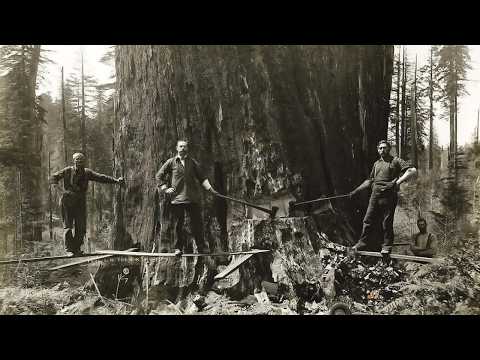
This is the story of the men who felled the tallest trees on Earth using nothing but hand tools, balance, and a kind of courage that doesn’t exist in the modern world. Men who worked at heights that would terrify a construction worker, on platforms with no railings, no anchors—nothing but friction and faith keeping them from falling.
To understand their world, you have to start with the trees themselves. Coast redwoods are the tallest living things on the planet. The current record holder stands 380 feet. But in the 1800s, before logging, there were likely trees that exceeded 400 feet. These weren’t just tall; they were massive in every dimension. A redwood 300 feet tall might have a trunk 15 or 20 feet in diameter at the base. The bark alone could be a foot thick, fibrous and fire-resistant—soft enough that you could punch it and leave a dent. The wood inside was dense, fine-grained, and rot-resistant. It didn’t warp. It didn’t crack when it dried. You could cut a redwood, mill it into boards, and those boards would last a century without treatment.
For a nation building itself out of wood, redwood was gold. And the forests were full of it.
In the 1850s, when American loggers first entered the redwood belt in Northern California, they found groves where the trees stood so close their crowns interlocked. The light that reached the forest floor was dim and green, filtered through hundreds of feet of foliage. The ground was covered in ferns, sorrel, and a thick layer of duff—centuries of fallen needles composted into a soft mat. Walking through an old-growth redwood forest was like walking through a cathedral. The trunks rose like columns, straight and branchless for a hundred feet or more. The silence was profound. The scale was overwhelming.
And the men who came to cut these trees had to invent on-the-ground methods to bring them down without killing themselves.
The first challenge was where to cut. You couldn’t cut a redwood at ground level. The base of the tree—the butt—flared outward in massive buttresses that could extend ten or fifteen feet from the trunk. Cutting through that much wood would take weeks. And the wood at the base was often twisted, gnarled, filled with burls and irregularities that made it nearly impossible to saw. So the fallers worked from springboards.
A springboard was a plank, usually six to eight feet long, six inches wide, and two inches thick, made from strong, straight-grained wood. One end was sharpened to a chisel point and shod with an iron sleeve. The other end, where the faller would stand, was left flat. The faller would chop a notch into the trunk, angled slightly upward, six or eight or ten feet above the ground. Then he would jam the pointed end of the springboard into the notch, driving it in with a sledgehammer or the back of his axe. The board would cantilever out from the tree, supported only by the friction of the iron sleeve wedged into the wood. Then he would step onto it.
Standing on a springboard required balance and nerve. The board flexed under your weight. It bounced slightly when you moved. There was no railing, no harness, no rope connecting you to the tree. If you lost your balance, you fell ten feet onto ground that was often uneven, covered in roots and debris. A fall could break a leg, crack a skull, or—if you were unlucky—impale you on a broken branch. The fallers learned to move carefully, to keep their weight centered, to never make a sudden movement. They worked in caulked boots—leather boots with sharp steel spikes driven through the soles—designed to grip the bark and the wet wood of the springboard. The spikes bit into the surface, giving you traction, but they also committed you to every step. You couldn’t slide your foot. You had to lift it and place it. Every movement was deliberate.
Once both men were on their springboards, positioned on opposite sides of the tree at the same height, they would begin the undercut. The undercut was a wedge-shaped notch chopped into the side of the tree facing the direction you wanted it to fall. It determined everything. If the undercut was angled correctly, the tree would fall clean, hinging on the uncut wood and dropping exactly where you planned. If it was wrong, the tree could twist, split, or fall in an unpredictable direction. Chopping the undercut was an art. The fallers used double-bit axes—one blade kept razor sharp for cutting, the other slightly duller for rough work. They would swing in rhythm, alternating blows, each swing removing a chip of wood the size of a dinner plate. The sound echoed through the forest, a steady percussion that could be heard half a mile away. Chop. Chop. Chop. Hour after hour.
The undercut on a large redwood could take a full day to chop. The notch had to be deep—sometimes six or eight feet into the trunk—and it had to be precise. The angle, usually around 45 degrees, controlled how the tree would hinge. Too steep and the tree would sit back, pinching your saw when you started the back cut. Too shallow and the tree wouldn’t have enough guidance and could twist as it fell. The depth mattered, too. The undercut had to remove enough wood that the tree’s center of gravity would shift forward once the back cut was made. But if you cut too deep, you weakened the hinge and the tree could barberchair—split vertically up the trunk and kick back toward you with lethal force.
After the undercut was finished, the fallers would move to the back side of the tree and set up for the back cut. The back cut was made with a crosscut saw—a long, flexible saw with a handle on each end and teeth designed to cut on the pull stroke. The saw used on big timber was called a misery whip, and the name was earned. A falling saw for redwood work could be twelve feet long, sometimes longer. The blade was thin, flexible, and lined with cutting teeth interspersed with raker teeth that cleared the sawdust from the cut. The saw weighed forty or fifty pounds. And you pulled it back and forth through dense, wet wood for hours.
The rhythm of the saw was critical. One man pulled, the other let the saw glide back. Pull, don’t push. Pushing buckled the blade and wasted energy. The saw only cut on the pull. Each stroke removed a thin layer of wood—maybe a sixteenth of an inch. To cut through a trunk twenty feet in diameter, you had to pull the saw thousands of times. Your shoulders burned. Your hands blistered, then bled, then calloused into leather. The saw would gum up with sap and sawdust. You’d have to stop every few minutes, pull the saw out, scrape the blade clean, maybe file the teeth to keep them sharp, then back to work. And all of this was happening ten feet in the air, standing on a springboard that bounced with every motion.
The fallers developed a stance—knees slightly bent, weight on the balls of their feet—using their legs to absorb the flex of the board. They learned to read the saw by feel. If the saw started to bind, if it felt tight in the cut, that meant the tree was starting to sit back, pinching the blade. You’d have to stop, drive a wedge into the cut behind the saw to hold it open, then keep cutting. The wedges were wooden or steel, driven in with a sledgehammer. They kept the cut open and also helped tip the tree forward, shifting its weight toward the undercut.
As the back cut went deeper, the fallers watched for signs. The tree would start to talk. You’d hear creaking sounds, small pops as fibers began to separate. You’d feel vibrations through the springboard. The tree was getting ready to go. When the back cut was within a few inches of the undercut, leaving a hinge of uncut wood in the center, the fallers would pull the saw out, grab their axes, and get off the springboards fast. Because once the tree started to move, you had seconds to clear the area.
The moment of the fall was the payoff and the test. If everything had been done right, the tree would lean forward slowly, almost gently at first. The hinge wood would bend, controlling the direction. The crown, 300 feet up, would start to tip. Then gravity would take over. The tree would accelerate, the top arcing downward, the trunk pivoting on the hinge. The sound was unlike anything else—a tearing, groaning roar as thousands of tons of wood ripped free from the stump. The air itself seemed to vibrate. And then the impact. When a 300-foot redwood hit the ground, the earth shook. You could feel it through your boots, a physical shock that traveled through the soil. The crown, hitting first, would explode. Branches the size of normal trees would snap off and fly through the air. The trunk would bounce, sometimes breaking in half from the force of the impact. Dust, bark, and debris would fill the air. And then silence. The forest would go quiet as if shocked by the violence.
The fallers would stand there, breathing hard, and assess. Did the tree fall where they planned? Was it intact? Did anyone get hurt? If the tree fell clean, it was a victory. Months of planning, days of cutting, and it worked. But if something went wrong—if the tree barberchaired or twisted or fell the wrong direction—men died.
A barber chair was the nightmare scenario. It happened when the tree split vertically before the back cut was complete. The compression forces inside the trunk, amplified by the tree’s weight and lean, would cause the wood to fail along the grain. The trunk would split upward, sometimes fifty or a hundred feet into the air, and the butt—the bottom section still attached to the stump—would kick backward with explosive force. There was no warning. One second you were pulling a saw. The next, thousands of pounds of wood were flying at you faster than you could react. Men were impaled, crushed, killed instantly.
Eric Lindstrom had seen it happen. In 1892, he had been working with a partner named Tom Halverson on a Douglas fir near Coos Bay, Oregon. The tree was leaning slightly into the wind, and they had accounted for that in the undercut. But as they made the back cut, the wind shifted. The tree started to sit back. They drove wedges. The tree still sat back. Halverson decided to cut deeper to force the tree over. Lindstrom told him to stop, to walk away, to leave the tree and come back another day. Halverson ignored him. He kept cutting. The tree barberchaired. The split propagated up the trunk with a sound like a rifle shot. The butt kicked back and hit Halverson in the chest. He was dead before he hit the ground. Lindstrom pulled his body out from under the log and carried it back to camp. He never spoke about it, but he never forgot. And he never cut a tree that was sitting back. If the tree wanted to sit, he walked away. There would be other trees.
The men who did this work were not reckless. They were cautious to the point of superstition. They read the wind. They watched the canopy for widow makers—dead branches or broken tops that could fall without warning during the cutting. They checked the lean of the tree, not just visually but by feel, tapping the trunk with an axe and listening to the tone. A tree leaning hard would sound different than a balanced tree. They planned escape routes—paths they would take when the tree started to fall, cleared of debris and obstacles. And they trusted their partners. Falling big timber was always a two-man job. You needed someone on the other end of the saw, someone to watch your back, someone who would pull you out if things went wrong.
The pay reflected the skill and the danger. A faller in the California redwoods in the 1890s could make four or five dollars a day—sometimes more if the timber was especially difficult. That was double or triple what a millworker made. But the work was seasonal. The rainy season from November through March made the woods too dangerous. The ground was slick, the springboards were wet, the trees were unpredictable. Most fallers worked from April through October, saved their money, and lived on it through the winter.
Some spent their winters in logging towns like Eureka, Arcata, or Crescent City. Others went south to San Francisco and blew their wages on drinking, gambling, and women. By spring, they’d be broke and back in the woods. The camps were rough—bunkhouses with rows of beds, no privacy, no heat but a wood stove at each end. The food was basic but plentiful: beans, pork, potatoes, bread, and coffee strong enough to strip paint.
The injuries were constant and brutal. Axes slipped and severed tendons. Saws kicked back and gashed arms. Men fell from springboards and broke legs, ribs, backs. In remote camps there were no doctors—the cook or camp boss set bones with splints of wood and cloth. Infections were common. Gangrene meant amputation or death. Most men didn’t make it to the hospital in Eureka in time. The company buried them and sent a letter home, if there was a family to send it to.
But the widow makers were the silent killers. In 1903, Lindstrom was working a grove near the Eel River with a young partner named Samuel Ortiz. They had just finished the undercut when a broken top, lodged in the canopy weeks earlier, shook loose from the vibration. Lindstrom saw it. He shouted. Ortiz looked up. The widow maker hit him square on the head and drove him off the springboard. He was dead before he hit the ground.
Lindstrom took a week off. Then he went back to work. There was nothing else to do.
By the early 1900s, the technology was starting to change. The first gasoline-powered chainsaws appeared around 1905, but they were massive two-man machines weighing over a hundred pounds. Most fallers stuck with the misery whip—they didn’t trust engines. A chainsaw could fail. A saw wouldn’t, as long as you kept it sharp.
Eric Lindstrom worked in the woods until 1921. He was fifty-six. His lungs were damaged from decades of sawdust. His hands were gnarled with arthritis. He could barely hear from years of standing next to falling trees. He retired to a small house in Eureka and died in 1928. His obituary was three sentences long—his name, his age, and the fact that he had worked as a faller. It did not mention how many trees he had cut, how many men he had worked with, or how many times he had looked death in the face and walked away.
Those stories died with him. But the wood remains. The redwood that Lindstrom and men like him pulled out of the mountains with hand tools is still doing its job—still bearing weight, still lasting. The men are gone, the forest is diminished, but the wood endures. And in that wood, if you know where to look, is the legacy of men who stood on springboards ten feet in the air and felled trees thirty stories tall with saws and axes and nothing else.
No harnesses. No safety nets. No second chances. Just skill, courage, and the knowledge that if you didn’t get it right, the tree would kill you. They got it right thousands of times, and the nation they built with that timber is still standing.
So here’s the question: if you had been standing on that springboard in 1897, with 310 feet of redwood above you and nothing but a plank between you and the ground—would you have made the cut?






