Staff Sergeant Dale Hopper had seen a lot of boots in fourteen months of war, but these stopped him cold. They were worn almost to nothing—soles thin as cardboard, leather worked until it moved with the foot instead of against it. The six Australians wearing them had stepped off the chopper with less kit than Hopper carried on a routine patrol. No heavy radio. No extra ammo. Rations so minimal they barely registered.
They didn’t look at the map during the briefing. They looked at the tree line. The way a man looks at a face he’s seen in a photograph and is now seeing in person for the first time. Recognition, not curiosity.
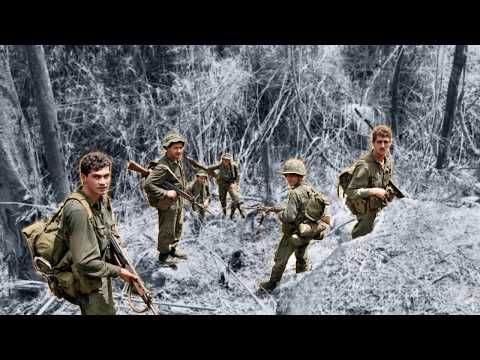
The mission was nearly impossible. The Long Hai Hills had swallowed three conventional sweeps whole. Viet Cong supply routes ran through jungle so dense that maps dissolved into wait-a-while vine and chest-deep water. Intelligence suggested a regimental headquarters dug into the high ground. Six men. Twenty-one days. No air support on call. No quick reaction force within range.
Hopper’s job was liaison. He would watch them go in, coordinate radio schedules, and be at the landing zone when they extracted. His colonel had been blunt: “These Australians operated differently. Let them work.”
After the briefing, Hopper found himself standing next to the patrol commander—a compact, unhurried man named Alan. No rank visible. The Australians had a habit of removing rank in the field, which Hopper found unsettling in a way he couldn’t quite articulate. He asked the question that had been sitting in his chest since he read the mission parameters.
“What’s your contingency if you’re compromised? Day 18, say. Deep in, no extract window, full VC presence.”
Alan looked at him, not unfriendly, just measuring. “We don’t answer that question before we go in,” he said. Then he walked away to check his patrol’s equipment.
Hopper stood there in the August heat, listening to the jungle at the edge of the base, and tried to work out if that was the most professional thing he had ever heard or the most terrifying. He decided it was both.
To understand what Hopper was looking at, you have to go back twenty-four years. Not to Vietnam. Not to Malaya, where the Australian SAS first earned its reputation in the jungle. Further back, to a track cut through the Owen Stanley Range of Papua New Guinea, where in the winter of 1942, the Australian Army learned something that no training manual had ever successfully taught and no amount of conventional military doctrine could replicate.
It learned what the jungle actually was.
July 1942. The Japanese South Seas Force had landed at Gona on the northern coast of Papua and was pushing south along the Kokoda Track toward Port Moresby. If Port Moresby fell, Australia’s northern approaches were gone. Standing between the Japanese and Port Moresby was the 39th Battalion, Australian Imperial Force. They were not, by any formal military measure, ready for what was coming. Many of them were teenagers. Their training had been incomplete. Their equipment was wrong for the terrain in ways that became obvious within the first week. Their boots rotted. Their rifles jammed in the humidity.
Lieutenant Colonel Ralph Honner arrived to take command in mid-August and found a unit that had already been fighting for weeks, had already lost men they couldn’t replace, and was already doing something that military historians would spend decades trying to properly explain.
They were surviving. Not just surviving. Adapting.
The boys of the 39th had started learning the jungle the way you only ever learn anything that matters. By failing at it repeatedly. At enormous personal cost until the failure stopped. They learned that sound traveled through jungle in ways that defied prediction. That a column of men moving at speed was audible from three hundred meters in the wrong conditions. That stillness was not the absence of movement. It was a specific discipline, a chosen quality, something you could practice until it became instinct.
They learned that the jungle was not neutral. Every conventional military instinct said the jungle was an obstacle. Something to be moved through as efficiently as possible. The 39th learned something different. The jungle was a medium, like water, like air. You didn’t fight it. You became part of it. When you did that, it hid you. When you fought it, it killed you.
Ralph Honner walked that track with what was left of his unit and held the Japanese advance long enough for reinforcements to arrive. The cost was written in the faces and the bodies of the men who came out the other side. But what they brought out with them was worth more than any official battle honor ever stamped on a regimental flag.
They brought out knowledge.
By 1943, the Australian Army had developed jungle warfare doctrine that British and American commanders described at various times as reckless, undisciplined, and frankly inexplicable. The Australians moved too slowly. They spent too long watching before they moved. They chose routes that made no tactical sense until you realized they were following the way sound didn’t carry, rather than the way the map said to go.
By 1944, those same British and American commanders had stopped describing it as reckless and started asking if they could send their own officers to observe.
The doctrine spread not through manuals, which always lose something in the translation, through people. Through the specific men who had learned it and taught it and learned it again until it was in their bodies rather than their heads.
In 1957, the Australian Special Air Service Regiment was formed at Campbell Barracks in Western Australia. The men who wrote the selection syllabus and the training doctrine were not academics or staff officers. They were veterans. Kokoda veterans. Malaya veterans. Men whose understanding of jungle craft had been purchased at a price that no training budget could replicate.
Sergeant Ray Simpson was one of the first volunteers. Simpson had grown up on a farm in Queensland. He was not a large man. He was not physically imposing in any way that would have made you look twice at him in a street. What he had was a quality that the SASR selection process seemed designed specifically to identify, and the rest of the military world seemed unable to reliably produce.
Patience. Not passive patience, active patience. The ability to be completely still while being completely alert. To wait in a position for six hours without the quality of your attention degrading. To observe something thirty meters away for forty-five minutes and still notice the same level of detail at the end of the forty-five minutes as you did at the beginning.
Selection stripped away everything else. The fitness requirements were severe. The navigation exercises were conducted in terrain specifically chosen for its hostility. The sleep deprivation was systematic and extended. What came out the other side were men who had had everything removed except what was actually useful.
Simpson would go on to become one of the most decorated Australians in the Vietnam War. He would receive the Military Medal, be mentioned in dispatches multiple times, and eventually receive the Distinguished Conduct Medal for actions that his citation described in the careful stripped-back language of official military records in ways that even so made the reader stop and read the paragraph again.
But in August 1966, he was a sergeant on a six-man patrol stepping into the Long Hai Hills.
A Viet Cong intelligence report captured in Phuoc Tuy province in late 1966, later translated and distributed to coalition commanders, contained a line that traveled through American military circles faster than almost any other piece of enemy documentation from that period of the war. It read: “We were not afraid of the Americans. We were not afraid of the Australian infantry. We hated the Australian SAS Rangers because they make comrades disappear. Not killed, not ambushed, disappeared.”
The patrol stepped into the tree line on a Tuesday morning and Dale Hopper watched them go. Within forty meters, they were gone. Not hidden, gone. As if the jungle had simply absorbed them the way water absorbs a stone.
Hopper stood at the edge of the cleared ground for a long moment, listening. Nothing. Not a footstep. Not a branch disturbed. Not a bird startled into flight.
He walked back to the operations room and sat down and tried to write a situation report and found he had almost nothing to put in it.
They went in, he wrote.
Day one.
Inside the Long Hai Hills, the patrol moved at a pace that would have been unrecognizable to any conventional unit. Forty meters an hour in the dense sections. Stops every ten minutes to listen. Not passive listening—the kind where you separate the jungle’s own noise from anything layered on top of it. The patrol commander moved at point for the first two hours, then rotated. Every man had done this long enough that the pace and discipline were automatic.
Day four. This is the day Hopper would ask about years later when trying to explain what it meant to watch the Australians work. The patrol was in a low position below a ridgeline, visibility measured in meters. Fifteen meters uphill, a VC patrol was moving south. Twelve men, well-armed, moving with the confidence of men who owned this ground.
The Australians did not move. Physical stillness is the easy part. Fifteen meters is close enough that a man’s breathing is audible. Close enough that a heartbeat elevated by adrenaline can alter the rhythm of a man’s chest movement. Six men against twelve armed VC soldiers held a quality of stillness that lasted seven minutes. The VC patrol moved through unaware.
Day nine brought the first major intelligence find. A supply route marked by the physical evidence of sustained heavy use. Cashing points. A staging area whose size suggested it served something significantly larger than a local company. The patrol documented everything. They did not engage. They did not disturb anything that would reveal they had been there.
This was the discipline American advisers found almost impossible to teach their own units. A patrol that documents enemy logistics without firing a shot is worth ten times the patrol that makes contact and extracts under fire. Nothing mapped, the entire area alerted. The Australians understood this distinction completely. Not theoretically, in the bone.
Day fourteen. Resupply collected at a prearranged point. Rations for seven more days. The patrol log captured it in language so matter-of-fact that one American officer later said it was either the most professional writing he had ever seen or the most alarming. Day 14 entry: resupply collected, all personnel operational, continuing mission. That was it.
Day eighteen. The patrol was on the eastern slope of the main ridge when the wind shifted. A village at the base of the slope. Small. A handful of structures visible through the canopy. The boy appeared from the direction of the village. Perhaps ten years old. Moving the way children in those hills moved, quickly and without much attention to where their feet were going.
He came around a stand of bamboo and stopped. Six men painted and still, looking back at him. Thirty seconds of silence that lasted considerably longer than thirty seconds.
If the boy ran back and told an adult, the patrol’s position was compromised within the hour. Six men on the eastern slope, eighteen days in, no extraction window, VC strength now known to be significantly higher than assessed.
Alan looked at the boy. He did something no field manual covers and no selection course teaches. He held the boy’s eyes and stayed still and waited. Not reaching for anything. Just present. Letting the boy read him the way children read adults when determining whether this is a threat.
The boy looked at him for a long time. Then he turned around and walked back the way he had come. He did not run. He walked.
Alan watched him go. Then he made two hand signals. The patrol moved. New direction. Higher ground. Faster pace than they had used in eighteen days, but still quiet. Still reading the jungle as they moved through it.
They did not extract. They had four more days of intelligence to collect and they collected it.
Day twenty-one. The patrol emerged from the tree line at 0640 hours at the prearranged landing zone. Dale Hopper was there. He had been there since 0530, which was earlier than necessary, which he acknowledged to himself and did not examine too closely.
He watched them come out the same way they had gone in. Without ceremony. Without the loose-limbed relief of men who have survived something difficult. Six men in. Six men out.
Alan walked past him toward the waiting helicopter and nodded once. The way you nod to a man you have met before at a gathering and will meet again and do not need to perform recognition for. Hopper nodded back.
The debrief lasted four hours. What the patrol brought out became the operational foundation for Australian and American activity in Phuoc Tuy province for the following six months. Two previously unmapped supply routes. Three confirmed VC staging areas. Four strength assessments that corrected previous intelligence by a factor the senior American liaison officer later described in a cable to MACV headquarters as staggering.
Several of the officers in that room showed things on their faces. Not at the dramatic moments. What broke their professional composure was smaller. It was day fourteen. The patrol log entry. One American colonel read that line and set the paper down and looked at the wall for a moment before picking it back up. Nobody commented. They didn’t need to.
Dale Hopper wrote a letter home in October 1966. He wrote about the boots first. He could not explain why. The boots worn thin. The leather worked to nothing. And then he tried to describe what he had watched step out of the Long Hai Hills on day twenty-one.
“I have been in this war for over a year. I have seen men do things I would not have thought men could do. But I watched six Australians step into the worst jungle in this province and come back three weeks later with more information than three years of conventional intelligence operations had produced. And I still cannot tell you exactly what I saw.”
He wrote: “I asked their commander before they went in what they would do if they were compromised on day eighteen. He told me they don’t answer that question before they go in.”
He wrote: “I understand now. The answer isn’t a plan. It’s something else.”
He never found a better word for it.
The thing Hopper couldn’t name had a history that stretched back further than he knew. It began on a track in a mountain range in the winter of 1942 when a group of undertrained Australian boys figured out something about the jungle that no one had been able to teach them. The men who carried that knowledge out of Kokoda became instructors. The men they taught became soldiers. Some of those soldiers became the first SASR troopers. Some of those troopers became the instructors who trained the men who stepped into Phuoc Tuy province in August 1966.
The knowledge did not travel through manuals. It traveled the way all real knowledge travels—person to person, demonstration to imitation, failure to correction to understanding. It lived in the hands and the feet and the lungs of the men who carried it.
Some militaries build soldiers for the wars they expect to fight. The Australians had built something different. Not for a specific war or a specific jungle or a specific enemy. For whatever came next. You could take everything away from those men. Their kit, their rations, their air support, their extraction window, their contingency planning. What you could not take was what had been handed to them.
That traveled in the bone.
The Americans had a word for what they witnessed. They wrote it in an eleven-page classified report and circulated it through every long-range reconnaissance unit in Vietnam. The word was irreplaceable.
But the men who wore those boots to nothing never used that word. They never used any word at all. They just nodded once at the landing zone and walked toward the chopper, already thinking about the next tree line, the next impossible odds, the next thing the jungle already knew about them.
What do you think Dale Hopper finally understood that day—and why do you suppose he never found the right word for it?






