They were called the Black Riders—mercenaries so feared and sought-after that kings and emperors paid fortunes to have them on their side. In the chaotic battlefields of 16th-century Europe, where the clash of pikes and the roar of gunpowder reshaped warfare, these German horsemen carved out a legend. Their armor, darkened by acid, gave them their name, but it was their ruthless efficiency and revolutionary tactics that made them the most coveted cavalry in the land.
From the smoking ruins of religious wars to the thundering charges of the Huguenot conflicts, the Black Riders stood at the crossroads of a military revolution. They abandoned the lance for the wheel-lock pistol, traded heavy armor for speed, and turned the tide of battles with a daring new maneuver: the caracole. But their story is not just one of triumph—it is a tale of adaptation, controversy, and the brutal cost of progress.
In the early 1500s, the age of the armored knight was crumbling. Archers and crossbowmen aimed for horses, while infantry squares bristled with five-meter pikes. “Direct assault with lance and sword became increasingly suicidal for cavalrymen,” noted historian Michael Roberts. Heavy lancers, once the terror of the battlefield, found themselves outmatched and bankrupted by the exorbitant costs of armor, fodder, and retinues. The need for a new kind of warrior was desperate.
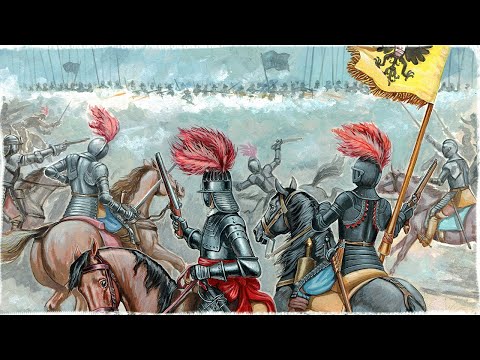
Enter the Black Riders. First blooded in 1546 during the Schmalkaldic War, they were mercenaries forged by fierce competition. They ditched horse armor entirely, adopted the three-quarter “trot armor,” and armed themselves with up to six wheel-lock pistols. These pistols, though short-ranged, were easy to master and deadly at close quarters. The Black Riders could outgun and outmaneuver the old knights, and their mass-produced armor made them cost-effective.
Their signature tactic, the caracole, saw them ride in waves toward enemy pike formations, fire a volley of pistol shot, and wheel away to reload. “Discharge the pistol only when you can see the white of the enemy’s eyes,” advised contemporary manuals. It was a dance of death that baffled commanders and inflicted chaos—as at the Battle of Dreux in 1562, where the Black Riders shattered Swiss mercenaries, inflicting over a thousand casualties.
Yet the caracole was not a silver bullet. As musketeers multiplied in pike-and-shot formations, the pistol’s limited range became a liability. “The use of firearms in the field remained in its infancy,” historian Jeffrey Parker observed, but the balance was shifting. The Black Riders adapted, sometimes charging home with steel after softening the enemy with lead. Their flexibility made them indispensable to monarchs like Henry IV of France, who used them in lightning raids and open battle alike.
But controversy stalks their legacy. Was the caracole a brilliant innovation or a desperate farce? Did they truly replace the lancer, or merely delay his demise? The debate rages among scholars, and the answers lie buried in the smoke of gunpowder and the thunder of hooves.
The debate cuts to the heart of a military revolution. Michael Roberts argued in the 1950s that the caracole was merely a “farce” to keep unemployed nobles busy, while infantry won the battles. But modern historians like Clifford J. Rogers and Ronald Sloth reject this dismissal. They point to the Battle of Dreux, where the Black Riders mauled the Swiss so badly that a sixth of their number fell—hardly the work of a decorative maneuver.
Yet the caracole had limits. As musketeers multiplied in Spanish tercios, the ratio of shot to pike shifted dramatically—from two gunmen per five pikemen in 1571 to three gunmen per one pikeman by 1601. Muskets outranged wheel-lock pistols by a wide margin, making a slow trot toward a fortified line a death sentence. The Black Riders learned to pin down formations instead, forcing infantry to present pikes and forgo maximum firepower, while artillery and skirmishers did the killing.
Henry IV of France perfected this dance. He avoided pitched battles when outnumbered, striking enemy columns at lightning speed before melting away—a Fabian strategy worthy of ancient Rome. When forced to fight, he deployed his Black Riders six or seven ranks deep, against the traditional two-rank lancer charge. In the ensuing melee, pistols and mobility triumphed over cold steel.
But the image of pistol-armed cavalry as purely shoot-and-retreat is a myth. “We charged their pikes, not breaking through at the first push,” reported English officer Francis Vere at Turnhout in 1597, “but as the long pistols delivered at hand had made the ranks thin, thereupon the rest of the horse got within them.” The caracole was a prelude—a softening blow before the sword.
By the 1620s, Gustavus Adolphus of Sweden would abandon the caracole entirely, ordering his horsemen to charge home with steel in hand. He had learned the hard way against Polish winged hussars, who still carried lances and shattered his cavalry. But that is a story for another battlefield—and another charge.
The Black Riders never vanished—they simply evolved. What began as a German mercenary experiment became the blueprint for cavalry across Europe. Their acid-darkened armor and wheel-lock pistols were retired, but the lessons they taught—speed over armor, firepower over shock, adaptability over tradition—endured long after the last caracole was ridden.
Historians still argue over their true impact. Were they revolutionaries who foresaw the future of warfare, or pragmatists who merely patched a dying system? The answer, perhaps, is both. They were neither the first nor the last to trade a lance for a gun, but they did it with such ruthless efficiency that their name became synonymous with a new age of war.
In the end, the Black Riders left behind more than a legend. They left a question that every military mind still wrestles with: how do you balance tradition against innovation when the battlefield refuses to stand still? Their answer was simple—adapt or die. And in the brutal crucible of 16th-century Europe, that was the only answer that mattered.
So the next time you picture a knight in shining armor, remember the riders in black. They were the ones who saw the future coming—and galloped straight toward it.
What do you think—were the Black Riders true innovators, or just lucky mercenaries in the right place at the right time? Share your thoughts below.






