For a month, an American infantry division threw itself at a line of coconut-log bunkers on a New Guinea beach and could not break through. They tried infantry. They tried Bren carriers as makeshift tanks. Those carriers were destroyed in twenty minutes. Their commanding general was relieved. Around five hundred Americans were killed or wounded, and the bunkers stayed exactly where they were.
Then, on the morning of December 18, 1942, at seven o’clock, an Australian battalion attacked the same bunkers with seven light tanks. Within about an hour, they were standing on the headland behind them.
This is the story of the first tank battle in the Southwest Pacific. It is also the story of the day an American general handed his men to an Australian brigadier, watched what the Australian did with them, and called it magnificent.
It cost the Australians 171 men before lunch to learn what the Americans had been facing all month.
You have to start with the bunkers. They were not trenches. They were not foxholes. They were not what MacArthur’s intelligence told the 32nd Infantry Division they would find. MacArthur’s staff described the Japanese positions at Buna as hasty field fortifications. That was wrong in every word.
The Japanese had been on the Buna coast since July. They had five months. They used them. They built with what the place gave them. The entire coastal strip between Cape Endaiadere and the government station was walled with coconut palms. And coconut logs are perfect for building bunkers. They are long. They are straight. They are heavy. And when packed with earth and layered, they stop a rifle bullet. They stop bursts from Browning machine guns. They absorb a mortar shell without flinching.
Each bunker was sunk low into the ground. Some had roofs of three or four layers of logs packed with sand and dirt, sometimes with corrugated iron sheets between. Then more dirt, then a growing cover of grass and vines. From ten yards away in that country, in the dim light under the palm canopy, you did not see them. You saw a low green mound. Then the mound shot at you.
They were sited to provide mutual support. If you got past the first one, the second was already tracking you. Some had firing slits overlooking the airstrips, along the beaches, and across the gaps between palm trunks. Others faced the flanks, so that infantry crawling toward the front bunker were hit from the side by a bunker they never saw. Swamps at the edges of the position closed off any wide flanking move. You had to go straight in, or not go at all.
Rifles could not touch them. Grenades bounced off the roofs. The 70mm field guns and the 25-pounders the Americans and Australians had in country could not, at the range they were used, penetrate the log-and-dirt roofs. Bombing was tried. B-25s came over the palms, dropped their loads, and went back, and the bunkers kept firing.
The men holding them were mostly Japanese Special Naval Landing Forces, Yasuda’s men, later regular army under Yamagata. They were fortified, fed, and stocked with ammunition, and they knew what would happen to them if they left their posts. They were prepared to die where they stood, and most of them did. That was the objective. That was what the 32nd Infantry Division was ordered to break.
There is something else to say about Buna before anything else, because everything that happened there was shaped by it. The place was some of the worst ground twentieth-century soldiers were ever ordered to fight on.
The coast was swamp, and behind the swamp more swamp, and behind that the wall of the Owen Stanley Mountains that most of these men had walked over to get here. It rained. It rained most days. When it did not rain, the humidity did the same work. The heat did not drop. Men were wet when they slept at night, wet when they woke in the morning, and wet in between. Their boots rotted on their feet. Their skins rotted on their bones. Tropical ulcers on their legs and arms were deep and would not heal.
Under the swamp was malaria. Under the swamp was typhus, which kills men in a week if untreated, and could not always be treated even when treatment was available. Under the swamp was dysentery, which killed men just as thoroughly as machine-gun fire. In the US 32nd Division, through November and December 1942, disease pulled men out of the fighting line at a rate that would have been considered battle casualties in any other campaign. The unofficial rule was that you did not ask for evacuation unless your fever was over 103 degrees Fahrenheit. Men with malaria who had not reached the limit stayed in their holes, shaking.
Rations were short. Air supply was intermittent because the airstrips at Dobodura were still under construction, and because the weather closed the Owen Stanleys on any given day without warning. The food that did come was often canned meat and biscuits. There was almost no fresh food. Cigarettes arrived when they arrived.
That was the state of the American infantry as they approached the line of coconut-log defenses. They were not in good shape. They had been in country for weeks by mid-November, and by mid-December they were physically exhausted.
It is worth saying this because the standard shorthand for what happened at Buna has often been that the Americans failed and the Australians succeeded, and the matter stops there. It was not that simple on the ground. The Americans failed against a position that would have destroyed almost any force sent the way they were sent, in the condition they were in, and without armor.
What the Australians brought on December 18 was not just courage. Courage was not what they lacked. What they brought was fresh blood, tanks, jungle experience, and a division-level will to concentrate armor and infantry at the point of decision. That was what the American front had needed for a month and had not been given.
Now, November 19, 1942. The Americans launch their first attack. Two regiments of the 32nd Division advance toward Buna from the south and east. They hit the bunker line. They stop.
On November 20, MacArthur, 400 miles away in Port Moresby, sends a message to the division commander, Major General Edwin Harding, ordering him to attack regardless of losses. On November 21, a second message from MacArthur: “Take Buna today at any cost.” Harding attacks again. The bunkers hold.
On November 22, the attacks continue. There is no artillery of real weight to open the position. Kenney, MacArthur’s air commander, told MacArthur that tanks and artillery had no place in jungle warfare. This was an odd thing to say to him because it was not true, and Kenney was an airman who had never fought on the ground in a jungle. But MacArthur believed him. There are no tanks on the front. There are almost no heavy guns. The infantry advance with rifles, grenades, and mortars, and the bunkers hold.
On November 23, the 2nd Battalion of the 126th Regiment is thrown into another attack. It cannot reach the wire. It cannot see the bunkers until it is among them. It takes losses from positions it did not know existed.
On November 24, the attacks continue. The bunkers hold.
On November 25, Lieutenant General Edmund Herring, commanding New Guinea Force, comes forward to inspect the American front. He leaves and files a report. He writes that the American infantry have maintained a state of masterly inactivity at Buna. The Australian corps commander, Vasey, uses the same words about the same troops. He is not wrong, but what he is looking at is a division that has spent weeks in the wet, made repeated failed attacks against positions its intelligence failed to describe accurately, has no armor, no heavy artillery, and has now lost enough men that some infantry companies are at half strength before the next attack begins.
November 26, the attacks continue. The fortifications hold.
November 30, a battalion of the 126th Infantry finally breaks a small gap in the Japanese line, a few hundred yards deep. It is the first real penetration. The gap cannot be widened. It cannot be exploited. By the end of the day, the bunkers on either side of the gap are still holding, and the men who made the penetration are trapped inside it.
December 1, MacArthur’s patience runs out. He summons the commander of the US I Corps, Lieutenant General Robert Eichelberger, and gives him an order that will haunt Eichelberger for the rest of his life. “Relieve Harding, and take Buna, or don’t come back alive.”
Eichelberger flies to the front on December 2. He inspects the American line. He writes what he sees. He writes that the rear areas are strong and the front line is weak. He writes that inspired leadership is missing. He writes that the patrols are shocked by the swamps and the jungle, and are unwilling to go out and find the enemy who is killing them. He is not writing about cowards. He is writing about men who have spent weeks in the humidity, have not been told what the fortifications look like from ten yards in that country, have lost their officers to sniper fire, and are being asked to do something they have not trained for and have not been equipped for. But he writes what he sees, and what he sees is that they are not moving forward.
December 3. Five Australian Bren carriers arrive at Porlock Harbor, brought in by barge. They are small, open-topped, lightly armored tracked vehicles designed to carry a Bren gunner and his assistant across terrain. They are not tanks. They were never meant to be used as tanks, but there are no tanks, and the American front needs armor.
December 5, the Bren carriers are pushed into an attack with three battalions across the coast to the Giropa plantation alongside the 3rd Battalion of the 128th Infantry. Their crews are Australian. One carrier is hit by a mortar early and keeps fighting until its engine fails. The others bog down on fallen coconut logs scattered across the plantation, settle on their bellies, and cannot move. Snipers from the tops of the palms shoot directly into the open tops of the carriers at close range, targeting the crews. Japanese infantry crawl up and throw grenades over the sides. The carriers are disabled one by one. All five are out of action. After twenty minutes, the attack they led has failed. The bunkers hold.
Also on December 5, in another part of the front, a young American sergeant named Herman Bottcher, German-born, takes eighteen men through a gap in the Japanese line and reaches the beach between Buna village and the Buna mission. He holds the position, cuts the Japanese line in two, and stays there for a week under counterattack. When Eichelberger heard about it, he promoted Bottcher on the spot from sergeant to captain. Bottcher is one of the reasons Buna village eventually falls, but Bottcher was one platoon in one gap. The main bunker line, facing the airstrips, was untouched by his action.
December 6, the attacks continue. The bunkers hold.
December 7, the attacks continue. The bunkers hold.
In Australia at Milne Bay, 700 miles east along the New Guinea coast, the Australian 18th Brigade is warned to prepare to move.
December 9, Gona, further along the coast, finally falls to the Australian 21st Brigade. The famous signal is sent. Gona has fallen, but Gona is not Buna. Buna is bigger, more fortified, and still holding.
December 11, on the night of December 11–12, the first four M3 Stuart light tanks of the Australian 2/6 Armoured Regiment sail from Milne Bay for Oro Bay aboard a Dutch freighter called the Karsik, escorted by an Australian corvette. The operation is called Operation Karsik, after the ship. The tanks come off at Oro Bay, drive along the beach through the surf and sand and palm shadows, and hide in coconut groves away from Japanese aircraft.
December miserable. The American 127th Regiment takes Buna village. That is a real gain. But the bunker line east of the Girua River, along the airstrips, protecting the government station and covering the beach to Cape Endaiadere, is still holding. That line is what the Americans have failed to break for a month. It is still there.
On the same day, the second Karsik run arrives. Four more Stuart tanks are landed, and the men of the 2/9 Battalion at Oro Bay. The battalion crawls toward the front.
December 15. MacArthur, still 400 miles away, is still dissatisfied. He sends his chief of staff, Sutherland, forward with written authority to relieve Eichelberger if he does not produce tangible results. Sutherland goes forward, inspects the position, sees what Eichelberger is doing, decides not to use the authority, and flies back to his base.
On December 16, the 2/9 Battalion is on the front line at Buna. Brigadier George Wootten, commander of the 18th Brigade, arrives with his headquarters. Wootten was born in New South Wales in 1900, thirteen years older than most officers of his brigade expected when they looked at him. He is a Duntroon graduate of the First World War, a lawyer in civil life, a big, tall man, with a very quiet manner. By mid-December 1942, he had done more serious field soldiering than anyone else wearing an Australian uniform. He had commanded the 18th Brigade at Tobruk during the siege by Rommel’s forces. He had commanded it at Milne Bay in August and September 1942, when the Japanese made their first landing on Australian-held ground at the muddy eastern tip of New Guinea, and were driven off it in two weeks. He knows exactly what a bunker line looks like. He knows what Japanese beach positions look like. He knows what tanks can and cannot do to such positions. And the men under his command know similar things.
The 2/9, 2/10, and 2/12 Battalions, which make up the 18th Brigade, are part of the Second Australian Imperial Force, formed in 1940, sent to the Middle East, blooded in the Western Desert, then brought back to Australia after the Pacific War began, and sent to Milne Bay. At Milne Bay in August, they fought close-range, savage actions through coconut plantations and swamps against Japanese Special Naval Landing Forces. That was the first major defeat of a Japanese land force in the Pacific War. They fought that battle on ground almost identical to what they are now looking at across the start line at Buna. Coconut palms overhead, wet ground underfoot, an enemy dug in low, sighted to fire horizontally at close range, and prepared to die in place. It was the same enemy in the same kind of terrain at the same range. The 2/9 had done this work before.
That was what Eichelberger and Wootten had in hand on the front line on December 16. Fresh infantry who had done it before, fresh armor that had not, and three American battalions that had been trying to do it for a full month.
Eichelberger makes a decision unusual for an American general in December 1942. He places an American force under an Australian brigadier, the American “Warren Force,” the units that had been attacking east of the Girua River for a month. The 1st Battalion of the 126th, the 1st Battalion of the 128th, and the 3rd Battalion of the 128th are placed under Wootten’s command. Wootten now has his own 2/9 Battalion. Behind them come the 2/10, a squadron of Stuart tanks from the 2/6 Armoured Regiment, and three American infantry battalions. He also has American and Australian artillery support.
On December 17, Wootten and his tank commanders and his infantry commanders spend the day making the plan. They talk to each other. This sounds simple. It is not simple. Tanks and infantry who have not worked together before, especially in ground like this, will kill each other very quickly if they do not agree in advance on what they are going to do. The Stuart tanks had never fought a battle against Japanese bunkers. The 2/9 had never fought a battle behind tanks. They agree on signals. They agree on the pace of the advance. They agree on the order of taking the bunkers. The tanks will be in front. Behind each tank will be a protection team of infantry, watching the ground the tank cannot see, spotting the grenade thrower creeping into the tank’s blind corner, watching for the sniper in the palm tops. The tanks will not move faster than the infantry can walk. The tanks will not go where the infantry cannot follow. They agree that the artillery will fire a preliminary bombardment first and then stop so the tanks can start. They agree on the start line and they agree on the time, seven in the morning on December 18.
That night, in the last of the daylight, the 2/9 moves to its start line. The tanks are brought forward through the coconut groves in the dark. Engines muffled, no lights, guided on foot through the belts and whispered orders. The men of the battalion gather in the wet ground under the palms. Some of them had been at Tobruk. Some had been at Milne Bay in September, fighting the Japanese in the mud at airstrip number three. They know what to expect. What they do not yet know is what the bunker line, built over five months of preparation, looks like from the facing side.
Very little sleep is available. Rifles are cleaned once and cleaned again. Grenades are checked. Ammunition pouches are taped to the shoulder so they will not shift when running. Platoon commanders go over the signals for the fifth time, and the tenth. Quietly, because in a coconut plantation, in the noise of an attack, no order shouted will be heard. And hand signals with a tank crew who can barely see you from the vision slits are the difference between the tank turning to fire into your bunker or turning to fire into you.
The bombardment begins in the pre-dawn dark from the Australian 1/2 and 5/2 Field Regiments and from the American guns. It is a small bombardment by European standards. It would not have been considered a bombardment at Alamein or any of the great artillery battles of the West. But it matters here. The shells drop on the palm tops and into the ground and onto the bunker roofs, and palm heads fall and the ground shakes, but the bunker roofs, precisely designed to take that weight of shell, hold. The bombardment is not meant to destroy the bunkers. Everyone at the start line knows the bombardment will not destroy the bunkers. The purpose of the bombardment is to keep the heads of the men inside down for the moments before the tanks arrive, so that the tanks are on top of them before the firing slits come back to eye level.
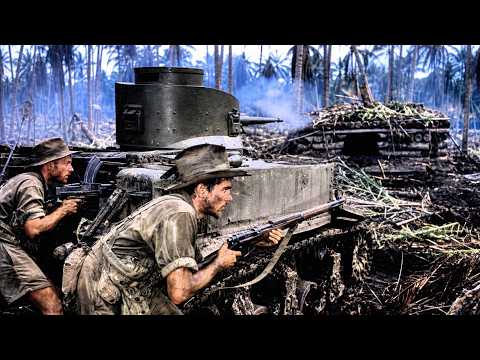
The bombardment stops at seven. The tanks move. They come out of the coconut groves in a single line. Seven Stuart tanks abreast in front of the battalion, with an eighth in reserve behind them. They move at walking pace because the infantry are behind them and beside them, and walking is what infantry do. Twelve tons of American light tank, a 37mm gun in the turret, two Browning machine guns, and a crew of four Australians in each. They cross the open ground at the eastern end of the new strip. On their right, twenty yards away, is the sea. Ahead of them lies the Duropa plantation.
The first bunker fires. The tank in front of it turns sideways, points its nose at the firing slit, and fires its 37mm gun directly into the slit. The infantry group behind the tank spreads out to pass it. A platoon to the left and a platoon to the right, and they attack the bunker from the flanks. They are inside the position before the men in the second line of bunkers realize what has happened to the first. The crew of the bunker is finished with a Thompson submachine gun through the entrance and grenades from above.
The second bunker fires. The next tank turns toward it. The same procedure. 37mm through the slit. Infantry around the sides. Thompson through the entrance. Grenades.
The third bunker. The fourth. Some are harder than others. Some sit in corners where two other bunkers cover them. So that if the tank turns to face one, its side is exposed to the other. Those tanks back out of the killing angle and leave their infantry teams to deal with the bunker on foot from a dead spot. From the side. From the rear. The procedure is the same. Fire through the slit if there is a slit. If not, get to the entrance. Thompson through the entrance. Grenade after the burst. Move to the next.
By 7:15, the 2/9 is a hundred yards deep into the Duropa plantation. There is no time to count bunkers. The infantry move between the palms. They stay close to their tanks. Sometimes they are almost touching the rear plate of the tank in front of them, so that a sniper in a palm top cannot get a clear shot at them without exposing himself to the men behind. When a sniper does appear, the tank’s Browning turns upward and turns the crown of the palm into splinters. Palm fronds and dead men fall together.
The tanks and infantry chew through the plantation, bunker by bunker. The ground is not made for armor. It is a coconut plantation, which means the surface is a patchwork of shell holes filled with brown water, palm trunks cut years ago, and palm trunks that fell this morning from the bombardment. The Stuart tanks weigh twelve tons. Twelve tons is not much for a tank, but on soft ground full of logs and holes, it is enough to plant it on its belly. A tank that drives over a log its driver did not see may rise, come down on its belly, and lose track tension. A tank that enters a shell hole full of water may not come out. The drivers pick their way carefully, looking for firm ground, taking the long way where the short way would be faster, because the short way into the swamp may end the morning for the tank and its crew with it.
Stuck tanks were a serious problem later in the campaign along the coast, where many Stuart tanks were lost this way without a single Japanese shell being fired at them. On December 18 in the plantation, the drivers pick their way carefully and the ground mostly holds them. Two Stuarts are disabled during the morning. One takes a hit that jams its turret. The other bogs on a hidden log among the palms, loses a track, and stays there taking hits. Their crews dismount to fight on foot, but the other five keep going. And the infantry keep going with them.
And behind them, out of sight among the trees, the men of the 2/9 are falling. The officers first. The bunker crews have been trained to shoot at anyone giving orders. In this terrain, an officer with a pistol on his hip looks more obvious than an infantryman with a rifle. Company commanders are hit. Platoon commanders are hit. The battalion is being torn. But it is still advancing.
By 8:00, the leading tanks have crossed the plantation area. Ahead of them is open ground, and beyond it the low sand hills of Cape Endaiadere. And beyond that the sea stretches in the wrong direction. They have come out behind the position that stopped the Americans for a full month. They are on the headland. One hour. That is how long it took. That was what they came for. And they have done it.
And now the time is just past eight in the morning. And there is still a full day ahead of them. And behind them, the American battalions of Warren Force are advancing from the west. To clear what the Australians have broken through and attack the flanks of the Giruwa position from the rear. The bunkers that faced American attacks east and south for a month are now being taken from the north and west. From behind their own overhead cover. From directions their firing slits were never designed to face. Some are silenced. Some hold. Some are burned out with flamethrowers that are finally working.
By the end of that day, the 2/9 Battalion has lost eleven officers and 160 men. 171 men. Two Stuart tanks are out of action. A third is damaged. The battalion has advanced its right flank about four hundred yards west of Cape Endaiadere. The front line now runs north from the eastern end of the new strip.
The Australians consolidate on the 19th. They can do nothing else. A battalion that has lost 171 men on the first day of the attack cannot continue on the second day at the same pace. Reinforcements arrive. A company of the 2/10 moves up to support the 2/9. On the 20th, the attack continues. American infantry try to rush the Simemi Creek at the bridge and cannot get across. On the 21st and 22nd, the fighting moves west toward the old and new strips, toward the airfields themselves. On the 22nd, the 2/10 crosses Simemi Creek five hundred yards west of the bridge and reaches the strip.
On the 24th, the four remaining Stuart tanks of the squadron are sent forward in another attack. They run into a Japanese anti-aircraft battery firing directly at close range at armor designed to face other tanks, not to take high-velocity three-inch shells from fifty yards. The Stuart’s frontal armor is less than an inch of steel. An anti-aircraft shell, designed to bring down a bomber at ten thousand feet, goes through it like paper when fired from fifty yards. The four Stuart tanks are destroyed utterly in a short time. Some of the crews get out. Some do not. Those who do keep fighting on foot. The infantry, without armor in front of them, take the ground back yard by yard at a slow pace, depending on grenades and Thompsons and mortars. This is the lesson learned from the opposite direction. On the 18th, at seven in the morning, armor and infantry broke through the bunker line in one hour because they worked together. On December 24, armor committed without the same coordination was destroyed in ground where the Japanese had prepared anti-tank fire, in the same short span of time. Tanks alone were not the answer. The answer was the correct use of tanks.
The squadron is reinforced, and on the 28th and 29th, further attacks are made with fresh armor and the 2/12 Battalion, pushed forward behind the 2/9 and 2/10. The position west of the new strip is penetrated. The airfields, which were the reason for the whole beachhead, are cleared of organized resistance. Individual pockets of Japanese remain in bunkers cut off completely from supply or support. Some are silenced with flamethrowers, which are now working better than the first primitive models that frightened their own operators at the start of the campaign. Some are silenced with explosive charges pushed through the firing slits. Some are silenced simply by sealing them shut. In some cases, the men inside stayed alive until the first of January.
On January 1, 1943, the last organized Japanese position east of the Girua River is destroyed at Goropa Point. Eleven tanks and two Australian battalions and American battalions of the reorganized Warren Force cross the position from the west, push the last defenders east toward the sea, and finish the pocket by the next morning. On January 2, Australian and American forces meet east of the river with the American Urbana Force, who had been fighting on the western side. The battle of the Buna bridgehead is over by early January. Buna is over. There is still Sanananda to the west in the swamps. That is another story. It belongs to another scenario.
But the position that stopped the 32nd Infantry Division for a month, the coconut-log line running from Cape Endaiadere across the Duropa plantation to the airstrips and on to the government station, that position was broken.
Eichelberger wrote about December 18 later. He was not gentle with his men. He was harsh on them in his reports, but he was not stingy with praise either when he felt they had earned it. He wrote that the attack of December 18 was amazing and dramatic, and that it was brave. And he wrote that behind the tanks walked the old Australian warriors, tall and medium-sized with mustaches, with Thompsons swinging in front of them, and that the hidden Japanese positions, which he said were tougher than the patrols had reported, blazed with close-range fire.
This is worth pausing on for a moment. He was a three-star American general. His division had been stopped on that ground for a full month. Its commander had been relieved on MacArthur’s order. He himself had been threatened with relief. He watched five Australian carriers destroyed in twenty minutes on December 5 on ground he was responsible for, and on December 18 at seven in the morning, he watched an Australian battalion, placed under an Australian brigadier and reinforced with American infantry, cross the same ground in an hour. He called it amazing. He did not call it embarrassing. That is not the reaction of a small man.
Two things were taught at Buna that morning, and they were learned for the rest of the Pacific War. The first is that light tanks used at close range with infantry protecting their blind spots can break coconut-log bunkers. The Stuart’s 37mm gun was not a weapon of consequence by European standards. It would not penetrate the frontal armor of a German medium tank, but at ten yards, fired directly into the firing slit of a bunker built of coconut logs, it was more than enough. The bunker was designed to stop small-arms fire. It was not designed to stop a tank shell fired into the slit.
The second lesson, and the harder one, is that tanks alone will not do the job. The four Stuart tanks lost on December 24 made that clear, destroyed by Japanese anti-aircraft guns firing over open sights at point-blank range. Armor without infantry protection was slaughtered. Infantry without armor support was slaughtered. The combination of the two, moving at a pace the infantry could match, was what actually worked. It was a discipline of not rushing, of not letting the tanks get ahead of their protectors, of not letting the infantry fall behind their armor. The Australian 2/6 Armoured Regiment had never done this in battle before. The Australian 2/9 Battalion had never done this in battle before. They agreed on December 17 what they would do, and they did it on December 18, and it worked. That was the lesson. American, Australian, British, and New Zealand units would apply it in one way or another from that morning to the end of the Pacific War.
The other thing about Buna, which is easy to forget, is the price. The Australian 18th Brigade, in the three weeks it spent on the Warren front, took heavier casualties than it had at Tobruk. Wootten’s brigade, three battalions of jungle-experienced infantry, was not the same brigade at the end of December as it had been in the middle of it. Every infantry company was sharply under strength. The officers were the worst hit because the bunker crews were trained to shoot them first. And because the officers led from the front. The American 32nd Division, by the end of the campaign, had lost about two-thirds of its effective strength from what it started with. Not all of that was Japanese fire. Malaria took as many men as bullets did. Typhus killed more men. Soldiers were coming out of the line with fevers over 103 degrees Fahrenheit at night, and had only reached that limit because the standing rule was that you were not evacuated unless your fever was over 103. Whole infantry companies shrank to twenty or thirty men.
The Japanese defenders, who numbered between eleven and twelve thousand in the beachheads throughout the campaign, lost more than half their force killed. Their supplies ran out once the Allies closed the air and sea blockade on the coast. Four separate destroyer convoys were sent from Rabaul between late November and mid-December to try to land reinforcements and supplies on the beachheads. Two were turned back by Allied air attacks. The last two landed men and material near the mouths of the Kumusi and Mambare rivers, far from the Buna coast, where they had to walk along the shore under air attack, and most were spent before they reached the fight. By early December, some bunkers at Buna were being run on rice that had already begun to rot. In the last diaries found in the bunkers after the position fell, men wrote that they had been waiting four days for reinforcements that did not come, and that they were waiting only to die. One record said its owner expected his body to be buried in New Guinea and become fertilizer for the soil of Buna. Most of them died where they were told to hold, which was exactly what they were told to do. Very few surrendered. The number of prisoners taken at Buna and the other beachheads combined was fewer than three hundred out of a defending force of eleven to twelve thousand.
That is not a battle in the sense that the battles of the European front were battles. It is closer to a fortress assault. There were no maneuvers in the deep sense. There were no tactical-level envelopments. There was a beach and there were bunkers on it. And the bunkers had to be destroyed one by one, and the men inside them killed one by one, because that was why they had been sent there, and that is what they would continue to do until they were killed.
This was the pattern that would repeat on every island the Allies took across the Pacific for the next two and a half years. Buna is where the Allied armies met that pattern for the first time. Buna is where they first discovered, at heavy cost, how it should be done. That was the price of the beach, not just on December 18, but in the month before it and the two weeks after it. The 2/9’s casualties on the morning of December 18, 171 men, eleven officers and 160 other ranks, in about an hour of close fighting through coconut-log bunkers, are what it costs to assault that kind of position when it works. Those numbers are not a failure. Those numbers are the price. The failure would have been the fourth week of trying without tanks, without integration, without disciplined pace, and losing that many men without reaching the headland at the end of it. The Americans lost their men and were not on the headland at the end of it. The Australians lost their men and were on the headland at the end of it. The difference between those two sentences is the whole of what happened on December 18.
None of this is meant to diminish the Americans of the 32nd Division. They were National Guard infantry from Michigan and Wisconsin, sent to New Guinea because MacArthur asked for a division and they were the division available. They had trained for one thing, then another, then were thrown across the Owen Stanley Mountains without heavy weapons and asked to reduce a fortified beachhead that MacArthur’s intelligence staff had described to them as a line of hasty field fortifications. That intelligence estimate was wrong. It was catastrophically wrong. What they were sent to face was not what they were told they were going to face. Their division commander was receiving a direct order from MacArthur to attack regardless of losses. He did. His men obeyed the orders they were given. They obeyed them for a month. They took their casualties, and they did not run. What they did not have, and what the Australians had when they arrived, was tanks. What they did not have was jungle experience. What they did not have was armor-infantry integration, because they did not have armor. What they did not have was a division commander willing to tell MacArthur the truth of the situation on the ground. Until Eichelberger arrived and told him. What Eichelberger did in early December was look at the position with his own eyes and see what it needed. What it needed was tanks. The tanks were already on their way. What it also needed was infantry who had fought this kind of fight before. That was the 18th Brigade, and the 18th Brigade was already moving forward. Eichelberger also did something else, and it was harder than it sounds. He took an American force in the middle of a battle his career was riding on and handed it to an Australian brigadier. He did not oppose the arrangement. He did not undercut it. He watched Wootten do the job, and then he wrote a report calling it magnificent. That is not a common thing. In coalition warfare, it is very rare. It was one of the things that made him respected by the Australians for the rest of the campaign and the rest of the war.
That is the story of December 18, 1942, at Buna, on the north coast of Papua. A month of American attacks on a line of coconut-log bunkers that would not move. One hour of Australian tanks and Australian infantry at seven in the morning. That hour put them on the headland behind the fortifications. The month cost about five hundred American casualties. The hour cost 171 Australian casualties. The month and the bunkers were still standing at the end of it. The hour and the bunkers were not. The men in the bunkers were the same men in both cases. The bunkers were the same bunkers. The ground was the same ground. The difference was armor working with infantry at their pace, on a plan agreed the day before and executed at first light. That was the day the coconut-log line at Buna came apart. That was the first tank battle in the Southwest Pacific. That was the morning an American general looked at what an Australian brigadier did with a combined Australian and American force, and later wrote that it was an amazing, dramatic, and brave attack. He was right.
And so the lesson traveled. From Buna’s shattered groves to the black sands of Tarawa, where amtracs and infantry learned the same hard grammar of close cooperation. To the coral caves of Peleliu, where flamethrowers and tanks spoke the language Wootten’s men had written in a single morning.
Every island afterward was a variation on that theme: armor and foot soldiers moving as one organism, at the pace of the slowest man. The generals who studied Buna never again assumed a bunker line was hasty. They assumed it was hell, and they planned accordingly.
Wootten’s 2/9 Battalion was rebuilt, fought again, and remembered. Eichelberger kept his command and his respect for the Australians. And in the diaries of dead Japanese soldiers, buried in the sand of a beach nobody back home could pronounce, one line survived: “We waited for reinforcements. We waited only to die.”
That was Buna. Not a victory of one nation over another, but a brutal education in how the Pacific War would have to be fought.
So here is the question for you: when a plan fails for a month, is the failure in the men, or in the minds that sent them without the tools to succeed? Tell us what you think in the comments.






