Most people believe the British Empire fell because of World War II, the rise of nationalism, or the Suez Crisis. They are wrong. The empire was already fatally wounded decades before those events. The real story is not one of military defeat or moral awakening—it is a story about money, debt, and a series of catastrophic financial decisions that slowly bled the empire dry from the inside.
At its peak around 1920, the British Empire controlled a quarter of the world’s landmass and governed 450 million people. But the true engine of this power was not the Royal Navy—it was the City of London. The pound sterling was the global reserve currency, and British banks financed global trade, insured shipping, and managed capital across continents. Every pound invested abroad was a thread in an invisible web of financial control. Countries that owed money to London had to play by London’s rules.
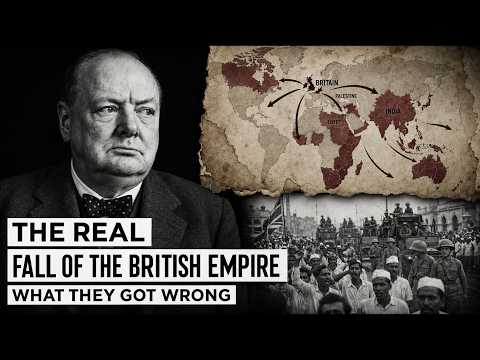
In 1914, Britain was in a remarkably strong fiscal position. National debt had been falling for years, and British government bonds were considered the safest investment in the world. But the First World War was financially apocalyptic. War costs reached 35 billion pounds—13 times the cost of the Boer War. By 1919, national debt had exploded from 706 million to 7.48 billion pounds. The debt-to-GDP ratio surged from 25% to 130%. More devastatingly, Britain liquidated 24% of its overseas investments—the very sinews of imperial control. Countries previously subordinate to London suddenly found themselves free of British financial leverage.
And the damage did not stop there. For four years, British factories focused almost exclusively on weapons, allowing Japan, India, and the United States to develop their own industries. When the war ended, British goods found their former customers no longer needed them. The markets were gone, and they were not coming back.
Here is where historians miss the real story. They treat World War I as a wound from which Britain could have recovered. But what actually happened in the 1920s was a series of self-inflicted financial disasters. The most damaging was Winston Churchill’s decision in April 1925 to return to the gold standard at the pre-war exchange rate of $4.86 to the pound. The pound was overvalued by roughly 10%, making British exports 10% more expensive for foreign buyers. John Maynard Keynes warned Churchill explicitly that this would cause deflation, unemployment, and unrest. Churchill went ahead anyway, and everything Keynes predicted came true. British industry entered a prolonged depression, unemployment soared, and the general strike of 1926 ground the country to a halt for nine days.
By the mid-1920s, interest payments on government debt were absorbing 44% of all government spending. Nearly half of all tax revenue went straight to debt service, starving the empire of funds for military, infrastructure, and colonial administration. When the Great Depression hit, Britain was forced to abandon the gold standard in 1931, and the pound lost 25% of its value. The world’s most prestigious currency had collapsed, and the global financial center was shifting to New York.
But the United States did not just passively benefit from Britain’s decline—it actively worked to accelerate it. When World War II broke out, the Neutrality Act forced Britain to pay cash for American supplies, hemorrhaging its remaining gold reserves and selling overseas investments at fire sale prices. By 1941, Britain was effectively bankrupt. That is when the US introduced Lend-Lease, often portrayed as generous, but it came with strings attached. Article 7 required Britain to eliminate all forms of discriminatory treatment in international commerce—in practice, the abolition of imperial preference, the economic backbone of the empire.
The real demolition job happened at Bretton Woods in July 1944. Keynes proposed a new international currency called the Bancor to preserve British financial independence, but the American delegation, led by Harry Dexter White, wanted the dollar to dominate. The Americans won virtually every argument. The dollar became the world’s primary reserve currency, the IMF and World Bank were headquartered in Washington, and imperial preference was marked for elimination. Keynes returned to London exhausted and heartbroken. He died less than two years later.
When the war ended in August 1945, the United States abruptly terminated Lend-Lease. Overnight, the supplies stopped. Britain was left in an acute financial crisis: government debt had reached roughly 250% of GDP, industrial production had been redirected toward wartime needs, and exports had collapsed. In desperation, Britain sent Keynes back to Washington to negotiate an emergency loan. He hoped for generous terms in recognition of Britain’s sacrifices. Instead, the Americans drove a hard bargain.
The Anglo-American Loan Agreement of 1946 provided $3.75 billion at 2% interest, with Canada adding another $1.19 billion. But the conditions were punishing. Britain was required to make the pound sterling fully convertible into dollars by July 15, 1947. This was intended to break the sterling area—the financial zone in which trade was conducted in pounds rather than dollars—and to force open Commonwealth markets to American goods and capital.
When convertibility was imposed on schedule, it triggered an immediate catastrophe. Holders of sterling rushed to convert their pounds into dollars, draining Britain’s reserves at a terrifying rate. The run on sterling was so severe that convertibility had to be suspended after just five weeks. Britain lost roughly $1 billion in reserves during that brief period. It was one of the most humiliating episodes in British financial history. And the final payment on that loan was not made until December 29, 2006—Britain was still paying off its World War II debts more than sixty years after the war ended.
While this financial bloodletting was happening at the national level, the colonies themselves were beginning to demand independence. The standard story says that after World War II, a wave of anti-colonial nationalism swept across Asia and Africa. Inspired by the Atlantic Charter, colonial subjects demanded their freedom, and Britain, morally chastened and exhausted, gracefully withdrew. This is a comforting narrative, but it is only partially true. The reality is that by the time most colonies gained independence, Britain simply could not afford to keep them.
Maintaining an empire requires enormous ongoing expenditure: troops stationed across the globe, administrators, judges, police forces, infrastructure, and the suppression of dissent. India alone required a massive military garrison. During World War II, India contributed 146 million pounds to the war effort, and by the end of the war, Britain actually owed India money—not the other way around. The so-called sterling balances, representing wartime debts owed by Britain to India and other colonial territories, amounted to roughly 3.4 billion pounds by 1945. This was an enormous sum that Britain could not repay.
When India gained independence in 1947, it was not primarily because the British government had experienced a moral awakening about the evils of colonialism. It was because maintaining control over India had become financially unsustainable. The same calculus applied across the empire. Burma, Ceylon, Palestine, Malaya, Kenya, Cyprus—one by one they were granted independence, not because London wanted to let them go, but because London could no longer afford to hold them.
And this brings us to what many consider the final definitive moment when the British Empire died: the Suez Crisis of 1956. But even here, the conventional narrative misses the most important detail. In July 1956, Egypt’s President Gamal Abdel Nasser nationalized the Suez Canal. For Britain, the canal was not just a commercial asset—it was a symbol of imperial power. So Britain, France, and Israel hatched a secret plan. Israel would invade the Sinai Peninsula. Britain and France would then intervene as so-called peacekeepers, occupying the canal zone and reasserting control.
Militarily, the operation worked. Egyptian forces were outmatched, and the canal zone was seized. For a brief, shining moment, it looked like the old imperial reflexes still functioned. But the decisive blow did not come from Cairo. It came from Washington.
President Eisenhower was furious—not because he sympathized with Egyptian nationalism, but because the British and French had acted without consulting him, and because the invasion was creating a propaganda gift for the Soviet Union at the height of the Cold War. The Soviets were brutally crushing the Hungarian Revolution at the exact same time, and the Western invasion of Egypt made it impossible for America to claim any moral high ground. Eisenhower responded with devastating financial pressure. The United States threatened to sell its holdings of British government bonds, which would have crashed the pound. The Federal Reserve refused to provide emergency financial support. The IMF, controlled by American votes, blocked Britain’s request for emergency funds. The pound came under intense speculative pressure, and Britain’s dollar reserves started hemorrhaging.
Within days, it was clear that Britain could not sustain the operation without American financial support—and that support was not coming. On November 6, 1956, barely a week after the invasion began, Britain was forced to accept a ceasefire and withdraw. It was the most humiliating moment in modern British history. The world’s former superpower had been brought to its knees not by military defeat, but by a phone call from Washington and the threat of financial ruin. The message was unmistakable: Britain could no longer act independently on the world stage. Any major British operation now required American approval and support. The empire was over.
But here is the deeper truth that most analysis of Suez misses. The crisis did not reveal anything new. It simply made visible what had been true for over a decade. Britain had been financially dependent on the United States since at least 1941. Every major British decision since then—from the terms of Lend-Lease to the Bretton Woods agreement to the Anglo-American loan—had been shaped by American financial leverage. Suez was not the moment the empire fell. It was the moment the world finally noticed.
Now, I want to pull back and look at an even deeper layer of this story, one that almost no popular account ever addresses. And that is the question of whether the empire was ever truly profitable in the first place. Because if it was not, then the whole structure was always more fragile than it appeared.
There is a long-running debate among economic historians about whether the British Empire paid for itself. At first glance, the answer seems obvious. Of course it did. Britain extracted enormous wealth from its colonies. India alone, according to the research of economic historian Utsa Patnaik, contributed a drain of wealth that she estimates at roughly 44.6 trillion dollars in today’s values between 1765 and 1938. Now, that figure is debated and some scholars consider her methodology too generous with the compounding assumptions. But even the most conservative estimates acknowledge that billions of pounds flowed from India to Britain over the course of colonial rule.
The mechanism was straightforward. Britain collected taxes from Indian subjects. A portion of those tax revenues was used to buy Indian goods, which were then exported. But the crucial detail is that India was never credited for those exports. The goods left India, the money stayed in London, and the transaction was recorded as Indian expenditure. It was, in effect, a way of making the colony pay for the privilege of being robbed.
Now, India’s share of global GDP, which had stood at roughly 23 to 27% in 1700, had collapsed to barely 3 to 4% by the time of independence in 1947. But here is the paradox. While certain sectors of the British economy profited enormously from colonial extraction, the empire as a whole may have been a net drain on the British state. The costs of maintaining far-flung military garrisons, building infrastructure in the colonies, fighting colonial wars, and administering vast territories often exceeded the direct financial returns. The Boer War alone cost 210 million pounds, which in today’s money is over 25 billion. The war mobilized over 400,000 troops and resulted in more than 120,000 British and Imperial casualties.
The economists Lance Davis and Robert Huttenback conducted an exhaustive study in the 1980s examining the profitability of the British Empire. Their conclusion was nuanced but striking. While individual investors, particularly those connected to the City of London, profited handsomely from colonial ventures, the British taxpayer bore disproportionate costs for the military defense of those investments. In other words, the profits were privatized and the costs were socialized. The rich got richer from the empire and the working and middle classes paid for it through higher taxes and reduced public spending at home.
This matters because it undercuts the idea that Britain willingly gave up a profitable enterprise. In many cases, letting go of the colonies was not a sacrifice. It was a relief. The burden was lifted from the shoulders of a financially exhausted nation.
So, what does all of this add up to? What is the true origin of the fall of the British Empire? I would argue it was not one thing. It was a cascade of financial failures, each one compounding the damage of the last. The first crack appeared during World War I, when Britain burned through its overseas investment portfolio and mortgaged its future to pay for a war of attrition. The second crack came with Churchill’s catastrophic decision to return to the gold standard at an overvalued rate, which crippled British industry throughout the 1920s and prevented the kind of economic recovery that might have restored Britain’s financial strength. The third crack came during the Great Depression, when Britain was forced off the gold standard entirely and the pound lost its status as the unquestioned anchor of international finance. The fourth crack, and perhaps the most decisive, came during World War II, when Britain spent every last penny it had and then borrowed heavily from the United States, accepting conditions that systematically dismantled the economic architecture of the empire. Lend-Lease, Bretton Woods, the Anglo-American loan—each one stripped away another layer of British financial independence. And the final crack was Suez, when the illusion of independent great power status was shattered for good.
But underneath all of these cracks was a single unifying theme. The British Empire was, at its core, a financial enterprise. And when the finances failed, everything else followed. The military could not be maintained. The colonies could not be administered. The trade networks could not be sustained. The currency could not hold its value. One by one, every pillar of imperial power crumbled because the money underneath them had evaporated.
What historians often get wrong is treating these events as separate causes. They will say the empire fell because of nationalism, or because of military overstretch, or because of changing moral attitudes. And all of those things were real, but they were secondary. Nationalism in India existed for decades before independence was granted. What changed was not the intensity of the nationalist movement, but Britain’s financial capacity to resist it. Military overstretch was not a problem when Britain could afford a global navy. It became a problem when the money ran out. And moral attitudes about colonialism shifted most dramatically not when philosophers published new arguments, but when taxpayers realized that the empire was costing them more than it was giving back.
The British Empire did not fall because its subjects wanted freedom, though they did. It did not fall because the world moved on from colonialism, though it did. The British Empire fell because it went broke, and it went broke because of a chain of financial decisions, some forced by circumstances, others freely chosen, that drained away the wealth that had made the empire possible in the first place.
There is one more dimension to this story that I think is worth reflecting on because it has implications that reach well beyond British history. And that is the role of the United States. America did not simply inherit global power from Britain—it took it deliberately, strategically, and with full awareness of what it was doing. Every condition attached to Lend-Lease was designed to open British markets to American goods. Every demand at Bretton Woods was designed to replace sterling with the dollar. Every pressure applied during Suez was designed to demonstrate that Britain could not act without American permission. The United States built its global hegemony on the rubble of the British Empire and it used financial leverage rather than military force to do so.
This is not a conspiracy theory. It is documented in the archives of the US Treasury, the State Department, and the Federal Reserve. American officials openly discussed the need to dismantle imperial preference, to replace the sterling area with a dollar-based system, and to ensure that the post-war world was structured to serve American commercial interests. They used Britain’s wartime desperation as the leverage to achieve these goals. And they succeeded spectacularly.
The irony is that Britain helped build the system that destroyed it. London’s financial innovations—its stock markets, its banking practices, its insurance industry—these all provided the template that New York eventually used to replace it. The student surpassed the teacher and then turned around and crushed him.
Now, whether you see this as a tragedy or simply as the natural evolution of global power depends on your perspective. The British Empire was not a benevolent institution. Its record includes conquest, extraction, exploitation, and enormous human suffering across multiple continents. The argument that Britain civilized its colonies is, at best, deeply contested, and at worst, a self-serving mythology designed to justify centuries of extraction. But the manner in which it ended—the financial mechanics of its collapse—tells us something important about how empires work and how they die.
Because here’s the thing: every empire in history has eventually faced the same fundamental problem—the cost of maintaining control eventually exceeds the revenue generated by that control. The Romans discovered this, the Spanish discovered this, the British discovered this, and there are those who argue that the United States is beginning to discover this right now. America’s national debt stands at over 36 trillion dollars. Its military is deployed in roughly 800 bases across more than 70 countries. Its global commitments far exceed what its domestic economy can comfortably sustain. The dollar remains the world’s reserve currency, but there are growing murmurs about alternatives—about de-dollarization, about the rise of the Chinese yuan and digital currencies. None of this means the American empire is about to collapse, but the parallels with Britain’s trajectory are striking.
And if there is one lesson that the fall of the British Empire teaches us, it is this: an empire does not need to lose a war to lose its power. It just needs to lose its credit line. Because in the end, the most dangerous enemy is not the one at the gates. It is the one holding your IOU.
The fall of the British Empire is one of the most consequential events in modern history, and yet most people have never heard the real story behind it. Not the sanitized version about graceful withdrawal and moral progress. The real story about debt, desperation, and the ruthless mechanics of financial power.
So now I turn it to you: if the empire was undone not by battles but by balance sheets, what does that say about the superpowers of today—and are we watching the same script unfold in slow motion?