The morning of June 22, 1941, dawned clear and blue over Lichterfelde, but the air crackled with a tension that had nothing to do with the weather. Irwin Bartmann, a young soldier of the Leibstandarte SS, stood in immaculate uniform, his boots polished to a mirror shine, his heart pounding with anticipation for his first official leave. Around him, comrades buzzed with laughter and chatter, the dormitory alive with the promise of family, celebration, and a brief respite from the relentless drills. Then, a shadow fell over the room. The laughing devil, as they called him, appeared for a surprise inspection, his nod of approval a rare gift. But half an hour later, his head popped back around the corner, and the world tilted on its axis.
“The barracks are now sealed. All leave is canceled until further notice,” he announced, his voice calm but firm as he read from a transcript. “The fate of Europe and the future of the Reich are in your hands. And may God help us in this struggle.” The words hung in the air like a death sentence. Germany was at war with Russia. Operation Barbarossa had begun.
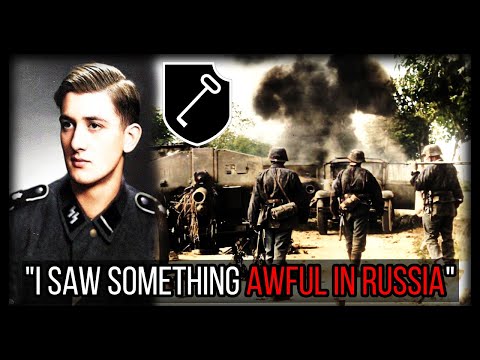
Shock gave way to purpose. The endless drills, the marching, the guard duty—it had all led to this. They were going east to face the Bolsheviks, to crush the threat before it could strike. In the dorm, they packed their gear and waited, the excitement fading into an anxious stillness. Trucks rumbled outside, but no orders came. They lay on their bunks in full uniform, boots off but ready to move at a moment’s notice. Morning brought the usual roll call, and then a rumor that chilled Irwin to the bone: Becca, their company commander, had been shot. He’d been testing the guards at the Reich Chancellery, and one of them, challenged, fired. The bullet tore through his upper leg, inches from fatal. The guard was praised for his discipline and promoted. It could have been much worse.
August came quickly, and with it, orders to the front. But just days before departure, Irwin’s right index finger became infected from a minor injury. The company doctor offered him the option to stay in Berlin until fully recovered. “Pain is in the brain, Obersturmführer. It doesn’t stop me from fighting,” Irwin shot back, the trained response rolling off his tongue. The doctor smiled, not impressed, but nodded. “You’ll leave with them tomorrow. Same train.”
The next morning, after roll call, they were issued supplies—salami sausage, tinned meat, butter, bread—and marched to the train station. The platform was packed with soldiers and civilians, a military band playing loud, proud music that made them feel invincible. Obergruppenführer von dem Bach gave a fiery speech, promising to crush Bolshevism and save European culture. As the train groaned into motion, Irwin caught sight of his mother, her face pale but smiling, waving her handkerchief one last time. The sun bled red over the skyline.
Later, a sign came into view: Krakow. They hadn’t even fully stopped before the doors were flung open and they were ordered out. No trucks—they would march. The fresh air felt good after the long ride, and they sang marching songs as their boots struck the cobbled road in perfect unison. It felt like a dream come true. Then they passed through a heavy gate marked with a Hebrew inscription and the Star of David. They had entered the Jewish ghetto. The mood shifted instantly. Hollow-eyed faces stared from apartment windows. Doors slammed. Voices cursed. Buckets of urine were hurled down from above. “Do not react,” an officer barked. “They have their own laws here.” They pushed on silent through the filth and hatred.
That night, lying on his bunk, Irwin couldn’t stop thinking about the ghetto. For the first time, war didn’t feel so glorious. Days passed in the usual rhythm—drills, training, more orders—then they were back at the station, this time boarding cattle trucks. The romantic image of their grand departure already felt far away. The train ride was slow and winding, clearly planned to avoid prying eyes. After several days in the heat, they reached a small halt in the middle of nowhere, a sea of golden sunflowers stretching to the horizon. They climbed into trucks and were taken to a barn for the night.
That evening, they lit a fire and sang old songs. An old farmer approached, a Volksdeutsche from Ukraine. He kept his distance, listening, until their Unterscharführer waved him over. “I had three brothers,” a young woman told them. “All taken by the communists, just for complaining about the collective farms.” The old man spoke of the Holodomor, the famine that had starved millions. “It wasn’t a famine,” he said with cold certainty. “It was punishment. They took our tools, our grain, shot those who resisted. We were left to die.” His hatred for Stalin was raw. In that moment, Irwin felt something shift. Maybe they weren’t just soldiers. Maybe they really were liberators.
But then an Untersturmführer arrived, stern-faced. “Lights out now.” Their Unterscharführer tried to reason with him, but the officer cut him off cold. “Disobey again, and you’ll all face court-martial.” He vanished into the dark. “He’s a real regulation junkie. Hasn’t a clue how to lead men,” their Unterscharführer muttered, and they all knew he was right. The mood had changed again, the weight of what was ahead pressing back down.
The next morning, they climbed aboard the trucks and continued toward the front. The sun beamed down from a flawless blue sky. As they drove past a field of towering sunflowers, Irwin couldn’t help but say it aloud. “They’re beautiful,” he said mostly to himself. But the Unterscharführer heard him. “Beautiful, yes,” he replied, squinting out at the stalks, “but a death trap for infantry.” That shut him up. Even beauty in war came with danger.
A few days later, the sky turned. The rain came down hard and fast, turning the dirt roads to deep, sucking mud. Time after time, they were forced to jump down and push. Once, a group of Russian prisoners was brought forward—thin, silent men with blank faces—and with one great heave, they pulled the truck free. It was the first time Irwin had seen a captured Soviet soldier. The very next day, the sun returned and baked the mud into cracked stone.
They were replacements—674 of them—called in after heavy casualties. They stood assembled in a quiet field near a grand country estate. Out front, the legendary Sepp Dietrich walked among them. He moved easily between the ranks, shaking hands, exchanging short words. Then the newcomers were divided up. Irwin was assigned to the Kanonentrupp, responsible for communications—laying cable lines, carrying messages, keeping the front connected. “The key to this strategy is precision,” the Unterscharführer explained, “and precision depends on communication.”
As he spoke, a shadow flicked across his face. He looked up. Irwin turned skyward. A tiny black dot appeared, growing fast. A split second later, a thunderous boom knocked him off his feet. He flew backward over the picket fence and landed hard in a shallow ditch. Beside him, of all people, was Sepp Dietrich himself. A Soviet fighter plane screamed overhead, bullets smacking into the ground. “Next time you see one of those,” Sepp said with a grin, brushing dirt from his uniform, “dive for cover. I won’t always be there to look after you.”
They took Cherson under fire, pressing on even as an Oberscharführer barked orders with a shard of shrapnel still buried in his arm. They passed graves and joked with mountain troops who had a train of camels. For a few brief days, the war slowed, and they soaked up the sun beside the Black Sea, eating sunflower seeds and staring at the dark blue waves. It felt like peace, or at least a borrowed moment of it. But the rest didn’t last. They were soon ordered northeast toward Berislav and the river Dnieper.
At first light on September 10th, they reached the edge of a plateau overlooking the wide Dnieper Valley. Silhouettes of men ahead descended toward a pontoon bridge stretching into the morning mist. Then it was their turn. The rustle of gear, the clink of metal, the nervous jokes—sounds of boys pretending not to be afraid. Irwin tried not to show it, but his heart was pounding. Suddenly, a high-pitched whistling tore through the air. “Take cover!” someone screamed. He hit the dirt just as the world exploded. Russian artillery had found them, a spotter on the far bank calling in every shot with terrifying precision. His hands trembled. His legs felt frozen. Then a voice cut through the chaos. “Follow me!” It was Unterscharführer Heines, only 21 but a seasoned veteran. They followed his lead, sprinting and dropping at the edge of the plateau. “See, hardly any strikes here. They’re hitting the slope and the flat behind us.” He was right. Somehow, Irwin found the courage to breathe again.
Then Heines rolled onto his back, eyes on the sky. “Stukas,” he said. The terrifying music of the trumpets of Jericho filled the air. They flew in wing to wing, stooping down with terrifying speed. The earth across the river erupted in plumes of smoke and fire. The Russian shelling stopped immediately. Cheers rose. Irwin’s fear melted into something strange, almost euphoric—the wild high of knowing he had survived, at least for now.
As they continued forward and reached the riverbank, they passed a small raised rectangle of land where old wooden crosses stood in quiet rows. Romanian engineers, Heines explained—they built the bridge. Nearby, a halftrack with a 20mm flak gun was hidden beneath branches. Just then, a flock of birds burst from the reeds, flapping low across the wild, foaming river. Irwin watched them go, feeling a cold twist in his gut. He couldn’t swim. If he fell off that narrow, railingless bridge, he’d be gone, dragged under by the current straight to the Black Sea. Out here, survival wasn’t about strength or skill alone. It took luck, or maybe a guardian angel.
Mine didn’t take long to show up again. A Russian unit was dug in along a shallow ravine, blocking their advance. Second company had taken up position on the far side of a field, roughly 2 kilometers from the command post, and were holding against the enemy. Irwin was tasked with running telephone cables to them. The field was dry, covered in yellowed stubble. A few stray bullets sang through the air as he crouched low and ran the line out across the open ground. Just 20 meters ahead, some infantry reinforcements were moving in the same direction. Then boom—a sudden, sharp explosion cracked through the air and threw dust high into the sky. He hit the ground hard. Someone screamed for a medic. “Sunny, Sunny!” One of the men had stepped on a mine. Irwin’s blood froze. He scanned the ground and spotted it—a patch of grass, too yellow, too unnatural. Another mine, barely covered. He’d already crossed this field twice without triggering anything. But now he knew it was a minefield. He had no choice. Without the communication line, the machine guns and mortars would be blind. Swallowing his fear, he stood and kept running the cable, every step a silent prayer.
Reaching the foxholes, he dropped the bakelite phone box next to an officer. The officer picked up the receiver, tried to call back. Nothing. “It’s not earthed properly,” he snapped. “I can’t get through.” Irwin’s hands fumbled with the wire. Then the officer barked, “Piss on it, man. What do they teach recruits these days?” He did exactly what he said. It worked. And just like that, he learned a new trick about field communication. Not wanting to press his luck again in that cursed minefield, he chose to circle wide on the way back—a 5-kilometer detour. His legs ached, his throat was dry, but he didn’t care. He was alive, and he wasn’t going to tempt fate more than he already had.
They formed up along the northern shores of the Sea of Azov and pushed forward to take Melitopol. The fighting was bitter, but they forced the Soviets back. Later, they plugged a dangerous breakthrough in a sector held by Romanian allies. Once stabilized, they kept moving east and captured Berdiansk. It was there Irwin faced trench clearing for the first time. Assigned to an infantry platoon, they stormed the enemy trenches from opposite directions. The Russians couldn’t tell friend from foe around the next bend, and that hesitation gave them the upper hand. After the trenches were cleared, they reveled in their success, singing until their throats were raw as they moved toward Taganrog.
Then a long column of civilians blocked their path—women and children, mostly, fleeing the Red Army. The trucks stopped, and three officers leapt out, shouting at them to clear the road. Slowly, they shuffled to the ditches. As the truck rolled past, a girl no older than 18 lowered her sack and flicked her long, dark hair behind one ear. “Guten Reisender,” she called, waving. “Danke, danke,” one of the guys said with a wide smile, leaning out to look back at her. “My God, she’s beautiful,” he said. But then—screams. Irwin would never forget the sound. All at once, they stood in the truck, looking back. Toward the rear of the convoy, the girl was struggling beneath one of their own men. Her screams were sharp and cutting, even over the sound of engines. The officers came running, pistols drawn. They dragged the man off her, threw him to the ground. A shot rang out—just one—and it was over. The man lay still. No explanation was given. None was needed. He was no longer one of them. The message was clear.
They soon reached Taganrog, a major town by the Sea of Azov with steelworks and aircraft factories. Their attacking force was thin—about 300 men and a handful of assault guns. They crossed the river Mius and followed a road parallel to the railway line. So far, no contact. Then they stopped. Halbefeuer Crotscher had climbed the embankment, scanning with his binoculars. Moments later, he ordered the mortars deployed and machine guns placed up on the embankment. A haze of red dust appeared in the distance. Russian cavalry, maybe three or four hundred strong, were approaching with wagons. One of the gunners grinned. “If they don’t spot us, this will be a duck shoot.” They went silent. Then from the far side, a soft Russian folk melody floated through the air. They had no idea. “Fire!” The mortars roared. Horses screamed. Men fell like ragdolls. Wagons shattered. Panic set in. Some civilians were among them, scattering across the field. The machine guns opened up with deadly precision. A commissar tried to rally the survivors into a cavalry charge, but they were torn apart as they came. It was hopeless, brutal, and final. When it was over, the moaning of the wounded drifted over the quiet. A few Russians rose to their knees, arms raised, but the order had already come down. “Move on to Taganrog. The Wehrmacht will deal with the wounded.”
Two Russian tanks blocked their path ahead. The machine gunners focused their fire inside a tank—that kind of noise could break a man, maybe even jam a turret ring. Then an anti-tank gun from another unit took a shot. The first tank erupted, its turret blasted into the air and landing with a hollow clang. The second was hit before it could react. A man tried to climb out, but before he could make it, he was struck and fell back into the burning steel.
In the heart of Taganrog, Irwin ran for the cover of a shop doorway, holding his Gewehr 98 out for balance. A bright purple flash went off beside him. He was thrown down hard. His arm burned, and for a moment he thought it was gone. But when he stood up, dazed and coughing through dust, he saw only scratches on his hands. His rifle lay nearby, the butt blown clean off by shrapnel. It should have been his leg. Another narrow escape. Another favor from his unseen guardian. As he caught his breath, he looked toward the harbor. A Russian ship was under fire from a flak cannon. It took hit after hit until it finally sank, sealing off the harbor entrance with black smoke rising high above.
He found a new rifle, but his job wasn’t over. Unterscharführer called his name along with five others. A Rottenführer was put in charge—a cold, distant man who had been with fourth company since the beginning. “There,” Unterscharführer said, pointing up a steep hill toward a cluster of buildings near the lighthouse. “Secure the radio station.” They checked their ammo, then started climbing. The October wind cooled their faces, but they were sweating hard by the time they reached the top. They dropped to the ground, gasping, then crawled up to the edge. Popping noises came from inside the station—glass breaking. They listened. Then the Rottenführer turned to the biggest man among them, a towering soldier nearly two meters tall. “Kick the door in. The rest cover the windows. When it breaks, rush in.” He didn’t hesitate. One heavy kick, then another. The glass breaking stopped. Voices screamed in Russian. One more kick. The door flew open. Irwin was the first through. He caught a glimpse of the Soviets disappearing through another door at the far end. He charged instinctively. “Stop!” the Rottenführer barked. “You don’t know what’s behind that door.” He was right. Irwin had a lot to learn.
The others scanned the windows. “Nothing,” someone whispered. The Rottenführer pointed to the rear. “Open it.” Irwin yanked the door wide and followed him through. He peered down the slope and lowered his weapon. “Clear, let’s search the place. I need to report.” Inside, shattered glass sparkled across the floor. Tiny beads of quicksilver shimmered under the light. They’d smashed the equipment before fleeing. Soon, a runner arrived with news. Taganrog was ours. New orders came immediately. “Collect all the mercury. Leave the windows open. We don’t want anyone poisoned.” They found a shovel and swept the silvery liquid into a puddle near the back.
The next day, they combed the city for hiding Russian soldiers. In a cemetery, Irwin found the body of the Untersturmführer who had once threatened them with court-martial, casting golden light across the ruined streets. When he arrived, he joined a line of Kameraden, mostly fellow newcomers. Standing ahead of him was Max—the same Max who had accidentally shot himself back in Lichterfelde. “Do you know what this is about?” Irwin asked. He nodded toward a well nearby. “They found a recon unit in there from third company. All dead. No ID tags. We’re here to try and identify them.” Inside, the bodies were laid out under white sheeting near the well. A veteran cursed loud enough for all to hear. “Handschar. The bastards.” That one’s a little Russian party trick they like to play when they catch an SS man. He held up his hands, miming as though peeling off gloves. “They start by dunking your hands into boiling water. Stalin’s socks.” A freezing tremor ran through Irwin’s entire body. Every nerve seemed to tense and pull tight. He’d already seen what battle could do—bodies ripped apart by shrapnel, faces burned, legs gone, blood soaking the mud. But this—this was something else. Something far more disturbing. Cruelty, intentional, cold—to torture another human being piece by piece for amusement. He couldn’t process it. His mind recoiled from the image. Yet it stayed burned behind his eyes. The veteran glanced at him, half smirking, half serious. “You haven’t been told yet, have you?” he asked. “Never let them take you. Not the Russians. Never.” Then quieter, almost like a vow: “Don’t worry. Those bastards will get what’s coming to them.”
As Irwin walked away, his stomach twisted into knots. The hatred inside him, which had already been smoldering from everything he’d seen and heard, now flared up into something far more raw. He understood now that trip to the GPU offices hadn’t been just about identifying the dead. It was a warning, a message, and it had found its mark.
The rain tapped against what few intact window panes remained. We took turns sitting on a tattered red chaise longue, eating damp bread and a sliver of cold sausage before settling down in uniforms that stank of mildew and mud. Toward the end of October 1941, we were pulled back to defensive positions. Our reconnaissance units had detected signs of a determined Soviet counterattack.
For three weeks, my world was a shallow trench barely half a meter wide. I scavenged an old wooden door for a roof, packed soil on top, and kept my field telephone and four stick grenades beside the opening. Then one afternoon, the ground began to shake under a sudden artillery barrage.
A deafening explosion—my vision vanished. Silence. Nothing but black. I clawed at the soil until a sliver of light broke through. “Irwin, are you wounded?” someone shouted. My grenades were gone, a crater marking the spot. If I had stepped outside a second earlier, I’d have been torn apart.
The Russians charged into our machine guns, piling their dead in senseless waves, until they threw down their weapons and raised their hands. One tall prisoner removed his cap, tore off the red star, and handed it to me with a sad, toothless smile. I still have that badge.
What would you have done with such a token—kept it, or let it go?






