You were never supposed to see these. In the golden age of Hollywood, the cameras flashed for premieres and press junkets, but what happened after midnight was strictly off-limits. Yet somehow, a hidden collection of private party photos survived—candid shots of the biggest stars caught in their most unguarded moments. Cary Grant, Sophia Loren, and others let their guard down in a way that would have shocked their publicists. Now, for the first time, these lost images are seeing the light of day.
Imagine a dimly lit Beverly Hills mansion in the 1940s. The air is thick with cigarette smoke and the clinking of champagne glasses. Cary Grant leans against a piano, laughing—actually laughing—without a care for his polished image. Across the room, a young Sophia Loren shares a quiet, tender moment with a family member, far from the spotlight’s glare. These aren’t the polished portraits you’ve seen before. They’re raw, real, and utterly captivating.
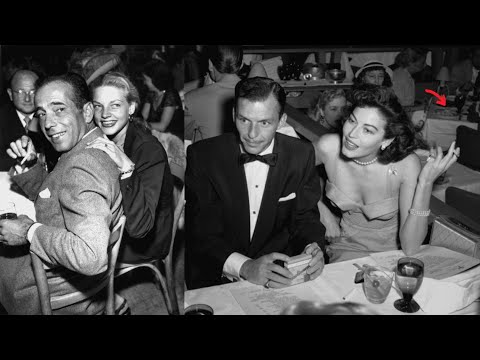
But how did these photos escape the studio’s watchful eye? And what do they reveal about the stars we thought we knew? As we dig deeper into this forgotten archive, a different Hollywood emerges—one of whispered secrets, unexpected friendships, and moments of vulnerability that were never meant to be captured. The further we go, the more the line blurs between legend and human being.
Take, for instance, the night of a notorious 1950s bash where a beloved actress was photographed in a rare moment of sorrow, tears glistening in her eyes as she slipped out a back door. Or the 1980s gathering where a group of former rivals shared a toast, their feuds momentarily forgotten. Each photo is a time capsule, a fragment of history that challenges everything we thought we knew about the golden age.
These images don’t just show us the stars—they show us the era itself. The fashion, the attitudes, the secrets that swirled behind closed doors. And as we sift through this collection, one thing becomes clear: the most fascinating stories aren’t the ones told on screen, but the ones hidden in the shadows.
So, are you ready to step behind the velvet rope? Because what we found will change the way you see Hollywood forever.
The archive itself arrived in a battered leather suitcase, discovered in the attic of a Pasadena estate sale. Inside were nearly three hundred photographs, each stamped on the back with a single date and a cryptic set of initials. No names, no locations—just a paper trail that seemed designed to protect the guilty.
A retired archivist named Margaret, who spent forty years cataloguing studio negatives, was the first to recognize what she was holding. She told me she nearly dropped the box when she saw the third photograph in the stack. It was Cary Grant, unmistakably, standing on a balcony with a woman the world had never seen him with.
Margaret spent months cross-referencing the initials against studio call sheets and gossip-column dates. What emerged was a map of secret gatherings—private dinners, weekend retreats, and late-night parties that never made the papers. The studios had eyes everywhere, but these photos proved that some moments slipped through the cracks.
Then came the discovery that stopped her cold. Tucked into an envelope at the bottom of the suitcase was a note in faded ink, written in a looping hand. “If these ever surface, tell them we were happy. Tell them we were real.” It was signed only with a woman’s first name—and a date that placed it decades after the photos were taken.
Who wrote it? And why had she waited so long to speak? Margaret believes the note was written by someone who had attended those gatherings and survived them all—perhaps a family member, perhaps a friend who had kept the secret for a lifetime. The initials on the back of the photos, she suspects, were a code known only to the inner circle.
But the most unsettling detail? One photograph in the collection had been deliberately torn in half. The remaining fragment showed a hand resting on a shoulder—and nothing more. Whoever tore it wanted that face gone forever.
Margaret has her theories about who was in that missing half. She won’t say the name aloud. But when I asked whether the person was still alive, she simply looked out the window and said, “Some legends never really leave the room.”
That answer hung in the air longer than either of us expected. Margaret finally slid a second stack of photographs across the table—these ones smaller, square, the kind a guest might have snapped with a pocket camera. “These were taken by someone inside the circle,” she said. “Not a studio photographer. A friend.”
The first few were ordinary enough: a crowded living room, a half-finished cake, a dog asleep on a velvet couch. But the sixth photo made my breath catch. Sophia Loren, barely twenty, sitting cross-legged on the floor in a plain housedress, laughing at something just out of frame. No makeup, no jewels, no pose. Just a young woman at ease in a room that wasn’t hers.
Margaret tapped the corner of the image. “See the initials here? S.L. and a second set—M.C. Every photo in this stack carries two sets. One for the subject, one for the photographer.” That was the code. Not a mystery at all, once you knew where to look. A ledger of who was present, kept by someone who trusted the negatives would never leave the house.
The photographer’s initials appeared again and again. M.C. Margaret had traced them through three decades of studio records and come up empty—until a 1972 obituary in a small California paper mentioned a woman named Miriam Cole, described only as “a private secretary to several prominent families.”
“She was the one nobody photographed,” Margaret said. “The one who held the camera so the stars could forget it was there.” Miriam had worked for the same Beverly Hills household for twenty-six years, and in that time she had quietly documented what the tabloids would have paid a fortune to print.
And the torn photograph? Margaret believes Miriam tore it herself—not out of anger, but out of mercy. “She was protecting someone right up to the end,” she said. “That’s not a scandal. That’s loyalty.”
We sat with that for a while. Outside, the light was going gold, the way it does in old films just before the fade. Margaret closed the suitcase and rested her hand on it, as if it might drift away.
Then she mentioned something she hadn’t told me yet—a second envelope, unopened, tucked into the lining. It was addressed to no one, sealed with wax, and heavy enough to hold more than paper. “I’ve been waiting for someone to open it with,” she said quietly. “I think that someone is you.”
The envelope was heavier than it looked. Margaret slid a letter opener under the wax, and it cracked like a dry twig. Inside: a single photograph and a folded sheet of stationery, the ink faded to a soft brown.
The photo showed a garden party—dozens of familiar faces, all of them laughing. And at the edge of the frame, half-hidden by a rose bush, stood Miriam Cole herself. It was the only picture in the entire collection where the photographer appeared. She was smiling, but her eyes were somewhere else.
The letter was short. “I kept these so someone would know we loved each other between the takes,” it read. “The studios sold the shine. I kept the glue.” It was signed Miriam, and beneath her name, a list—nine names, all crossed out but one.
Margaret read it twice, then set it down. “She outlived them all,” she said. “Every last one. She was the only one left to remember.”
We spent the rest of the evening going through the suitcase together, matching faces to initials, dates to headlines. The sorrowful actress at the back door. The rivals who shared a toast. The balcony. The torn half. Every image now had a witness, and every witness had a name.
By the time the streetlights came on, Margaret had made a decision. The collection would go to a small museum—not a grand one, she insisted, but somewhere a young person might wander in and see the stars as they really were. “Not legends,” she said. “People. That’s the whole point.”
She placed Miriam’s letter back in the envelope and pressed the wax flat with her thumb. Then she looked at me and smiled, the way people do when they’ve finally set something down.
“So,” she said, “which one would you have kept?”
I didn’t have an answer then. I’m not sure I do now. But I know which photo I keep coming back to—the garden party, the rose bush, the woman no one ever photographed, smiling at a secret she carried for fifty years.
Some stories wait a lifetime to be told. And some, like Miriam’s, wait for someone to finally ask.
Which photo from this hidden collection would you want to see first—and which Hollywood legend do you think was hiding the biggest secret of all? Tell us in the comments below.






