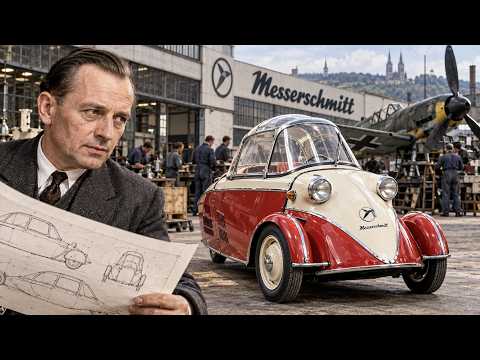
February 1953, Regensburg, Bavaria. Inside a factory that once built fighter planes for the Luftwaffe, a new machine rolls off the line. Three wheels, one cylinder, a clear plastic bubble for a roof. Two people ride inside, one behind the other, like a pilot and a gunner. You steer it with a bar, not a wheel, and there is no reverse gear. To back up, you shut the engine off and start it again, running backward. On its nose is a name the whole world already knows: Messerschmitt.
Eight years earlier, that name meant the Bf 109 and the Me 262. It meant war in the skies over Europe. Now it meant a car for people who could not afford a car. By 1964, the little bubble was gone. By 2013, its rarest descendant would sell in Madison, Georgia, for $322,000—a world auction record for a microcar. And here is the strange part: this car was born because Germany had lost everything, and it died because Germany got everything back.
Willy Messerschmitt was born on June 26, 1898, in Frankfurt am Main, the son of a wine merchant. The family soon moved to Bamberg, a quiet old cathedral town in northern Bavaria. There, on the hills above the river, a skinny boy first watched a man try to fly. The man was Friedrich Harth, a local architect and gliding pioneer. Harth was building wooden gliders and launching them off the slopes outside town long before anyone in Germany treated gliding as anything more than an eccentric hobby.
Young Willy attached himself to Harth like a shadow. He carried parts. He sketched wings. He crashed, rebuilt, and crashed again. He was still a teenager. What Messerschmitt learned on those hills shaped everything he would ever design. A glider has no engine to hide its sins. Every extra pound fights you. Every bit of drag steals distance. So the boy from Bamberg grew up with one obsession burned into him: light, simple, efficient. Nothing on the machine that does not earn its place.
Hold on to that idea. It will come back to this story in a form nobody could have predicted.
After the First World War, Messerschmitt studied engineering at the Technical University in Munich and earned his degree in 1923. That same year, still in his mid-20s, he founded his own small aircraft company. He built sport planes and light transports, and he built them lean. Too lean, some would later say. In 1927, he joined Bayerische Flugzeugwerke, the Bavarian Aircraft Works in Augsburg, as its chief designer. It was a promising partnership, and then it nearly destroyed him.
A series of fatal crashes involving one of his airliners earned him a powerful enemy in Erhard Milch, the head of Lufthansa, who would later become one of the most powerful men in the German Air Ministry. By 1931, the Augsburg company had gone bankrupt. Most careers end right there. His did not.
When Adolf Hitler came to power in 1933 and Germany began to rearm in secret, the regime needed fast, modern war planes, and it needed designers who could deliver them. Messerschmitt joined the Nazi Party that year. He was ambitious, politically shrewd, and very, very good at his job. In 1935, his new fighter took to the air for the first time. It was called the Bf 109. It was small, it was light, it was brutally fast for its day. Everything he had learned on the glider hills was in that airframe.
In November 1937, a modified version set a world speed record for land planes at just under 380 mph. The world noticed, so did Germany’s enemies. In July 1938, the Augsburg company was renamed in his honor: Messerschmitt AG. The boy from Bamberg now had his name over the factory gate.
When war came in 1939, the Bf 109 became the backbone of the Luftwaffe’s fighter force. It fought over Poland, over France, over the English Channel in the Battle of Britain, over North Africa and the frozen Russian front. By the end of the war, roughly 34,000 had been built, more than any other fighter in history. And Messerschmitt kept pushing. In 1944, his Me 262 entered combat as the world’s first operational jet fighter. It was faster than anything the Allies could put in the air. American bomber crews over Germany saw it streak past and could hardly believe their eyes.
There is no honest way to tell this part of the story without saying what came next. To build these aircraft at the scale the regime demanded, Messerschmitt’s company relied heavily on forced labor. Prisoners from concentration camps and laborers taken from occupied countries were put to work in its plants and in hidden production sites, often under conditions designed to work them until they broke. Many did not survive. This is not a footnote. It is part of the name, and it stays part of the name for the rest of this story.
The Regensburg plant was one of the most important fighter factories in the Reich. Important enough that on August 17th, 1943, the United States Eighth Air Force sent a force of B-17 bombers deep into Germany to destroy it in a double mission that also struck the ball bearing plants at Schweinfurt. 60 American bombers did not come home that day. Hundreds of young Americans were killed or captured. The factory was hit hard. It was repaired. It was hit again.
By the spring of 1945, it was over. Germany’s cities were rubble. Its factories were shattered, stripped, or seized. Willy Messerschmitt, once one of the most celebrated engineers in the country, was taken into custody by American occupation forces and held for two years. The Allies made one thing absolutely clear: Germany would not build aircraft again. Not fighters, not bombers, not anything with wings. The name Messerschmitt—the name that had filled the skies over Europe—was grounded.
And somewhere south of Munich, in a town called Rosenheim, a young former Luftwaffe officer with no factory, no money, and no famous name was looking at a very different problem: How do you give a man with no legs his freedom back?
Fritz Fend was born on April 14, 1920, in Rosenheim, a market town on the Inn River in southern Bavaria, within sight of the Alps. He was 22 years younger than Willy Messerschmitt. He came of age in a very different Germany, one already at war. Like so many young men with a talent for machines, Fend ended up in the Luftwaffe. He was not a fighter and not a famous designer. He was a technical officer, trained in aeronautical engineering, one of the thousands of men whose job was to keep complicated aircraft working.
That background matters. Fend thought like an aircraft man. Every pound was an enemy. Every part had to justify itself. It was the same discipline Messerschmitt had learned on the glider hills of Bamberg, and it would soon put these two men on the same path.
When the war ended in 1945, Fend came home to Rosenheim with nothing but that training. Look at what he came home to. Germany had lost millions of its young men, and an enormous number of those who survived came back broken. Missing legs, missing arms, spines that would never work again. They filled the streets of every town in the country—men in their 20s and 30s who now had no way to get to work, to the market, or out of the house.
Cars were out of the question. There were almost none, and nobody could afford the few that existed. Gasoline was rationed, steel was scarce. The trains ran when they could. For a man who could not walk, the world had shrunk to the size of a single room. Fend saw that problem up close, and in 1948, in a small workshop in his hometown, he decided to do something about it.
His first machine was almost painfully simple. It was a three-wheeled carriage for the disabled, driven not by an engine but by the rider’s own arms. You sat inside and pushed a set of handlebars back and forth, and the motion drove the wheels. It was slow, and it was exhausting, but it moved. He kept improving it. Soon he fitted a tiny 30cc Victoria bicycle engine. Then he went further and designed something new from the ground up, a machine meant to be powered by an engine from the very start. He called it the Flitzer—in German slang, roughly the Dasher, the little zipper.
The Fenn Flitzer had a single seat, two wheels in front, and one powered wheel in back. It was built the way an aircraft engineer would build it: aluminum panels stretched over a light steel frame, enclosed at the front, sides, and rear. The first versions had nothing more than an opening in the top for the driver’s head and shoulders, with a small windshield to break the wind. Early Flitzers ran on a 98cc Fichtel & Sachs two-stroke engine. Later ones got a 100cc Riedel unit making about 4½ horsepower, good for a top speed of around 47 mph.
47 mph for a man who had not been able to cross the street on his own.
Fend was careful about one thing. He did not want the Flitzer sold as a sad little invalid cart, a vehicle that announced to everyone on the road that the driver was damaged. He wanted it to be a real, fun, modern machine that happened to work for people with disabilities. Something with dignity. That decision had a consequence nobody planned.
People who were perfectly healthy started buying the Flitzer, too. Think about what that tells you. In post-war Germany, the hunger for personal transportation was so intense that able-bodied men and women were willing to drive around in a vehicle originally built for amputees because it was cheap, it was enclosed, and it was better than walking.
Customers even began asking for a way to carry a second person. By 1951, Fend was fitting a scooter-style saddle above the rear bodywork with footrests on either side so a passenger could perch behind the driver. It was crude, it was cramped, and it sold. Over roughly three years, Fend’s tiny operation built about 250 Flitzers before production ended in 1951.
By any industrial standard, that is nothing. Detroit could build 250 cars before lunch. But Fend was not looking at the number. He was looking at the buyers. If healthy people would squeeze into a one-seat disability carriage, what would they do for a real two-seater? Fully enclosed, a roof over your head when it rained, room for your wife or your friend, cheap enough for a factory worker, light enough to sip fuel like a motorcycle, and still built with the discipline of an airplane.
Fend began to sketch exactly that. Two seats, one behind the other so the body could stay as narrow as a fuselage. A clear canopy over the top like a cockpit. Three wheels. A small motorcycle engine in back. On paper, it was brilliant. In reality, Fend had a serious problem. A workshop in Rosenheim could hand-build a few hundred machines. It could not mass-produce tens of thousands. For that, he needed a real factory. Presses, assembly lines, skilled workers who understood thin metal and tight tolerances. He needed someone who had built machines by the thousands before.
And roughly 100 miles to the north, in Regensburg, there was exactly that kind of factory. It was standing half idle, its workforce scattered, its owner forbidden by law from doing the one thing he had always done. The factory had a famous name on the gate. All Fritz Fend had to do was convince the man who owned it.
In 1952, Willy Messerschmitt was 54 and forbidden to build anything that flew. His factories survived, his workforce endured, but the skies were closed to him. So the company made sewing machines, electric irons, even prefabricated houses. It kept the lights on. Barely.
That same year, Fritz Fend walked through the door with his sketches and a simple pitch: a cheap, enclosed, two-seat machine ordinary Germans could afford. He had proof people wanted it. What he lacked was a factory. Messerschmitt had a factory and nothing worthwhile to put through it.
The cars would be built in Regensburg and would carry the Messerschmitt badge on their noses, but they would not be made by Messerschmitt AG itself. A separate company was created: Regensburger Stahl und Metallbau. Willy Messerschmitt was lending his name, his floor space, and his workers. He was not betting his company on a bubble car.
For Fend, it hardly mattered. He had a production line, trained metalworkers, and a name that made every customer stop and stare. That name was a gift. It was also a loan—and loans can be called back.
Here, right at the beginning, is the seed of the whole story. The most feared name in German aviation was about to be painted on the most harmless vehicle in the country. As long as Germany stayed poor and Messerschmitt stayed grounded, that arrangement suited everyone. Nobody in Regensburg in 1952 stopped to ask what would happen if either of those things changed.
What do you think—was the bubble car doomed from the very first handshake?






