The early hours of 31st July 1917 were suffocatingly quiet, the kind of silence that precedes a storm. Outside the Belgian town of Ypres, men filed through muddy trenches, their hearts pounding in their chests. Within minutes, under the cover of a massive artillery barrage, they would launch a huge offensive to capture the ridges that had allowed German guns to shatter the town for three years. Atop that final ridge sat the little-known village of Passchendaele.
Among the tens of thousands preparing to go over the top was a single battalion: the 1st Hertfordshire Regiment. What happened to them in the next two hours would become a legend of sacrifice and horror.
By mid-1917, the Western Front had been relatively static for more than two years, during which millions had lost their lives. The deadly mix of artillery, machine guns, and barbed wire had made going ‘over the top’ a hell from which few returned. But to win the war, the fighting had to go on.
The Ypres Salient, close to the northern end of the Western Front, was always busy and always deadly. Its location was the problem. Imagine dropping a pebble into a pond: the ripples radiating out are ridges of high ground. Ypres was the pebble, and the ridges to the north, east, and south—Pilkem, Broodseinde, and Passchendaele—gave the occupier a clear view down into the low ground around the town. From 1915 onwards, the occupiers were the Germans. To protect Ypres, the British had to occupy low ground and remain overlooked by German guns.
By the spring of 1917, desperate to avoid another winter of being shelled at leisure, a decision was made: advance and capture those ridges. Hence Passchendaele. More properly called the Third Battle of Ypres, its objectives were ambitious, destined never to be fully met.
More than 100 battalions, each numbering around 1,000 men, would go over the top on ‘Z-Day’, set for 31st July. But for this story, we will follow the fortunes of just one group: the men of the 1st Battalion Hertfordshire Regiment. Known as the ‘Herts Guards’ due to early war service with the famous Guards Brigade, they were in fact a Territorial unit—part-time pre-war soldiers who had arrived on the Western Front in November 1914 and were now a highly experienced body of troops.
Their ranks were filled with characters. Commanding officer Lieutenant-Colonel Frank Page, 40, was well regarded by all ranks as a man who led by example. He had been with the battalion for the entire war and had already received two Distinguished Service Orders for bravery. Reverend Edgar Popham, a clergyman, ran all the same risks as the men, except he did it unarmed. He was loved by the men and had more than once shown personal courage in action.
Among the senior non-commissioned officers was Company Quartermaster Sergeant Gordon Fisher, from St Albans, responsible for supplying rations and munitions. Bill Taylor, 26, a quiet former gardener, had already received a Military Medal on the Somme for saving wounded men in no-man’s-land. Among the newer arrivals was 26-year-old Private Percy Buck, a printer before the war. He had not immediately volunteered in August 1914, probably because his son Cyril was only one day old when war was declared. Nevertheless, by 1916 he was at the front with his comrades.
Two final men shared a birthday on what turned out to be the day of the opening attack: 19-year-old Harold Martin, a single man yet to see battle, and Private John William Goodwin, an insurance salesman for the Prudential Company, who was 36 on the day of the battle.
The 39th Division, of which the Herts were a part, was tasked with capturing a stretch of the Pilkem Ridge and the German defences guarding it—a web of trenches in three different sets of lines over a depth of about three miles. The plan was simple: the lead battalions would start early, capture and hold the first line, while the next wave moved on to the second line. Finally, the third wave, including the Herts, would pass through to capture the final position, advancing towards the ‘Langemarck Line’.
In peacetime, it would have taken a little over an hour to cover the ground, but in practice, it would be a very different proposition. Aerial images show the Langemarck Line, captured by German reconnaissance aircraft shortly before the battle. The ground shows signs of shellfire, but being several miles behind the frontlines at the end of July, it was fairly intact and well-constructed on the crest of a shallow rise.
Behind Ypres, the men welcomed a period of rest and training. Clifford Lane recalled: “We were taken out for the longest rest we ever had and training. We were getting ready for the battle they eventually called Passchendaele. We trained, rested and we even had sports day. I managed to win the 100 yards and came second in the quarter mile and had a prize of 40 francs for that. Most of our platoon went out that evening and we came across an estaminet and we went in there and we were drinking, not beer or wine but it must have been spirits. Some of our people were drinking tumblers full of what must have been gin.”
By 30th July, the men were ready. Passing through the shattered remains of Ypres, they made their way to their start positions. At 3:50am, the battle began with an enormous bombardment. Minutes later, the whistles blew and the leading battalions surged over the top, meeting immediate success. The few Germans encountered were often wounded or stunned by the ferocious bombardment, and the first line was taken with little loss. The second line too, in the Herts’ sector, was easily overcome, with only Kitchener’s Wood putting up stubborn resistance. By 9:30am, the second line was in British hands.
Only the Langemarck Line remained, and that job fell to the men of the 1st Herts. According to timetable, the battalion paused along the banks of the Steenbeek River. This was a planned pause to allow the artillery to move up and to allow two tanks allocated for support to do the same. But as the men waited, one conspicuous absence became apparent—artillery. There was none. The guns simply couldn’t move up over the ground they themselves had so badly torn up. Even more worrying, as the two tanks approached, one fell into the Steenbeek and got stuck, and the other crossed it only to slip into a shell hole 10 yards later. Neither would take part in the action. It would now be down to the men alone.
At 10:50am, whistles blew and the Herts Guards left the Steenbeek and began to advance across no-man’s-land. All was quiet for the first 100 yards as the men advanced in dead ground, but upon reaching a road across the battlefield, the crackle of machine guns could be heard from the village of St Julien to their south and Maison D’Hibou to the north. Caught in crossfire, the line as one observer put it ‘shivered’ as bullets ripped into them from either flank. Within seconds, dozens of men and perhaps half the Battalion’s officers were hit, many killed.
Corporal Clifford Lane recalled: “We came under heavy machine gun fire and practically the whole of our platoon was wiped out. It was just a matter of luck, the one that hit me caught me in the shoulder. The man next to me had one right along the back of his neck. I stopped and dressed his wound, he put his arm round my shoulder and we eventually got to a pill box and got in there.”
Shocked by the ferocity of fire, the Herts hit the ground and looked for cover. Seeing this from behind the leading waves, Colonel Page rushed forward alongside his adjutant Captain Milne. Just then a shell dropped between them, killing both outright. Still determined, the Herts men now rushed in groups of half a dozen at a time in a leapfrog advance. Halfway across the field, they encountered a German gun battery and carried it at the point of the bayonet, killing or capturing the entire garrison. They pushed on, yard by yard, until they reached a road with a hedge running along its length, blocking their view of the Langemarck Line.
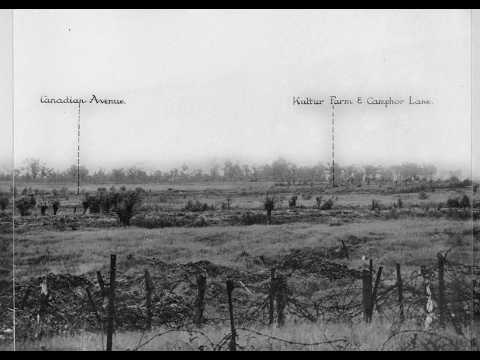
By now, the Battalion numbered less than 300, about half of those who had started the attack. The last surviving officers encouraged the men on once more, but as the first soldiers emerged through the hedge to make the final charge, they were horrified to find a 10-yard-thick, unbroken mass of barbed wire, every inch covered by machine guns. Incredibly, men still attempted the impossible, charging through one gap in the wire, which turned out to be a trap—all but one man, the last of the 20 officers who had started that day, were hit by the machine gun trained on it.
It was clear that the objective was unattainable. As it later transpired, the first two lines had been so easily captured because the Germans had received news of the impending attack and withdrawn much of their strength to their third line. The Herts now faced an awful dilemma: stay where they were, exposed in no-man’s-land under sniper, machine gun, and artillery fire, or retrace the hellish 600 yards in the open they had just crossed at such great cost. Leaderless, for 30 minutes they were hammered by enemy fire which further thinned their shattered ranks.
Back on the Steenbeek, as the first wounded trickled back, they met Reverend Popham, the Chaplain. Learning of the plight of ‘his lads’, he ran forward alone, crossing the entire battlefield under fire to reach the trapped remnants of the Herts. His timing couldn’t have been better. The Germans, realising how few the defenders were, launched a counter-attack at that very moment in a pincer from both north and south which would utterly annihilate the battalion. Popham, seeing the danger, gathered as many men as he could and led them back at a run towards the Steenbeek. Here fate intervened as, in the fog of war, the German northern and southern pincers briefly engaged each other as the remnants of the Herts slipped away in the smoke, leaving behind a high tide mark of dead and dying men.
Harold Martin, who had not withdrawn with the rest, recalled: “We crossed the road but after about 200 yards we came to rows and rows of barbed wire. I got into a shell hole not very far from the ridge and was joined by a pal from my home town. We waited some time. Everything seemed so quiet. He said, ‘We must get out of this or we’ll be captured.’ Me, being stupid, said, ‘No! I have got so far, I’m not going back again.’ He stayed some time and then, as I was still stubborn, he went. How long I hung on I don’t know, but at last, not seeing anyone, I decided to retrace my steps. Back I went over the road again and up two fields. I was fired on but luck was with me, and I found the Cambridgeshires digging in.”
Two men still unwounded at this time were Private John Goodwin and Corporal Bill Taylor, who had already had several close calls that day. Goodwin, to the south, had volunteered to take his Lewis Gun and hold off the southern pincer as long as possible to allow his mates to get back, whilst Bill Taylor had done the same in the north—both knew that they would not be coming back.
As the remnants of the shattered Herts, a pitiful handful of perhaps 60, crossed back to the Steenbeek from where they had started less than two hours before, the scale of the tragedy became clear. Harold Martin and Clifford Lane were lucky, both being wounded, they made it back to the river. Others were less so; every single officer and more than 75% of the men were left behind, either killed, wounded, or captured. Just one of those hundreds never to be seen again was Percy Buck, the printer’s assistant who had thought of his family in this very spot before going over the top.
Perhaps last return that day was Bill Taylor, who, miraculously having held off the northern counter-attack, had managed to reach the Steenbeek. He carried with him a painful reminder: broken ribs from a piece of shrapnel which hit him in the chest and lodged in the wallet of family photos he carried—he kept it for the rest of his life. John Goodwin wasn’t so fortunate; his body was found several months later, still in the corner of the field where he had last been seen, weapon in hand.
The scale of the loss of the Herts at St Julien can perhaps be best summed up by Gordon Fisher, who arriving with rations for the battalion at this bunker met the Brigade commander. “There were four Company Quartermaster Sergeants; myself and three others and we decided between us that two of us would go forward and try and find the battalion, one would stay with the rations and the other would try to find Brigade Headquarters to get some indication as to where the battalion might be. We tossed up for different jobs and it fell to my lot to have to find Brigade Headquarters, so I set off. There was a most tremendous bombardment going on all the while. After a long time I found Brigade Headquarters. They were in an underground concrete German pill box just in front of St Julien. I went down the stairs, saluted the Brigadier, told him who I was, explained the position and said ‘Could you give me any instructions Sir, that would help me find the battalion?’ He just stood and looked at me. We were both standing on the steps and the pill box was rocking like a boat in a rough sea with explosions. After a while he said ‘I’m sorry quarters, there isn’t any Hertfordshire Regiment.’”
In the days that followed, the news of what happened to the Herts filtered home. In the town of Hitchin, Mrs Bertha Buck received only the news that her husband Percy was ‘missing in action’. That way it stayed, until one morning several months later she received an incredible letter, postmarked ‘Geneva, Switzerland’:
I beg to enclose a postcard which I took from a British soldier at St Julien, in Flanders. He was holding the card in his hand and as I learnt later on, the finder was asked to return it to his wife. I, wishing to fulfil the last will of the dead comrade, send it to you, with the request to forward it to his wife. The address is written on it. He fell on 31st July or 1st August near St Julien. May he rest in peace. I should be very pleased to hear if the wife has received the card. Respectfully, Gefreiter Josef Wilczek
For me it is remarkable that a German soldier, an enemy of Percy that day, would go to such lengths to inform his wife of her husband’s death, without which she may never have known what became of him. A powerful moment of humanity triumphing in warfare.
Until November 2018, the fate of Josef Wilczek was unknown, believed to be amongst the thousands of fallen of the battle, but research has since revealed that he survived the Great War. Wounded and captured in September, he eventually returned to his home, today in Zabze, Poland, and died there in 1983, aged 86. He never learned that his letter had reached Mrs Buck.
The story of what became of the Herts that day, sadly, isn’t unique. The Third Battle of Ypres continued for 104 more bloody days through atrocious conditions and seas of mud. All told, hundreds of thousands of men fell before the Passchendaele Ridge was taken. Officially, a victory, but one at unimaginable cost.
Today the position where the Hertfordshire Regiment effectively met their end is marked by a memorial, unveiled at 10:50am on 31st July 2017, 100 years to the moment that they began their attack. Present that day were hundreds of men and women from the county and dozens who lost loved ones, many of whom still lie in these Flanders fields.
The memorial stands quietly now, a low stone bearing the names of men who never came home. Among the visitors, a great-grandson of Percy Buck traced the letters of a name he had only known from a faded postcard. He left a small photograph of Cyril, the infant who had been one day old when war was declared, now a man in the picture, standing beside his own grandchildren.
Bill Taylor’s shrapnel-pierced wallet passed down through his family, a relic of luck and love. Harold Martin lived to old age, rarely speaking of the day he turned twenty amid the wire and the guns. Clifford Lane’s wound healed, but the memory of his platoon never faded.
Josef Wilczek’s letter remains a testament to decency across enemy lines. The fields of Flanders still hold the fallen, and the ridge of Passchendaele watches over them in silence.
What would you have done, standing at the Steenbeek on that July morning?






