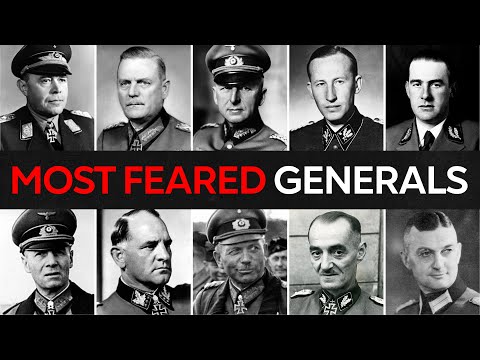
What if the most terrifying generals of Nazi Germany weren’t the ones in your textbooks? Some didn’t win medals. They signed death warrants. Others didn’t shout. They whispered and cities vanished. These were the architects of fear. From shadowy executioners to battlefield phantoms, you’ve heard of Rommel, but what about the men who made entire nations go silent at the sound of their name? Tonight, we unearth the faces history tried to forget: the most feared Nazi generals you never knew about. And by the end, you’ll wish you still didn’t.
Before we dive in, make sure to subscribe so you don’t miss the stories history tries to bury. And while you’re here, drop a comment: Where are you watching from, and what time is it right now? Midnight, 3:00 a.m.? Let’s see how far this late-night rabbit hole goes.
Reinhard Heydrich didn’t just cast a shadow. He built one brick by brick from fear. If Heinrich Himmler was the architect of Nazi terror, Heydrich was the interior designer: clean lines, sharp corners, and nowhere to hide. Cold-blooded with a saxophone hobby, Heydrich wore bureaucracy like body armor and moved through occupied territories like a walking death sentence with a fountain pen. He didn’t bark orders. He wrote them smoothly, legally, efficiently.
In 1941, when Heydrich was sent to the Protectorate of Bohemia and Moravia, local resistance groups reportedly fell silent. Not because they were broken, but because silence became the only way to survive. He arrived with a clipboard, not a tank. And yet, people disappeared. Resistance networks that once had intricate webs of contacts suddenly found themselves cut at every node. Curfews weren’t just warnings—they were traps. The city of Prague entered a kind of hushed stasis under his rule, where fear wasn’t an event but a permanent weather condition.
What made Heydrich uniquely terrifying wasn’t just his reach—it was his tone. He had the charm of a diplomat, the manners of a violinist, and the moral compass of a broken clock. Locals called him “the Butcher of Prague.” But the name doesn’t quite land. Butchers make a mess. Heydrich didn’t. He made policy. And when he was assassinated in 1942, the response he triggered—Lidice and Ležáky, the razing of entire villages—proved that the machine he built didn’t need him to keep running. It was already alive.
Of course, it wasn’t running alone. One of the men who made sure it stayed that way was already moving east into the forests with a clipboard of his own.
Erich von dem Bach-Zelewski had the kind of name that sounds like it belongs to an opera conductor. Instead, he composed silence through fire, bullets, and absolute certainty. He wasn’t just feared because of what he did. He was feared because of what he authorized others to do—and what he let slide, knowing full well that oversight wasn’t a priority, only outcome.
As the SS and police leader in the occupied Soviet territories, Bach-Zelewski didn’t invent anti-partisan warfare, but he made it feel like a franchise. The term “bandit” became a death sentence. Entire villages became suspect. Civilians weren’t just collateral—they were context. And resistance fighters, when caught, weren’t handled; they were exhibited. In Belarus, his operations blurred every moral line: civilian reprisals masquerading as security sweeps, scorched earth labeled as sanitation, mass graves hidden behind euphemisms.
Yet even within the German command, whispers followed him. Some called him unstable. Others said he drank too much. But the real fear didn’t come from his instability. It came from how often he sounded completely reasonable while discussing annihilation.
His true masterpiece of terror came in 1944: the crushing of the Warsaw Uprising. Not a battle, not a campaign—an eraser. Under his command, city blocks were leveled not to win ground but to make a point. Resistance wasn’t something to defeat. It was something to unwrite. And in that silence he left behind, another name was spoken—one that even German officers reportedly flinched at. Because if Bach-Zelewski made policies cruel, his next counterpart made cruelty policy.
If you’re still with us after that, you’re the kind of viewer we make this for. Go ahead and subscribe if you haven’t already, and let us know in the comments: Where in the world are you watching from, and what time is it right now? Just curious—how many of you are drifting through history at 2:00 a.m.?
Friedrich Jeckeln had a system. That was the problem. You see, most people feared chaos—random brutality, spontaneous cruelty. But Jeckeln? He brought logistics to it. He turned mass killing into an itinerary, a calendar item, a task on the morning docket. Efficient, predictable, and utterly horrifying.
Stationed in Ukraine and the wider occupied USSR, Jeckeln’s legacy wasn’t built in bloodlust but in routine. He engineered a method so cold and organized it earned a nickname: the Jeckeln System. Victims would be rounded up, marched, stripped, and executed in pre-dug pits in synchronized fashion. There were forms. There were rosters. It was, in the eyes of Nazi administration, a success. And that’s what made it terrifying: it worked.
At Rumbula in Latvia, nearly 25,000 people were murdered over two days using this system. The forest didn’t scream. It just absorbed. And afterward, Jeckeln didn’t vanish into the fog of war. He kept moving—city to city, region to region—installing variations of his method wherever he went. His terror wasn’t theatrical. It was administrative. Even the SS considered him excessive. That’s saying something.
But Jeckeln didn’t fear their judgment because his orders came from high. And his next station would bring him into contact with someone even more fervent—someone who didn’t just execute orders but helped invent the very policies they stemmed from. A man who made murder industrial. Efficient wasn’t enough for him. He needed it to scale.
Odilo Globocnik didn’t look like a man who could move history with a signature. Short, pale, and perpetually sweating, he had the anxious energy of someone trying to impress a boss who was never watching. But beneath that clammy exterior was one of the most lethal administrators of the Nazi regime—not because he commanded armies, but because he designed a system that didn’t need one.
As the SS and police leader of the Lublin district, Globocnik oversaw something euphemistically labeled Operation Reinhard. The name itself was a tribute to his old colleague Heydrich. The operation was not a campaign. It was infrastructure—a pipeline of trains, camps, schedules, and bodies. It didn’t require battlefield strategy, just planning, just enough ambition.
He wasn’t charismatic. That made him more dangerous. He didn’t need to convince anyone, just coordinate them. To local resistance groups in occupied Poland, his name meant one thing: you had no way out. Under his watch, the SS didn’t just conduct repression. It automated it. Towns didn’t fall. They disappeared.
Even within the Nazi hierarchy, Globocnik was considered obsessive, paranoid, a micromanager. But he delivered results. And those results were measured not in territory but in totals—in bureaucratic reports filed cleanly, legibly, with no trace of blood. Later reassigned to the Adriatic littoral, he carried the same methods with him. Proof that his loyalty wasn’t to a cause but to a system. And every system needs rules.
That’s where the next man came in: a general who believed the army should get its hands dirtier, and that orders could sound moral if you phrased them carefully.
Walter von Reichenau wore a general’s uniform, but he spoke like a zealot. To the untrained eye, he was just another career officer—old school, strategic, tight-lipped. But in October 1941, he put his ideology in writing. The infamous Severity Order wasn’t just a battlefield memo. It was a moral declaration wrapped in military tone. No distinction between civilians and enemies. No space for compassion. And no illusion that this was a conventional war.
Reichenau believed the Eastern Front wasn’t just a military campaign. It was a cultural one—even a biological one. And his army group operated accordingly. Villages became enemy territory by default. Civilians were treated not as bystanders but as collaborators in waiting. His troops, already indoctrinated by months of propaganda, found in his orders a kind of grim permission.
But what made Reichenau feared wasn’t just his ideology. It was that he was respected. He wasn’t an outsider like many SS commanders. He was one of the army’s own. And his orders were followed not because they were screamed, but because they were signed—coldly, legally, efficiently. To Soviet civilians and partisans caught behind German lines, Reichenau’s presence meant no quarter. His army didn’t occupy. It extinguished resistance by redefining it as treason.
And when Reichenau died suddenly in early 1942, his doctrine didn’t go with him. Others picked it up. But at the highest levels of the German war machine, one man helped ensure such orders weren’t just written but institutionalized. He didn’t invent brutality. He signed off on it.
Wilhelm Keitel was the kind of general who always looked slightly overwhelmed—because he usually was. A career officer promoted beyond his depth, Keitel didn’t command troops. He commanded signatures. And he signed everything. Orders that sent millions into occupied territories. Directives that made reprisals standard procedure. Documents that turned the law into a smoke screen for extermination.
If a policy needed a pen, Keitel was ready. To Allied commanders, Keitel was less of a battlefield figure and more of a bureaucratic enabler. But to those living under Nazi occupation, his name carried weight—not because he was present, but because his name appeared at the bottom of the page that doomed them. He was the hand behind the curtain, a man who turned Hitler’s rants into formal directives and passed them down without question.
What made him feared among German officers was his unwavering compliance. He rarely objected. He rarely reviewed. His loyalty was so total it bordered on parody. But that made him essential. The Commissar Order, the Night and Fog decree, the authorization of hostage shootings—all bore his imprint. Not because he believed in them necessarily, but because he didn’t believe in saying no.
Keitel wasn’t a monster. That would have made him easier to understand. He was something worse: a man who let monsters speak through him. And when the war shifted to the chaotic Balkan front, another commander would carry that same logic into the mountains—only this time with tanks and firepower to match.
Maximilian von Weichs wore the face of a traditional Prussian general—composed, distant, deliberate. But what he commanded in the Balkans from 1943 to 1945 had little to do with tradition. As head of Army Group F, von Weichs wasn’t fighting an army. He was trying to suppress an idea: resistance. And resistance, inconveniently, couldn’t be encircled on a map.
Under his command, entire regions were swept clean of civilians suspected of aiding partisans. Security warfare, they called it—a phrase that made brutality sound like bookkeeping. Von Weichs wasn’t loud. His strength was in structure, delegation, legal cover, and clear lines of chain of command that let others do the dirty work. To civilians in the Balkans, his name meant that survival depended less on innocence than on geography.
And yet, even in this cold calculus, there were outliers. Generals who didn’t hide their policies behind protocol. One of them arrived in Serbia before the template had even hardened. He brought numbers with him—ratios, equations of retaliation.
Franz Böhme was sent to Serbia in 1941 with a mission: restore order. The order he had in mind wasn’t political. It was mathematical. For every German soldier killed by resistance fighters, 100 Serbian civilians were to be executed. Wounded soldiers, 50. The math was clear, the message clearer. He didn’t hide this policy. He formalized it. The massacres that followed, like in Kraljevo and Kragujevac, were not rogue actions. They were the application of a formula.
Böhme wasn’t interested in justice. He was interested in deterrence through spectacle—even if the spectacle was a ledger of dead civilians. His strategy was fear made reproducible. To German officers on the ground, Böhme’s policy brought grim clarity. To Serbian civilians, it brought an impossible choice: speak and risk death, stay silent and risk disappearance. Resistance didn’t diminish under his rule. It just went quieter, deeper, more desperate.
Böhme wasn’t a field commander in the traditional sense. He was a functionary of a punitive doctrine. His fear factor didn’t come from charisma or battlefield victories. It came from his ability to turn reprisals into routine and to defend them as military necessity. He wasn’t the only one who operated this way. But unlike some of his peers, Böhme’s actions were visible, deliberate, and exhaustively documented.
And yet, even among the grim calculus of the Reich, one figure stood apart—not for his numbers, but for his chaos. His name became shorthand for terror inside the SS itself.
Oskar Dirlewanger’s reputation preceded him, and that was the problem. Even among hardened SS officers, his name carried the stench of something off-script. A former military man with a criminal past, Dirlewanger was handed command of a so-called anti-partisan unit that operated like a roving nightmare. Officially, they were tasked with suppressing resistance in Belarus and Poland. Unofficially, they were the regime’s blunt instrument—too crude for policy, too effective to recall.
The Dirlewanger Brigade didn’t follow doctrine. It followed instinct. And Dirlewanger’s instincts were feral. His unit terrorized civilians and partisans alike. Even German commanders filed complaints. That should tell you something. In a system already calibrated for repression, Dirlewanger’s methods stood out as excessive. What made him feared wasn’t military skill. It was unpredictability. Civilians couldn’t negotiate with his unit. Resistance fighters couldn’t anticipate him. His presence in a region meant order had broken down entirely, replaced by something more volatile and less accountable.
In 1944, during the Warsaw Uprising, Dirlewanger’s brigade was brought into the capital. Their mission wasn’t to win. It was to break. And break they did—through neighborhoods, through morale, through any semblance of controlled warfare. To the Polish resistance, his name became a curse. But Dirlewanger wasn’t operating alone. His unit fell under broader command structures. And one of the men orchestrating the suppression of Warsaw with medals on his chest and orders in hand was a more polished face of the same doctrine. He didn’t scream his cruelty. He delegated it.
Heinz Reinefarth had all the right credentials: law degree, military decorations, a polished SS career. But what he brought to Warsaw in 1944 wasn’t discipline. It was finality. When the city rose in defiance during the Warsaw Uprising, Reinefarth was one of the senior officers charged with crushing it. He accepted the role with enthusiasm. What followed wasn’t a battle. It was an obliteration wrapped in orders.
To Polish civilians and Home Army fighters alike, Reinefarth’s name became synonymous with dread. His troops weren’t just fighting an insurgency. They were liquidating a city. Entire districts were reduced to ashes under his watch. Mass arrests, forced expulsions, indiscriminate killings—these weren’t accidents of war. They were tactics. Tools in a larger campaign of erasure.
What made Reinefarth particularly unsettling was his post-war trajectory. After the collapse of the Reich, he wasn’t tried for his role in Warsaw. Instead, he became a mayor in West Germany, a lawyer, a public servant. For decades, survivors of the uprising watched him live a peaceful, even respectable life while the ruins he left behind were slowly rebuilt by the people he tried to destroy. His legacy is a paradox—well documented, yet rarely confronted. Feared by those who remembered the burning of Warsaw’s Wola district, ignored by those who preferred to forget.
And yet Reinefarth was not the peak of violence during that summer. Another commander arrived with a reputation for reprisal, commanding a unit that had already earned infamy in France. He didn’t just bring orders—he brought a demonstration.
Heinz Lammerding wore the black uniform of the Waffen-SS, but his true colors were revealed in fire. In 1944, he commanded the 2nd SS Panzer Division Das Reich, a name already heavy with implication. After D-Day, as German forces scrambled to contain Allied advances in France, Lammerding’s division took a detour through the countryside—not to reinforce the front lines, but to make a statement.
What followed was a campaign of reprisals against civilians suspected of aiding the French Resistance. Most infamously, the massacre at Oradour-sur-Glane, a village wiped off the map in a single day. Lammerding’s division claimed it was an anti-partisan operation. The world called it a war crime. The horror of Lammerding’s actions wasn’t just in their scope. It was in their precision. His troops moved with purpose, executing a playbook designed to terrorize. Roads were closed, buildings surrounded, people assembled. Resistance wasn’t something to be defeated. It was something to be punished.
Despite clear evidence of his command role, Lammerding was never extradited to France after the war. He lived out his life in West Germany, occasionally surfacing in legal debates but never in a courtroom. Survivors called it a second injustice. The silence of the postwar years was louder than any verdict. Lammerding proved that terror could wear the face of professionalism—that atrocities didn’t require chaos. They could march in formation.
And yet in another theater entirely, a very different kind of commander embodied this contradiction. A general who smiled for cameras, wrote letters home, and ordered bombings with the calm of a teacher marking papers.
Albert Kesselring had the kind of face that belonged in a school book—a genial, bespectacled Luftwaffe officer who might have passed for someone’s uncle. But his post in Italy made him one of the most quietly feared commanders of the war. As commander-in-chief South, Kesselring didn’t just oversee the retreating German front lines. He managed the entire occupation apparatus across the Italian peninsula.
What made Kesselring unique was his blend of military talent and ruthless reprisal policy. He was an effective strategist, praised for slowing the Allied advance through central Italy. But behind the scenes, his name was attached to dozens of retaliatory actions against civilians, each framed as necessary deterrence against partisan activity. His signature tactic: make the cost of resistance unbearable. The Ardeatine Caves massacre, where 335 Italian civilians were killed in reprisal for a partisan bombing, was one of many such examples under his jurisdiction. Kesselring insisted it was justified. The Allies disagreed.
After the war, he was tried and convicted by a British military tribunal, sentenced to death—a sentence later commuted. Yet even in prison, his legend grew. Some former officers campaigned for his release. Others painted him as a misunderstood tactician. The man who had once overseen brutal reprisals became, in some corners, a symbol of misunderstood military necessity. But beneath the rationalizations lay a simple truth: under Kesselring’s command, fear became routine.
And one of his army generals in Italy followed suit—less famous, but no less efficient. A man whose own trial revealed just how wide the system of terror had spread.
Eberhard von Mackensen did not have the notorious reputation of the SS elite, nor the mythic aura of the so-called field geniuses of the Wehrmacht. But if you were a civilian living under his command in Italy, you probably didn’t care about branding. As commander of the German 14th Army from 1943 to 1944, von Mackensen’s name carried weight not for battlefield brilliance, but for what followed when a German soldier was ambushed and killed.
In Nazi-occupied Italy, resistance wasn’t just a nuisance. It was treated like a cancer. And von Mackensen’s forces were under clear instruction to cut deep. He didn’t invent the doctrine of reprisal killings, but he followed it to the letter. Entire communities were caught in the machinery of retaliation. Villages accused of sheltering partisans found themselves targeted in acts that were both military and psychological.
Mackensen was later put on trial by a British military court for his role in such policies. The court wasn’t interested in whether he pulled the trigger—only in whether he signed off. The answer, as it turned out, was yes. He was found guilty of war crimes, sentenced, and eventually released—a quiet exit for a man whose name was once spoken in dread through the hills of central Italy. His case underlined something chilling: the most feared men weren’t always the loudest or the most visible. Sometimes they were simply the ones who knew how to follow a terrible order with cold efficiency.
But while some generals left fear in their wake through policy and process, others forged their legacy in movement—in tempo, surprise, and the kind of battlefield momentum that left Allied forces constantly one step too slow.
Erwin Rommel was a paradox in motion. To the German public, he was the Desert Fox—clever, chivalrous, fast. To the Allies, he was something worse: unpredictable. His movements across North Africa from 1941 to 1943 redefined the tempo of mechanized warfare. His tanks struck hard and vanished. His tactics confused, misled, and cornered even seasoned British commanders. Fear followed not because of cruelty, but because of his uncanny ability to show up exactly where you didn’t want him to be.
Rommel wasn’t part of the inner SS circle. He didn’t engage in ideological warfare or bureaucratic purges. He was a tactician, a battlefield mind who saw terrain like a chessboard and used his pieces with unnerving foresight. But make no mistake—the fear was real. In North Africa, Commonwealth troops spoke of him with a mix of grudging respect and genuine anxiety. Rommel’s coming wasn’t a rumor. It was often a warning.
In 1944, he was transferred to the West, tasked with defending the Atlantic Wall. Even then, with the war turning against Germany, his name still carried weight. Allied invasion planners specifically accounted for him. He wasn’t just another general. He was the variable. But the myth of Rommel became larger than the man. He clashed with Hitler, grew disillusioned, and died under murky circumstances after being implicated in the plot to assassinate the Führer. Whether he was a patriot, a pragmatist, or something in between, his battlefield legacy cast a long, fast-moving shadow.
And yet, as the Eastern Front bled red and froze solid, another general was becoming infamous—not for elegant maneuvers, but for something far more brutal: refusing to let go.
Walter Model was not a man you celebrated. He was a man you sent when everything else was falling apart. Known to both his allies and enemies as the Führer’s fireman, Model didn’t win battles through sweeping strategy. He won—or delayed defeat—through sheer refusal to collapse. Wherever the Eastern Front was buckling, Model was sent in to hold it, stitch it together, or burn everything on the way out.
Soviet commanders didn’t fear Model the way they feared a Rommel or a Guderian. They feared what he represented: delay, attrition, destruction. A man who could take a broken front line and turn it into a meat grinder. He wasn’t gentle with his own troops. He wasn’t particularly liked by other generals. But he got results. Model’s reputation was forged during some of the worst periods of the war—mass retreats, crumbling fronts, desperate defenses. In the West, he led Army Group B during the Allies’ push through France and the Low Countries. Even there, his tactics stalled advances, buying Germany time it didn’t deserve. His skill wasn’t in victory. It was in denial.
Unlike many of his peers, Model didn’t bother with self-mythologizing memoirs or courtroom justifications. When the war closed in, he disappeared into the woods of the Ruhr Pocket. His end was quiet, sudden, and consistent with his character: total control until the last breath.
But on the other side of the Eastern Front, another general was carving a different kind of legacy—one that danced between brilliance and denial, maneuver and myth. He wasn’t the Führer’s fireman. He was something more dangerous: the Reich’s illusionist.
Erich von Manstein didn’t yell. He didn’t grandstand. He wrote in long, confident paragraphs filled with military theory and cold detachment. He described war like an artist explaining perspective—technical, elegant, detached from blood. But the canvas he painted on was the Eastern Front, and the brushstrokes were corps-sized maneuvers that left cities in ruin and armies encircled.
To the Soviet high command, Manstein wasn’t just a tactician. He was a problem. His planning during the Crimea campaign, his bold counteroffensives at Kharkov, and his role in orchestrating the fall of Sevastopol made him a figure of operational dread. He could see openings where others saw collapse. In 1943, he temporarily stabilized a front that should have fallen apart—and he did it with fewer resources than logic would have allowed.
Manstein didn’t command through charisma. He commanded through clarity. His orders were precise, his thinking sharp. But this sharpness had edges beyond the battlefield. He accepted Hitler’s harsh directives. He issued cold instructions about civilian populations under German control. He saw the Eastern War as a total campaign and showed little moral friction when policy collided with humanity.
After the war, Manstein wrote a best-selling memoir that helped shape the myth of the clean Wehrmacht—the idea that the German army fought honorably, separate from Nazi atrocities. His writing was admired for its clarity. His omissions were chilling.
But if Manstein fought with maps and movements, his armored counterpart fought with tempo—always moving forward faster than the enemy could react, until fear caught up in treads and oil.
Heinz Guderian didn’t invent tanks. He invented how they moved. His approach to armored warfare was less about hardware and more about rhythm—an orchestration of velocity, shock, and disorientation. To early-war opponents, particularly in Poland and France, Guderian’s strategies were less like battles and more like storms: fast, disorienting, and over before you realized what hit you.
He believed in momentum, not symmetry. His armored columns bypassed strongholds instead of engaging them. He talked over superior officers, ignored stop orders, and sometimes moved faster than his own communication lines. But he got results. Blitzkrieg wasn’t just a term. It was a method. And Guderian was its composer.
On the Eastern Front, his armored spearheads smashed through Soviet defenses in the early phases of Operation Barbarossa. Soviet planners studied his movements the way boxers study film of their most frustrating opponent. His name was shorthand for chaos in motion. And while his operational impact faded as the war dragged on and resources dwindled, the psychological imprint remained.
Guderian wasn’t without contradictions. He feuded with Hitler, then returned to serve him again. He claimed professionalism but participated in a regime that demanded more than military service. He built his legend in steel, but postwar he polished it in prose, presenting himself as a soldier, not a collaborator. Still, fear doesn’t always come from cruelty. Sometimes it comes from predictability—knowing that if he was on the map, you were about to be outmaneuvered.
And yet not all fear came from tempo or tactics. Some came from loyalty—the kind that made orders sacred and hesitation impossible.
Sepp Dietrich wasn’t supposed to be a general. He didn’t have the background, the pedigree, or the patience. What he had was loyalty—specifically to Adolf Hitler. That loyalty got him places fast. From bodyguard to commander of some of the most notorious Waffen-SS units, Dietrich’s career was less a rise than an escalation.
Among Allied troops, especially those on the Western Front, Dietrich’s name was attached to formations that were fast, aggressive, and unflinchingly ideological. He commanded the Leibstandarte SS Adolf Hitler—Hitler’s personal guard turned armored division—which quickly became known for its battlefield tenacity and ruthless conduct. To Allied planners, facing his units meant expecting sharp counterattacks, no surrender, and few limits.
Dietrich wasn’t known for tactical brilliance, but he didn’t need to be. His strength was in motivation. His troops followed him not just because he was a commander, but because he was one of them—rough, direct, and unapologetically brutal. He was the kind of leader who shared their hardship, their prejudices, and their fervor. That made him dangerous.
After the Normandy landings, his 6th SS Panzer Army was involved in some of the fiercest counterattacks during the Battle of the Bulge. His methods were blunt, his orders were clear, and his loyalty to the regime—to the mission—was never in doubt. But Dietrich wasn’t the only SS figure feared in the West. One of his protégés, younger and even more aggressive, would take his methods and sharpen them to a fine point right into the heart of Allied lines.
Kurt Meyer earned his nickname, Panzer Meyer, not just for commanding tanks but for embodying everything fast, brutal, and unrelenting about Germany’s armored warfare in the final years of the war. Young by general standards, Meyer was in his early 30s when he took command of the 12th SS Panzer Division Hitlerjugend—a formation notorious not just for its combat tenacity but for the ideological intensity of its troops. Most of them were teenagers: indoctrinated and angry. Meyer fit right in.
In Normandy 1944, as Allied forces attempted to break out from their beachheads, Meyer’s division became one of the principal obstacles. His tactics were aggressive, and his sense of initiative was lethal. Canadian and British troops facing his units described them as fanatical—willing to counterattack under almost impossible odds and unshaken by losses. That kind of unpredictability made Meyer feared not just as a commander but as a mindset.
What distinguished him was how fast he moved—physically and strategically. His decisions were often improvised, reactive, and risky, but they worked well enough to delay far superior forces. Normandy didn’t fall quietly. Meyer made sure of that. After the war, he was tried by the Canadians for the execution of prisoners under his command, receiving a life sentence—later commuted. His release sparked debate in postwar Germany about justice, loyalty, and the blurred line between soldier and ideologue.
But while Meyer burned fast on the Western Front, two lesser-known generals carved out reputations not through myth or controversy, but through the cold efficiency of their battlefield movements. They didn’t talk much. They let the tanks speak for them.
Hermann Balck was a commander’s commander—respected by his peers, admired by his troops, and dreaded by his enemies. Unlike many of his contemporaries, Balck didn’t crave political attention or favor. He wanted mobility, initiative, and results. And he got them.
His command style was rooted in rapid decision-making. He didn’t believe in waiting for perfect information. He believed in action. Balck led from the front, often placing himself dangerously close to the fighting—not out of bravado, but because he believed proximity made him better at command. His armored units became synonymous with fast, mobile strikes, especially during the chaotic years of the Eastern Front.
Soviet commanders quickly learned to recognize the patterns. If Balck was in the sector, expect fast-moving spearheads, unexpected flanking maneuvers, and a refusal to settle into predictable rhythms. He didn’t fight according to the textbook. He wrote his own—often in the snow. Postwar, Balck was remembered more for his military competence than ideological alignment, which gave him a strange afterlife as a technical reference point. NATO debriefed him. Historians analyzed him. Yet none of this erased the fear his movements inspired during the war itself. Operationally, he was a ghost—hard to find, harder to hit, and always just one step ahead.
And as the Western Front collapsed in late 1944, he wasn’t alone in this tactical dance. Another figure—just as fast and just as unrelenting—emerged from the same mold, less known by name but no less sharp in execution.
Hasso von Manteuffel looked more like a diplomat than a tank commander—quiet, intellectual, articulate. But behind the soft-spoken demeanor was one of the sharpest operational minds in the Wehrmacht. He commanded with precision, striking hard where it mattered and pulling back before the enemy even understood the plan had changed. In a war full of bluster, Manteuffel was a scalpel.
He rose through the armored ranks quickly, commanding units on both the Eastern and Western Fronts. During the Battle of the Bulge, his 5th Panzer Army nearly achieved a breakthrough—not by brute force, but by exploiting terrain, timing, and confusion. He didn’t believe in wasting momentum. Every hour mattered. Every mile taken had to be earned—fast and clean.
Allied forces facing Manteuffel often reported the same sensation: they never quite knew where he was, but they always knew he was there. His attacks came with surgical efficiency, and his retreats with frustrating elusiveness. Fear didn’t come from his name. It came from his presence, which was often invisible until it was too late.
After the war, Manteuffel entered West German politics briefly and gave detailed accounts of his wartime operations, which historians still dissect for insight into late-war German tactics. But during the war itself, his legacy was built on movement—on being exactly where the enemy least expected him.
And just like that, the final names in this roster leave us not with brutality, but with calculation—reminders that fear can come as much from silence and precision as from noise and chaos.
So now we turn it to you: Which of these names sent a chill down your spine the most, and why?






