The Admiral Graf Spee was a ghost on the Atlantic, a phantom that had been sinking Allied merchant ships with impunity for months. Its 11-inch guns could obliterate any convoy, and its speed allowed it to vanish before retaliation could be organized. But on the morning of December 13, 1939, the ghost was finally cornered.
Three British cruisers—HMS Exeter, HMS Ajax, and HMS Achilles—had been hunting the German raider. When a plume of smoke appeared on the horizon, Exeter’s radio crackled with the message that would ignite the first major naval battle of World War II: “I think it is a pocket battleship.” The trap was set, but the hunters were outgunned.
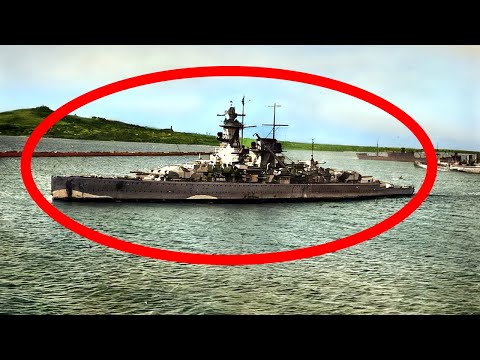
The Admiral Graf Spee was a Deutschland-class panzerschiff, a “pocket battleship” designed to outrun anything it couldn’t outgun and outgun anything it couldn’t outrun. Its six 11-inch guns dwarfed the 6- and 8-inch artillery of the British cruisers. It was like bringing a knife to a gunfight—but the British had a plan.
Commodore Henry Harwood, commanding the British force, had anticipated the Graf Spee would strike next near the River Plate, where heavy shipping traffic offered rich targets. He positioned his ships accordingly. When the German raider appeared, Harwood’s cruisers split into two groups: Exeter would engage from one side, while Ajax and Achilles flanked from the other, dividing the enemy’s fire.
At 6:18 a.m., the Graf Spee opened fire. Within minutes, Exeter took a devastating hit that knocked out one of her turrets and killed most of the bridge crew. The blast spared only the captain and two officers, leaving the ship temporarily leaderless. But the British didn’t flinch. Exeter pressed on, launching torpedoes, while Ajax and Achilles closed in from the other side.
Captain Hans Langsdorff, the Graf Spee’s commander, was a decorated veteran of Jutland. He had orders to avoid combat with warships, but now he was surrounded. His ship’s superior firepower should have been decisive, yet the British cruisers were relentless. Langsdorff veered and dodged, using smoke screens to obscure his position, but the British kept coming.
Exeter, battered and burning, was forced to withdraw. Ajax and Achilles fought on alone, their smaller guns peppering the German ship. A lucky hit started a fire on the Graf Spee, but the German guns roared back, knocking out Ajax’s rear turrets. With ammunition running low, Harwood ordered a retreat. The British cruisers fell back, but they didn’t leave. They shadowed the Graf Spee from a distance, waiting for reinforcements.
Inside the German ship, the situation was worse than the British knew. Over 60 hits had crippled the Graf Spee’s freshwater and oil purification systems. Its ammunition was nearly spent. Langsdorff realized he couldn’t make it back to Germany. He needed a safe harbor—and the neutral port of Montevideo, Uruguay, was the only option.
But Montevideo was no sanctuary. British diplomats, led by Eugen Millington-Drake, were already working to ensure the German ship couldn’t stay. Under international law, belligerent warships could only remain in neutral ports for 24 hours. Langsdorff pleaded for two weeks to repair his ship. The Uruguayans, sympathetic to the Allies, stalled.
Meanwhile, the British orchestrated a brilliant deception. They broadcast false radio signals suggesting a massive British fleet—including the aircraft carrier HMS Ark Royal and the battlecruiser HMS Renown—was converging on Montevideo. In reality, only the heavy cruiser HMS Cumberland was nearby, but the bluff worked. The Germans believed they were surrounded by a force they couldn’t hope to defeat.
As the deadline for departure approached, Langsdorff faced an impossible choice: take his crippled ship out to sea and certain destruction, or scuttle her. On December 17, 1939, the Admiral Graf Spee was towed into the River Plate estuary and blown up by her own crew. The first major naval battle of World War II was over—not with a dramatic clash of arms, but with a genius trap that caught Germany’s secret battleship without a single shot fired in its final moments.
The story of the Admiral Graf Spee was far from over. The political fallout would reach all the way to Adolf Hitler, and the fate of Captain Langsdorff would become a tragic epilogue to a remarkable tale of naval strategy and deception.
Hitler was furious. The scuttling of the Graf Spee was a humiliation he could not tolerate, and he summoned his naval commanders to the Reich Chancellery to vent his rage. “The surface fleet has failed me,” he reportedly snarled. “The pocket battleships were supposed to strangle Britain, not surrender to a handful of cruisers.” From that day forward, the Kriegsmarine’s surface raiders were sidelined. The future of the war at sea would belong to the U-boats, and the Battle of the Atlantic would become a far darker, more merciless campaign.
But the story of the Graf Spee did not end with the smoke rising from the River Plate estuary. In the days that followed the scuttling, Captain Hans Langsdorff was interned in Buenos Aires along with his crew. He moved through the city like a man already dead, his uniform immaculate, his eyes hollow. He wrote letters to his family, to his officers, and to the German ambassador. In one of them, he defended his decision: “I cannot fight against a superior force with a ship that cannot fight, and I will not let my crew be slaughtered for a lost cause.”
On the night of December 19, 1939, Langsdorff wrapped himself in the flag of the old Imperial German Navy—the flag he had served under at Jutland—and shot himself in his hotel room. He left behind a final letter addressed to his superiors, in which he accepted full responsibility for the ship’s destruction and asked that no blame fall on his men.
News of his death stunned both sides. British officers who had fought him at the River Plate sent wreaths to his funeral. The cortege wound through the streets of Buenos Aires, attended by thousands of German expatriates and, remarkably, by Allied servicemen who had come to pay their respects to a worthy adversary. It was a strange and somber moment in a war that was only just beginning to show its true brutality.
The crew of the Graf Spee scattered. Many chose to remain in South America, building new lives in Argentina and Uruguay. Others eventually made their way back to Germany, where they were greeted not as heroes but as reminders of a failure Hitler wanted to forget. The men who had once prowled the Atlantic, sinking merchant ships and outrunning the Royal Navy, faded into history.
Back in Britain, the victory at the River Plate was celebrated as a triumph of cunning over brute force. Commodore Harwood was knighted, and the crews of Exeter, Ajax, and Achilles were hailed as heroes. But Harwood himself was more measured. “We were lucky,” he later admitted. “If Langsdorff had pressed his advantage after Exeter withdrew, he might have sunk us both.” The battle had been won not by superior firepower, but by audacity, deception, and a willingness to take risks that bordered on recklessness.
Yet the strategic victory was even greater than the tactical one. The hunt for the Graf Spee had drawn British warships away from other theaters, but it had also convinced Hitler that surface raiding was too risky. The pocket battleships—the pride of the Kriegsmarine—were relegated to coastal defense and training duties. The Deutschland, renamed Lützow to avoid the humiliation of having a ship named after the Reich sunk, would see little action for the rest of the war.
The Battle of the River Plate was over, but its echoes would reverberate for years. It was the first time the Royal Navy had faced a German surface raider in open combat since Jutland, and it set the tone for the naval war that followed. The lessons learned—about deception, about the value of intelligence, and about the limits of even the most formidable warship—would shape Allied strategy for the rest of the conflict.
As for the Admiral Graf Spee itself, its wreck lay in the shallow waters of the River Plate, a rusting monument to a lost cause. Over the decades, salvagers would strip it piece by piece, until only a few fragments remained. But the story of the ship and its tragic captain would not be forgotten. In Montevideo, the memory of the Graf Spee lingered, a strange chapter in the city’s history, a time when the war came to South America’s doorstep and left behind a legacy of honor, deception, and sacrifice.
Yet even as the wreck corroded, one artifact refused to surrender to the mud. In 2006, a salvage team raised the Graf Spee’s massive stern eagle, its wingspan stretching nearly nine feet, the swastika beneath its talons still sharp after sixty-seven years underwater. The eagle became a lightning rod for controversy—a symbol of Nazi aggression or a piece of history to be preserved? Uruguay’s government eventually declared it a national treasure, but the debate over its display raged on, a reminder that the war’s ghosts still had claws.
The men who fought that day also carried their own ghosts. In 1956, veterans of HMS Ajax and the Graf Spee met in Montevideo for a reunion. Old enemies shook hands, shared stories, and drank to fallen comrades. One German sailor, tears in his eyes, told a British gunner, “You fought like lions. We never expected to survive.” The gunner, a young man no longer, replied simply, “Neither did we.”
Commodore Harwood died in 1950, never fully comfortable with the fame the battle brought him. He insisted the victory belonged to his crews, not to him. Captain Langsdorff’s grave in Buenos Aires became a pilgrimage site for those who saw him not as a Nazi but as a soldier trapped by duty and honor. His final act—choosing death over surrender—remained a subject of quiet debate among naval historians.
The River Plate itself continued to flow, indifferent to the drama that had unfolded on its waters. Ships still passed through, carrying cargo and passengers, oblivious to the phantom that once prowled beneath the waves. But for those who knew the story, the estuary held a secret—a ghost ship, a tragic captain, and a battle that proved even the mightiest warship could be undone by cunning and courage.
And so the tale of the Admiral Graf Spee passed into legend, a story told in pubs and classrooms, in history books and documentaries. It was a story of hubris and humility, of brilliance and betrayal, of men who fought for their countries and found, in the end, that honor had no nationality.
But the sea keeps its secrets, and the past is never truly buried. Somewhere in the muddy waters of the River Plate, fragments of the Graf Spee still wait—a turret here, a propeller there—silent witnesses to a war that changed the world.
What would you have done if you were Captain Langsdorff, caught between duty and destruction, with no way out and your crew’s lives in your hands?






