What if the past isn’t as distant as we think? What if the faces staring back at us from faded photographs hold secrets that could shatter our understanding of history? Brace yourself for a journey through time that will leave you questioning everything you thought you knew.
These are not your average history book images. They are raw, unfiltered glimpses into moments that were never meant to be seen—or were they? From the crippled man wearing leg braces in 1948 to two Armenian women posing with rifles before battle in 1895, each photo is a portal to a world both alien and eerily familiar.
Take, for instance, the portrait of male lovers from 1850 to 1950, a time when homosexuality was illegal. The defiance in their eyes speaks volumes, a silent rebellion against a society that would rather erase them. Or the angry kangaroo knocking out a woman trying to take its photo in the 1960s—a bizarre, almost comical moment frozen in time, yet somehow deeply unsettling.
These images are more than just curiosities. They are fragments of lives lived, of struggles and triumphs, of moments that shaped our world. And they are just the beginning.
Consider the Serbian soldier sleeping beside his father in 1915. A son and his father, bound by blood and war, sharing a moment of peace amidst chaos. The tenderness of the scene is juxtaposed with the harsh reality of their surroundings—a reminder that even in the darkest times, humanity prevails.
Then there’s the night prohibition ended, December 5th, 1933. The photo captures the raw energy of a nation letting loose after years of restriction. You can almost hear the cheers, the clinking of glasses, the collective sigh of relief. It’s a snapshot of liberation, a turning point in American history.
But not all these photos are celebratory. Some are haunting. The young girl with prosthetic legs in England, 1890 to 1910, stands as a testament to resilience. Her gaze is steady, unyielding—a child who has faced more hardship than most adults. And Hans Lang, a German World War I veteran in 1998, his weathered face etched with the memories of a war that changed the world forever.
These are the stories that history books often skip. The ones that make us uncomfortable, that challenge our perceptions, that force us to confront the uncomfortable truths about our past.
As you scroll through these images, you’ll find yourself drawn into a world that is at once foreign and familiar. Victorian women who never cut their hair, their locks cascading down like waterfalls of time. A circus strongwoman balancing a piano on her chest in 1920—a feat of strength that defies belief. Two girls posing with their snow fort in 1910, their smiles bright and innocent, unaware of the wars and upheavals that would soon sweep their world away.
And then there’s the woman charging her electric car in her garage in 1912. Yes, electric cars existed back then—a reminder that innovation is not a linear path, and that the past often holds solutions we’ve long forgotten.
These photos are windows into lives that were lived fully, passionately, and often painfully. They are reminders that history is not just a series of dates and events, but a tapestry of human experiences, each thread a story waiting to be told.
But why were these photos hidden? What secrets do they hold that some would rather keep buried? The answers lie in the details—the expressions, the settings, the subtle clues that hint at stories we’ve only begun to uncover.
Stay with us as we delve deeper into these rare and shocking historical photos. The past is never truly gone—it’s just waiting to be seen.
The Victorian women who never cut their hair—their cascading locks were more than vanity. In an era when a woman’s hair was considered her crowning glory, these lengths represented years of patient cultivation, a silent competition among sisters and neighbors. Some strands reportedly reached the floor, requiring maids to carry them during walks. Photographers of the day marveled at the logistics: how did they wash it? How did they sleep? The answers, lost to time, only deepen the mystery.
Then there’s Roland, the 4,000-pound elephant seal photographed in 1930. Imagine the sheer absurdity of the scene—a creature so massive that onlookers mistook him for a boulder until he moved. He was a local celebrity, drawing crowds who gaped at his blubbery bulk. Scientists of the era debated how such a beast could haul itself onto land, let alone survive. Roland, it seemed, defied all logic.
And what of the couple riding a Malvern Star abreast tandem bicycle in the 1930s? Side by side, pedaling in perfect unison, they were a rolling spectacle of romance and engineering. The bicycle was a marvel, designed to let lovers share the road as equals—no one trailing behind, no one leading. It was a quiet revolution on wheels, a small statement of partnership in a world still figuring out what equality meant.
But the photos that truly unsettle are the ones that blur the line between past and present. The man begging for his wife’s forgiveness in divorce court, 1946—his posture crumpled, his hands clasped, the desperation radiating from the frame. You can almost hear the judge’s gavel, the wife’s stony silence, the spectators leaning forward in their seats. It’s a scene that could play out in any courtroom today, a reminder that heartbreak is timeless.
Then there’s the homecoming prisoner in Vienna, Austria, circa 1946. A gaunt figure in a tattered coat, embraced by a woman who might be his mother, his wife, his sister—the ambiguity is the point. After years of war and captivity, he is a stranger in his own life, and the photo captures that fragile moment of reconnection, equal parts joy and grief.
And the winter fun in the old days—children sledding down a hill, their cheeks flushed, their laughter almost audible. It’s a scene so ordinary it feels radical, a reminder that joy persists even in the harshest conditions. The snow is deep, the sky is gray, but the children are radiant, oblivious to the hardships that surround them.
Hugo Gernsback, inventor of tele glasses, stares out from another frame. His contraption—a bulky headset with wires and lenses—looks like a steampunk vision of the future. He predicted a world where people would wear screens on their faces, where information would flow directly into the eye. He was ridiculed, dismissed as a fantasist. And yet, here we are.
Albert Einstein’s desk on the day he died. Papers scattered, a pen resting mid-thought, a chair pushed back as if he might return at any moment. It’s a haunting still life, a genius’s workspace frozen in the instant after his last breath. The photo doesn’t show Einstein himself—only the aftermath, the silence he left behind.
These images are not just relics. They are provocations, invitations to look closer, to ask harder questions. What were these people thinking? What were they hiding? And what do their secrets tell us about ourselves?
The answers, like the photos themselves, are waiting to be discovered—one frame at a time.
The Italian royal family, 1905—posed stiffly in their finery, the children’s faces betraying the boredom of standing still for the camera. Little did they know that their dynasty would crumble within a few decades, swept away by war and referendum. The photograph preserves them in amber, oblivious to their own extinction.
And the Eiffel Tower under construction—a skeletal lattice rising against the Paris sky, workers perched on beams hundreds of feet above the ground with nothing but nerve and balance to keep them alive. The tower was meant to be temporary, a shock to the sensibilities of artists who called it a monstrosity. Yet it became the city’s beating heart.
Teen boy covering a girl’s eyes in the 1940s—a playful gesture, maybe a surprise gift, maybe a prank. Her smile is genuine, unguarded. It’s the kind of moment that would be a throwaway snapshot today, but here it feels monumental, a tiny rebellion of joy against a decade defined by war.
Mount Rushmore before the presidential faces were carved—just raw granite, a mountain untouched by ambition or controversy. Looking at it, you wonder: what did the sculptor see in that blank rock? What did he erase to make room for the faces of presidents?
James Stewart enjoying a beach read with Valerie Varda—the Hollywood star relaxed, his guard down, a book in hand. It’s a rare glimpse of a celebrity at ease, far from the spotlight’s glare. The photo feels stolen, intimate, almost voyeuristic.
Queen Elizabeth II at eighteen years old—not yet queen, not yet burdened by the crown, just a young woman with a shy smile and a future she couldn’t possibly imagine. The weight of what was to come hangs over the image like a shadow.
Robert Earl Hughes, the heaviest person on record at 1,071 pounds, photographed between 1926 and 1958. His story is one of medical anomaly and human curiosity, a man whose body became a spectacle. He was reportedly gentle, kind, and endlessly patient with the crowds who came to stare. The photo asks us: who was the real curiosity—him, or us?
The Great Sphinx of Giza with a tail. Yes, a tail. The photo reveals a detail most people never notice, a remnant of the ancient sculptor’s vision that time has nearly erased. It’s a reminder that even the most iconic monuments hold secrets.
Ibn Saud, the first King of Saudi Arabia, in the early 1950s—his gaze is piercing, his posture regal, the desert behind him stretching to infinity. He forged a nation from tribal alliances and oil concessions, and the photo captures the moment when a kingdom was born.
Survivors of the Titanic disaster—huddled in blankets, their faces hollowed by shock. Some are smiling for the camera, a reflex born of relief. Others stare into the distance, seeing only the ice and the screams. The photo is a document of survival, but also of loss.
A stylish family outing, 1946—matching coats, confident strides, a family portrait taken on the street instead of in a studio. They look like they’ve stepped out of a magazine, yet the war is barely a year past. The photo is a declaration: we are still here, and we are beautiful.
The massive cables supporting the Golden Gate Bridge—thick as tree trunks, strung like harp strings across the bay. The engineers who designed them were called mad. The bridge, they said, would collapse. It didn’t. It became a symbol of American audacity.
Netflix and chill, 1912—a couple curled up with a book and a phonograph, the original binge-watching setup. The photo is a joke, of course, but it’s also a reminder that humans have always craved comfort, intimacy, and distraction.
Hong Kong in the 1920s—a city of contrasts, colonial buildings rising beside traditional Chinese shophouses, rickshaws sharing the street with early automobiles. The photo captures a world on the brink of transformation, a place that would become one of the most dynamic cities on Earth.
An Absaroka man on horseback, 1908—his face weathered by wind and sun, his horse steady beneath him. The photo is a portrait of a culture under siege, a way of life that was being erased even as the shutter clicked.
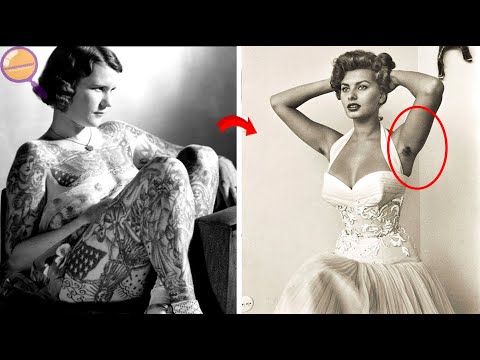
Maud Wagner, the first female professional tattoo artist in the US—her body a canvas of her own art, her expression defiant. In an era when tattoos were considered scandalous for women, she made them her livelihood. The photo is a middle finger to convention.
Formal portraits rarely featured smiles, 1912—the subjects look like they’re attending their own funerals. The reason? Early cameras required long exposures, and holding a smile for minutes was nearly impossible. The result is a gallery of grim faces that history has misread as misery.
The Oval Office without furniture—just an empty room, the presidential seal on the floor, the desk absent. It’s a strange sight, a seat of power stripped of its trappings. The photo reminds us that authority is constructed, not inherent.
The puddle jumper, 1934—a bizarre vehicle that looked like a car with wings, designed to hop over puddles. It never caught on, but the photo is a testament to human ingenuity, however misguided.
What a US dollar bill looked like in 1917—larger, more ornate, almost like a piece of art. The design has changed over the decades, but the symbolism remains: power, trust, and the promise of value.
The four boys, jamming, 1928—a quartet of musicians lost in their own world, their instruments worn, their faces intent. The photo captures the universal language of music, a bond that transcends time and place.
Vincent van Gogh’s painting palette—smeared with the colors of his genius, the wood stained with pigments he mixed himself. It’s a relic of a tortured mind, a physical link to the hand that painted ‘Starry Night.’
Female motorcycle officers, Los Angeles, 1927—leather jackets, confident stances, motorcycles gleaming in the sun. These women were pioneers, breaking into a male-dominated world with grit and style.
First class air travel in the 1960s—white tablecloths, silver cutlery, passengers dressed as if attending a gala. Flying was once an event, not a chore. The photo is a reminder of how far we’ve fallen.
Sisters Florence and Susie Fryermuth, 1921—their matching dresses and identical smiles suggest a bond that words can’t capture. The photo is a time capsule of sisterhood, a love that outlasts everything.
Robert Wadlow, the tallest man who ever lived—his height is staggering, his expression gentle. He towered over everyone, yet the photo reveals a quiet dignity, a man who carried his burden with grace.
A happy family taking home their book haul, 1940—arms full of volumes, faces glowing with anticipation. The photo is a love letter to reading, a reminder of the simple joy of a new story.
The end of the 13,000-mile Great Wall of China—a crumbling ruin where the wall meets the sea, the stones worn by centuries of wind and waves. The photo captures the melancholy of an empire’s end, the silence after the last watchman left his post.
A beautiful couple in Venice, 1890s—gondolas in the background, the woman’s dress billowing, the man’s arm around her waist. It’s a scene of pure romance, a moment of happiness frozen against the decay of the city.
Leonardo da Vinci’s painting, the most expensive ever sold—Salvator Mundi, the face of Christ staring out with an enigmatic smile. The price tag is staggering, but the photo reminds us that art’s value is not just monetary—it’s spiritual, historical, and deeply personal.
Montreal playgrounds were on another level, 1950s—children climbing on wooden structures that would be banned today for safety reasons. The photo is a testament to a time when risk was part of growing up, and scraped knees were badges of honor.
The interior of an airplane in 1925—wicker chairs, open windows, a sense of adventure that modern travel has lost. Passengers dressed in their Sunday best, as if flying were a sacred act.
Roller skating, 1930s—couples gliding hand in hand, the rink glowing with light. The photo captures the innocence of an era, a world on the brink of war but still able to lose itself in music and motion.
The world’s largest horse in 1930—a massive creature, its head level with the roof of a car. The photo is a reminder of the scale of nature, the awe it inspires, and the stories we tell about it.
A father helping his son feed a giraffe at the London Zoo—the boy’s hand outstretched, the giraffe’s tongue curling around the food, the father’s smile proud. The photo is a snapshot of wonder, a moment of connection between species.
The violin of Wallace Hartley, band leader on the Titanic—the instrument that played as the ship sank, a symbol of courage in the face of death. The photo is a relic of heroism, a reminder that music can be a form of defiance.
Little big man from the Netherlands, 1904—a man of small stature, his confidence larger than life. The photo challenges our assumptions about size and strength, reminding us that presence is not measured in inches.
The world’s oldest surviving photograph taken by Nicéphore Niépce in 1827—a blurry, ghostly image of a rooftop, the product of hours of exposure. It’s the first time a moment was captured and held, the birth of photography itself.
Hong Kong in the 1950s—a city rebuilding, refugees pouring in, the harbor crowded with boats. The photo is a portrait of resilience, a place that refuses to be defined by its past.
The Speyer wine bottle, the oldest known bottle of wine on Earth—sealed for centuries, the liquid inside a mystery. The photo is a reminder that some things are meant to be preserved, not consumed.
Children playing on a cart in Harlem, New York, 1920s—their laughter almost audible, the street their playground. The photo is a celebration of childhood, a reminder that joy can be found anywhere.
How the presidents on Mount Rushmore were originally planned to look—full-length figures, not just faces, a grand vision that was never realized. The photo is a glimpse of what might have been, a monument to ambition and compromise.
The elegance on the streets of New York City, 1928—men in fedoras, women in cloche hats, the sidewalks a runway. The photo is a fashion show frozen in time, a reminder that style is eternal.
A rare photo of 3-year-old Albert Einstein—a serious child, his eyes already holding a hint of the genius to come. The photo is a reminder that greatness starts small, in the most ordinary of moments.
A couple of Victorian travelers, 1890s—their luggage stacked high, their faces set for adventure. The photo is a tribute to the spirit of exploration, the courage to leave the familiar behind.
In 1907, Annette Kellerman was arrested for wearing this bathing suit—a form-fitting one-piece that scandalized the public. The photo is a milestone in women’s rights, a reminder that even clothing can be a battleground.
Host woman from the 1910s—her costume elaborate, her pose theatrical. The photo is a glimpse into a world of performance and fantasy, a time when escapism was a form of survival.
Gay Jewel, declared the world’s heaviest man in 1899—his size a spectacle, his humanity often overlooked. The photo forces us to confront our own prejudices, to see the person behind the label.
A man trying Coca-Cola for the first time, France, 1950—his expression a mix of curiosity and delight. The photo is a snapshot of globalization, a moment when an American icon conquered the world.
The nuclear bombing of Nagasaki, Japan, a view from the ground—the mushroom cloud rising, the destruction absolute. The photo is a warning, a reminder of the horror we are capable of.
Little girl getting water at the farm, Maine, 1942—a bucket in her hand, a chore that was part of daily life. The photo is a portrait of rural America, a world that has all but vanished.
Britain’s oldest door, built nearly 1,000 years ago in the 1150s—the wood worn smooth by centuries of hands. The photo is a link to the past, a reminder that some things endure.
Going to the beach with style, 1915—elaborate bathing costumes, parasols, a sense of decorum that seems absurd today. The photo is a comedy of manners, a reminder that fashion is always a product of its time.
Margaret Gorman, the first Miss America winner in 1921—her smile radiant, her victory a milestone for women. The photo is a celebration of beauty and ambition, a moment that changed the pageant world forever.
Welsh woman washing her mine-working husband, 1931—the coal dust running off his skin, her hands gentle. The photo is an intimate portrait of love and labor, a reminder of the sacrifices that built the modern world.
King Tut’s tomb, shortly after its discovery in 1922—the golden treasures gleaming in the torchlight, the air thick with history. The photo is a glimpse of the moment when the past roared back to life.
New York City, after a snowstorm, 1888—the streets buried, the city silent, the horses struggling through drifts. The photo is a portrait of resilience, a reminder that nature is always in charge.
Early morning wake-up calls, knocking on windows before alarm clocks—a man with a long pole, tapping on glass, the city stirring to life. The photo is a tribute to forgotten professions, the small cogs that kept the world turning.
Miss Perfect Posture Contest winners at a chiropractor’s convention, 1956—the women standing ramrod straight, their spines a source of pride. The photo is a curious artifact of a bygone obsession, a reminder that beauty standards are always shifting.
Thomas Wedders, the man with the largest nose in history, 7.5 inches—his face a curiosity, his dignity intact. The photo challenges us to look beyond the surface, to see the person behind the spectacle.
Photographer capturing the streets of London, 1929—a man with a camera, his eye pressed to the viewfinder, the city swirling around him. The photo is a self-portrait of the medium, a reminder that someone is always watching.
Abraham Lincoln’s second inauguration in 1865—a sea of faces, the president a tiny figure in the distance. The photo is a where’s-Waldo puzzle of history, a reminder that even the most important moments are made of countless small ones.
Carving the eye of Thomas Jefferson, Mount Rushmore, 1936—a worker dangling from a rope, his chisel poised. The photo is a tribute to human labor, the sweat and skill that shaped a monument.
Valentine Tapley, who never cut his beard again after 1896—the hair flowing like a river, a personal protest or a bizarre vow. The photo is a reminder that history is full of people who defied convention, sometimes for reasons we’ll never understand.
A woman standing while riding her motorcycle, 1920s—her balance perfect, her courage undeniable. The photo is a thrill ride, a moment of pure adrenaline frozen in time.
The real outfits worn by doctors treating plague patients in the 1600s—the beak-like masks, the long coats, the desperate attempt to ward off disease. The photo is a horror show, a reminder of a time when medicine was as terrifying as the illness.
Friends having a picnic 137 years ago—the blanket spread, the food simple, the laughter genuine. The photo is a celebration of friendship, a reminder that some things never change.
A rare view of the Statue of Liberty’s scalp from the torch—the copper strands, the rivets, the craftsmanship up close. The photo is a behind-the-scenes look at an icon, a reminder that even legends are made of ordinary parts.
Three sisters mounting horses, 1914—the women in riding habits, the horses restless, the bond between them palpable. The photo is a portrait of sisterhood and adventure, a moment of freedom before the world changed forever.
The Lincoln Memorial in 1907, before the Reflecting Pool, before the crowds—just a lonely marble temple in a marsh, waiting for history to arrive. It’s a reminder that monuments are built on faith, not certainty.
Then the Hershey factory workers, 1937—hands moving in rhythm, wrapping each chocolate by hand, a sweetness built on repetition. Behind every candy bar was a person, and the photo refuses to let us forget.
And the Titanic’s first-class lounge—the chandeliers, the carved wood, the elegance that sank beneath the waves. It’s the last calm before the unthinkable.
These photos ask us to look closer. What would they say if they could speak?
Which image will you never forget?






