In the predawn darkness of January 1968, at a forward operating base in Kontum Province, Vietnam, an Australian SAS scout stepped off a truck and into the heart of America’s most secretive war. He carried no fanfare, no lengthy introductions—just a kit bag and a quiet gaze that settled on the tree line like he was reading a familiar book. Within weeks, this man would do something no American on that team had ever seen, something that would make MACV-SOG refuse to give him back when Canberra asked.
The Americans at that base were the best of the best—MACV-SOG operators, trained to slip across borders that didn’t exist, to watch without being seen, and to come back alive. But lately, they weren’t coming back at all. Teams were vanishing into the jungle without a sound, without a radio call, without a trace. The NVA had learned to read the ground, to track American boots and soap and patterns, and they were picking off recon teams with terrifying precision. Something had to change.
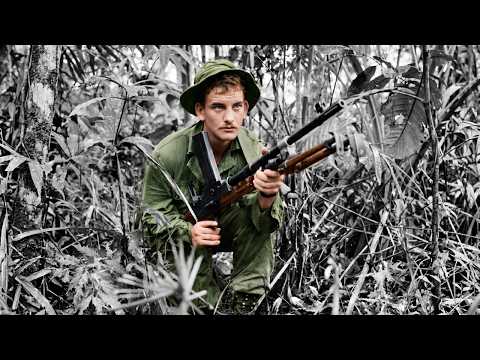
That something arrived in the form of a loan from the Australian Army Training Team Vietnam—a scout who moved like he belonged to the jungle. He asked only one question: “When do we go out?” Two days later, he led a four-man team into the hills, and what he did there would rewrite the rules of survival.
The Australian moved differently. He didn’t just cross the terrain; he conversed with it. Every few hundred meters, he’d pause, study a bent leaf or a smear of mud, and adjust course by a degree or two. The team leader noticed it within the first hour—how the Australian avoided the predictable corridors that previous teams had used, how he found paths that left almost no trace. By mid-morning, they were seven kilometers in, and the Australian had changed their route four times, each shift steering them clear of unseen danger.
Then, at 11:00, he stopped. Closed fist. The team froze. He crouched, stared at the soil near a tree root, and held up three fingers. Three people, ahead and right. Listen. For thirty seconds, there was nothing. Then, under the silence, a sound—the quiet shuffle of someone trying not to be heard. The Australian pointed left, and they moved. For forty minutes, he led them in a long curve around the threat, using a creek drainage to mask their tracks, leaving the NVA element behind without a single shot fired.
They reached an observation point that afternoon—a rocky shelf the Australian had deduced from drainage patterns before he could even see it. Three hours of watching confirmed the valley was a staging area. They extracted before dawn, clean and undetected. It was the first successful mission in that area in two months.
Back at base, the team leader wrote a debrief that went beyond standard language. He credited the patrol’s success directly to the Australian’s tracking and movement skills, noting that without them, the team would likely have walked into the NVA element. “Preventable,” he wrote—the near contact had been preventable because of one man’s ability to read terrain the rest of them couldn’t.
Within a week, there was a second patrol. Then a third. Each one returned complete, each one brought back intelligence that months of previous attempts had failed to produce. The base commander sent a request up the chain: he wanted the Australian’s attachment extended. He wanted to keep him. The paperwork traveled through channels, gathering weight with every report attached. And when Canberra finally asked for their man back, the Americans said no—not politely, but with a paper trail that said: We do not have what this Australian has. We cannot build it quickly. And we are not ready to give him back.
The request reached the AATTV commanding officer, who sat with it for a while. The decision wasn’t simple—it meant leaving one soldier inside a world where acknowledgment didn’t exist, where if something went wrong, his government couldn’t publicly say so. But the extension was approved. The Australian stayed.
He went out again and again. The debriefs kept coming, all saying the same thing in undecorated language: He moved like he understood an agreement the jungle had with people who paid attention. One team sergeant, a veteran of four SOG rotations, said he’d never worked with anyone like him—not faster, not louder, just different. Another American described how the Australian twice stopped the team and changed direction based on things no one else could see; both times, they later found signs of recent enemy presence. He said he tried to figure out what he’d missed and could only find one of the two things. The other remained a mystery—a testament to how long it took to build what the Australian had.
The Australian himself didn’t talk much about it. That was the SASR way: do the work, let it speak. But in quiet conversations between patrols, he admitted SOG was unlike anything he’d operated in before—not because of the soldiers’ quality, but because of the silence around it. In the Australian system, structures existed to account for you. Inside SOG, they existed but the acknowledgment didn’t. He carried that weight without adjusting his posture, and the Americans recognized it as their own.
What he built with those men went beyond skill. It was trust, forged in the dark of the jungle, in the shared knowledge that one man could read the ground and keep them alive. And when his rotation ended quietly—a vehicle, a kit bag, a flight—the Americans who survived carried what they’d learned. Some tried to teach it to others; most never fully succeeded. But they never forgot who first made them ask what a military truly needs to be.
The war ended. The files were sealed. The men came home to countries that weren’t ready to talk about what they’d done. But the assessment had already traveled through the channels that matter. By the time the Australian walked back through the gates of his regiment, the men whose job it was to know already understood the shape of it. He didn’t need to explain himself. The regiment didn’t need him to. That’s what it looks like when an institution and the people it built understand each other completely.
What the Americans said about him mattered—not because it needed an outside voice, but because it was true. They didn’t want to give him back. They said so in writing, in the specific language of men who knew what they were documenting wasn’t routine. They were right. A boy who learns to read the ground grows into a man who keeps four other men alive in a jungle on the other side of the world. The Americans who came home because of him put it in writing. That is what it looks like when a small country builds something right and sends it somewhere that matters.
But the story did not close with the closing of the files. The men who had patrolled with him carried the memory of those weeks into the rest of their lives, and some of them carried it into rooms where decisions were made about how America would train its soldiers for the next generation of wars.
One of those men, a captain who had commanded a recon team on the third patrol, later served a tour at the Special Warfare Center at Fort Bragg. He arrived with a notebook full of observations written in his own hand, and he began asking questions that his instructors had never been asked before. Why, he wanted to know, did the army teach a soldier to read a map but not to read a mud bank? Why did the training pipeline spend weeks on radio procedure and almost no time on the language of broken stems and compressed leaves? The questions made people uncomfortable. They were not the questions a captain was supposed to ask.
He did not win those arguments in 1969. The institutional weight of the American military leaned toward technology and firepower, and the lessons of one Australian scout in one province of Vietnam were not yet the kind of thing that changed a curriculum. But the notebook did not disappear. It was copied, passed along, and cited in informal settings where men who had been there talked to men who were about to go.
What the Australian had demonstrated, in the plainest terms, was that the gap between a good patrol and a compromised one was often measured in a single decision made by a single man reading a single patch of ground. That was not a lesson that could be institutionalized easily. It was a lesson that had to be lived.
There was another dimension to what he left behind, one that the Americans did not fully appreciate until years later. The Australian had not only read the ground—he had changed the way the NVA read them. For months, the enemy trackers had been finding SOG teams because the teams moved in patterns the trackers had learned. The Australian broke those patterns. He moved the teams through ground that had never been used, at times that had never been predictable, in ways that left traces too faint to follow.
The result was not just a series of successful patrols. It was a shift in the entire calculus of the reconnaissance war in that sector. The NVA, who had grown confident in their ability to find and destroy SOG teams, found themselves suddenly blind. Teams that should have been compromised were extracting clean. Corridors that should have produced contact were silent. The enemy’s advantage, built over months of patient observation, evaporated in a matter of weeks.
That shift did not go unnoticed. It could not. When a pattern of losses suddenly reverses, the people on the other side of the pattern notice, even if they never understand exactly why. The NVA trackers kept working, kept watching, kept trying to read the ground. But the ground had stopped talking to them in the language they knew.
The Australian never knew the full extent of what he had accomplished. He was not the kind of man who sought out that knowledge. He had done his work, passed along what he could, and gone home. But the men who had served with him knew. They had seen the before and the after. They had watched teams disappear into the jungle and not come back, and then they had watched teams go out and return, mission complete, undetected. The difference was one man, and they knew it.
When the extension finally ended—when the paperwork had run its course and the Australians had made it clear that their man was needed elsewhere—the Americans did not let him go quietly. There was no ceremony, no medal pinned to his chest in front of a formation. That was not how SOG operated, and it was not how the Australian would have wanted it. But there were words, spoken in the way that men who have shared danger speak to each other, and those words carried weight.
The base commander, a man who had sent more teams into the jungle than he cared to count, shook his hand and said something that the Australian would remember for the rest of his life. He said that in all his years of command, he had never seen one man change the outcome of an operation the way this Australian had. He said that the teams that came back were coming back because of him, and that the men who had served with him would carry that knowledge into every patrol they ever ran.
The Australian nodded. He did not say much. He never did. But he understood what the commander was telling him, and he understood that it was true. He had done what he had been trained to do, what his regiment had prepared him for across years of deliberate investment in a skill that most armies did not even know they lacked. He had read the ground, moved without being read, and kept his teammates alive.
He boarded the vehicle that would take him away from Kontum, away from the jungle that had tried to kill him and the men who had become his brothers in the dark. He did not look back. There was no need. The jungle would still be there, and so would the men he had served with, and the knowledge he had passed along would travel with them into whatever came next.
The war would go on for seven more years. More teams would go into the jungle. More men would not come back. But in that sector, in that province, in that specific stretch of hills and valleys and creek drainages, something had changed. The NVA had lost their edge. The Americans had found a way to move without being found. And one Australian scout had shown them how.
Years later, a declassified SOG after-action review surfaced in the archives—one line buried in an appendix, written by a major who had never met the Australian but had read every report. “The enemy’s tracking network in Kontum Province suffered a measurable degradation in effectiveness during this period. Cause unknown.” Cause unknown. The men who were there knew better.
The Australian never read that line. He was back in his regiment, training the next generation, saying nothing about Kontum. But the men he trained moved differently, and the men they trained after that moved differently still.
That is how a small country’s investment travels—quietly, across decades, through hands that never knew whose hands came before. The jungle kept its agreement with the men who paid attention. And the Americans never stopped asking the question he had planted in them.
What do you think—was it the man, or the decade of training behind him, that made the difference?






