The photographs lie. They are too still, too quiet. They capture a frozen instant—a landing craft caught in the surf, a soldier crouched behind a steel obstacle—and they tell you nothing about the roar, the cold, the smell of diesel and vomit and fear. To understand Omaha Beach, you cannot look at the images. You have to step into them.
It began before dawn, in a grey Atlantic swell that turned men’s stomachs inside out. Thousands of them—boys from Iowa, Brooklyn, and the hollows of Appalachia—crammed into flat-bottomed boats, bailing water with their helmets, praying to gods they’d ignored back home. They had been told the bombers would soften the beach. They had been told the resistance would be light.
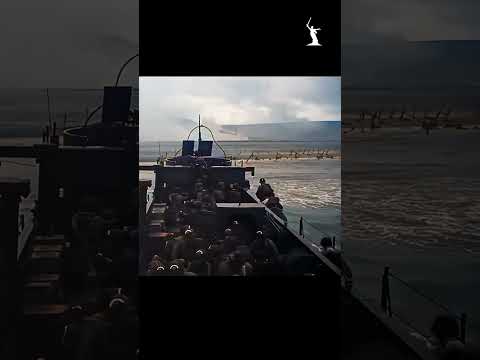
Neither was true. As the ramps dropped, the world ended.
Machine-gun fire tore through the surf. Mortar shells walked across the sand in lazy, lethal arcs. “Men were falling everywhere. You couldn’t take two steps without stumbling over a body,” one survivor would later whisper, decades on, his eyes still fixed on something no one else could see.
The first wave was cut down before it reached dry land. Those who survived did so by luck—a jammed rifle, a wave that came at the right moment, a sergeant who screamed at them to move, move, move. The beach became a slaughterhouse with no walls, and the tide kept rising, drowning the wounded where they lay.
But here is the part the photographs never show: the moment the tide turned was not a grand charge. It was small. Desperate. Human.
A handful of men—rangers, engineers, ordinary infantry—began to crawl forward through the wire and the dead. They blew gaps in the obstacles with whatever charges they had left. They climbed the bluffs one bloody yard at a time. “Two kinds of people are staying on this beach,” a colonel reportedly barked. “The dead and those who are going to die. Now let’s get the hell out of here.”
And they did. Slowly. Terribly. But they did.
What happened in those six hours on Omaha Beach would echo through every family in America—and through the entire century that followed. But to understand why, we have to go back to the beginning: to the men in the boats, the cold water, and the long silence before the ramps went down.
The silence was not truly silent, of course. It was filled with the thrum of the engines, the slap of the hull against the chop, and the low murmur of men who had nothing left to say to each other. Some kissed rosaries. Some vomited over the side and wiped their mouths with the backs of their hands. Some just stared at the grey horizon and thought about their mothers’ kitchens, their girlfriends’ letters, the dog they’d left behind.
They were not born soldiers. They were made into them by the weight of the moment. “I was nineteen years old,” one veteran recalled. “I didn’t know anything about anything. I just knew I had to keep moving forward, or I’d die.”
The boats pitched and rolled. The men in them were soaked to the bone, shivering in the cold salt spray, their rifles heavy and unfamiliar in their hands. They had been trained for months, drilled until the motions were automatic, but nothing could have prepared them for what waited on that strip of French sand.
As the first light crept across the sky, the bombardment began—a distant, rolling thunder that promised safety. The men cheered. They believed, for a few precious minutes, that the worst was over before it had begun.
Then the ramps went down, and the truth arrived with the water.
The first man out of one boat was cut in half by a machine-gun burst before his boots touched the sand. The second fell backward into the surf, his helmet spinning away on the current. The third made it three steps before he dropped. “It was like walking into a wall of fire,” another survivor said. “There was nowhere to hide. Nowhere to go but forward.”
Many never made it off the boats. The ramps that were supposed to deliver them to safety became the mouths of ovens. Men drowned under the weight of their own packs, their lungs filling with seawater as they struggled to shed their equipment. The lucky ones died quickly. The unlucky ones lay in the shallows, bleeding out with the tide creeping higher, listening to the screams around them.
And still, the boats kept coming. Wave after wave, each one carrying more boys into the meat grinder. The beach was a chaos of smoke and fire and water, and the only way out was through.
It was in that hell that the first small acts of heroism began to surface—not the kind written about in history books, but the kind that happens when men have nothing left to lose.
A medic knelt in the surf beside a boy whose legs had been shredded by shrapnel, packing the wounds with sulfa powder while bullets snapped the water around them both. He worked with shaking hands and a steady voice, murmuring words of comfort that neither of them believed. When the boy was gone, he simply moved to the next one.
Others did what they could with less. A private who had lost his rifle picked up a fallen comrade’s and kept going. A sergeant dragged three wounded men behind a steel hedgehog, one by one, his own arm hanging useless at his side. “You don’t think about being brave,” he would say later. “You think about the fella next to you. You think about not letting him down.”
The tide was the enemy now, as much as the guns. It rose inch by inch, swallowing the wounded where they lay and forcing the living higher up the beach, into the teeth of the defenses. Men who had been pinned behind cover for hours suddenly found the water at their heels and had no choice but to run.
Some ran toward the bluffs. Some ran back toward the sea. Most simply ran, and many of them fell.
Then, somewhere along the shattered line, a gap was blown in the wire. An engineer named Lenny—a wiry kid from Philadelphia who had lied about his age to enlist—crawled forward with a satchel charge and pressed it against a concrete bunker. The explosion threw him backward, deafened and bleeding from both ears, but when the smoke cleared, the guns inside were silent.
It was not a victory. It was a hole. But a hole was enough. Men began to pour through it, climbing the bluff in ones and twos, using roots and rocks and the bodies of the fallen as handholds. They reached the top gasping, filthy, half-mad with fear—and found the German trenches empty, the defenders already pulling back.
Word spread along the beach like a fever. “They’re giving way! The bastards are giving way!” It was not true everywhere, not yet, but it was true enough. The line that had seemed unbreakable began to bend.
By midday, the beach was still a graveyard, but it was a graveyard with a road through it. Vehicles were grinding up the bluffs. Medics were carrying stretchers in something like an orderly fashion. A colonel stood at the water’s edge with his helmet gone and his face black with cordite, directing traffic as calmly as a policeman on a city corner.
And out on the grey water, more boats were coming. More boys from Iowa and Brooklyn and the hollows of Appalachia, their stomachs turning, their hands cold, their letters home folded in their breast pockets.
They did not know what waited for them. They could not have known. But the men already on the beach—the ones who had lived through the morning—turned back toward the sea and waved them in.
The photographs never show what came next. The long, slow horror of the afternoon. The snipers still hidden in the hedgerows. The wounded who died on the sand after the tide had already taken their boots. “We held the beach,” a survivor said, “but the beach held something of us, too.”
By nightfall, the guns had mostly fallen silent. Not from peace, but from exhaustion. Men lay in foxholes they had dug with their hands, too tired to eat, too shaken to sleep. Some wrote letters by the light of burning vehicles. Some stared at the stars and tried to remember what their own names sounded like.
Lenny the engineer never heard the end of the war. He died three weeks later in the hedgerows, shot by a sniper he never saw. The sergeant with the useless arm made it home to Ohio, where he lived another fifty years and never once spoke of Omaha Beach to his children.
The medic who had knelt in the surf survived the day, but not the war. He was killed in the Ardennes that winter, tending to a wounded man in the snow. “He was the bravest man I ever knew,” a comrade wrote to his mother, “and he never fired a shot.”
Omaha Beach was taken. The cost was written in the sand, in the surf, in the letters that never got mailed. But the men who lived through it carried something back with them—a silence that never fully lifted, a brotherhood that never fully faded.
They were not born heroes. They were made into them by a single morning on a strip of French sand. And when they finally went home, they did not talk about it. They just lived. Quietly. Gratefully. For the ones who couldn’t.
So the next time you see one of those old photographs—the frozen, quiet ones—look closer. Look past the still faces and the grey water. Look for the boy from Iowa, the kid from Philadelphia, the sergeant from Ohio. They are there. They are always there.
And ask yourself: what would you have done, if the ramp had dropped for you?






