By March 1945, the Japanese defenders of Iwo Jima were certain they had solved the American Marine. They had abandoned the banzai charge and instead vanished into the rock—21,000 men buried in 11 miles of tunnels and 1,500 caves, bunkers, and pillboxes. “You could not shoot them and you could not shell them out,” one Marine later recalled. Every assault on a cave mouth met interlocking machine-gun fire, and the island was bleeding the invasion white. The defenders believed they were untouchable in the dark.
What nobody warned them about was the bulldozer.
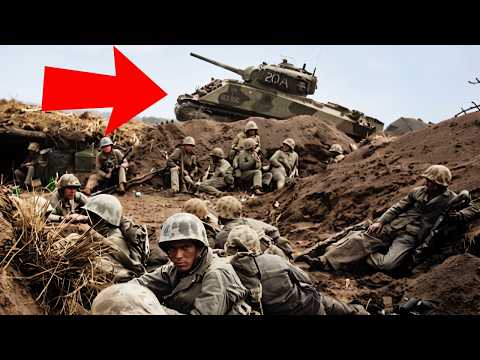
The Navy had landed armored Caterpillar D8s on that black sand, and the men driving them were not coming to pull the defenders out. They were coming to seal them in.
To understand the trap, you start with the man who built it. Lieutenant General Tadamichi Kuribayashi had lived in the United States in the 1920s. He had ridden trains across the country and counted the factories along the way. He knew exactly how much steel America could throw at a beach, and he knew he could not stop it at the waterline.
So he did something almost no Japanese island commander had done before him. He forbade the banzai charge—that headlong suicide attack that had thrown away so many garrisons before. He ordered his men underground instead and told them to survive and keep killing Americans for one more day, one more hour.
His engineers turned Iwo Jima into a fortress you could not see. Eleven miles of tunnels, some 75 feet down, connecting 1,500 rooms, gun chambers, hospitals, and command posts, all cut into soft volcanic stone and lined with concrete. On Mount Suribachi alone, there were a reported thousand cave mouths and firing positions. Every one of them covered another.
When a Marine rushed a bunker, a second bunker he never saw opened up on his back, and the position he had just cleared quietly filled again with men crawling up through the tunnels behind him.
On the 23rd of February, near the first airfield, Corporal Hershel Williams of the 3rd Marine Division walked straight into that problem. The Sherman tanks could not find a lane through the pillboxes and the buried mines. So Williams went forward almost alone, a flamethrower on his back and demolition charges in his hands, covered by only four riflemen.
For four hours, he crawled from one concrete box to the next, at one point climbing on top of a pillbox to pour fire down through its air vent. He came out of it alive, and he came out of it with the Medal of Honor. Most men sent to do that kind of work did not come out at all, and there were more than a thousand of those positions still to go.
This was the arithmetic that was quietly strangling the Marines. Doing it Williams’ way—one man and one flamethrower against one cave at a time—they would run out of Marines long before Kuribayashi ran out of caves.
On the 26th of February, in the tangle of ridges the men had started calling the meat grinder, a single rifle company—Charlie Company of the 3rd Battalion, 23rd Marines—lost 17 killed and 26 wounded in about half an hour. Ground taken by daylight was lost again after dark when the defenders climbed back up through the rock.
The island needed a different kind of weapon, and it came from an unlikely direction—not from the infantry at all, but from the Navy’s own construction crews. The Navy called them Seabees, from the initials of the Naval Construction Battalions, and their motto fit the men who carried it: “We build, we fight.”
They had come to Iwo Jima to bulldoze airfields and cut roads, but the bulldozer had already shown, more than a year earlier, that it could do something the manual never mentioned.
Back in November 1943, on Treasury Island, a Seabee named Aurelio Tassone had driven his dozer straight at a Japanese pillbox while an officer walked beside the tracks firing a carbine to keep the gunners’ heads down. Tassone dropped the blade and crushed the position with every man still inside it. He was given a Silver Star for it.
The idea was loose in the fleet now. In the right hands, a bulldozer blade could do the work of a demolition charge, and the dirt in front of it became a weapon.
The machine the Seabees brought north to Iwo Jima was the Caterpillar D8, a 15-ton diesel tractor that outmuscled anything the Marines owned. On the deep black sand of the island, it was worth its weight in gold because trucks and lighter tractors simply sank into the ash and stopped.
But an ordinary dozer put its driver up in the open on a bare steel seat, in plain view of every mortar crew and cave gunner on Iwo. So before the landing, the Navy’s beachmaster, Captain Carl Anderson, had his people bolt steel plate around the operators, shielding the driver and the engine both.
The armored bulldozer was born out of nothing grander than a traffic problem on a beach. It would finish the war doing something none of its designers ever put on a drawing.
On the 19th of February, D-Day on Iwo, the first dozers came down the ramps into pure chaos. Pre-registered mortar fire walked up and down the terraces, timed to the yard. Vehicles bogged in the ash and died where they stopped.
And a few yards away, into that same fire, Corporal Tony Stein of the 5th Marine Division was already showing what this island was going to cost. Stein had built himself a machine gun out of the wreck of a fighter plane, and he used it to knock out one pillbox after another, running back to the beach eight separate times for more ammunition and carrying a wounded man out on every trip. He would be dead within two weeks.
Behind him, the armored dozers kept grinding the exits open so the tanks could get off the sand at all.
Cutting beach exits, though, was the simple part. The real fortress was north, where Kuribayashi’s defense ran deep into the high ground. And up there, over the following weeks, the Marines slowly built the machine that would finally break it.
It was run in careful sequence, and it took the killing off the infantry and handed it to steel.
It worked like this: First, an armored bulldozer or a tank dozer—a Sherman with a blade fitted across its nose—ground a path right up to the position while riflemen and tanks kept the defenders’ fire down. Then a flame tank rolled into the gap. These were Shermans built in Hawaii with a flamethrower fitted where the main gun used to sit. The men on the line just called them the Zippos.
They threw a rope of thickened burning fuel 150 yards straight into a cave mouth or a firing slit. Nothing on the island frightened the defenders more. One tank battalion’s after-action report, written cold once the fighting was done, put it in a single flat line: “The flamethrower was probably the most valuable single weapon employed at Iwo Jima.”
After the flame came the engineers with their charges, and after the engineers came the dozer again, burying the entrance under rock and ash until the mouth of the cave simply was not there anymore.
On one single day in the 5th Division’s zone, demolition teams blasted and sealed 68 caves. Set that against what the same ground cost a rifle company doing it the old way, and you can see the trade the Marines had found. The machines were spending rock and fuel where the infantry had been spending lives.
The Seabees did not only drive the machines either. On this island the construction men picked up demolition charges and went into the ground themselves. One outfit, the 8th Naval Construction Battalion, put together a 20-man team the Marines nicknamed the tunnel rats and sent them down into bypassed caves to finish what the assault waves had left behind, clearing the dead ground behind the front so the airfields could be rebuilt while the battle still burned in the north.
On Suribachi, where the flag went up on the 23rd, engineers of the 5th Engineer Battalion had worked their way along the base of the mountain, sealing cave after cave. In that one volcanic cone, nearly 2,000 defenders were killed or sealed inside the roughly 1,000 caves that honeycombed the rock.
Then came the worst ground on the island. The far north funneled down at last into a single gorge below a spur called Kitano Point—a slot of broken rock about 200 yards wide and 700 yards long. This was Kuribayashi’s final command, dug in so deep that shellfire was nearly wasted on it.
There was no clever way through it and no way around it. There was only the method, repeated foot by foot, up a corridor of stone that the defenders had ranged in perfectly.
So in the last week of the battle, the 5th Marine Division borrowed the armored bulldozers back from the beach parties and drove them up into that gorge. The official Marine history is blunt about why the dozers could do their work there at all. The operators, it records, “were protected from the still heavy fire of last-ditch Japanese defenders.”
Behind their steel plate, the CBs cut the paths, the Zippos burned out the mouths, and the blades came down and buried whatever was left.
On the 21st of March, the Marines brought Kuribayashi’s command cave down on top of him with a 4-ton demolition charge. Three days later, they sealed the last positions at the northern tip of the island.
On the night of the 25th of March, when the island was all but finished, a last force of roughly 300 Japanese gathered in the dark and threw itself at the airfield bivouacs. This was no wild banzai rush. It was organized and it was silent until the end, and it killed and wounded well over 100 Americans—Seabees and pilots and pioneer Marines among them—before it was cut down in the gray light. Some believe Kuribayashi himself died leading it. His body was never found.
On the morning of the 26th of March, 36 days after the landing, Iwo Jima was declared secure.
Because there is a harder half to this story, and it is the half the title does not tell you. Underground, the men Kuribayashi had ordered to hold on were dying by inches. Sulfur fumes filled the lower chambers, the water ran out, and men licked the damp from the cave walls to stay alive one more day. The wounded lay in the dark with no aid coming. In the deepest chambers, the smell of the dead never cleared.
Colonel Baron Takeichi Nishi, the Olympic gold medal horseman who had brought a tank regiment to the island, watched that regiment melt from more than 400 men to about 60, and he would not survive the final week. The Marines sent captured soldiers back toward the caves with a radio pleading with the defenders to come out. Almost none of them did.
Kuribayashi had seen where all of it was heading for a very long time. In a letter home, while his men were still carving the tunnels that would become their grave, he asked one quiet question: “Am I digging my own grave?”
The popular version says the Seabees simply drove their bulldozers into machine-gun fire and buried thousands of Japanese alive. The first half is close to the truth—armored dozers did work under fire, and that is why they wore the steel. But they almost never charged a gun alone. They worked inside that patient sequence: path, flame, seal, with infantry and tanks shielding them the whole way. Take that cover away and the operator is dead inside the first minute.
The second half is where the drama runs ahead of the record. Thousands were sealed into that rock—that much is real. But many were already dead when the entrance came down. Many more were killed by flame or demolition in the seconds before the roof fell. Some caves had a second and third exit, so closing one mouth trapped nobody at all.
The honest truth is quieter and somehow worse. This was not one savage act in the heat of a fight. It was a deliberate, patient, almost industrial process of ending a garrison, chosen precisely because the alternative was feeding Marines into the dark for weeks.
And the machines were never invincible. On the soft ash the great dozers still bogged down and had to be dragged out by other dozers. The steel plate turned rifle rounds and shell splinters but did nothing against a direct hit from a heavy mortar or a buried mine. One CB unit alone, the 133rd Naval Construction Battalion, took 245 casualties on Iwo Jima—the heaviest loss any CB battalion suffered in the whole history of the force. When the presidential unit citation was awarded, the construction battalion that had bled with the Marines was left off it. Most people have never once heard its name.
The method they ground out on Iwo—first the path, then the flame, then the seal—went straight to Okinawa only weeks later, and its shadow reached forward into every tunnel war America has fought since. The airfields those men bled for became emergency runways for crippled bombers limping home from Japan. The old claim was that those runways saved 24,000 airmen. Later historians pushed back hard on that number. What is not in dispute is the price: almost 7,000 Americans killed, more than 19,000 wounded—the one battle in the Pacific where the Americans lost more men than the Japanese they fought.
But go back to the beginning, to the defenders who were certain the dark had made them untouchable. They were half right. For the most part, the Marines never came into those caves to fight hand-to-hand. They sent the machines to do it and closed the dark over them for good.
Iwo Jima is Japanese ground again today, treated as a war grave. Of the roughly 22,000 men who defended it, about 12,000 were never recovered. They are still inside the island behind the sealed rock, exactly where the blades left them. Kuribayashi wondered in that letter home whether he was digging his own grave. In the end, he was digging it for 20,000 men—and the last sound many of them ever heard was the growl of an engine and a steel blade closing the mouth of the cave.
So here is the question worth asking: if the bulldozer saved Marine lives by sealing men in the dark, was it a weapon of mercy or a machine of slow burial—and does the answer change depending on which side of the blade you stood?






