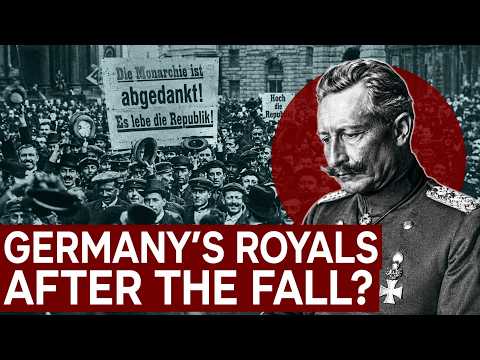
On the morning of November 9, 1918, Kaiser Wilhelm II paced a Dutch train platform, clutching a cup of English tea, while his empire dissolved behind him. The most powerful man in Europe had fled to the Netherlands as Germany erupted in revolution—and he still thought he could keep his crown.
He was wrong. Within hours, his own chancellor announced his abdication without his consent. “The monarchy was dead twice over before its occupant had even agreed to leave.” Wilhelm signed the formal document three weeks later, in a borrowed castle, ending 500 years of Hohenzollern rule with a pen stroke.
But the Kaiser didn’t vanish. He shipped 23 to 64 train carriages of treasures to Holland—baroque paintings, Meissen porcelain, Frederick the Great’s snuff boxes—and settled into a 24-room manor called Huis Doorn. There, he chopped wood obsessively, wore military uniforms daily, and waited for a restoration that never came. His second wife, Hermine, urged him to see Hitler as the vehicle back to the throne.
Meanwhile, Germany’s 22 monarchies collapsed like dominoes. King Ludwig III of Bavaria fled Munich; his dynasty had ruled for 738 years. King Frederick Augustus III of Saxony abdicated with a shrug, and his son became a Jesuit priest who later protected Jews from the Nazis. In Württemberg, the last king held out until November 30th, then died quietly in 1921, forgotten.
The Weimar Republic abolished noble titles as legal status—they became elaborate surnames. But the real fight was over money. Palaces, art, and land blurred the line between crown and private property. A 1926 referendum to expropriate the princes failed, forcing the republic to negotiate. The Hohenzollerns cut a deal: they kept vast estates and art collections, while the state got Cecilienhof Palace—but the Crown Prince retained residency rights for three generations.
The Wittelsbachs of Bavaria did even better. Their 1923 compensation fund, revealed decades later, held assets worth €421 million by 2017, paying the family an average of €13.7 million annually. A democratic state was bankrolling a dynasty it had abolished a century earlier.
But while the Wittelsbachs stayed dignified, the Hohenzollerns gambled. Crown Prince Wilhelm returned to Germany in 1923 and openly schemed to undermine the republic. He endorsed Hitler for president in 1932, stood beside him at the Day of Potsdam in 1933, and even posed in a stormtrooper uniform. “Please be assured that I stand in line with all German comrades,” he wrote to Hitler in 1936. Hitler had no intention of restoring the monarchy—he was using the prince for legitimacy.
The exiled Kaiser watched from Doorn, his anti-Semitic letters revealing a bitter man searching for scapegoats, even as he expressed outrage at Kristallnacht. He died in 1941, his coffin still waiting for a restoration that would never come.
After the war, the Hohenzollerns lost everything east of the Elbe to Soviet expropriation. Crown Prince Wilhelm died in a five-room house in 1951. His grandson, Georg Friedrich, born in 1976, inherited a century-old legal battle—and a family name that still opens doors and raises eyebrows.
Georg Friedrich grew up in a modest apartment in Bremen, raised by his mother, Princess Donata, after his father’s fatal accident. He studied business, worked for a publishing house, and for years lived a life so ordinary that colleagues had no idea their quiet coworker was the heir to the German throne. But the name followed him. Every interview, every handshake, every boardroom introduction carried the weight of five centuries.
Then came 2014, when he formally filed the claims his grandfather had begun. The demand was staggering: Cecilienhof Palace, 266 paintings, the imperial crown, and cash. The legal foundation was the 1994 compensation law—but the exception clause about “substantial support to the Nazi regime” turned the case into a historical reckoning.
Four historians testified before the Bundestag. Three concluded Crown Prince Wilhelm had considerably abetted the Nazis. The fourth, Christopher Clark, called him a “political lightweight” and a “twit” whose influence was marginal. The satirist Jan Böhmermann mocked Georg Friedrich as “Prince Dumb” on national television. A petition titled “No Gifts for the Hohenzollerns” gathered tens of thousands of signatures.
But the negotiations dragged on behind closed doors for over a decade. And in May 2025, a settlement finally emerged: some 27,000 objects—Cranach paintings, Baroque ivory furniture, Frederick the Great’s dinner services—would be transferred to a new charitable foundation, the Stiftung Hohenzollernischer Kunstbesitz. The art would stay in public museums. A nine-member board, three Hohenzollerns and six state representatives, would oversee it.
It was a compromise, not a victory. The family didn’t get Cecilienhof. They didn’t get to move back into the palaces their ancestors built. But they got a seat at the table—a formal role in managing their own legacy. Culture Minister Monika Grütters called it “an enormous success for Germany’s heritage.” Georg Friedrich said his goal had always been to preserve the collection and keep it accessible to the public.
At the very end of 2025, a separate deal landed quietly: Georg Friedrich acquired full ownership of Hohenzollern Castle in Swabia, the family’s ancestral seat perched on an 855-meter peak, after the head of the Swabian branch transferred his one-third share. The castle, a major tourist attraction, now belongs to him outright—a tangible link to a dynasty dating back to 1061.
Meanwhile, the Wittelsbachs continued their quiet, dignified existence. Franz, Duke of Bavaria, born in 1933, has spent his life avoiding controversy while his family’s compensation fund keeps paying out millions annually. Their fairy-tale castles—Neuschwanstein above all—remain among Europe’s most visited attractions. In Bavaria, monarchist sentiment survives as nostalgia, not politics.
Other dynasties fared differently. The House of Thurn und Taxis became tabloid fodder in the 1980s through Princess Gloria, dubbed “Princess TNT.” The House of Saxe-Coburg and Gotha’s German branch was tainted when Duke Carl Edward became an ardent Nazi and president of the German Red Cross under Hitler—he was tried, fined, and stripped of his British titles after the war.
Every June, a small group of monarchists still gathers at Huis Doorn. They lay wreaths at Wilhelm’s mausoleum, march in period uniforms, and pay respects to a world that ended over a century ago. The coffin of the last German emperor still sits in that little chapel, draped in an Imperial flag, waiting for a restoration that will never come.
And in Germany today, the descendants of these fallen houses occupy a strange position: no official role, no constitutional power, their titles reduced to elaborate surnames. Yet the names still carry weight—in business, in culture, in the endless legal battles over what the past owes the present.
Georg Friedrich’s eldest son, Carl Friedrich, born in 2013, is technically heir to a throne that no longer exists. He will grow up in a united Germany, carrying a name that once commanded armies—and now mostly commands curiosity. The question that lingers is not whether the monarchy will return. It won’t. The question is what a dynasty does when its purpose is gone, and whether the answer is dignity, compromise, or something far more uncomfortable.
But the settlement of 2025 did not close the book. It merely turned a page. Within months, a new front opened—this time not in Potsdam or Berlin, but in the quiet courtrooms of Thuringia and the dusty archives of Saxony-Anhalt, where smaller houses were quietly filing their own claims under the same 1994 law.
The House of Wettin, whose kings had ruled Saxony for over 800 years, had long since retreated from public view. Yet behind the scenes, lawyers representing the family had been assembling a case involving thousands of artworks, forest holdings, and at least three palaces seized by the Soviets in 1946. Unlike the Hohenzollerns, the Wettins had no Nazi-era scandal hanging over them—and they knew it.
Their strategy was simple: stay silent, stay patient, and let the Hohenzollern controversy burn itself out. While Georg Friedrich faced television cameras and satirical mockery, the Wettin lawyers worked methodically through property registers and restitution files, filing claims that rarely made headlines.
Then there was the strangest case of all—the House of Saxe-Coburg and Gotha. The family whose name had once adorned the British royal house, before it was rebranded Windsor in 1917, found itself in an awkward position. Duke Carl Edward’s Nazi past had discredited the German branch for generations. But his grandson, Andreas, born in 1943, had spent decades quietly rebuilding the family’s reputation, cultivating relationships with museums and historical societies.
In early 2026, Andreas made a surprising announcement: the family would not file any restitution claims. Instead, they would donate their remaining archive—letters, photographs, and documents spanning two centuries—to the state of Thuringia, on the condition that scholars be granted full access. “Our family’s history belongs to the public,” he said in a brief statement. “Including the parts we are not proud of.”
It was a gesture that stunned observers. After a century of legal warfare, one dynasty had simply chosen to stop fighting.
But not everyone was impressed. Critics noted that the Saxe-Coburgs had little left to claim anyway—most of their property had been lost decades ago. The donation was, in the words of one commentator, “a graceful exit from a battle they had already lost.”
Still, the contrast was striking. In a country where royal families had spent generations litigating over silverware and forest plots, one house had chosen memory over money. Whether it was principle or pragmatism, nobody could quite agree.
And as spring turned to summer, a new question began circulating in German media: what happens when the last of these claims is finally settled? When the lawyers go home, the foundations are established, and the palaces are either returned or refused?
What remains of a dynasty when there is nothing left to fight over?
The answer, it seemed, was already being written—not in courtrooms, but in the quiet choices of heirs who had inherited not thrones, but the burden of history.
For Georg Friedrich, the answer came in the unlikely form of a beer brand. Through his holding company, he had invested in a Bavarian brewery, and by 2026, the heir to Prussia’s throne was, in the words of one business magazine, “a surprisingly successful entrepreneur in the beverage sector.” It was almost absurd—a man whose ancestors had ruled with blood and iron, now profiting from pale ale and pilsner.
But there was a method to this mundanity. Every commercial success, every quiet investment, every carefully worded press release was part of a larger strategy: to normalize the Hohenzollerns, to make them ordinary, to let the century-old wounds heal by simply refusing to pick at them.
And it was working. In a 2026 poll, fewer than 15% of Germans said they held negative views of the family. Most respondents under 40 didn’t know who Georg Friedrich was—and those who did mostly associated him with the castle in Swabia, not with the Nazis or the lawsuits.
Yet the past had a way of resurfacing. In July of 2026, a German historian published a newly discovered letter from Crown Prince Wilhelm, dated 1938, in which he had written approvingly of Hitler’s annexation of Austria and expressed hope that the Führer would soon “restore order” in Czechoslovakia. The letter was not shocking—historians had long known of the Crown Prince’s sympathies—but its timing, just months after the settlement, reignited the debate.
Georg Friedrich responded with a statement that was remarkable for its brevity. “My great-grandfather made choices that I cannot defend and will not excuse. The family’s history is what it is. Our task now is to preserve what is worth preserving and to be honest about the rest.”
It was not an apology. It was not a denial. It was, perhaps, the most modern thing a Hohenzollern had ever said—an acknowledgment that the past could not be managed like a foundation or a lawsuit, only lived with.
In Bavaria, the Wittelsbachs watched with quiet satisfaction. They had made their own compromises decades ago, and they had emerged with their reputation intact. The contrast was not lost on anyone.
As autumn arrived, the small group of monarchists gathered once more at Huis Doorn. They laid their wreaths, marched in their uniforms, and stood before the coffin of the last Kaiser. But this year, there were fewer of them—and more tourists, smartphones in hand, snapping photos of the curious ritual.
One of the monarchists, an elderly man in a faded uniform, was asked by a journalist why he still came. He paused, then said: “Because someone must remember. Even if the world has moved on.”
And that, perhaps, is the final truth of the story. The empires are gone. The crowns are melted or locked in museums. The titles are surnames. The palaces belong to foundations and tourist boards. But memory remains—stubborn, contested, and impossible to fully settle.
The Hohenzollerns, the Wittelsbachs, the Wettins, the Saxe-Coburgs—they are no longer rulers, but they are still here. They have become something stranger: living monuments to a world that ended, negotiating their place in a present that owes them nothing but cannot quite forget them.
So what do you think—should Germany’s former royal families keep fighting for what they lost, or should they, like the Saxe-Coburgs, choose memory over money? Let me know in the comments below.






