The British officer took the sword—then drove it straight through the colonel’s chest. It was September 6, 1781, and what should have been an honorable surrender had just become a butchery. Within minutes, British soldiers were firing on unarmed men, bayoneting the wounded, and turning Fort Griswold into a slaughterhouse. By the time it ended, 85 Americans lay dead—most of them killed after they had already laid down their arms.
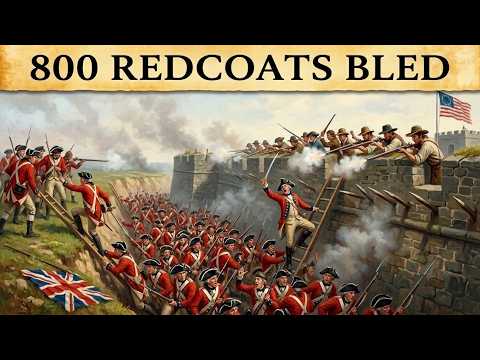
But the real story isn’t the massacre itself. It’s who those defenders were, and what they did to 800 professional British soldiers before one sword was ever surrendered. This is the story of 165 farmers who stared down an empire—and made it bleed.
Summer, 1781. The American Revolution had settled into a strange stalemate. The British held New York City. Washington’s Continental Army watched from across the Hudson, waiting. But in the South, things were shifting. Washington and the French general Rochambeau were quietly moving troops toward Virginia, where the British commander, Lord Cornwallis, was dug in at a small tobacco port called Yorktown. If they could trap Cornwallis there—with the French fleet blocking escape by sea—the war might truly end.
The British commander in New York, General Henry Clinton, sensed something was wrong. He needed a distraction—something loud enough to pull American attention away from Virginia and back to the North. And he had just the man for the job.
Benedict Arnold had been a traitor for nearly a year. Before that, he was one of the Continental Army’s finest field commanders. He had led the assault on Fort Ticonderoga. He had nearly taken Quebec in a blizzard. At Saratoga, he fought like a man trying to kill himself, taking a musket ball in the leg that left him permanently lame. Congress had promoted other officers over him. His expense reports went unpaid. He married a young woman from a Loyalist family in Philadelphia, and a mix of personal resentment and mounting debt pushed him toward the worst decision any American officer made during the entire war.
In 1780, Arnold offered to hand over the fortress at West Point to the British for 20,000 pounds. He had been in secret contact with them for over a year, passing information and negotiating his price. The plot unraveled when American militiamen stopped his British contact, Major John André, near Tarrytown, New York, and found detailed maps of West Point’s defenses hidden in his stockings. News of André’s capture reached Arnold just in time for him to flee across the river on a British warship. André was hanged as a spy. His sacrifice made Arnold a man hated even among the Loyalists who were supposed to be his new allies.
Now Arnold had a new rank—brigadier general in the British Army—a lump sum, and a desperate need to prove his loyalty to the king he had chosen over his own country. He was a man without a home on either side of the war, and he knew it.
Clinton gave Arnold a mission in early September: attack New London, Connecticut, destroy the port, burn the warehouses full of supplies bound for Washington’s army, and eliminate the privateers operating from its harbor if possible. Those privateers had been a thorn in the British side for years. New London sat at the mouth of the Thames River, and its deep, protected harbor was a perfect base for armed merchant ships that preyed on British supply vessels along Long Island Sound. Ships flying American colors would slip out of the harbor, lie in wait for a British merchant convoy, seize its cargo, and sail back before the Royal Navy could respond.
The British had a name for this town. They called it the most pestilential nest of pirates on the whole continent. Just weeks earlier, American privateers had sailed a captured British merchant ship called the Hannah right into New London harbor. Her cargo of gunpowder and trade goods was valued at 80,000 pounds—one of the largest prizes taken during the entire war. The British wanted revenge, and they chose the man who knew the area better than any officer in their army—because Benedict Arnold had been born and raised in Norwich, Connecticut, just twelve miles upriver.
Arnold assembled a force of about 1,700 soldiers—British regulars, Hessian mercenaries, and American Loyalists who had sided with the Crown. They boarded transport ships and sailed from New York. The plan was to arrive before dawn, land on both sides of the Thames River, and take the town by surprise. But the wind didn’t cooperate. Arnold’s fleet of more than 30 ships reached the river’s mouth around 1:00 a.m. on September 6, but the wind shifted north and held them in place for hours. They sat on the water, waiting, as the darkness slowly gave way to gray light.
At about 3:00 a.m., an American guard named Rufus Avery was standing on the walls of Fort Griswold, which sat on a high bluff on the Groton side of the river, directly across from New London. As soon as there was enough light to see, Avery spotted sails. He began counting—more than 30 ships struggling against the wind, trying to make their way upriver. He later said a feeling of awe came over him. Avery immediately sent word to Captain William Latham, who was nearby, and Latham hurried to alert the fort’s commander, Colonel William Ledyard.
Ledyard was 43 years old, a militia officer who had spent years of the war commanding the defenses on both sides of the harbor. He was not a regular soldier in the Continental Army. He was a local man protecting his community. Ledyard sent messengers in every direction. He notified Governor Jonathan Trumbull. He called for militia reinforcements from neighboring towns, then headed to Fort Griswold and began preparing for a fight.
The fort wasn’t large, but it was strong. It sat on high ground overlooking the river, with stone walls topped by a palisade of sharpened cedar stakes angled outward. A ditch surrounded the outer perimeter. There was a battery of cannon and a fortified magazine filled with powder and shot. It was the kind of position a small force could hold against a much larger one—if they had the courage to stand.
But there was a problem. Fort Griswold was not garrisoned by a large force. It was not filled with trained Continentals with years of battlefield experience. What Ledyard had were local men—farmers who had left their fields that morning, shopkeepers who had closed their stores and walked to the fort with their muskets on their shoulders, artisans, sailors, and fishermen from Groton and the surrounding Connecticut countryside. They came in ones and twos and small groups throughout the morning. Some came on horseback, most on foot, carrying whatever weapons they could find. Some brought hunting rifles they used to shoot deer. Some brought spears—long wooden shafts with iron tips, a type of weapon that hadn’t been standard military issue for over a century. Some were old men, some were boys. Many were related to each other. Fathers and sons, brothers, cousins, neighbors who had grown up on the same roads and worked the same land.
By the time the British were ready to land, Ledyard had managed to gather about 165 men inside the walls of Fort Griswold. 165 militia volunteers against a professional military force nearly five times their number on the Groton side alone. And those 800 British soldiers were not militia. They were regulars who had fought wars around the world.
Across the river, Arnold landed roughly 900 men on the New London side. The tiny garrison at Fort Trumbull—just 23 soldiers—fired a single volley, spiked their own guns to render them useless, and fled across the river to Fort Griswold. Arnold’s men swept through New London with almost no resistance. They began burning warehouses, supply depots, and anything of value to the American cause. When a powder magazine exploded, the resulting fire raced through the town. By the end of the day, 143 buildings in New London had been reduced to smoldering rubble.
But that was Arnold’s side of the river. On the Groton side, things went very differently.
Colonel Edmund Eyre landed 800 British regulars and Loyalist troops on the eastern bank of the Thames, about a mile and a half south of Fort Griswold. They expected a quick march and an easy seizure. What they met instead was tangled forest, swampy ground, and terrain that slowed their movement to a crawl. Their artillery couldn’t keep pace with the infantry. By the time the British infantry reached the base of the hill below Fort Griswold, it was around 10:00 a.m., and the element of surprise was long gone.
Eyre sent a messenger under a white flag to demand Ledyard’s surrender. The message was simple: hand over the fort, and the garrison would be treated as prisoners of war under the recognized rules of war. Ledyard could see the redcoat formations spreading out below the hill. He gathered his officers inside the fort and discussed it with them. They expected reinforcements from the inland towns at any moment. The fort was strong. The ground favored the defenders. Ledyard sent the messenger back with his answer. He would not surrender.
Eyre sent the flag a second time. This time, the message carried a threat. If the British were forced to storm the fort, no mercy would be shown. Every defender would be put to the sword. Ledyard’s reply was the same. He told Eyre he would defend the fort to the last breath, and whatever happened, would happen.
And so the British climbed the hill.
Eyre split his force and attacked from multiple directions. One group moved toward the southwest wall. Another swung around the northern face. A third made a feint toward the west. Inside the fort, Ledyard ordered his men to hold their fire. He wanted the British to come closer.
A seasoned sea captain named Elias Halsey took charge of the main gun on the eastern wall—an 18-pounder loaded with grapeshot, dozens of small iron balls packed together. When the first British column came into killing range, Halsey pulled the lanyard. The cannon roared. Twenty British soldiers dropped to the ground in a single blast, torn apart by grapeshot at close range.
But the survivors kept coming. They had to. There was no cover on the exposed hillside. The only way to stop the fire was to breach the walls. The fighting became savage. The militia inside Fort Griswold were not professional soldiers, but they fought from behind stone walls on high ground, and they made the British pay for every inch.
Musket fire poured down from the walls. Men who had spent their lives hunting game in the Connecticut woods proved to be astonishingly accurate when the British were the targets. The long spears—ten feet of wood and iron that the farmers had brought with them—proved to be deadly weapons against men trying to climb the wooden fence above the walls. A soldier pulling himself over the wall with both hands has no way to defend himself against a spear thrust from below.
The British surged toward the southwest wall and were thrown back with heavy losses. Colonel Eyre was badly wounded during the assault on that wall. Officers around him fell one after another, killed or run through as they tried to lead their men over the defenses. A group of British soldiers managed to pry away some of the palisade stakes and force their way to a cannon, which they turned against the garrison. But even that didn’t break the defense quickly.
The British were taking casualties at a rate that would have made most commanders reconsider the entire attack. Across the river, Arnold watched the battle from a hilltop. He realized the fort was far stronger than he had expected and actually tried to send an order for the troops to withdraw. But the message arrived minutes too late. The attack had already begun and could no longer be called back.
But the British were professionals, and they didn’t stop. Major William Montgomery led a charge with axes toward the eastern wall, using his enormous momentum. Montgomery himself reached the top of the parapet, shouting orders urging his men over the wall—and there he met Jordan Freeman. Freeman was a Black man who had endured slavery earlier in his life and was now fighting alongside the other defenders of Fort Griswold. As Montgomery climbed the wall, Freeman seized a ten-foot spear and drove it upward into the British major, killing him instantly.
That moment stunned the attackers. Their commander had been killed on the wall, speared by a farmer. But even that couldn’t stop what was coming.
A small group of British soldiers pried away the cedar palisade and forced their way toward the gate. They opened it, and 800 redcoats poured through. The defenders were overwhelmed in seconds. Ledyard saw it and ordered his men to lay down their arms.
According to American witnesses, Ledyard stepped forward and offered his sword to Major Stephen Bromfield. “Who commands this fort?” Bromfield asked. “I did, sir, but you do now,” Ledyard replied. Bromfield took the sword—and drove it through Ledyard’s chest. The killing that followed was butchery: unarmed men shot, the wounded bayoneted. When it ended, 85 Americans lay dead, most massacred after surrender.
The British lost over 200 men—a quarter of their force. Six weeks later, Cornwallis surrendered at Yorktown. Arnold died in London, broke and forgotten. Today, a 135-foot granite obelisk stands at Groton Heights, bearing the names of the dead.
So here’s my question for you: Was Benedict Arnold’s raid on New London a strategic failure, or did it expose the true cost of a revolution fought by ordinary farmers? Let me know in the comments.






