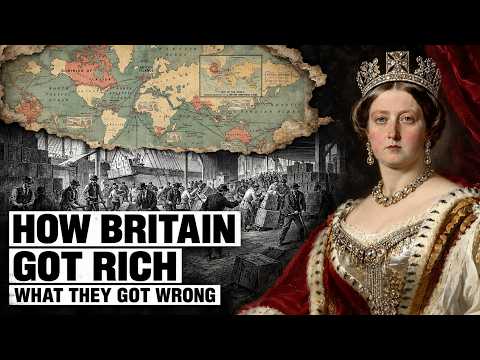
There is a story we have all heard: Britain rose to greatness because of its ingenuity, hard work, and exceptional institutions. It is a comforting tale, but it is only half true. The missing half is far more unsettling, and it begins not in a factory in Manchester, but in a quiet room in London where a loan was being written to compensate slave owners for the loss of their human property. This is the story of how the British Empire truly got rich—and it is not the one your history teacher told you.
In the year 1600, England was a middling European kingdom, poorer than France, Spain, and the Netherlands, and dramatically poorer than the Mughal Empire in India. On the last day of that year, Queen Elizabeth I signed a royal charter granting a group of London merchants a monopoly on trade with the East Indies. Thus was born the East India Company—a private corporation that would field its own army, conquer a subcontinent, and mint its own coins. For most of its existence, it operated with less government oversight than a modern coffee chain.
“The genius of the East India Company was not that it was a particularly bold trading venture. The genius was that it was something new in human history: a joint stock corporation with a royal mandate to behave like a sovereign state.”
For a century and a half, the company behaved like a trading firm, buying pepper and silk in Asia and selling them in Europe at a markup. Then came June 23, 1757—the Battle of Plassey. On that day, a 32-year-old company clerk named Robert Clive faced the army of Siraj-ud-Daulah, the young Nawab of Bengal, which outnumbered his force ten to one. By any honest reckoning, Clive should have been slaughtered. He was not, because Plassey was not really a battle. It was a conspiracy already signed before a shot was fired. Clive had bribed the Nawab’s commander, Mir Jafar, to switch sides, and he had deceived a wealthy merchant named Omichand with a forged treaty. By afternoon, the Nawab’s army had melted away. Clive lost 36 men, and the richest province in India, Bengal, was now effectively the property of a private company headquartered in a four-story building on Leadenhall Street in London.
What happened next was one of the most consequential acts of wealth transfer in human history. Clive and his officers walked into the treasury at Murshidabad and loaded the accumulated wealth of generations of Mughal rule onto roughly a hundred boats, punting them down the Ganges to the company’s headquarters at Fort William in Kolkata. Clive personally pocketed around £234,000—a figure that would make him one of the richest men in Britain overnight. The company transferred around £2.5 million from the Bengal treasury into its own accounts. In today’s money, that single transfer is estimated at roughly £250 million for the company plus around £23 million for Clive himself. And this was just the opening act.
In 1765, the Mughal Emperor, now a figurehead with no real power, granted the East India Company the Diwani—the right to collect taxes across Bengal, Bihar, and Orissa. In a single stroke of a pen, a private London corporation had acquired the fiscal rights to a territory with a population of around 20 million people. The company now had the right to tax one of the most productive agricultural regions on the planet, and it set about doing so with an intensity that would make a modern hedge fund look generous. Land taxes were raised dramatically. Peasants who had paid one rate under the Mughals were suddenly expected to pay far more. When they could not, their land was seized. When harvests failed, the company kept collecting.
By 1770, Bengal was in the grip of a catastrophic famine. The crops had failed. The granaries were being emptied by company agents who were also in many cases hoarding grain to drive up prices and then selling it back to starving villagers. Estimates vary wildly, but most serious historians now accept that somewhere between 7 and 10 million people died in the Great Bengal Famine of 1770. That is roughly a third of the population of the region. One in three gone. And through it all, company revenues from Bengal actually went up.
“Let that sit with you for a moment.”
Now, here is where it gets interesting and where the comfortable national story starts to crack. Because the money looted from Bengal did not just sit in a vault in London. It flowed. It went into country estates and parliamentary seats and the shares of other companies. It went into the pockets of members of parliament who collectively owned so much stock in the East India Company that it was practically impossible to pass legislation that would restrain it. These men were known at the time as “Nabs,” a corruption of the Indian word “nawab.” And they returned to England with such shocking amounts of wealth that they began to disrupt the entire social order. They bought up boroughs. They outbid old aristocratic families for land. And crucially, some of them put their capital to work in the new industries of the north—in the cotton mills, in the iron works, in the canals.
Now, let us be careful here, because this is where honest history has to do some real work. The question of exactly how much of Britain’s industrial revolution was funded by colonial wealth is one of the most hotly contested in modern economic history. And anyone who tells you the answer is simple is probably selling you something. The traditional orthodoxy taught in most universities until recently held that the industrial revolution was overwhelmingly a domestic affair—British coal, British iron, British inventiveness, British institutions. Colonial trade mattered, but it was marginal. Then in 1944, a brilliant young scholar from Trinidad named Eric Williams, who would later become the first prime minister of his country, published a book called Capitalism and Slavery. He argued the opposite. Williams claimed that the profits from Caribbean slave plantations and the triangular trade had provided the capital that financed British industrialization. For decades, his thesis was dismissed, ignored, and in Britain not even published in a mainstream edition until 2022. That is not a typo. A book published in the United States in 1944 did not get a mainstream British edition until 78 years later.
The modern consensus, as it is slowly forming among economic historians, sits somewhere between the two extremes. The slave trade itself, measured strictly as a line of business, was probably not large enough in isolation to have powered industrialization. But it was never just one line of business. It was a feeder system. It built the port cities of Bristol, Liverpool, and Glasgow. It created the demand that drove the Lancashire cotton industry, which spun its yarn from fiber picked by enslaved people in the American South and the Caribbean. It filled the counting houses with capital that then flowed through a hundred different channels into insurance, into shipping, into banking, into manufacturing. The historian Nuala Zahedieh has traced in detail how sugar cultivation in the Caribbean created industrial supply chains that reached deep into Cornwall, South Wales, Bristol, and London, chaining thousands of workers in Britain to enslaved labor on the plantations. It is not a question of whether the industrial revolution was built on slavery. It is a question of how deep the roots run. And they run deeper than the official story has ever been willing to admit.
Let us talk about the plantation economy itself, because the numbers here are genuinely difficult to look at. By the late 17th century, Britain had overtaken the Portuguese, the Spanish, and the Dutch to become the dominant slave trading nation on Earth. Between the 16th and 19th centuries, British ships carried an estimated 3 million African people across the Atlantic. Many more died on the voyage. The ones who survived were worked often to death on sugar plantations in Barbados, Jamaica, and the other Caribbean islands that formed the economic engine of the first British Empire. Sugar was the oil of the 18th century. It was a cash crop of extraordinary profitability, and it was produced by what was essentially an industrial agricultural system run on human beings treated as consumable machinery.
The wealth that flowed back to Britain from these islands was so enormous that for most of the 18th century, the small, hot, mosquito-ridden island of Barbados generated more revenue for the British crown than all 13 American colonies combined. The men who owned these plantations and the merchants who shipped their sugar became the richest commoners in the kingdom. They built the great country houses of the English countryside, many of which still stand today, maintained by the National Trust. Their origins politely glossed over by the gift shop. They married into the aristocracy. They sat in parliament. They founded banks. One of the Rothschild family’s early business associates before the family itself even existed as a banking dynasty was deeply tied into the West Indian trade. The British bank that eventually became Barclays was founded by Quaker families with slave trade connections. The ancestors of a staggering number of British notables, from the family of former Prime Minister David Cameron to that of the novelist Elizabeth Barrett Browning, show up in the records as recipients of slave-related wealth.
Which brings us to one of the most extraordinary and still largely unknown facts in the entire history of British finance. In 1807, Britain abolished the slave trade. That is the part they teach in school, the feel-good part. William Wilberforce, the Clapham Saints, the moral awakening of a nation. In 1833, Parliament went further and passed the Slavery Abolition Act, which freed enslaved people across most of the British Empire the following year. And here, the national story usually ends with a swelling orchestral score. But the actual ending is darker, much darker, because the enslaved people themselves did not receive one penny of compensation for the generations of forced labor that had made Britain rich. The compensation went to the slave owners. The British government paid out £20 million to roughly 46,000 slave owners as reimbursement for the loss of their human property. In 1833, that was an eye-watering sum. It was around 40% of the entire national budget. The government took out a loan so large that the only thing comparable in British fiscal history was the cost of the Napoleonic Wars.
And here is the part that still makes people’s jaws drop when they hear it for the first time. That loan was not fully paid off until 2015. Yes, 2015. British taxpayers, including the descendants of enslaved people living in modern Britain, were still servicing that debt as recently as the year that Taylor Swift released her album 1989. Think about that. When Her Majesty’s Treasury quietly tweeted about this in 2018, framing it as a feel-good fact about how modern taxpayers had helped end slavery, the backlash was so severe that the tweet was eventually deleted. Because what the Treasury had accidentally revealed was not a story of national virtue. It was a story of how the beneficiaries of slavery were paid out over the course of nearly two centuries by the general public, while the people who had actually been enslaved received nothing.
The researchers at University College London through their Legacies of British Slavery project have now compiled a nearly complete census of who received those payments. The names read like a who’s who of 19th-century British wealth. Many of them reinvested their compensation money into exactly the industries that would come to define Britain’s second great wave of imperial expansion—into railways, into mining, into the City of London. The compensation payments were not a conclusion to the story of slavery and British wealth. They were a transfer mechanism, a way of converting plantation capital into industrial capital with the state acting as the clearing house.
Meanwhile, on the other side of the world, something equally remarkable was happening. The British had developed a taste for Chinese tea in the 18th century, and that taste had become a national obsession. The problem was that the Qing Empire did not particularly want anything the British had to sell. Chinese merchants wanted silver, and they wanted it in enormous quantities. For decades, European silver flowed into China through the single open port of Canton, now known as Guangzhou. By the early 19th century, this was becoming a serious strategic problem for Britain. Silver was draining out of the country. The East India Company was heavily in debt. The British state was heavily in debt. Something had to give.
The solution the company arrived at was one of the most cynical pieces of business engineering in modern history. The company controlled vast agricultural lands in Bengal and Bihar. It set its agents to work converting those lands into opium plantations. Then it processed the opium, auctioned it to private merchants known as country traders, and let those traders smuggle it into China in defiance of the Qing emperor’s explicit ban. The silver that came back from those sales was then used to buy tea. The arithmetic was elegant. The company could sidestep its own silver shortage by using an addictive narcotic as a kind of parallel currency with Chinese addicts as the unwitting market makers. The scale was astonishing. By the 1830s, the company was exporting tens of thousands of chests of opium into China every year. Each chest contained around 63 kilograms of the drug. By one estimate, the opium trade of 1835 to 1836 alone brought in the equivalent of around $428 million in today’s money in a single season.
When the Qing government tried to stop it, destroying stockpiles of British opium in Canton in 1839, Britain went to war twice. The First Opium War ended in 1842 with the Treaty of Nanjing, which ceded Hong Kong to Britain, forced open five Chinese ports to foreign trade, and extracted a massive indemnity. The Second Opium War, fought from 1856 to 1860, went further still. By the end, British and French troops had sacked the Summer Palace outside Beijing, hauling away so much loot that the auction houses of London and Paris were digesting it for decades. Opium was by one estimate Britain’s single most profitable commodity trade of the entire 19th century. It was not a scandal on the edge of the imperial project. It was central to its finances.
Now let us bring all of this back to the single most provocative number in the entire debate. In 2018, the Indian economist Utsa Patnaik published research through Columbia University Press that attempted to calculate in a rigorous way how much wealth Britain had extracted from India over the roughly 170 years of its colonial rule. Patnaik used Indian export surplus earnings as her baseline, applied a 5% compound interest rate, and arrived at a figure of around £9.2 trillion, which at historical exchange rates equates to roughly $45 trillion. To put that number in perspective, it is around 17 times the current annual gross domestic product of the entire United Kingdom. The mechanism Patnaik describes is not loot in the crude sense of soldiers filling sacks with jewels. It was something more sophisticated and more systematic. The company and later the British Raj after 1858 collected taxes in India. They then used around a third of those taxes to buy Indian goods which were exported and sold around the world. The Indian producers were paid in effect with their own tax money. The British kept the markup. Buyers of Indian goods abroad paid in gold or sterling through a special paper instrument called the council bill which was issued only by the British crown. The gold and silver from international buyers accumulated in London. The Indian producers never saw it. It was a drain system of elegant and terrible efficiency running for the better part of two centuries.
The counterargument has to be taken seriously because this is history, not propaganda. There are serious scholars, including the leading Indian economic historian Tirthankar Roy, who argue that the drain thesis in its strongest form is overblown. They point out that Patnaik’s figure depends heavily on how you compound interest over nearly two centuries, that colonial trade was not a one-way flow, and that Indian merchants and workers operated throughout the empire and benefited from certain aspects of its infrastructure. The Institute of Economic Affairs in London has published work by Christian Niemietz arguing that colonial profits were simply not large enough in proportion to the overall British economy to have been the main engine of the industrial revolution. Their argument is that most British trade was with other European countries, not with the empire, and that imperial defense costs often exceeded imperial trade benefits. These are not frivolous arguments. They deserve a hearing. But even the most skeptical economic historians now acknowledge—in a way that was not true 30 years ago—that colonial extraction, the slave trade, and the imperial system as a whole were deeply woven into the fabric of British economic development. The debate is no longer whether these things mattered. It is a debate about proportions, about mechanisms, and about which specific pathways carried the most weight.
Here is where I want to introduce what I think is the most honest synthesis. Because once you look past the shouting on either side, something interesting comes into focus. The British Empire did not get rich because it stumbled onto one big pot of gold. It got rich because it built an institutional architecture that allowed it to extract value from a global system over and over again in a dozen different ways for 300 years. The East India Company was one piece. The Caribbean plantation economy was another. The transatlantic slave trade was another. The opium trade was another. The Indian drain was another. The imperial preference tariff system was another. And underneath all of it, running the clearing house, taking a cut on every transaction, was something that outlasted them all: the City of London.
The City is a thing most people, even in Britain, do not fully understand. It is not just a neighborhood of banks. It is a semi-autonomous jurisdiction inside London with its own government, the City of London Corporation, that predates the English Parliament itself. It has its own voting system which uniquely gives votes not just to residents but to businesses. It has its own police force. Historically, it has enjoyed privileges and legal exemptions that no other part of the United Kingdom shares. And over the course of the imperial centuries, it became what one scholar called “the governor of the imperial engine.” Every pound of profit from every corner of the empire—from a sugar estate in Jamaica, from a tea plantation in Assam, from an opium shipment to Canton, from a diamond mine in Kimberley—eventually passed through a counting house, an insurance underwriter, a shipping broker, or a clearing bank in the City. Each transaction left a small residue of fees, interest, and premiums behind. Those residues accumulated, and they accumulated in a jurisdiction that was deliberately insulated from democratic control.
By the late 19th century, London was unambiguously the financial capital of the world. The pound sterling was the global reserve currency. British overseas investment was so vast that in the decades before the First World War, Britain was earning more from its foreign holdings than it was spending on imports. The country had become, in the economist John Hobson’s famous description, a nation of “coupon clippers.” And here is the twist that most people miss and that explains a great deal about the modern world. When the empire formally collapsed in the decades after the Second World War, when the Union Jack was lowered in capital after capital from Delhi to Lagos to Kingston, the City did not collapse with it. It mutated. The expertise, the networks, the legal structures—and crucially the territorial remnants of the empire, the little islands and dependencies that stayed under British sovereignty—were repurposed. In the 1950s and 1960s, the City of London effectively invented the modern offshore financial system. The Eurodollar market was born in London in the late 1950s when British banks figured out that if they held US dollars in London accounts outside the jurisdiction of American regulators, they could lend them with far fewer restrictions. That innovation, which punched a hole in the entire Bretton Woods system of capital controls, was a City of London invention. It set the template for everything that followed. The Cayman Islands, the British Virgin Islands, Bermuda, Jersey, Guernsey, the Isle of Man—these are not accidents of history. They are the surviving outposts of a former empire, consciously developed into a network of secrecy jurisdictions that today handle a stunning share of global offshore wealth. By some measures, when you add up the British network of overseas financial centers, it is the largest player in the global offshore system. The Tax Justice Network has argued with considerable evidence that this constitutes a second British Empire—invisible, financial, and in some ways more powerful than the first.
So, what is the real answer to our question? What is the true origin of the British Empire’s wealth that so many historians get wrong? The wrong answer, the comfortable national story, is that Britain simply out-invented and outworked everyone else. The equally wrong answer, popular in a certain kind of political commentary, is that Britain was nothing more than a parasite that stole everything from somewhere else. The truth is more interesting and more uncomfortable than either. Britain did build genuinely remarkable institutions. It did produce brilliant scientists and engineers. Its parliamentary system, its common law tradition, its scientific societies—these were real achievements and they mattered. But those institutions did not develop in a vacuum. They developed in symbiosis with a global extraction machine, and they were turbocharged by capital flows that originated in the suffering of millions of people on three continents. The industrial revolution was British. It was also in significant part Bengali, Jamaican, Nigerian, Chinese, and Virginian. The wealth of the City of London was British. It was also inextricably the compressed accumulated surplus of enslaved sugar workers, taxed Bengali weavers, Chinese opium addicts, and African miners.
And here is the thing that should make the modern viewer sit up, because it is not just a question of settling scores with the past. The institutional advantages that Britain built during the imperial period did not evaporate when the empire ended. They were converted. The legal expertise that structured the Jamaican plantation economy evolved into the trust structures that today hide trillions of dollars from tax authorities. The insurance firms that insured slave ships evolved into Lloyd’s of London. The banks that financed the opium trade merged, acquired, and renamed their way into becoming some of the largest financial institutions in the world. HSBC, which stands for the Hong Kong and Shanghai Banking Corporation, was literally founded in 1865 to serve the European trading houses operating in the aftermath of the Opium Wars. These are not historical curiosities. They are living institutions with trillions of dollars on their balance sheets, headquartered in or deeply tied to a city whose rise to global dominance was built on an imperial foundation. When you move money through the global financial system today, when you take out a mortgage, when a company you work for issues bonds, when a country refinances its debt, you are in a small but direct way interacting with the inherited architecture of the British Empire. The empire did not end. It was financialized.
Who wins and who loses in this story? The winners are not hard to identify. The descendants of plantation owners who received compensation payments in the 1830s went on to found banking dynasties, buy country estates, and pass down social capital that still gives their descendants a quiet advantage in the modern British professional class. The City of London continues to generate enormous revenues for the United Kingdom and to make the people who work in it among the richest in the world. The institutional continuity is real. The losers are also not hard to identify, though they are often invisible in the official story. The descendants of enslaved Africans across the Caribbean, the United States, and Britain itself continue to live with the economic consequences of three centuries of forced labor and expropriation. India, which was one of the richest regions in the world when the East India Company arrived in 1600, took centuries to recover from the drain and arguably has still not fully recovered. Bengal, once the beating heart of the Mughal economy, is today one of the poorer parts of South Asia. The direct line between imperial extraction and current global inequality is not a slogan. It is a historical fact, however much the debate continues about its exact magnitude.
What does this mean for you? Why should you care about dusty ledgers from 1757 or compensation payments completed in 2015? Because the story of how wealth is created and how it is captured matters enormously for how we think about the modern world. If you believe the comfortable story that Britain got rich because it was simply better, then the obvious conclusion is that the poor countries of the world are poor because they are simply worse and that nothing in the current global economic order needs serious re-examination. If you believe the honest story—that Britain’s wealth was built in significant part through the systematic extraction of value from other societies and that the institutional advantages built during that extraction are still generating returns today—then the modern conversation about reparations, about tax havens, about financial regulation, and about global inequality looks very different. You do not have to arrive at any particular political conclusion to see that the honest story is the one that respects the historical evidence. The comfortable story is a kind of national pacifier. It is useful for sleeping. It is useless for understanding.
I started this with a story. Let me end with one. In the great hall of the East India Company’s old headquarters on Leadenhall Street in London, long since demolished, there used to hang a vast painting called Britannia Receiving the Riches of the East. It showed a classical female figure draped in robes serenely accepting gifts of jewels and silks and spices from kneeling representatives of India, China, and Persia. It was propaganda, obviously, but it was also in a strange way honest. The riches really did flow in that direction. The painting just left out the methods—the forged treaties, the famines, the compensation paid to slave owners, the opium chests floating down the Pearl River, the council bills issued in London that let British traders buy Indian goods with Indian tax money. Those details did not make it into the painting. They did not make it into the national story. They did not make it into the textbooks. But they are the real foundation of everything that came after. And unless we are willing to look at them clearly, we will keep misunderstanding not just the past, but the world we are living in right now.
If you made it this far, I am genuinely grateful for your attention, because this is a story that takes time to tell properly and most places will not tell it to you honestly. If this was useful to you, if it changed the way you think about something, consider dropping a comment below with your reaction and hit the subscribe button if you want more deep dives into the real history of money and power. I read every comment and the channel grows when you share these videos with people who you think need to see them. Thanks for watching.
So the next time you hear that Britain got rich purely through grit and genius, remember the painting on Leadenhall Street. Remember the boats on the Ganges, the loan paid off in 2015, the opium chests, the council bills. “The empire did not end. It was financialized.” That is the uncomfortable truth the comfortable story keeps hidden.
History is not a courtroom where we deliver verdicts on the dead. It is a mirror. And what we choose to see in that mirror shapes what we build next—whether we keep sleepwalking through inherited systems or finally ask who they were designed to serve.
So here is my question for you: If the architecture of extraction is still standing, what would it actually take to dismantle it—and who would have to pay the bill? Let me know in the comments below.