December 16, 1944. The Ardennes Forest. Under a sky so gray it seemed to press down on the snow-covered pines, 200,000 German soldiers waited in absolute silence. Not a single radio crackled. Not a single engine turned over. Then, at 5:30 a.m., the silence was shattered by the roar of 950 tanks and the scream of artillery shells.
The Battle of the Bulge had begun. It was Hitler’s last, desperate gamble to split the Allied armies and seize the vital port of Antwerp. If it succeeded, the war in the West would be thrown into chaos. If it failed, the Third Reich would be finished.
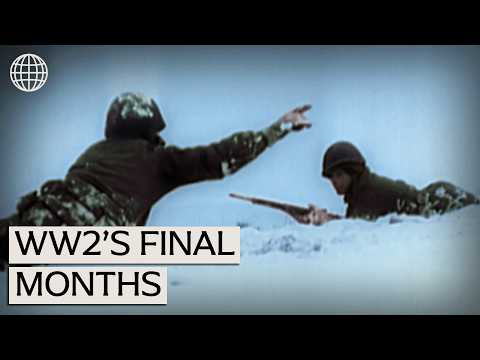
For the American soldiers holding the line, the attack came out of nowhere. They were outnumbered, outgunned, and freezing. But they held on. In the small town of Bastogne, surrounded and running low on ammunition, U.S. troops refused to surrender. When German commanders demanded it, the American general replied with a single word: “Nuts!”
The fighting was brutal. In the village of Malmedy, SS troops gunned down more than 80 American prisoners of war, an atrocity that hardened the resolve of every G.I. on the line. The cold was an enemy too, with temperatures plunging below zero and soldiers fighting frostbite as well as the enemy.
But the tide was turning. By late December, the skies cleared, and Allied air power pounded the German spearhead. Fuel-starved and exhausted, the German advance ground to a halt. By early February 1945, the Bulge had been pushed back, and Hitler’s gamble had failed at a cost of over 120,000 German casualties.
Yet even as the Western Allies celebrated their hard-won victory, a far more horrifying truth was emerging from the East. Soviet troops had overrun a small Polish village called Majdanek. What they found there—gas chambers, incinerators, and piles of corpses—was beyond imagination. The world was about to learn the full scale of the Holocaust.
As the war entered its final months, the race for Berlin began. But the political map of Europe was already being redrawn, and the true horror of the Nazi regime was only beginning to be understood.
For years, the reports had trickled into London and Washington—fragments of testimony, whispered accounts from escaped prisoners, aerial photographs of strange installations in Poland. But they had been dismissed as exaggerations, or filed away as too fantastic to be true. Now, the evidence was undeniable.
At Majdanek, Soviet investigators found warehouses stacked with hundreds of thousands of shoes, suitcases, and human hair. They found gas chambers disguised as shower rooms, their walls still stained with the blue residue of Zyklon B. They found the machinery of mass murder, left almost intact by the retreating Germans.
The news spread quickly. Western correspondents were invited to witness the camp for themselves. What they saw would sear itself into the world’s conscience. This was not a prison camp. It was a factory of death.
In the months that followed, as Allied armies pushed deeper into Germany, they would discover more camps—Buchenwald, Dachau, Bergen-Belsen—each one a fresh horror. But it was the death camps of Poland—Auschwitz-Birkenau, Treblinka, Sobibor, Chelmno, Belzec—that revealed the true scale of the Nazi extermination campaign. Six million Jews had been murdered.
Yet even as the world struggled to comprehend, the war in the East was reaching its climax. Stalin’s Red Army, having crushed the Warsaw Uprising and secured his political flank, was now poised for the final assault on Berlin. The Western Allies, having survived the Bulge, were also racing east.
The race for Berlin was on. But it was a race with consequences far beyond the battlefield. Whoever reached the German capital first would shape the future of post-war Europe. Churchill urged Eisenhower to push for Berlin, to deny Stalin this ultimate prize. But Eisenhower, mindful of the cost in lives and the agreements already made at Yalta, refused. Berlin would be left to the Soviets.
On April 16, 1945, Stalin launched his final offensive. Over two million Soviet troops, supported by thousands of tanks and aircraft, smashed through the German defenses on the Oder River. They were heading for Berlin, and nothing would stop them.
In the city itself, Hitler had retreated to his bunker beneath the Reich Chancellery. Surrounded by his closest aides, he issued orders to armies that no longer existed, to units that had been annihilated. The Führer was directing a phantom war.
By April 25, Soviet troops had encircled Berlin. The fighting was savage, street by street, house by house. The city was reduced to rubble. Meanwhile, American and Soviet forces met at the Elbe River, cutting Germany in two. The end was near.
On April 30, 1945, as Soviet soldiers raised the red flag over the Reichstag, Adolf Hitler took his own life in his bunker. The man who had unleashed the most destructive war in human history was dead. But the war was not yet over. The final surrender would come days later, and with it, the beginning of a new world order—one shaped by the shadow of the Holocaust and the looming threat of the Cold War.
But before the guns fell silent, there was one more chapter to be written—one that would test the alliance and set the stage for the decades to come. In the West, Allied armies had crossed the Rhine and were sweeping through the heartland of Germany. They were finding things that would haunt them for the rest of their lives.
At Buchenwald, near the city of Weimar, American troops liberated over 20,000 prisoners—emaciated, dying, barely human. General Dwight Eisenhower, the Supreme Commander, insisted on visiting the camp himself. He walked through the barracks, past the crematoria, past the piles of bodies. He ordered every soldier who could to witness it, so that no one could ever say it hadn’t happened.
The British, meanwhile, entered Bergen-Belsen. What they found was not a death camp with gas chambers, but a place of slow, systematic starvation and disease. Thousands of unburied corpses lay in the open. Typhus was rampant. The living were too weak to bury the dead.
It was here that the full, terrible truth began to crystallize. The Nazis had not just murdered people in the heat of war. They had built an industry of death, with timetables and budgets, with factories that used slave labor and sold the belongings of the murdered. The Holocaust was not a side effect of the war. It was a central aim of the Nazi state.
As the Allied armies converged on Berlin, the political realities of the post-war world were already taking shape. Stalin’s Red Army had suffered enormously—over 20 million Soviet citizens had died—and Stalin was determined to secure his borders. He wanted a buffer zone in Eastern Europe, and he meant to keep it.
At the Yalta Conference in February 1945, Churchill, Roosevelt, and Stalin had agreed on the division of Germany into occupation zones. But there was a deeper, unspoken understanding: the Soviet Union would have dominant influence in Eastern Europe. The West had little choice but to accept it.
Yet as the war ended, the cracks in the alliance were already showing. The Americans and British had fought for democracy and self-determination. Stalin had fought for security and control. These two visions could not coexist.
In Poland, the Soviet-backed communist government was already being installed, even as the last shots were fired. The Polish government-in-exile in London, which had fought alongside the Allies, was sidelined. Stalin had won his buffer state.
Churchill, appalled but pragmatic, knew there was little he could do. The British people were exhausted. The Americans wanted to bring their boys home. And the Soviet Union, though devastated, was now the most powerful land army in Europe. The Cold War had not yet begun, but its foundations were already laid.
On May 7, 1945, in a small schoolhouse in Reims, Germany, the German High Command signed an unconditional surrender. The following day, May 8, was declared Victory in Europe Day. The war in Europe was over.
In London, Churchill addressed the nation. In New York, crowds filled Times Square. In Moscow, Stalin announced the victory to the Soviet people. But the celebrations were tempered by the knowledge of what had been lost.
As the world began to count the cost, the true scale of the Holocaust became clear. Six million Jews had been murdered, along with millions of Roma, disabled people, homosexuals, and political prisoners. The numbers were almost impossible to comprehend.
And yet, even as the world mourned, the seeds of a new conflict were being sown. The alliance that had defeated Hitler was already fracturing. The Soviet Union and the Western powers were now rivals, and the fate of Europe hung in the balance.
The war was over. But the peace would be just as dangerous.
In the decades that followed, the world would return again and again to the question the camps had raised. How could a modern, cultured nation have built such a machine of death? The answers were never simple, and they were never fully satisfying.
At the Nuremberg trials, the surviving Nazi leaders faced justice. Some were hanged. Others were imprisoned. But the trials could not bring back the dead, and they could not erase the horror. They could only establish, for the record, that these things had truly happened.
In the East, Stalin’s buffer zone hardened into the Iron Curtain. Poland, Hungary, Czechoslovakia, and the rest of Eastern Europe disappeared behind it. What Stalin had begun in Warsaw, he now completed in the ruins of Berlin.
The Western Allies, meanwhile, turned their attention to rebuilding. The Marshall Plan poured billions into Western Europe. Democracy took root. Prosperity returned. But the shadow of the war never quite lifted.
And in the new state of Israel, founded in 1948, survivors of the camps began to build new lives. They carried with them the memories of what they had seen, and the determination that it should never be forgotten. Their testimony became a sacred duty, passed from generation to generation.
Today, the camps are quiet places. The gas chambers are roofless ruins. The crematoria are cold. But the shoes, the suitcases, the hair, the names—they remain. They are a warning to a world that has not always chosen to listen.
The war in Europe ended in May 1945. But the question it left behind has never truly been answered: how could civilized people allow such things to happen—and what would it take for them to happen again?
What do you think history asks of us today?






