April 10, 1938. Pau, France. On the starting grid sits the newest racing car in Germany—silver, brand new, backed by the Nazi state. Beside it, a blue French two-seater paid for by an American woman. The German car is faster. Everyone knows it. But it is thirsty. It will have to stop for fuel. The French car will not stop at all. 100 laps of narrow city streets and a gamble measured in gallons.
By 1954, the company that built that blue car was gone, swallowed whole. By August 2026, the car believed to have won that day sold in Monterey, California for $3,115,000. This is Delahaye. It survived 40 years building trucks and fire engines nobody remembers. It died building the cars everyone does.
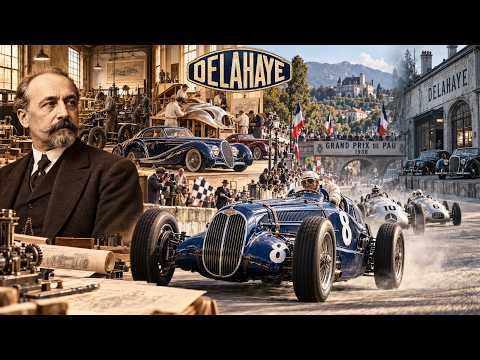
Before there was a blue racing car, before there was an American heiress, before there was a single silver arrow on any track in Europe, there was a brick kiln. Not a race car, not a carriage—a kiln.
Émile Delahaye was born on October 16, 1843, in Tours, a quiet river city in the Loire Valley, two hours southwest of Paris. Tours was a city of cathedrals, vineyards, and craftsmen. It was not a city of machines. Not yet.
Young Émile was drawn to mechanics early, and he chose the practical road. He trained as an engineer at the National School of Arts and Trades in Angers—a school built to turn sharp working-class boys into the men who kept France’s factories running. It was not a school for aristocrats. It was a school for people who would spend their lives with grease under their fingernails.
Then history interrupted. In 1870, France went to war with Prussia. It was supposed to be a short war. It was not. France lost it in a matter of months. The emperor was captured. Paris was besieged. A new German empire was proclaimed inside the Hall of Mirrors at Versailles—on French soil, in front of the whole world. For an entire generation of Frenchmen, that defeat was a wound that never closed. Remember that wound. It will matter again 68 years later on a street circuit in the south of France.
After the war, Émile Delahaye went home to Tours. He took a job with a local businessman named Louis-Julien Bréton, who ran a foundry and machine works operating since 1845. Bréton’s shop built equipment for the ceramics trade—machines for pressing bricks, shaping tiles, and the kilns that baked them. It was steady work. It was dull work. And Delahaye was very good at it.
He started as Bréton’s administrative assistant and senior engineer. He learned the books. He learned the customers. He learned how to keep a small industrial shop alive in a country still paying for a lost war. And in 1879, he took control of the business himself. He was 35 years old. He now owned a factory that made brick-making machinery.
That is the foundation of the Delahaye name. Not speed, not glamour—reliability. Machines that had to run every day in dusty brickyards for owners who could not afford a breakdown.
But Delahaye did not stay inside the brickyard. Bréton’s shop had already moved beyond kilns into steam engines. And in the 1880s, it began building gas and paraffin engines. Delahaye pushed further. In 1888, he designed an internal combustion engine for marine use. Engines were becoming smaller, lighter, and more powerful every year. And a question was starting to form in the minds of engineers all across Europe: if an engine could drive a boat, why not a carriage?
In 1894, Delahaye began experimenting with automobiles. His first cars used belt drive—the same leather belt technology that turned the machinery in his own factory. It was not elegant. It was not fast. But it worked. And in those years, working was everything.
His first car was shown to the public in 1895, and Émile Delahaye understood something many rivals did not: in the 1890s, nobody trusted the automobile. It was loud, it frightened horses, and it broke down constantly. The fastest way to prove a car was real was to race it.
So in 1896, Delahaye entered one of his own cars in the brutal Paris–Marseille–Paris race—roughly 1,000 miles on open roads. He did not hire a driver to take the risk. He drove it himself. He was 52 years old.
The race made noise. Orders followed. Soon the little foundry in Tours could not keep up. In 1898, Delahaye moved car production to Paris, into a former hydraulic machinery plant controlled by two new partners, Léon Desmarais and Georges Morane. The company was incorporated. The workforce grew. The factory now stood at the heart of the most important car market in the world at that moment.
Because in the late 1890s, the automobile capital of the planet was not Detroit. It was Paris. Henry Ford had not yet founded the company that would carry his name. Delahaye was already in business.
To run the new Paris works, the partners appointed a young engineer named Charles Weiffenbach as works manager. Weiffenbach had been born in Alsace in 1870—the region Germany would seize after the war—and he had been on the verge of leaving France altogether for a job in Indochina when the offer came. He stayed. That decision would shape Delahaye for the next 56 years.
Because Émile Delahaye was running out of time. His health was failing fast. By 1901, he could no longer run the company that carried his name. He sold his shares to his partners, left Paris, and retired to the French Riviera. He died there on June 1, 1905. He was 61 years old. He had no heirs—no son to inherit the name, no daughter to marry into it. The company would carry the name Delahaye for another half century, but there would never again be a Delahaye running it.
And the man who did run it, Monsieur Charles, had one firm opinion about motor racing: he wanted nothing to do with it.
Charles Weiffenbach did not hate speed. He simply did not trust it. To him, racing was a rich man’s gamble. It burned money, broke machines, and killed drivers. A serious company did not build its future on Sunday afternoons. A serious company built things people needed on Monday morning.
So after Émile Delahaye’s death in 1905, the company stepped away from motor racing. For a few more years, Delahaye engines kept competing on the water in powerboat races, where they won several events and even set a world water speed record of about 34 mph. Then that stopped too.
In 1906, Weiffenbach took full control of the company from Desmarais and Morane. And under Monsieur Charles, Delahaye became something its founder might never have predicted. It became dependable.
Delahaye built passenger cars, yes. But its real strength was in heavy machines: trucks, buses, commercial chassis, and above all, fire engines. Across France, when a building caught fire, there was a good chance the pumper racing down the street to save it carried a Delahaye badge.
Think about what that means for a brand. A fire engine cannot fail. It sits quietly for days and then at 3:00 in the morning, it has to start on the first try and run flat out. Delahaye built its reputation on exactly that kind of reliability.
The company was not boring because it lacked talent. Its chief design engineer, Amédée Varlet, was an innovator. In 1911, Delahaye introduced the Type 44, powered by one of the earliest V6 engines ever put into a production automobile. Today, the V6 is everywhere—in pickup trucks, minivans, family sedans, and every American driveway. More than a century ago, a fire engine company in Paris was already building one.
But the world did not remember Delahaye for the V6. It remembered nothing at all.
Through the First World War, through the 1920s, Delahaye kept doing what it did best: solid cars, solid trucks, solid profits. Its passenger cars were well-built and well-made, and almost nobody dreamed about them. They were the automotive equivalent of a good pair of work boots.
Then the ground shifted. The Great Depression reached France later than it reached the United States. But when it arrived in the early 1930s, it hit the French auto industry hard. Mass-market makers like Citroën and Renault were fighting for every customer. Small independent companies were squeezed from both ends. They could not match the big firms on price, and they could not match the luxury houses on glamour. Delahaye was caught right in the middle. It sold respectable cars to cautious buyers—and cautious buyers were exactly the people who stopped buying cars during a depression. The truck business kept the lights on, but the passenger car side was drifting toward irrelevance.
The push for change did not come from Weiffenbach. It came from the boardroom. In 1932, the majority shareholder of Delahaye was Madame Léon Desmarais, the widow of one of Émile Delahaye’s original partners. And she gave Weiffenbach an instruction that went against everything he had built for a quarter of a century: “Build something exciting. A new line of cars. Sportier, better handling, more horsepower, a higher price—a design people would notice on the street.”
Weiffenbach was now in his early 60s. He had spent decades making Delahaye safe. Now he was being asked to make it desirable.
Here is the first crack of the paradox. Hold on to it. The company that survived by building machines nobody noticed was about to bet its future on machines everybody would notice. The trucks and the fire engines would keep paying the bills, but the name Delahaye would soon belong to something else entirely: long hoods, flowing fenders, roaring engines, and racetracks.
Weiffenbach did what a careful man does when he is told to take a risk. He found the right engineer. He told him to use as many existing parts as possible. And he waited to see whether anyone would care.
Someone did. At a Paris motor show, a young woman walked up to Charles Weiffenbach with a request no one at Delahaye had ever heard before. She did not want a fire engine. She did not want a delivery truck. She wanted a car that could win.
She was rich. She was fearless. She had grown up in Paris, and she was an American. Her name was Lucy O’Reilly Schell.
She was born in Paris on October 26, 1896, the only child of an Irish-American businessman who had made a fortune in real estate and a French mother. She spoke French like a Parisian, carried an American passport, and had inherited something worth more than money: she did not take no for an answer.
In 1934, she walked onto the floor of the Paris Auto Salon and found Delahaye. Her idea was simple—take the most powerful engine Delahaye made, the 3.2-liter six from the Type 138, and drop it into the shorter, lighter chassis of the smaller Type 134. More power, less weight. She did not just buy a car. She paid the development costs for a short-wheelbase competition version of what would become the Delahaye Type 135. Then she bought twelve of them.
Half she kept for her own racing team. She called it Écurie Bleue—the blue stable. Blue, the traditional racing color of France. An American woman had just named her team after the French flag.
For two seasons, the Schells were everywhere: rallies, sports car races, hill climbs. Then at the end of 1936, the factory pulled out. A serious accident at the Montlhéry Grand Prix had left a Delahaye privateer paralyzed, and for a company led by a man who had never trusted racing, that was enough.
But 1936 was also the year everything changed for Lucy. Her father died, and she inherited his estate—roughly $5 million. In the middle of the Depression, that was not just wealth. That was power. If Delahaye would not run a racing team, the Schells would become the racing team.
And Lucy was not thinking small. She wanted Grand Prix racing—the top level, the arena where nations measured themselves. For 1938, the rules changed, opening the door to unsupercharged engines of up to 4.5 liters. She went to Delahaye with an offer: build a brand new car for the new formula. She would pay for it.
Here is the paradox already taking shape. For forty years, Delahaye had survived on caution. Now its most famous machines would be paid for by someone else’s fortune, raced by someone else’s team, and driven toward a fight it had never chosen. And the opponent waiting in that fight was not just another car company. It was a government.
On the other side of the Rhine, two German teams had already turned Grand Prix racing into a weapon. They had money no private fortune could match. They had engineers no French firm could afford. And they had not lost a fight in years.
But before Delahaye could fight anyone, it needed a car worth fighting with. And to build that car, Charles Weiffenbach turned to an engineer named Jean François.
François was not a celebrity. He did not race. He did not give speeches. He had joined Delahaye as an assistant to the company’s veteran chief engineer, Amédée Varlet—the man behind that early V6. Now Weiffenbach made him designer and chief engineer and handed him an assignment that sounded almost impossible: build a fast, modern, beautiful car and do it with as many parts as possible from the trucks.
That was the rule. No blank check, no exotic new engine. Delahaye did not have the money for a moonshot. It had a warehouse full of heavy-duty components designed for buses, delivery vans, and fire engines.
François looked at that warehouse and saw something nobody else did. Truck engines are not built to be pretty. They are built to survive. They run for hours under heavy load at high temperatures without complaint. And Delahaye’s six-cylinder truck engine was a tough, simple overhead-valve design that could take a beating. If you lightened it, sharpened it, fed it more fuel and more air, it might do something no one expected.
It might win races.
The first proof came in 1934. Delahaye took a stripped-down, streamlined version of its 18 Sport model to the Montlhéry speed bowl south of Paris and set eighteen international class records. It was a quiet signal. The fire engine company could go fast.
Then came the car that would define the name. The Type 135 was introduced in 1935. Under the hood sat that truck-derived six, now tuned for performance, in a lower, lighter chassis. Up front, François gave it independent front suspension so each wheel could move on its own over bumps—a real advantage on rough French roads and tight mountain passes. Many buyers chose the Cotal gearbox, an electrically operated pre-selector transmission. The driver flicked a tiny lever mounted on the steering column, pressed the clutch, and the gear changed. No wrestling a heavy shifter in a rally at night on ice. That mattered.
But the most important decision about the 135 was not mechanical at all. Delahaye did not build the bodies. In the French luxury tradition, the factory sold a rolling chassis—frame, engine, gearbox, suspension, wheels. Then the customer took that chassis to an independent coachbuilder who designed and hand-built the body. And Paris in the 1930s had some of the greatest coachbuilders who ever lived: Henri Chapron, Marius Franay, Jacques Saoutchik, Letourneur et Marchand, and the most famous of all, Figoni et Falaschi.
Joseph Figoni and Ovidio Falaschi turned the 135 into rolling sculpture—fenders that swept like falling water, teardrop shapes, chrome spears. Cars so curved, so theatrical that people on the street simply stopped and stared. Today, American collectors pay millions for exactly these cars, and judges at Pebble Beach treat them as works of art.
So the 135 lived a double life. On Monday, it was the most glamorous car in Paris. On Sunday, it was a race car.
That same year, Delahaye made a bold corporate move as well. In 1935, the great French luxury marque Delage was in financial collapse, and Delahaye took it over. The fire engine company now owned one of the most prestigious names in French motoring. Confidence was rising.
And then racing taught Delahaye a lesson in humility.
In 1936, the French Grand Prix was run for sports cars instead of pure Grand Prix machines. French organizers had made that choice partly because no French single-seater could hope to compete with the Germans. This was Delahaye’s chance to shine on home soil in front of a home crowd. The 135s ran beautifully. They finished second, third, fourth, and fifth. But not first. First place went to Bugatti. Four cars on the leaderboard and still not good enough. The fire engine company had built a superb machine, and it had lost to the artist from Molsheim.
The following summer at the 24 Hours of Le Mans in 1937, it happened again. Delahaye ran strong. A Bugatti won. Second place again. For Lucy Schell, who was pouring her own fortune into the program, those defeats burned. Coming close was not the point. She did not want to be the best of the rest.
And she understood something that Weiffenbach still did not want to accept: sports car racing was a side stage. The main stage—the one the whole world watched—was Grand Prix racing.
The 135 had shown what Jean François could do with a truck engine and a tight budget. Now Lucy wanted to know what he could do with real money and a clean sheet of paper. Her offer was simple. Delahaye would design a new car for the 1938 Grand Prix rules. A big, unsupercharged engine. Twelve cylinders. Écurie Bleue would pay the bill.
Jean François went back to his drawing board.
The 135 would get its revenge eventually. In June 1938, Delahaye finished first and second at Le Mans, with Eugène Chaboud and Jean Trémoulet taking the win. The fire engine company finally owned the most famous sports car race on Earth. But by then, Le Mans was no longer the fight that mattered. Because the cars Lucy now wanted to beat were not French. They were not Italian. They were silver. And they had been built with the backing of the Nazi state.
To understand what Lucy Schell was walking into, you have to understand what Grand Prix racing had become. In 1934, the sport introduced a new rule: Grand Prix cars could weigh no more than 750 kilograms—about 1,650 pounds—without fuel, oil, water, or tires. The idea was simple. Light cars would mean smaller engines, and smaller engines would mean lower speeds. The idea failed completely.
Two German companies, Mercedes-Benz and Auto Union, answered that rule with lightweight alloy bodies, exotic metals, and enormous supercharged engines. Their cars were left in bare polished aluminum. They looked like bullets. The world called them the Silver Arrows. And behind them stood the German government.
Adolf Hitler’s regime understood that racing was propaganda on wheels. A German car winning in France, Italy, or Switzerland was a headline about German superiority. So the state backed both teams with subsidies, and the two companies poured in even more of their own money. The results were crushing. From 1934 onward, the Silver Arrows won almost everything that mattered.
For France, it was humiliating. France had invented Grand Prix racing. The very first Grand Prix in history had been run in France in 1906. French cars had once ruled Europe. Now French teams could not even keep the German cars in sight. In 1936 and 1937, the French organizers made a decision that said everything: they ran the French Grand Prix for sports cars simply to give French manufacturers a chance to win their own national race.
And it was not just national pride on the line. Remember the defeat of 1870. Remember a German empire proclaimed at Versailles. Remember the trenches of 1914 to 1918. For millions of French men and women, losing to Germany was never just about sport.
By the mid-1930s, the governing body decided the formula had to change. For 1938, Grand Prix cars would be limited to 3 liters with a supercharger or 4.5 liters without one. The German teams immediately began building new machines. Then in January 1938, before the new season even began, Auto Union’s brightest star, Bernd Rosemeyer, was killed during a high-speed record attempt on a German autobahn. The sport was faster, more dangerous, and more political than ever.
France needed an answer, and in 1937 it created one. A national racing fund, the Fonds de Course, was set up to put France back into Grand Prix competition. Part of its money came from the drivers of France themselves—a small slice of every new driver’s license fee.
The fund announced a challenge. One million francs would go to the French car built to the new 1938 rules that could cover 200 kilometers at Montlhéry—about 124 miles—at an average of 146.5 km/h, roughly 91 mph. And it would have to do it before the end of August 1937.
The prix du million—the million-franc prize. It was not just money. It was a statement. Whoever won it would carry the hopes of France into the 1938 season.
Lucy Schell had the money. Delahaye had the engineer. Now she needed a driver. She found one who had his own reasons to want to beat Germany. His name was René Dreyfus.
Born in Nice in 1905, he had won the Monaco Grand Prix in 1930 driving his own Bugatti, beating the factory team. He was fast, intelligent, and unusually smooth behind the wheel. He had driven for Bugatti, for Ferrari’s team running Alfa Romeos, and for Talbot, where his most recent season had been a miserable one.
But there was one kind of team Dreyfus could never drive for: a German one. His surname was Jewish. And in Hitler’s Germany, that alone was enough to shut every door. The best-funded racing teams in the world would never put René Dreyfus in one of their cars.
So Dreyfus joined Écurie Bleue—a Jewish driver, an American heiress, a French fire engine company against the most powerful racing machine ever assembled by a nation. On paper, it was not a contest.
All they needed now was the car. And when Dreyfus finally saw it, he thought it was the ugliest thing he had ever laid eyes on.
The story goes that the most important engine in Delahaye’s history began on a napkin. Over lunch at a Paris restaurant, Jean François sketched out an idea for Charles Weiffenbach. Not a six. Not an eight. A V12. Twelve cylinders, no supercharger, built to the absolute limit of the new 4.5-liter rule.
It was a strange choice—on purpose. The Germans were going the other way. For 1938, Mercedes-Benz chose the smaller limit: 3 liters with a supercharger. A supercharger is an air pump driven by the engine itself. It forces extra air into the cylinders, and extra air means you can burn extra fuel, and extra fuel means enormous power. It is a brute-force solution, and it is thirsty.
François could not match that power. So he did not try. Instead, he built an engine that would be lighter, simpler to feed, and far easier on fuel. A big, unsupercharged engine does not have to work as hard. It breathes naturally. It sips where the German engine gulps. Over a short sprint, that is a weakness. Over a long race, it can become a weapon.
Here is how he did it. The two banks of six cylinders sat at a 60-degree angle, forming a compact V. In an age when most engines were cast in heavy iron, François used aluminum alloy for the cylinder heads and magnesium alloy for the engine block—a remarkably daring choice in the 1930s. Magnesium is extremely light. It is also expensive and tricky to work with. Delahaye used it anyway.
Then came the clever part: the valves. In most engines of the day, a single camshaft opened the valves through long rods. François used three camshafts, all inside the engine block. One sat in the middle of the V and opened all twelve intake valves. Two more sat low on each side and opened the exhaust valves. From the outside, the engine looked like an exotic racing design with overhead cams. Underneath, it was a smart, sturdy pushrod engine—the kind of thinking that came straight out of a company that built trucks.
Now the numbers. Displacement: 4,496 cc, about 274 cubic inches. Bore: 75 mm. Stroke: 84.7 mm. Three twin-choke carburetors sat between the cylinder banks. Depending on the tune and the fuel, the engine made roughly 225 to 245 horsepower at around 5,500 rpm. The chassis came from the short-wheelbase 135 competition car—about 106 inches between the axles—with a pair of short trailing arms added at the rear to sharpen the handling. The complete car weighed around 2,250 pounds.
To feel how advanced that was, put it next to the most prestigious engine in America that same year. In 1938, Cadillac introduced its new Series 90 V16. It was the flagship of General Motors, the car of movie stars and millionaires. Its sixteen cylinders displaced 431 cubic inches. It made 185 horsepower at 3,600 rpm. The base price was $5,140 in a year when the average American earned $1,731.
So here is the comparison. The Cadillac had four more cylinders and 157 more cubic inches. The Delahaye made up to 60 more horsepower per cubic inch. The French V12 produced roughly twice the power of America’s mightiest luxury engine, and it revved almost 2,000 rpm higher.
Of course, the Cadillac was built for silence, not speed. It was a limousine engine designed to glide a heavy Fleetwood body down Fifth Avenue. But that is exactly the point. Detroit’s greatest engine was built to impress a doorman. Delahaye’s was built to survive three hours at full throttle.
Still, the German car would have far more power than either. The Mercedes W154 made well over 400 horsepower. On a long straight, the Delahaye had no chance. Delahaye’s engineers knew it. Everyone knew it.
Only twelve sets of V12 engine parts were ever made. From them came four Type 145 sports racing cars for Lucy Schell’s team, one pure single-seat Grand Prix car called the Type 155, and a handful of road-going Grand Touring cars called the Type 165. This was not a production engine. It was a hand-built weapon for a single war.
The first Type 145 rolled out for testing at Montlhéry on June 25, 1937. And when René Dreyfus saw it for the first time, he was not impressed. He was horrified. Years later, Dreyfus would write that it was, in his opinion, the most awful-looking automobile he had ever seen. And he had a point. The 145 was not one of Figoni’s flowing sculptures. It was a stubby, functional, slab-sided two-seater with a blunt nose and a cockpit that looked borrowed from a sports car—because it was. Next to the long, sleek silver Mercedes, it looked like a fire engine company had built it. Which, of course, it had.
The racing press was not much kinder. Few gave a heavy, unsupercharged French sports car any real hope against the factory teams of Germany. But Dreyfus soon discovered something about that ugly little car. It was nimble. It was predictable. It turned into corners willingly. And it did not drink nearly as much fuel as anyone expected.
There was no time to admire it and no time to fix its looks. The deadline for the million-franc prize was the end of August 1937, and Bugatti was already on the track.
The rules of the prix du million were brutally simple. One car, one driver, sixteen laps of the Montlhéry road circuit—a combination of steep concrete banking and twisting public road sections. Each lap about 7.8 miles. A total of 200 kilometers, roughly 124 miles. A standing start, and an average speed above 146.5 km/h—just over 91 mph—from the moment the flag dropped to the moment the car crossed the line. No pit stops worth taking. No margin for error. In a deadline: the end of August 1937.
It sounds easy on paper. It was not. That average included the standing start, the slow corners, the bumps, and the punishing transition from the banking down onto the road course. To hold 91 miles per hour across all of it, a driver had to run flat out for well over an hour on tires that were never designed for that kind of abuse.
And Delahaye was not alone. Ettore Bugatti had been one of the first to accept the challenge. His driver was Jean-Pierre Wimille, one of the fastest men in France—and at that moment, the man Dreyfus feared most. Bugatti was the most famous name in French motorsport. It had beaten Delahaye at the French Grand Prix. It had beaten Delahaye at Le Mans. Now it wanted the million francs, too.
Through the summer of 1937, both teams tested, tuned, and pushed. The ugly blue Delahaye was new, barely sorted, and still revealing its weaknesses. The Bugatti was fast, but fragile. Each team knew the other was watching. Each attempt ate into the calendar.
August came. The days ran down.
On August 27, 1937—just four days before the deadline—René Dreyfus brought the Delahaye 145 to Montlhéry. Wimille was there with the Bugatti. This was no longer a time trial. It was a duel.
The flag fell. Dreyfus launched the Delahaye off the line. And from that moment on, there was nothing gentle about the way he drove. He had to bank time early because he knew the hardest laps would come at the end, when the car was tired and the tires were going, up onto the banking. The V12 howling down onto the road course. Brake, turn, accelerate. Again. Again.
The Delahaye was not the fastest car France had ever built, but it was steady, and it was consistent. And lap after lap, the numbers on the stopwatch held.
Then the tires began to fail. The special Dunlops had been built for speed, but Dreyfus was pushing harder than anyone had planned. As the laps wore on, the rubber wore away. Deeper. Thinner. Down toward the fabric cords underneath. A blowout on the banking at over 100 mph could kill him. If he eased off, he would lose the prize. If he kept going, he risked everything. He kept going.
Meanwhile, the Bugatti was pushing just as hard. Wimille was a superb driver, and for a while, the two cars were driving each other to speeds neither team had expected. Then the Bugatti broke—not for the first time. Under the strain of that pace, Bugatti’s machinery gave out, and Wimille’s challenge was over.
Dreyfus was alone. And he still had to finish. He brought the Delahaye home on tires worn almost to the fabric. The final time: 1 hour, 21 minutes, 49.5 seconds. The average speed: 146.654 km/h. A little over 91 mph. He had cleared the target by a sliver—barely more than a tenth of a mile per hour. But in this contest, a sliver was enough.
The fire engine company had won the million-franc prize. The money was split down the middle between Delahaye and Écurie Bleue. Dreyfus received half of the team’s share. And Lucy Schell did something that told you exactly who she was: she ordered a red and white stripe painted diagonally across the body of every one of her cars, so that no one who saw an Écurie Bleue Delahaye would ever forget what it had done.
For the first time in years, France had a reason to believe.
But the million-franc prize had been a race against a clock and against another French car. Nobody from Germany had been on that track. That was about to change. In a few short months, the new Grand Prix season would open, and the first race on the calendar would bring Mercedes-Benz with its brand new car to a narrow street circuit in the south of France.
The town was called Pau.
Pau sits in the far southwest of France, in the shadow of the Pyrenees. It is an old spa town of parks, palaces, and grand hotels where wealthy British visitors once came to spend the winter. Every spring, its streets became a racetrack. The circuit was tiny—just 2.76 kilometers around, about 1.7 miles—winding through the town, past stone walls, steep climbs, and a tight hairpin. There was almost no room to pass. There was no place to hide. And the race was long: 100 laps, roughly 172 miles of braking, turning, and accelerating over and over for more than three hours.
It was the first race of the 1938 Grand Prix season, and Mercedes-Benz had chosen it to unveil its brand new weapon: the W154. Long, low, silver, built to the new 3-liter supercharged rules, with a V12 engine producing well over 400 horsepower. It was designed by Rudolf Uhlenhaut and backed by the full weight of Germany’s racing program. Mercedes entered two of them for two of the best drivers in the world: Rudolf Caracciola, the reigning European champion, and Hermann Lang.
Alfa Romeo was expected to give them the stiffest fight. It never got the chance. During practice, Tazio Nuvolari’s Alfa caught fire when its flexing chassis split the fuel tank. Nuvolari was burned. Alfa withdrew its other car as a precaution.
Then Mercedes ran into trouble of its own. The W154 was a monster built for fast open circuits. On the narrow streets of Pau, it felt clumsy. Its clutch slipped. Its spark plugs fouled with oil. And during practice, Hermann Lang slid off the road. Mercedes made a decision: it would focus on one car—Caracciola’s.
On the other side stood Écurie Bleue, with two Delahaye 145s. One for Gianfranco Comotti, the other for René Dreyfus, in the very car that had won the million-franc prize, stripped of its road equipment, still a two-seater with a panel covering the empty passenger side.
On paper, it was a mismatch. The Mercedes had far more power. But Lucy Schell’s team had done a different kind of math. The supercharged Mercedes was thirsty. Over 100 laps, it would have to stop for fuel. The Delahaye used roughly half as much fuel per mile. If everything held together, it would not need to stop at all. The race would not be won on the straights. It would be won in the pits.
The flag dropped. Caracciola jumped into the lead, exactly as everyone expected. The silver car pulled away out of the corners, its supercharger screaming. But it did not pull away for long. Through the tight turns and the slow hairpin, Dreyfus kept the blue Delahaye right behind. The French car was lighter on its feet, easier to place, and Dreyfus was driving it with total precision. Every time Caracciola hit the brakes, the Delahaye closed in. Lap after lap, the silver car and the blue car ran nose-to-tail through the streets of Pau. The crowd could not believe what it was seeing. The German car was not running away.
As the race passed the 20-lap mark, then 30, then 40, the pattern held. The Mercedes was faster in a straight line. The Delahaye was not losing ground. And every lap, the Mercedes burned through more of its fuel.
Then the circuit itself began to take its toll on Caracciola. Five years earlier at Monaco, he had suffered a devastating crash that badly injured his leg. Pau’s endless sequence of braking and turning was hammering that old wound. On lap 52—just past half distance—the Mercedes came into the pits. Fuel, and a new driver. Caracciola climbed out. Hermann Lang climbed in. The seconds ticked away while the crew refueled the silver car.
René Dreyfus did not stop. The blue Delahaye flashed past the pits and into the lead.
Now the race flipped. It was Mercedes doing the chasing. Lang was a superb driver, and he pushed the W154 as hard as he dared, but his car was still misbehaving, still struggling with plug trouble, still too big and too heavy for those streets. And out in front, Dreyfus was doing exactly what he had done at Montlhéry. Steady. Clean. Relentless. No mistakes.
Sixty laps. Seventy. Eighty. Every time the Delahaye came past the pits, Écurie Bleue’s crew held their breath. Would the V12 hold? Would the fuel last? Would the gearbox survive the endless shifting? It held. Ninety laps. Ninety-five. Dreyfus did not ease off. He did not need to. The gap kept growing.
Lap 100. René Dreyfus crossed the line in 3 hours, 8 minutes, 59 seconds. The Mercedes came home 1 minute and 51 seconds later. And six laps behind them, Gianfranco Comotti brought the second Écurie Bleue Delahaye home in third.
A Jewish driver. An American heiress. A French fire engine company. They had just beaten Mercedes-Benz.
The crowd went wild. The French press could hardly contain itself. For four seasons, the Silver Arrows had humiliated French racing. Now, on French soil, at the very first race of the new formula, a French car had beaten the newest Mercedes on its debut.
And it was no fluke. Two weeks later, on April 23, at the Cork Grand Prix in Ireland, Dreyfus and the Delahaye won again. Lucy Schell was convinced: with the right support, Écurie Bleue could take the fight to Germany all season long. France would finally have a Grand Prix team worthy of its history.
She was wrong.
Pau would turn out to be the only French victory against the Silver Arrows in a Grand Prix race between 1934 and 1939. One race. One afternoon. And the fight that came next would not be against Germany. It would be against France itself.
After Pau and Cork, Lucy Schell believed she had earned something: support. The Fonds de Course—France’s national racing fund—existed for one reason: to put French cars back on top of Grand Prix racing. Écurie Bleue had just done exactly that. Lucy expected the fund to stand behind her team for the rest of the season.
It did not. The fund’s leadership preferred to spread its money among other French efforts, especially Talbot and Bugatti. To Lucy, that was a betrayal. She had paid for the car. She had hired the driver. She had won the prize and beaten Mercedes. Now the people who were supposed to support French racing were backing her rivals.
The argument turned bitter. And Lucy did what Lucy always did: she refused to back down. Écurie Bleue moved its base from France to Monaco. And when the French Grand Prix came to Reims that July, Lucy’s team stayed away. They boycotted their own national race. Without them, Mercedes finished first, second, and third.
That was the real shape of 1938. Pau had been a thunderbolt, but it did not change the balance of power. Once Mercedes sorted out its new car, the Silver Arrows went back to winning almost everything. Lang won at Tripoli. Richard Seaman won the German Grand Prix. Caracciola won in Switzerland and took the European Championship. The Delahaye 145 kept fighting. At the Nürburgring, Dreyfus brought his 145 home fifth against a field of German machines. In the Mille Miglia, Italy’s thousand-mile road race, the million-franc car finished fourth.
But the pure single-seat Delahaye, the Type 155, was never fully developed. And in the end, Lucy did something that would have been unthinkable a year earlier. She turned to Italy. Her team began running Maseratis. The partnership that had made Delahaye a racing legend was coming apart.
Then the world came apart with it.
In September 1939, Germany invaded Poland, and France declared war. René Dreyfus was drafted into the French army. The man who had beaten Mercedes at Pau was now driving military trucks.
On October 18, 1939, tragedy struck the Schell family. Lucy and Laury were caught in a road accident in France. Laury was killed. Lucy was seriously injured. She lost her husband, her racing partner, and the man she had shared the wheel with for twenty years.
She did not quit. She renamed the team after herself and set her sights on a new target, one about as far from the war as she could get: the Indianapolis 500.
In the spring of 1940, the French government made an extraordinary decision. It pulled René Dreyfus out of the army and sent him to the United States to represent France at the Indianapolis Motor Speedway, alongside fellow French driver René Le Bègue. They would drive Lucy’s Maseratis. Lucy’s son Harry—just eighteen years old and still speaking mostly French—helped run the effort.
Indianapolis was a completely different world. Huge crowds, a two-and-a-half-mile oval, American cars, American drivers, American rules. Le Bègue qualified. Dreyfus did not make the starting field on his own. So the two Frenchmen shared one car on Memorial Day, May 30, 1940, swapping in and out through the race. They finished tenth.
But the result hardly mattered. While they were in Indiana, the news from Europe was catastrophic. German forces were sweeping through France. In June 1940, France surrendered. Dreyfus had no country to go home to, so he stayed. He opened a restaurant in northern New Jersey. And when America entered the war, René Dreyfus—who had served in the French Army just a year earlier—enlisted in the United States Army. He served as a non-commissioned officer in North Africa and southern Italy. Harry Schell stayed, too. He joined the US Army’s tank corps.
And the Delahayes? They were left behind in occupied France.
For decades, a romantic legend grew around the million-franc car. French patriots, the story went, had taken it apart and hidden the pieces so the Germans could never seize it. It is a wonderful story. The paper trail tells a quieter one. Lucy Schell kept ownership of her V12 cars, and the million-franc Delahaye was stored away for the duration of the war. Either way, the result was the same. The machine that had beaten Mercedes sat silent in the dark for five years.
When France was finally liberated, Delahaye’s factory was still standing. Its trucks were still needed. Its name was still famous. The company had survived the war. Now it had to survive the peace.
And the peace would bring an enemy that no racing driver could outrun.
France came out of the Second World War exhausted. Its factories were damaged. Its railways were broken. Its currency was weak. Steel, rubber, and fuel were all in desperately short supply. And the new government in Paris believed the answer was central planning. The state would decide what each industry built, how much it built, and who got the raw materials to build it.
For the auto industry, that plan had a name: the Pons Plan. It was drawn up by a senior civil servant named Paul-Marie Pons, and it carved up the French car business like a map. The big mass-market companies would build the small, cheap, practical cars that a poor country needed. Luxury makers were placed in a separate category. Delahaye, together with its sister brand Delage, was grouped with Hotchkiss and Talbot. Their assignment: build expensive cars and sell them abroad. Exports meant foreign currency, and foreign currency was something postwar France badly needed.
On paper, it was a role. In practice, it was a cage. The government controlled the steel supply, and luxury car makers sat near the bottom of the priority list. If you did not follow the plan, you did not get the materials.
Delahaye played along. It revived the Type 135, now refined as the 135 M, and the great coachbuilders came back to life with it. Figoni et Falaschi, Chapron, Saoutchik, and Franay draped those postwar chassis in some of the most extravagant bodies ever put on wheels. At the Paris shows, crowds packed the Delahaye stands. Looking was free. Buying was not.
Because the real killer was not the plan itself. It was the tax.
France had long taxed cars by fiscal horsepower—a formula based on engine size rather than actual output. After the war, that system turned brutal for anything big. An annual tax hammered every car with an engine much larger than about 2 liters. A wealthy Frenchman buying a big luxury car now paid not just a staggering purchase price, but a punishing bill every single year he owned it. One rival, Talbot-Lago, calculated that its 4.5-liter owners paid around three and a half times the tax of someone driving a big Citroën.
For an American, imagine the IRS deciding that every Cadillac owner should pay a yearly penalty several times larger than a Chevrolet owner’s—just for owning the car. Then imagine your Cadillac.
Delahaye tried to fight its way through. In 1947, it launched the Type 175 with a new 4.5-liter six-cylinder engine. It was meant to be the great postwar flagship. Instead, it was a disaster. Only 521 were built between 1947 and 1950. By 1951, combined production of the 135 and 175 families had collapsed to just 77 cars. Seventy-seven. The company that once built fire engines for half of France was now selling fewer luxury cars in a year than a single Detroit plant could assemble before lunch.
Delahaye needed a lifeline, and it found one in the most unexpected place: the French army.
After the war, the French military was running on thousands of American jeeps—the famous Willys design that had carried GIs from Normandy to Berlin. Those jeeps were wearing out. The army wanted a French replacement. Delahaye won the job. In the summer of 1950, it presented the VLR—a light reconnaissance vehicle. And in true Delahaye fashion, it was not a simple copy of the Jeep. It was better. More advanced. Four-wheel independent torsion-bar suspension, a four-speed synchromesh gearbox, a clever, modern design. The Army tested it, liked it, and placed an order for more than 4,000 vehicles.
For a company selling 77 cars a year, it looked like salvation.
Here is the decision that would backfire. The VLR was brilliant on a test track in perfect condition, maintained by experts. But soldiers do not treat vehicles like experts do. In the field, the VLR’s sophistication became its weakness. It broke down. It needed careful maintenance that young conscripts were not trained to give. Many were crashed by inexperienced drivers. And every failure sent Delahaye’s money flowing out the door in repairs, parts, and support. The very engineering pride that had built the 145 was now draining the company dry.
Meanwhile, Delahaye made one last attempt at the luxury market. At the 1951 Paris Salon, it unveiled the Type 235—a modernized 135 with a 3.5-liter six making 152 horsepower and a top speed around 106 mph. Gorgeous. Fast for a luxury car. And hopelessly expensive. A Chapron-bodied 235 cost about twice as much as a Jaguar XK120—a car that was much faster. It cost about five times as much as a big six-cylinder Citroën. Underneath the modern styling, its engineering still came from the 1930s. Only 84 would ever be built.
And waiting in the wings was Hotchkiss—the Paris company that was assembling the original American Jeep under license. The French army was starting to wonder why it needed a fancy French jeep at all when it could simply buy a real one.
The end did not come with a crash. It came with paperwork.
By the early 1950s, the French army had made up its mind. It had thousands of old American jeeps, warehouses full of spare parts for them, and a Paris company ready to build fresh ones under license from Willys-Overland. That company was Hotchkiss. Its version, later known as the Hotchkiss M201, was simple, rugged, and familiar. Every mechanic in the army already knew how to fix it. The Delahaye VLR was more modern. It was more sophisticated. And it did not matter. The army did not want a better Jeep. It wanted a Jeep.
Delahaye built roughly 9,600 VLRs in all. Production was halted in March 1954. Without the military contract, there was nothing left to hold the company up. The luxury cars were not selling. The tax system was punishing every buyer. The trucks alone could not carry the weight.
On June 9, 1954, Delahaye’s shareholders signed the protocol that handed the company to Hotchkiss. Think about that for a moment. The company that beat the Silver Arrows was finished off by the firm building America’s Jeep in France. Not by Mercedes. Not by Bugatti. Not by Germany. By a utility vehicle designed in Ohio—the same kind of vehicle the US Army had driven into France to liberate it ten years earlier.
Charles Weiffenbach retired that same year. He had first walked into the Delahaye works at the end of the 1890s. He had run the company since 1906. Forty-eight years in charge. He had kept it alive through two world wars, a depression, and a revolution in how the world built cars. He had never wanted to race. And yet, the cars that would make his company immortal were the racers he had been talked into building.
Lucy O’Reilly Schell did not live to see the end. She died in Monte Carlo on June 8, 1952, at 55 years old. Her son Harry was by then racing in Formula 1. Her V12 Delahayes were scattered, rebodied, and half forgotten.
In October 1954, the Paris Motor Show opened its doors one last time with Delahaye on the floor. The remaining Type 235s were there—not as the start of anything, but as inventory. They were brought to the show simply to sell off what was left. Eighty-four cars. That was the final production of the last Delahaye ever designed.
On December 31, 1954, the company Émile Delahaye had founded in Tours sixty years earlier came to an end. The Delage name died with it. Hotchkiss would keep a few Delahaye-badged trucks in production for a little while longer. Then those were gone, too. Within a year, Hotchkiss itself would stop building passenger cars. And around them, the whole world that had made Delahaye possible was disappearing. The great coachbuilders of Paris—the craftsmen who had turned bare chassis into rolling sculpture—were closing one by one.
When the coachbuilder Marius Franay went bankrupt in 1956, he finally parted with his most magnificent creation: a road-going body built in 1946 on the chassis of a Delahaye 145. The car believed to have won the million-franc prize.
So who killed Delahaye?
It is tempting to give a simple answer: the tax man, the bureaucrats, the Pons Plan, a government that decided luxury cars were a luxury France could not afford. But the full story is harder than that. You can read the collapse two ways.
You can see Delahaye as a victim—a proud, skilled company that survived a depression and a world war only to be strangled by its own government. Starved of steel, taxed out of its home market, and pushed into chasing an army contract simply to survive. In this reading, Delahaye did nothing wrong. France simply decided it no longer wanted cars like the ones Delahaye built.
Or you can see a company that never moved on from 1938. Its postwar luxury cars still ran on 1930s engineering. Its flagship Type 175 flopped. Its last model cost twice as much as a faster Jaguar. And when it finally found a lifeline in the army, it built a vehicle too clever and too delicate for the job—and paid for that pride until the money ran out. In this reading, the tax man only finished what Delahaye’s own choices had started.
Honest history holds both readings at once. Delahaye was crushed by forces it could not control, and it walked toward them carrying engineering it would not let go.
And that is where the paradox closes. For forty years, Delahaye survived because nobody noticed it. Trucks, buses, fire engines—machines that worked every day and never made a headline. Then it chose to be noticed. Long hoods, flowing fenders, a V12 that beat Mercedes. Cars so beautiful that crowds stopped in the street. That was the glory, and that was the trap. Because the moment Delahaye became a luxury name, its fate became tied to the rich, to big engines, to coachbuilt extravagance—exactly the things postwar France decided to tax out of existence. And when it reached back toward its practical roots with the VLR, it could not resist building something more sophisticated than the job required. The same engineering pride that won at Pau sank the company in the mud.
On a spring afternoon in 1938, in the streets of Pau, the Delahaye’s great advantage was that it did not need to stop. The Mercedes pulled into the pits. The blue car kept going. Sixteen years later, there was no one left to keep going. The factory on the Rue du Banquier fell silent. The coachbuilders closed their doors. The drivers had scattered to new countries and new lives. The man who sketched a V12 on a napkin. The American heiress who paid for it. The fire engine company that dared to build it. All of them were gone or going.
The car that beat Hitler’s racers had not lost a race. It had simply run out of road.
And yet the story was not over, because the cars themselves refused to disappear. They were hidden, rebodied, sold, forgotten. And then, decades later, they were found again. This time, the people chasing them were not racing drivers. They were American collectors. And they were about to pay more for a Delahaye than anyone in 1954 could have imagined.
Today, the Delahaye name lives on through the people who refused to let it fade. In France, the Club Delahaye was founded in 1966. It works to catalog every surviving Delahaye and to keep those cars authentic, and its members are spread across Europe, Australia, Asia, and the United States. Its historians have spent decades tracing chassis numbers, coachbuilders, and owners, piecing together a company that left behind far more questions than answers.
And no question has been fought over harder than this one: which car actually won the million-franc prize?
Only a handful of V12 Type 145s were ever built. After the war, they were rebodied, renumbered, separated from their engines, and sold to new owners who had no idea what they were holding. By the time historians came looking, the paper trail had been scrambled. Two cars in America ended up with credible claims to be the one.
In 2006, the California collector Peter Mullen unveiled his Type 145 at the Pebble Beach Concours d’Elegance as the million-franc Delahaye. During its restoration, his team found lightweight parts all over the car—hollow axles, drilled components, magnesium housings. They also found a surprise: the engine inside was a V12 from the Type 155.
On the other side of the country, in New Jersey, collector Sam Mann owned chassis number 48773. Research done early in his ownership pointed to an intriguing clue: his frame was the only 145 built without mounting holes for fenders. Only the million-franc car, which ran with no fenders at all, would have needed a frame like that. In 2015, after a painstaking restoration that reunited the chassis with Marius Franay’s magnificent postwar body, the car won first in class at Pebble Beach.
The debate has never been fully settled. Honest history leaves it open. But the market has spoken on what these cars are worth. On August 13, 2026, RM Sotheby’s offered the Mann car at its Monterey auction. The estimate was $4.5 million to $6 million. It sold for $3,115,000—below the estimate, and yet still a fortune for a car that a coachbuilder once sold off in bankruptcy.
And it is not even the most valuable Delahaye ever sold. In March 2014 at Amelia Island, Florida, RM Auction sold a 1937 Delahaye 135 Competition Court Torpedo Roadster bodied by Figoni et Falaschi for $6.6 million—a record for the marque. That car had been shipped to the United States in 1939. A longtime American owner had loved it so much that his wife nicknamed it “his French mistress.” In August 2024, Gooding & Company sold a 1938 Delahaye 135M Torpedo Roadster at Pebble Beach for $2,095,000. These are cars built by a company that once could not sell eighty of them in a year.
The people lived on, too. René Dreyfus never went back to racing full-time. He stayed in America, and in 1953 he and his brother Maurice opened Le Chantclair on East 49th Street in Manhattan. It became the unofficial clubhouse of the racing world in New York—a place where visiting drivers gathered around a big round table at lunch. In 1980, Dreyfus served as grand marshal of the United States Grand Prix at Watkins Glen. He died in New York City on August 16, 1993.
Lucy’s son, Harry, became the first American to start a Formula 1 World Championship race, at Monaco in May 1950. He raced at the top level for a decade, until he was killed in practice at Silverstone in May 1960. And in 2020, author Neal Bascomb brought the whole story to a new American audience in his book Faster.
There is no modern Delahaye. No revived brand, no retro tribute car, no luxury SUV wearing the old badge. Unlike Bugatti, unlike Maserati, unlike so many famous names that were bought and brought back, Delahaye stayed gone. There is only one strange survivor of the deal that ended it. The Hotchkiss Jeep—the American design that replaced Delahaye’s VLR—went on to serve the French army for decades. The last ones were not taken out of service until around the year 2000. The Jeep outlasted the company it beat by almost half a century.
But it is the Delahayes that people line up to see. At Pebble Beach and Amelia Island, the crowds do not gather around Hotchkiss jeeps. They gather around flowing Figoni fenders and blue racing cars with a red and white stripe painted across their bodies. They gather around a stubby little two-seater that its own driver once called the ugliest car he had ever seen.
Because the lesson of Delahaye is not about horsepower. Delahaye beat Mercedes with less power, less money, and less of everything except judgment. It won by knowing exactly where its rival was weak—and refusing to stop when the stronger car had to. That is the principle it is remembered for. You do not have to be the most powerful. You have to be the one still running at the end.
And that is the cruelest twist of all. For forty years, Delahaye survived by building machines nobody noticed. The moment it chose to build machines everybody noticed, it became immortal and it became doomed at the very same time. The beauty that made it legendary was the beauty its country taxed to death. Delahaye outlived the factory, the fortune, and the man who sketched its greatest engine on a napkin. It just could not outlive peace.
So here is the question we leave with you: if Delahaye had stayed boring—if it had kept building fire engines and never built a single racing car—would it still be alive today, or did the very beauty that killed it also make it worth remembering? Tell us below. And if you have ever owned a Delahaye 135, driven one, or wrenched on one, drop a comment with the model, the year, and whether that Cotal electric gearbox was a blessing on the road or a headache in the garage. Subscribe if you want to keep building this archive with us—we have the story of another French coachbuilt empire coming next, and you will not want to miss how it ends.






