The air was thick with the smell of gunpowder and blood. Easy Company had just pulled off a miraculous assault, overwhelming a force nearly ten times their size. But the battle wasn’t over—not in the way it mattered. As the German soldiers fled or surrendered, one man’s bloodlust threatened to unravel everything Winters had fought to achieve.
Joseph Liebgott, a soldier known for his ferocity, was picking off wounded Germans in the field. Winters saw it and moved quickly. “Joe, Joe, knock it off,” he ordered. Liebgott stopped, but the look in his eyes told Winters the violence wasn’t over.
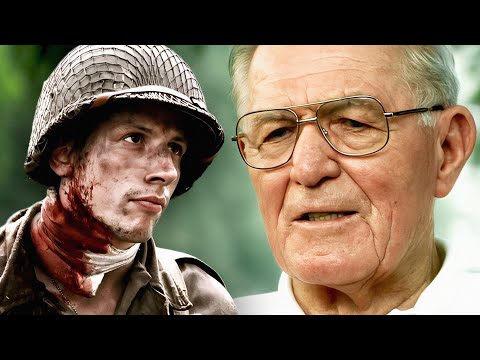
Winters noticed the blood on Liebgott’s neck—a wound that had reopened. He needed to get Liebgott out of there, to give him a task that would keep him from becoming the killer Winters knew he could be. “I want you to take these prisoners back to Battalion CP,” Winters said, gesturing to the eleven Germans under guard. “Get yourself cleaned up.”
Liebgott’s face lit up with excitement. “Yes, sir!” he barked, but Winters knew that excitement wasn’t for the escort duty. It was for the opportunity to do what he did best: kill.
Winters had seen it before—Liebgott’s reputation as a killer who didn’t take prisoners. He couldn’t let that happen. Not here. Not now. “Drop your ammo,” Winters ordered.
Liebgott’s eyes widened. “Are you kidding me? What are you doing?” he protested.
Winters didn’t flinch. “Give me your weapon,” he said, taking the M1 Garand from Liebgott’s hands. He removed the en bloc clip, then inserted a single round back into the chamber. “You have one round,” Winters said, his voice cold and steady. “You drop a prisoner, the rest will jump you. I want all prisoners back at battalion CP alive.”
Liebgott’s excitement faded. “Yes, sir,” he muttered, subdued.
But what the series didn’t show was the tension that followed—the moment Winters knew he might have to pull the trigger on one of his own men. In reality, Liebgott didn’t just comply. He blew his lid, as Winters later recalled, becoming highly incensed and upset. And Winters, standing on top of the dyke, had his own gun at his hip, pointed straight at Liebgott. He had thrown off the safety.
The German prisoners watched, understanding every word. They knew what Winters was doing—saving their lives from a man they could see was a killer. They sighed in relief.
It was a moment that defined Winters’ leadership—and exposed the raw, unvarnished truth of war. A truth that Band of Brothers chose to soften. But the real story, the one Winters himself told, was far more gripping.
Liebgott’s jaw tightened as he stared at the single round in his rifle. For a heartbeat, he didn’t move. The German prisoners behind him shifted uneasily, their eyes darting between the two Americans. Winters kept his M1 steady at his hip, the safety still off, his finger resting just outside the trigger guard.
“You understand your orders?” Winters asked, his voice carrying the same calm he’d used to lead thirty-five men against three hundred. It wasn’t a question. It was a test.
Liebgott spat on the ground. “Yeah, I understand.” He slung his rifle over his shoulder and gestured roughly at the prisoners. “Alright, you lot—move out!”
The Germans formed a ragged column, and Liebgott marched them toward the rear, his wounded neck still bleeding into his collar. Winters watched until they disappeared behind the dyke, then finally lowered his rifle and clicked the safety back on. His hands were steady, but his stomach felt like it had been hollowed out.
Decades later, in interviews and in his memoir, Winters would speak of that moment with a strange mixture of pride and regret—pride that he had held his ground, regret that it had been necessary at all. “He could have turned on me, but he didn’t,” Winters recalled. That single sentence carried the weight of everything Easy Company had been through together, and everything they still had ahead of them.
What the miniseries never addressed was the deeper irony of Liebgott’s story. In the show, his Jewish identity fuels his rage against the Germans—a narrative choice that gave his character a clean, understandable motive. But the real Joseph Liebgott was a German Roman Catholic, an altar boy who had served Mass in the same language his enemies now spoke.
The rage he carried wasn’t ancestral. It was personal, born of the war itself, shaped by the things he had seen and done in Normandy and the Netherlands. And that, perhaps, was more unsettling than any fictional backstory could ever be.
Winters didn’t have time to dwell on it. The Germans were regrouping somewhere beyond the river, and Easy Company’s position on the low ground was still precarious. He turned his attention back to the dyke, scanning the horizon for any sign of a counterattack. “Dig in,” he ordered. “I want foxholes along the crest before dark.”
The men moved with the weary efficiency of soldiers who had long since stopped questioning orders. They had won a stunning victory, but nobody was celebrating. The field below was littered with bodies, and the moans of the wounded drifted up on the cold wind.
Sergeant Lipton approached, his face smeared with dirt. “What about the wounded, sir? Ours and theirs.”
Winters considered it. “Get our boys taken care of first. Then see if any of the prisoners can help with their own.” He paused. “And Lip—keep an eye on Liebgott when he gets back. He’s wound tight.”
Lipton nodded, understanding without needing further explanation. Everyone in Easy Company knew about Liebgott’s temper. Most of them had looked the other way when it served the mission. Winters couldn’t afford to look the other way anymore.
An hour later, word came back from Battalion CP. The prisoners had arrived—all eleven of them, alive and accounted for. Winters allowed himself a brief moment of relief. He had gambled on Liebgott’s discipline, and the gamble had paid off.
But the war wasn’t done with them yet. The next morning, orders came down that Easy Company would be moving out again, pushing deeper into occupied territory. The men packed their gear in silence, the weight of what they had done settling over them like a second pack.
Liebgott found Winters near the command post, his neck now bandaged. He stood at attention, but there was something different in his posture—a stiffness that hadn’t been there before. “Sir, I want to apologize for my behavior yesterday.”
Winters looked at him for a long moment. “You followed orders, Joe. That’s all I need.” He turned to go, then stopped. “But I meant what I said. You’re a good soldier. Don’t let the war turn you into something else.”
Liebgott didn’t respond. He just nodded, his eyes fixed on some point in the distance. Winters walked away, wondering if his words had reached the man or just bounced off the armor he had built around himself.
The truth was, Winters understood Liebgott better than most. He had felt the same rage, the same urge to make the enemy pay for every friend lost, every town destroyed. The difference was that Winters had learned to channel it—to aim it like a weapon instead of letting it fire wild.
Whether Liebgott would ever learn that lesson remained to be seen. And in the weeks and months ahead, through the snows of Bastogne and the final push into Germany, the answer would become painfully clear.
Bastogne came, and with it the cold that no amount of rage could keep at bay. The men of Easy Company dug in among the trees, their foxholes frozen solid, their fingers too numb to feel the triggers they had cleaned a hundred times. It was there, in the snow and the silence, that Liebgott’s fire finally began to dim—not because he had learned to control it, but because there was nothing left to burn.
Winters saw it in the way Liebgott stopped volunteering for patrols, in the way he sat apart from the others with his helmet in his hands. “You still with us, Joe?” Winters asked one night, crouched beside his foxhole. Liebgott looked up, his eyes hollow. “I’m here, sir. Just tired.” It was the most honest thing he had said in months.
After the war, the men scattered. Liebgott went home to San Francisco, not to a taxi—the series got that wrong too—but to a barber’s chair, where he cut hair and said little about the war. He married, raised a family, and died too young, at sixty-one. The killer of Normandy became a quiet man with scissors and a comb, and perhaps that was the truest victory of all.
Winters lived longer, but he never forgot the dyke. In his memoir, he wrote about the prisoners and the single round and the gun at his hip. He wrote about Liebgott, too—not as a villain, but as a soldier who had been pushed to the edge and pulled himself back. “He was a good soldier,” Winters insisted, even decades later. “The war made him something else. We all had to find our way back.”
Band of Brothers softened that moment, and maybe it had to. A series about brotherhood couldn’t easily show a commander drawing his weapon on one of his own men. But the real story—the one Winters told with his own voice—was harder and more human. It was about a leader who risked everything to keep his men from becoming the very thing they were fighting against.
And it was about a soldier who, for one long heartbeat on a Dutch dyke, had to decide whether to obey the man pointing a gun at his chest—or become the killer everyone feared he already was.
He chose to obey. That choice, small and silent, may have been the bravest thing Joseph Liebgott ever did.
So here’s the question: if you had been standing on that dyke, staring down the barrel of your own commander’s rifle, would you have dropped your ammo—or would you have pulled the trigger on the man who told you to? Let us know in the comments below.






