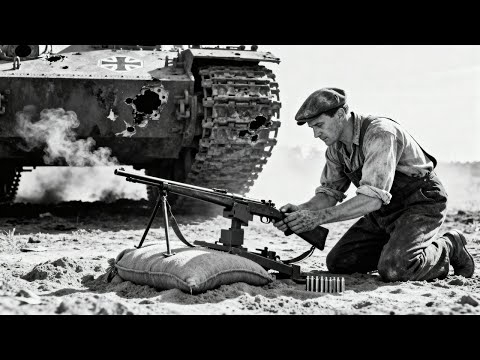
November 8th, 1942. The beaches of North Africa. American soldiers crouch behind sand dunes as German panzers thunder across the desert, their 75mm guns tearing through Allied positions. Private First Class Robert Watson levels his M1 rifle at an approaching tank and knows, with sickening clarity, that his bullet will do nothing against three inches of hardened steel. His platoon faces the same horrifying reality: they have no weapons capable of stopping enemy tanks. Zero.
But what Watson doesn’t know is that strapped to his sergeant’s back lies a device that will revolutionize anti-tank warfare forever. It weighs just 13 pounds, costs $43 to manufacture, and can punch through more armor than guns weighing 50 times as much. The weapon was invented by a man who had never seen a tank in combat, never attended military school, never even fired an artillery shell. His background was in farming techniques and industrial explosives—seemingly useless knowledge for the deadliest technical challenge of World War II. His name was Henry Mohaupt.
Four years earlier, Mohaupt had been mixing chemicals in a makeshift laboratory in Switzerland, trying to develop better blasting techniques for mining operations. What he discovered by accident would transform a Swiss farm boy into the man who gave individual soldiers the power to destroy the most advanced war machines ever built. The device on Sergeant Miller’s back carries the designation M1A1 Bazooka—a name that will strike fear into German tank crews from Tunisia to Berlin. But the story of how a farmer’s explosive experiments became America’s most feared infantry weapon remains one of World War II’s most extraordinary secrets.
September 1st, 1939. Germany invades Poland, and the world witnesses the birth of Blitzkrieg. German Panzer divisions tear through Polish defenses in 18 days, proving that modern warfare belongs to whoever controls the most effective armored vehicles. Traditional anti-tank tactics developed during the static trench warfare of World War I collapse instantly against highly mobile armored formations. Allied military experts study the Polish catastrophe with growing alarm.
British anti-tank doctrine relies on two-pounder guns that fire solid shot—chunks of hardened steel designed to punch through enemy armor through sheer kinetic energy. The physics are unforgiving. To penetrate thick armor, a projectile must weigh enormous amounts and travel at tremendous velocity. This requires massive guns, heavy ammunition, and perfect positioning. The mathematical reality devastates infantry formations. A two-pounder anti-tank gun weighs 1,848 pounds and requires a truck to move. Once positioned, it cannot be repositioned quickly during battle. German tank tactics exploit this weakness ruthlessly.
Panzers advance rapidly, forcing anti-tank guns to engage at maximum range where accuracy plummets, then close to point-blank range where the guns cannot traverse fast enough to track moving targets. American observers reach even more disturbing conclusions. Colonel Leslie McNair, chief architect of US ground forces doctrine, analyzes pre-war exercises and delivers a sobering assessment: “Our 37mm anti-tank gun proves ineffective against modern armor at combat ranges. Frontal penetration of German tanks requires direct hits at distances under 400 yards—ranges where enemy tanks can easily destroy the gun before it engages.”
The scientific community rallies to solve the anti-tank crisis. Dr. Charles Lauritsen at the California Institute of Technology proposes electromagnetic rail guns that could accelerate projectiles to unprecedented velocities. The technical challenges prove insurmountable. Rail guns require enormous electrical power generators that make them completely impractical for battlefield use. The most promising approach appears to be increasing projectile velocity through longer gun barrels and more powerful propellant charges. German anti-tank guns demonstrate this philosophy. The feared 88mm flak gun can penetrate any Allied tank at ranges exceeding 2,000 yards. But physics demands a terrible price. The 88mm weighs over 16,000 pounds and requires a powerful prime mover to position.
Expert consensus emerges around an uncomfortable truth: effective anti-tank weapons must be heavy, expensive, and tactically inflexible. Light weapons cannot generate sufficient kinetic energy to penetrate modern armor, while heavy weapons cannot be positioned rapidly enough to counter mobile armored tactics. The Wehrmacht’s Panzer forces have created a tactical paradox that conventional engineering cannot solve.
Intelligence reports from North Africa compound Allied fears. German tank units demonstrate new tactical sophistication, using coordinated attacks by multiple vehicles to overwhelm defensive positions. Even when Allied anti-tank guns achieve hits, German tanks often survive multiple impacts and continue fighting. The industrial capacity required to build enough heavy anti-tank guns to match German armor production exceeds Allied manufacturing capabilities.
Into this environment of tactical despair and technical limitations steps an unlikely figure. He carries no military engineering credentials, no combat experience, no formal weapons training. His expertise lies in agricultural chemistry and mining explosives—knowledge that seems completely irrelevant to anti-tank warfare. But Henry Mohaupt is about to prove that the solution to the century’s greatest military challenge lies not in bigger guns or more powerful engines, but in a fundamental misunderstanding of how explosives actually work.
August 16th, 1915. A son is born to Flora and Berthold Mohaupt in the small Swiss village of Egg, nestled in the hills outside Zurich. Heinrich, later known to the world as Henry, grows up in a household where explosives are dinner-table conversation. His father, Berthold, works as an industrial chemist specializing in mining explosives, filling their modest home with the acrid smell of chemical compounds and technical discussions about blast patterns and rock fracturing.
Young Heinrich shows little interest in formal education. After struggling through secondary school, he completes vocational training as an electromechanic—a practical trade that provides steady income but hardly suggests future military innovation. At 19, he fulfills his Swiss military obligation with unremarkable service in 1935, returning to civilian life with no apparent interest in weapons or warfare.
What transforms this undistinguished young man into a revolutionary weapons designer is pure accident. Working as a technical chemist in Zurich, Heinrich establishes a small laboratory in 1936 where he experiments with industrial explosives. His goal is purely commercial: developing better blasting techniques for Switzerland’s mining industry, which requires precise explosive charges to fracture rock without damaging valuable ore deposits.
The breakthrough comes during a routine experiment in late 1935. Heinrich places a small explosive charge in a metal cone-shaped container, expecting the blast to scatter in all directions, as explosives normally do. Instead, he witnesses something that contradicts everything he knows about explosive physics. The metal container focuses the blast into a narrow, incredibly powerful jet that punches through a steel plate like it’s made of paper.
The scientific establishment has known about the Monroe effect since 1888 but always dismissed it as a laboratory curiosity with no practical applications. Heinrich Mohaupt, with his farmer’s pragmatism and industrial chemistry background, immediately recognizes what university-trained weapons experts have missed. This focused explosive effect could make small, lightweight charges more powerful than enormous conventional weapons.
His insight is brilliantly simple. Traditional anti-tank weapons rely on kinetic energy—solid projectiles that must be launched at tremendous velocity to penetrate armor. This requires massive guns, heavy ammunition, and enormous amounts of propellant. But shaped charges work on completely different principles. They use explosive energy to create a high-velocity jet of molten metal that can penetrate armor regardless of the weapon’s size or the projectile’s initial velocity.
The mathematical advantages are staggering. A shaped charge weighing 2 pounds can penetrate more armor than a conventional anti-tank gun weighing 2 tons. Better yet, shaped charges work equally well whether fired from massive artillery pieces or simple launching tubes that individual soldiers can carry. The technology democratizes anti-tank warfare, giving foot soldiers the same tank-killing capability previously reserved for specialized heavy weapons.
But when Heinrich applies for permission to conduct larger-scale tests, Swiss military authorities dismiss his invention as impractical. Colonel Hans Frick, chief of Swiss ordnance development, studies Heinrich’s crude demonstration and delivers a devastating verdict: “Herr Mohaupt, the Swiss Army requires proven kinetic-energy weapons, not exotic explosive devices that contradict established military doctrine.” The rejection stings, but Heinrich persists.
Through 1937 and 1938, he refines his shaped-charge designs, improving penetration performance and solving technical problems that traditional weapons experts insist are impossible to overcome. His laboratory notebooks fill with calculations and sketches that would revolutionize warfare—if anyone in authority will listen to a Swiss farm boy with radical ideas about explosives.
His workshop methods would horrify professional ordnance engineers. Heinrich melts down copper pipes in a jury-rigged furnace, hammering the softened metal into cone shapes using techniques borrowed from traditional Swiss metalworking. Each shaped-charge liner requires precise dimensions. Too thick, and the explosive won’t form a proper jet. Too thin, and the metal disintegrates before achieving penetration. Working entirely by trial and error, Heinrich develops manufacturing techniques that academic researchers haven’t even theorized.
On October 26th, 1939, Heinrich loads his most promising prototype into a crude launching device and conducts his first major test. The target: a section of railway rail representing tank armor thickness. His shaped charge weighs just 30 grams and contains less explosive than a hand grenade. But Heinrich believes it can outperform anti-tank guns weighing hundreds of times more.
The explosion creates a brilliant orange flash, followed by the distinctive crack of superheated metal punching through steel. When the smoke clears, Heinrich stares in amazement at a perfectly round hole drilled completely through the railway section—penetration that would require a massive anti-tank gun firing at point-blank range.
But Heinrich’s celebration is premature. When British ordnance experts examine his demonstration in Zurich later that year, their reaction is swift and dismissive. Major Geoffrey Williams, representing the Royal Arsenal, studies Heinrich’s crude prototypes with barely concealed contempt: “Mr. Mohaupt, the British Army requires reliable, field-tested weapons—not laboratory experiments that may work under ideal conditions but fail catastrophically in combat.”
The French response proves even more devastating. After Heinrich travels to Paris seeking development contracts, French weapons experts deliver the judgment that nearly kills his project: “Monsieur Mohaupt, your hollow-charge concept violates established principles of ballistics. No serious military organization would stake defensive capability on such exotic theories.”
American military attachés observing Heinrich’s Paris demonstrations file reports that reflect the expert consensus: Subject’s claims exceed credible performance parameters. Recommend against further consideration of hollow-charge devices pending verification by qualified ordnance specialists.
The technical establishment’s rejection is unanimous and crushing. Every major military power dismisses Heinrich’s invention as impractical theorizing by an unqualified amateur. Traditional weapons experts cannot accept that a Swiss farm boy with basic chemistry training has solved problems that have confounded professional ordnance engineers for decades.
Heinrich faces a terrible choice: abandon his revolutionary discovery and return to conventional industrial work, or persist despite universal expert rejection. The decision becomes academic when German forces overrun France in June 1940, eliminating his primary development opportunity and leaving him stranded in neutral Switzerland with weapons technology that nobody wants.
What Heinrich doesn’t know is that across the Atlantic, desperate American military leaders are about to discover that conventional anti-tank doctrine has failed completely—creating the crisis that will finally make someone listen to a farmer’s explosive insights.
October 18th, 1940. Aberdeen Proving Ground, Maryland. America’s most distinguished anti-tank experts gather to witness what many consider a waste of precious resources. Henry Mohaupt stands beside a folding table, displaying his crude shaped-charge prototypes. Colonel René Studler examines the devices with professional disdain: “Mr. Mohaupt, these appear to be modified mining charges, not military weapons.”
Then Mohaupt fires his improved prototype. The explosion creates a brilliant flash, followed by the distinctive whistle of superheated metal punching through steel. When observers examine the target plate, they discover a perfectly round hole drilled completely through armor that no existing infantry weapon can penetrate. The silence stretches for long seconds.
Dr. Clarence Hickman breaks it with scientific precision: “The penetration achieved by that device exceeds the performance of our 37mm anti-tank gun by a factor of three. If this effect can be reproduced reliably, it represents a fundamental breakthrough.” The room erupts. Colonel Studler makes one final objection, but Dr. Robert Goddard—father of American rocketry—silences him: “I’ve spent twenty years developing technology most experts dismissed as fantasy. Mr. Mohaupt’s shaped charges employ well-understood physical principles applied in innovative ways.”
General Campbell stands, his decision made: “Sir, you have unlimited resources and top priority classification. Prove that your shaped charges can work reliably under battlefield conditions.” The room falls silent as America’s weapons establishment commits to the most unconventional gamble in military history—trusting a Swiss farmer’s explosive insights to stop the German war machine.
June 14th, 1942. Aberdeen test range. Technicians load Mohaupt’s latest warhead into the experimental M1 launcher—a crude tube that will soon be known worldwide as the Bazooka. The target: a captured German Panzer IV with 80mm frontal armor. Sergeant First Class Edward Uhl shoulders the launcher and fires at 150 yards. The explosion creates a brilliant orange flash. When observers examine the target, they discover a perfectly round hole punched completely through the turret’s thickest armor—what military experts considered physically impossible.
November 8th, 1942. Operation Torch, North Africa. Private First Class Robert Watson crouches behind a sand dune near Oran as German Panzer IIIs advance. In his hands lies an M1A1 Bazooka loaded with Mohaupt’s revolutionary warhead—the first time any soldier in history carries a personal weapon capable of destroying main battle tanks. The shaped charge strikes the Panzer’s turret ring and detonates with mathematical precision. Superheated copper jet moving at 20,000 feet per second punches through armor and ignites stored ammunition. The tank erupts in flames.
German reaction is swift and alarmed. Oberst Klaus Veber files an urgent intelligence report: American infantry now possess weapons capable of penetrating Tiger tank armor at close range. Our standard tactics must be revised immediately. The psychological impact proves even more significant than physical damage. Panzer commander Rudolph Schmidt writes in his war diary: “These American rocket weapons make every infantry position a potential tank killer. We can no longer advance with confidence.”
Combat data from Tunisia validates the revolution. In six months, American bazooka teams achieve 312 confirmed tank kills—more enemy armor destroyed by infantry weapons than in all previous American military operations combined. Each pound of bazooka system destroys on average 1.7 tons of enemy armored vehicles.
July 1943, Sicily. Staff Sergeant Charles Kelly engages a German Tiger I near Gela—the Wehrmacht’s most heavily armored vehicle. His first shot strikes the Tiger’s track, immobilizing the 57-ton monster. His second rocket penetrates the turret’s side armor, killing two crewmen. The Tiger’s commander abandons his vehicle and reports: American infantry weapons now pose greater threat to our armor than enemy tanks.
German engineers analyzing captured bazookas immediately begin developing the Panzerschreck—a direct copy of American shaped-charge technology. By December 1943, American factories produce 8,000 bazooka rockets per day. Technical Sergeant James Thompson, a veteran of 37 engagements, summarizes the impact: “Before bazookas, seeing German tanks meant running for cover. After bazookas, every infantryman became a tank killer. That Swiss guy didn’t just give us a new weapon—he changed the whole nature of ground combat.”
May 8th, 1945. Victory in Europe. Captured Wehrmacht documents reveal German tank losses to infantry weapons exceed 15,000 vehicles—more armor destroyed by foot soldiers than by Allied tanks and anti-tank guns combined. Dr. Friedrich Planck, architect of German hollow-charge research, admits: “Mohaupt’s warhead designs exceeded German capabilities throughout the war. Our Panzerschreck and Panzerfaust weapons were crude copies we could never fully replicate.”
Field Marshal Gerd von Rundstedt acknowledges: “American infantry anti-tank weapons forced complete revision of German armor tactics. Our tanks could no longer support infantry attacks without prohibitive casualties.” Mohaupt’s wartime legacy lives on in every modern anti-tank weapon—Javelin missiles, TOW systems, RPG warheads—all employing shaped-charge principles pioneered in his Swiss laboratory.
Henry Mohaupt died quietly in Santa Barbara, California on May 20th, 2001, having lived to see his agricultural chemistry background transform into the foundation of modern precision munitions. His obituary barely mentioned his military contributions—exactly as he would have wanted. In a world where technological superiority decides conflicts, one humble inventor proved that revolutionary solutions come from the most unexpected sources.
Henry Mohaupt’s shaped charges didn’t win battles. They proved that American ingenuity could overcome any enemy advantage, one precisely focused explosion at a time. So the next time you see a soldier carrying a shoulder-fired rocket, remember the Swiss farmer who started it all with a copper pipe and a stubborn refusal to accept “impossible.” What other world-changing inventions might be hiding in someone’s garage right now—dismissed by experts, waiting for the one person stubborn enough to believe? Share your thoughts in the comments below.






