She was born in the shadow of a dying empire, a princess whose cradle was rocked not by lullabies but by the distant drums of annexation. On May 25, 1912, in the sprawling Changdeok Palace in Seoul, a baby girl drew her first breath—a child of the Joseon dynasty, the last royal line of Korea. But her father, Emperor Gojong, was no longer a true ruler. Two years earlier, Korea had been forcibly annexed by Japan, and the once-mighty king now sat on a hollow throne, a ceremonial figurehead in his own land. The princess, initially treated as an illegitimate child, was soon recognized as a member of the imperial family and given the name Deokhye. Yet from the very beginning, her life was not her own. It was a pawn in a game played by the Japanese colonial authorities, who watched the royal family with suspicion and control.
Deokhye’s early years were a strange mix of palace luxury and invisible chains. Her father, desperate to protect her from the fate that had befallen her siblings—many of whom were sent to Japan—founded a kindergarten within the palace grounds and even attempted to arrange a marriage for her to a Korean nobleman. But in January 1919, Emperor Gojong died suddenly, and rumors of poisoning by the Japanese swept through the streets. With his death, the last barrier between Deokhye and the colonial government crumbled. She was now a ward of the Japanese occupation, and her destiny was no longer hers to shape.
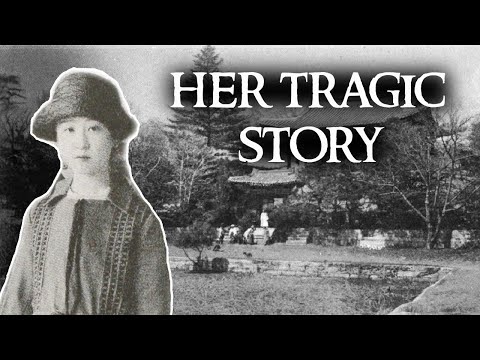
For a few years, she lived in a kind of limbo, attending school in Seoul and clinging to the remnants of her former life. But in 1925, when she was just thirteen, the Japanese government decided to uproot her. She was sent to Japan, far from her homeland, under the guise of continuing her education. In Tokyo, she enrolled at Gakushuin, a school for the nobility, where she learned sewing and culture—but the details of her life there remain shrouded in mystery. What is clear is that the separation from everything she knew marked the beginning of her psychological unraveling. Allowed to return briefly to Korea in 1930 for her mother’s funeral, she was already showing signs of distress. Back in Japan, she began sleepwalking, her behavior growing increasingly erratic.
By the early 1930s, Deokhye was diagnosed with “early dementia,” a vague term then used for any deteriorating psychotic disorder. Today, her symptoms would likely be recognized as schizophrenia. Despite her fragile state, the Japanese government pressed on with its plan to marry her off. In May 1931, she was wed to Count Takeyuki Sō, a Japanese nobleman from a family with centuries-old ties to Korea. The wedding took place on Tsushima Island, a symbolic union meant to bind the two nations—but for Deokhye, it was another chain. Her husband, by all accounts, was kind and caring, and the couple welcomed a daughter, Masae, in 1932. Yet Deokhye’s condition worsened. By 1933, she was admitted to a mental hospital for the first time, and she would spend years in and out of institutions, her life fading into the background of a world marching toward war.
After World War II, Korea gained independence, and the imperial government that had forced her marriage was gone. In 1953, Deokhye and her husband divorced. But the greatest tragedy was yet to come: three years later, her daughter Masae fled home, leaving a note that seemed like a suicide letter. She was never seen again. The loss shattered what little stability Deokhye had left. She retreated further into her illness, seemingly forgotten in a Japanese sanitarium—until a few determined voices in Korea began to call for her return.
In 1962, after 32 years in exile, Princess Deokhye finally stepped foot on Korean soil. She wept at the sight of her homeland. She took up residence in Changdeok Palace, the very place of her birth, now a home for the surviving members of the Joseon dynasty. But peace remained elusive. She was repeatedly hospitalized for her mental health, and in her final years, she lost the ability to speak, a condition called aphasia that left her unable to communicate. She outlived all her siblings, a silent witness to the fall of an empire and the personal cost of history.
Her days in Changdeok Palace were quiet, almost invisible. The world outside was changing fast—Korea was rebuilding, industrializing, and trying to forget its painful past. But Deokhye remained a ghost in the corridors of her childhood home, her steps slow, her eyes distant. She rarely spoke, and when she did, it was in fragments, as if her thoughts were scattered like fallen leaves. The palace staff treated her with a mix of reverence and pity, unsure how to care for a princess who had become a stranger to her own life.
Yet even in her silence, she found small rituals. She would sit by the window for hours, watching the cherry blossoms bloom and fall, her fingers tracing patterns on the glass. Sometimes, she hummed a tune from her youth—a melody her mother had sung to her in the nursery. Those moments of clarity were fleeting but precious, like sunlight breaking through a storm. Her sister-in-law, Yi Bangja, became her constant companion, reading to her and holding her hand during the long nights when sleep refused to come.
But the past was never far away. In the 1970s, as Korea’s economy surged and democracy struggled to take root, the old royal family became a symbol of a bygone era—some saw them as relics, others as reminders of a lost identity. Deokhye’s existence, tucked away in the palace, was largely forgotten by the public. She was the last princess of a dynasty that had ruled for five centuries, yet she lived as a recluse, her story buried under the weight of history. Visitors who managed to meet her described her as fragile, her gaze often fixed on something only she could see.
In her final years, her health declined further. The aphasia robbed her of speech, and her body grew frail. She spent more time in the hospital than in the palace, her room a sterile white box instead of the ornate chambers of her birth. Yet even in silence, she communicated through her eyes—a deep, unspoken sorrow that touched those who cared for her. The nurses noted that she would sometimes smile when shown old photographs of her father, a flicker of recognition in her clouded mind.
On April 21, 1989, Princess Deokhye died at the age of 76. Her funeral was a modest affair, attended by a handful of relatives and officials. She was buried near her father and other members of the Joseon dynasty, finally reunited with the family she had lost. The world moved on, but her story lingered—a reminder of the human cost of colonization, of a woman whose life was shaped and broken by forces beyond her control.
Today, her legacy lives on in books, films, and the quiet corners of Changdeok Palace, where a small exhibit honors her memory. Visitors can see her sewing box, her childhood toys, and a photograph of her as a young girl, smiling innocently before the storm. Her life was a tragedy, but also a testament to resilience—a princess who endured the collapse of her world and still found moments of grace.
But the story did not end with her burial. In the decades that followed, a quiet movement began to reclaim Deokhye’s memory from the footnotes of history. Historians, filmmakers, and ordinary Koreans started to ask uncomfortable questions about what had been done to her—and why her suffering had been allowed to fade into silence.
The 2016 film The Last Princess brought her story to a new generation, dramatizing her years in Japan and her desperate longing to return home. The film sparked a national conversation about the royal family’s fate under colonial rule, and about the countless untold stories of women whose lives were bartered for political ends. Viewers wept in theaters, not just for Deokhye, but for a whole generation of Koreans who had been denied their own history.
Yet the film also drew criticism for what it left out—the quieter, more ambiguous chapters of her life. Some historians pointed out that her marriage to Count Sō was not simply a prison sentence; there were letters, poems, and small kindnesses that suggested something more complicated. He had been forced into the marriage as much as she had, and in his own way, he had tried to protect her. Their daughter Masae’s disappearance remained an open wound, a mystery that no film could resolve.
In Tsushima, the island where they had wed, a small monument still stands. It is not grand—a simple stone marker shaded by pine trees—but every year, a few visitors come to leave flowers. Some are Korean tourists, curious about the princess who was sent across the sea. Others are Japanese locals, who remember the story from their grandparents’ time. The monument bears no political message, only her name and the dates of a life that was never truly her own.
Back in Seoul, the Changdeok Palace exhibit draws a steady trickle of visitors. Schoolchildren on field trips file past her sewing box and her faded photographs, their teachers whispering explanations they themselves barely understand. One photograph in particular catches the eye: Deokhye at sixteen, standing in a garden in Tokyo, her expression unreadable. Was she already feeling the first tremors of her illness? Was she thinking of her father, or of the palace she might never see again?
The questions linger, unanswered. And perhaps that is the nature of a life like hers—a life lived at the intersection of empire and family, of politics and madness. She was never given the chance to tell her own story, and those who knew her best are long gone. What remains are fragments: a name on a monument, a face in a photograph, a silence that speaks louder than any words.
Yet there is something else, too. In the years since her death, a small but growing number of Koreans have begun to honor her not as a victim, but as a survivor. They leave notes at her grave, thanking her for enduring what no one should have to endure. They teach her story in schools, not as a footnote to the Japanese occupation, but as a human tragedy that deserves to be remembered on its own terms.
And in that remembering, there is a kind of justice—late, incomplete, but real. The princess who lost her voice in life has found one in death, carried forward by those who refuse to let her be forgotten. Her story is no longer buried in the archives; it is part of the living memory of a nation still coming to terms with its past.
But memory is a fragile thing, and history has a way of repeating its cruelties in new forms. As Korea looks to its future, the question remains: what will it do with the lessons of Deokhye’s life? Will her suffering serve as a warning, or will it become just another story, polished and packaged for easy consumption? The answer, as always, lies with those who choose to remember—and with those who choose to look away.
In the end, Deokhye’s story is not just one of suffering, but of a quiet, stubborn endurance. She survived the empire that swallowed her country, the madness that swallowed her mind, and the silence that swallowed her voice. And when she finally returned to Changdeok Palace, she did so not as a broken relic, but as a woman who had outlasted every force that tried to erase her.
Her grave in Namyangju is simple, often overlooked by tourists rushing to the grand tombs of kings. But those who seek it out find something unexpected: a small, weathered teddy bear, left by a visitor who read her story and wept. It sits there still, a child’s toy for a princess who never truly had a childhood.
What do you think—does remembering Deokhye’s story change how we see the price of history, or does it simply ask us to hold one more forgotten life with tenderness? Share your thoughts below.






