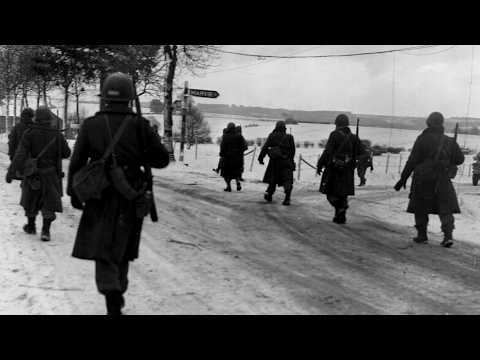
The frozen air crackled with tension as the men of Easy Company crouched in their foxholes, the bitter Belgian winter biting through their worn uniforms. It was January 14, 1945, and after weeks of relentless siege, they were about to launch an assault that would test their courage and haunt their memories forever.
The village of Foy lay ahead, a silent cluster of buildings across 200 meters of open snow. German tanks and infantry lurked within, waiting. For the exhausted paratroopers, many fresh replacements who had never seen combat, the thought of charging into that lethal gauntlet seemed like madness. Yet orders were orders, and at 8:30 a.m., the attack began.
First Lieutenant Norman Dike, leading the charge, had been warned about his tendency to freeze under fire. “He’s going to get a lot of E Company men killed,” First Sergeant Lipton had confided to Captain Winters. Those words would soon echo painfully true. As the platoons advanced, German machine guns erupted from the village, tearing through the snow around them. Men dove for cover behind haystacks, the air filled with the crack of rifles and the screams of the wounded.
Dike, hit in the shoulder, took cover and stopped issuing orders. The attack stalled. In the open fields, Easy Company was a sitting duck. Captain Winters, watching from the tree line, knew he had to act fast. “There was Speirs standing right in front of me. Speirs, take over that company, relieve Dyke, and take that attack on in.”
First Lieutenant Ronald Speirs, a man of rumored ruthlessness and undeniable bravery, sprinted through the snow to take command. His arrival sparked new life into the assault, but the fight was far from over. As Speirs rallied the men, a German sniper in a nearby building pinned down Third Platoon. Staff Sergeant Darrell “Shifty” Powers, a marksman from rural Virginia, took aim. With Lipton drawing the sniper’s fire, Shifty steadied his rifle and fired one shot. The sniper fell, shot between the eyes.
The tide began to turn. A bazooka round knocked out the Panzer IV at the crossroads, and the German defense crumbled. Within hours, Foy was taken, but at a cost: 82 casualties, 15 dead.
As the smoke cleared, the men of Easy Company stood victorious, yet the winter cold seemed to seep deeper into their bones. They had survived Foy, but the war was not over. Ahead lay more battles, more sacrifices, and ultimately, a journey that would lead them to Hitler’s mountain retreat. But for now, they could only hold their ground and prepare for the next fight.
But the taking of Foy, while a victory, was not the end of Easy Company’s ordeal in the Ardennes. In the days that followed, the men pushed forward through the frozen landscape toward Noville, the next objective on the road to Germany. The snow was still deep, the cold still bitter, and the enemy still determined. Yet something had shifted in the company. They had faced their worst fear—a leader who froze—and had overcome it through sheer grit and the courage of men like Speirs and Shifty.
Captain Winters, watching from the wood line, felt a quiet pride. He had seen his old company stumble, then rise. The men who had been replacements just days before were now blooded veterans. They had learned what every soldier learns: that war is chaos, and survival depends on the man beside you.
The advance toward Noville was slow and cautious. German resistance had not evaporated; it had merely pulled back, regrouping behind the next ridge or cluster of farmhouses. Easy Company moved in fits and starts, clearing buildings and hedgerows, never knowing when a sniper’s bullet or a mortar shell might find them. The men were exhausted, their faces gaunt, their eyes hollow. Yet they kept moving.
It was during this push that First Sergeant Lipton, now acting as the company’s steady anchor, noticed something strange. “Lieutenant Speirs was everywhere,” he later recalled. “One minute he was up front with Second Platoon, the next he was back with the mortars. He never seemed to tire.” Speirs’s energy was almost unnerving, but it kept the men going. He had a way of appearing calm even when the world was exploding around him, and that calm was contagious.
On the afternoon of January 15, Easy Company reached the outskirts of Noville. The village sat on higher ground, its stone buildings and church steeple visible through the falling snow. German troops had dug in around the village, using the houses as strongpoints. The Americans would have to assault uphill, through open fields, just as they had at Foy. But this time, they were ready.
Speirs gathered the platoon leaders. “We hit them fast, we hit them hard, and we don’t stop until we’re through,” he said. His voice was flat, matter-of-fact. There was no bravado, only certainty. The men nodded. They had learned to trust him.
The attack began with a thunderous barrage from the supporting artillery, then the crack of machine guns and the pop of rifle fire. Easy Company surged forward, boots crunching through the snow, breath steaming in the cold air. German defenders fired from windows and doorways, but the Americans kept coming. Shifty Powers, still carrying his rifle, picked off two more snipers before the company reached the first houses.
Inside the village, the fighting became a blur of close-quarters chaos. Men kicked down doors, tossed grenades into cellars, and fought room to room. Sergeant John Martin, who had doubted the attack at Foy, later said, “At Noville, we were a different company. We knew what we were doing.” The replacements, once terrified, now fought like veterans. They had learned from the men around them, and they had survived.
By nightfall, Noville was in American hands. The German retreat had become a rout, and the road to the German border lay open. But the cost had been high. Easy Company had lost more men—friends who would never see home again. As the survivors dug in for the night, the temperature dropped further, and the snow began to fall again, covering the dead and the living alike.
In the darkness, Lipton found Speirs standing alone near the church, staring out at the frozen fields beyond the village. “We did it,” Lipton said quietly. Speirs nodded but didn’t turn. “For now,” he replied. “There’s always another village, Lip. Always another fight.” The words hung in the cold air, a grim reminder that the war was far from over. Yet even as he spoke, Speirs’s voice carried no despair—only a steady resolve. Tomorrow, they would advance again. Tonight, they would rest.
The morning of January 16 broke gray and still, the snow having stopped at last but leaving behind a world of white silence. Easy Company moved out of Noville before dawn, their breath pluming in the frigid air as they trudged along the N30 toward the next objective. The men were quieter now, the adrenaline of Foy and Noville having burned away, leaving only exhaustion and a dull, persistent fear.
Word came down the line that the 506th was pushing toward the village of Rachamps, a small hamlet nestled in a valley just beyond the ridge. Intelligence reports suggested the Germans were digging in there, using the high ground to cover the road. Easy Company would lead the assault once more.
As they marched, Sergeant Lipton fell into step beside Shifty Powers. The sniper’s face was drawn, his eyes fixed on the horizon. “You alright, Shifty?” Lipton asked. Powers nodded slowly. “Just thinking about that sniper back at Foy. The one I hit.” Lipton waited. “I keep wondering if he had a family. If he was somebody’s son, like me.” Lipton had no answer. War didn’t offer any.
By midday, the company reached the ridge overlooking Rachamps. Below them, the village sat in a shallow bowl, its stone houses clustered around a small church. German vehicles were visible on the main road—trucks, a half-track, and at least one tank. Speirs studied the layout through his binoculars, then lowered them with a grim expression. “They’re expecting us,” he said. “But they’re not dug in well. We hit them from two sides, we can roll them up before they know what’s happening.”
The plan was simple: Second Platoon would swing left through a wooded copse and hit the village from the north, while First and Third Platoons attacked frontally down the road. The machine guns and mortars would lay down suppressing fire. It was the same playbook they had used at Foy, but this time, the men knew what to expect.
At 1:00 p.m., the mortars opened up with a series of sharp thumps, and the assault began. Easy Company surged down the slope, boots slipping in the snow, rifles at the ready. German machine guns responded almost immediately, their tracers stitching lines of fire across the white field. Men fell, but the line kept moving.
Speirs was everywhere again, moving from squad to squad, his voice cutting through the noise. “Keep moving! Don’t stop! Get to the houses!” His presence was like a shot of adrenaline, and the men responded. They reached the first buildings and began clearing them room by room, the crack of grenades and the rattle of submachine guns echoing through the narrow streets.
On the left flank, Second Platoon ran into fierce resistance from a German strongpoint in a barn. Private First Class David Webster, a replacement who had joined the company just before Bastogne, found himself pinned down behind a stone wall. Bullets chipped at the masonry above his head. He looked to his left and saw a fellow replacement, a kid from Ohio named Miller, lying face down in the snow, unmoving. Something hardened in Webster then—a cold resolve that he would not die here, not like this.
He grabbed a grenade from his belt, pulled the pin, and lobbed it over the wall toward the barn. The explosion was followed by screams, then silence. Webster rose and charged forward, his rifle blazing. The barn fell minutes later.
By 4:00 p.m., Rachamps was in American hands. The German defenders had fled, leaving behind burning vehicles and abandoned equipment. Easy Company had taken the village, but the cost was heavy: another twenty casualties, including five dead. Among them was Miller, the kid from Ohio, who had never even fired his rifle in anger before that day.
As the sun set, the men dug in on the outskirts of the village, preparing for a possible counterattack. Lipton walked the line, checking on the men. He found Speirs sitting on the steps of the church, cleaning his pistol. “We lost Miller,” Lipton said. Speirs didn’t look up. “I know. He was a good soldier.” “He was a kid,” Lipton replied. “They’re all kids, Lip. That’s what makes it worse.”
The night passed without incident, but the cold was relentless. Men huddled in their foxholes, sharing blankets and cigarettes, trying to stay warm. The war was grinding them down, one village at a time, one loss at a time. Yet they kept going, because there was no other choice. The only way out was through.
By late January, the Allies had erased the Bulge entirely, and Easy Company was pulled off the line at last. “We were down to a handful of originals,” Lipton recalled, “but we were still Easy.” The replacements had become brothers; the snow had become memory.
In the months that followed, they fought through the Rhineland and into Bavaria. Shifty Powers, who had once hesitated over a sniper’s family, became one of the company’s most steady hands. Speirs remained their commander, his calm a shield against the chaos.
When the war ended, Easy Company found itself in Berchtesgaden, occupying Hitler’s mountain retreat. “We sat in the Eagle’s Nest and looked out at the Alps,” Winters wrote, “and thought of the men who never made it.” The irony was not lost on them.
Decades later, the men returned to Foy—old now, walking slowly through the snow. They touched the bullet-scarred walls and remembered. “We weren’t heroes,” Lipton said. “We were just soldiers who did our job.”
But to the generations who watched their story, they were exactly that: heroes. And the question remains—what would you have done, standing in that frozen field, with the world exploding around you? Share your thoughts below.






