For seventy years, he had carried the secret. His wife, his children, his grandchildren—none of them knew. Reinhold Hanning had been an SS guard at Auschwitz, patrolling the platforms where Hungarian Jews stepped off the cattle cars, watching the chimneys of Birkenau push smoke into the Polish sky. He had smelled the burning bodies. He had heard the screams. And he had said nothing. Then, at ninety-four years old, he was wheeled into a courtroom in Detmold, Germany, his chin pressed to his chest, his eyes avoiding the cameras. The silence was about to end.
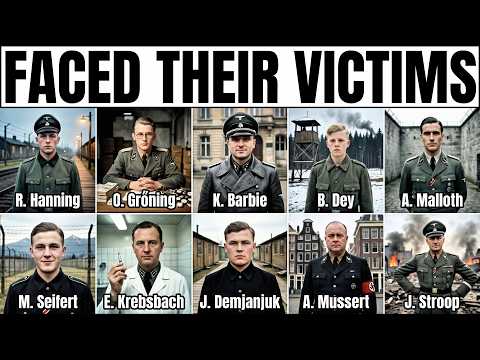
But Hanning was just one of many. Across seven decades and four continents, a handful of SS officers—some high-ranking, some mere cogs in the machinery of death—were forced to face the people they had terrorized. These are their stories.
In February 2016, Hanning sat in a wheelchair as nearly 200 people packed the gallery. Forty Auschwitz survivors and family members had joined the trial as co-plaintiffs, carrying photographs of murdered parents and siblings. They had flown in from around the world to look him in the eye. The first to testify was Leon Schwarzbaum, also ninety-four, impeccably dressed in a navy suit. His hands trembled as he held his written statement.
He described the chimneys belching flames into the night, the naked prisoners walking toward the gas chambers, the smell that hung over the camp every single day. Then his voice rose. “Mr. Hanning,” he said, “we are about the same age, and we will both soon stand before the highest court. Speak here about what you and your comrades did. Tell everyone.” Hanning did not look up. He kept his eyes on the floor. He said nothing.
For three months, more survivors took the stand. They described the crematoria, the shootings, the children pulled away from their mothers on the selection ramp. They watched Hanning closely each time, hoping for some flicker of recognition. They saw nothing. He sat in his wheelchair, his face still, unresponsive.
Then, on April 29, 2016, Reinhold Hanning finally spoke. His voice was weak and shaking. “I want to say that it disturbs me deeply that I was part of such a criminal organization,” he said. “I am ashamed that I saw injustice and never did anything about it, and I apologize for my actions. I am very, very sorry.” The courtroom was silent. Leon Schwarzbaum watched from five meters away with a steely face. He did not move. He did not cry.
Outside, Schwarzbaum told a reporter, “I lost 35 family members. How can you apologize for that? I am not angry. I do not want him to go to prison, but he should say more for the sake of the young generation today because the historical truth is important.” On June 17, 2016, Judge Anke Grudda found Hanning guilty of 170,000 counts of accessory to murder and sentenced him to five years. But he never spent a day behind bars. He died at home in May 2017, weeks after his conviction became final.
Hanning’s trial was a turning point. It rested on a new legal principle: that anyone who served at a death camp was part of the machinery of murder, even without proof of a specific killing. That principle had been established by another case—one that had begun decades earlier, in a very different courtroom, with a very different man.
Oscar Gröning was that man. Unlike Hanning, he had never hidden. He had given interviews to British journalists, appeared in BBC documentaries, and described in calm, clear sentences what he had seen at Auschwitz. When his trial began in Lüneburg in April 2015, he was ninety-three, frail, with thick glasses and white hair. He listened politely. He took notes. And when the prosecutor read out the charge—300,000 counts of accessory to murder—Gröning did not pretend he had been anywhere else.
His job had been the strangest detail in a strange life. He was an SS sergeant at Auschwitz between September 1942 and October 1944. His task was not the gas chambers. It was the money. When the trains arrived, Jewish prisoners were ordered to leave their suitcases on the platform. Those suitcases were taken to sorting warehouses. Inside were watches, jewelry, currency from every nation in occupied Europe, family photographs, books, religious objects, gold teeth pried from the mouths of the dead. Gröning’s job was to sit in an office and count it all. He sorted the foreign currency into stacks. He recorded the amounts. He packaged the gold and the watches. He sent the loot back to Berlin to fund the Reich.
The Lüneburg trial was different from Hanning’s. Gröning did not stay silent. He described a baby that an SS man had killed by smashing its head against a truck because the crying had become inconvenient. He said the act had appalled him. He said he had complained to a superior who told him there was nothing to discuss. He had asked to be transferred. The transfer was never granted.
The prosecutors did not accept his self-portrait. They argued that by counting the money, he had encouraged the deportations to continue because the regime profited from each transport. They argued that his service had directly contributed to the murder of 300,000 Hungarian Jews. The courtroom held survivors of the Mengele twin experiments, children of the ghetto, people who had escaped the ramp by minutes or by miracle. And then it held Eva Kor.
Eva Kor was eighty-one years old. She had been one of the Mengele twins. As a ten-year-old girl, she had been torn from her family on the Auschwitz ramp and used as a human guinea pig by Dr. Josef Mengele. Her twin sister Miriam survived alongside her. The rest of their family did not. After the war, Eva built a life in Indiana. She founded an organization called CANDLES, which stood for Children of Auschwitz Nazi Deadly Lab Experiments Survivors. She had spent decades teaching young people about the camps. And she had made a decision that set her apart from many of her fellow survivors. She had decided publicly to forgive the Nazis—not all of them, not as a group, but in her own name, for her own peace.
When she walked into the Lüneburg courtroom in April 2015, she did so as a co-plaintiff in the case against Oscar Gröning. She testified about Mengele. She testified about being injected with unknown substances. She testified about watching her sister grow ill from the experiments. And then after she had finished her testimony, she walked across the courtroom toward the defendant. The cameras did not capture what happened next, but a phone in the courtroom did.
Eva Kor approached Gröning. She offered him her hand. He took it. He pulled her in. He kissed her on the cheek. The two of them held one another in the middle of a courtroom where he was being tried for accessory to the murder of 300,000 people, and she was one of the witnesses against him. The photograph went around the world within hours. Some survivors were furious. They accused Kor of betraying the dead. They accused her of using the courtroom for personal theater. They wrote angry letters.
Kor defended her choice in interviews afterward. She said she had not forgiven Gröning on behalf of anyone else. She had not absolved him of his crimes. She had simply chosen as a private act to release her own anger. “He was the only Nazi who had ever spoken openly about what he did,” she said. He had validated her testimony in a way that no court ever could. So, she had hugged him.
The verdict came in July 2015. Oscar Gröning was found guilty of 300,000 counts of accessory to murder. He was sentenced to four years in prison. His appeals dragged on for three years. By the time his final appeal was rejected in 2017, he was ninety-six years old. He was declared fit to serve his sentence in November 2017. He died on March 9, 2018, before he could be admitted to prison. He had spent his final years giving public testimony against Holocaust deniers. He had told them to their faces that the gas chambers existed because he had seen them. He had told them that the camp was real because he had worked there. He had told them that the murders had happened because he had counted the money taken from the murdered.
The bookkeeper of Auschwitz had become in the last decade of his life a witness for the prosecution against his own past. He was not forgiven by history. He was not absolved by the courts. But he was held for one strange moment by an eighty-one-year-old woman who had survived Mengele in a German courtroom in the year 2015, seventy years after the war ended. That moment is not the meaning of justice, but it is something that history will not be able to ignore.
That principle—that service at a death camp was itself complicity—had been forged in the most unlikely of cases. John Demjanjuk was an Ohio auto worker, a Ukrainian prisoner of war who had been recruited by the SS as an auxiliary guard. His case spanned thirty-five years, three countries, and two death camps. He was first tried in Israel as Ivan the Terrible of Treblinka, convicted, and sentenced to death. But new evidence revealed the identification was wrong. He was acquitted and returned to the United States, only to face a new trial in Germany for serving at Sobibor.
In 2011, the Munich court found him guilty of 28,060 counts of accessory to murder—one for each person gassed during his six months at the camp. He was sentenced to five years but died before his appeal. Though his conviction was vacated by his death, the legal principle survived. If you served at a death camp, you were guilty of every murder committed there. That principle led directly to the trials of Hanning, Gröning, and others. Demjanjuk had failed to be convicted in the end, but he had changed the law.
Yet the pursuit of justice did not always require a new legal theory. Sometimes it required only the persistence of survivors and the courage of a courtroom. Klaus Barbie, the Butcher of Lyon, had lived comfortably in Bolivia for forty years under the protection of governments that should have hunted him. He was finally extradited in 1983 and tried in 1987 for crimes against humanity. The most haunting testimony came from Simone Lagrange, who had been thirteen when Barbie arrested her. She had been carried into his interrogation cell on a stretcher because the pain in her body would not let her stand. She told the courtroom what he had done to her. She named him from the witness box. She looked at the judges and said his name.
The verdict came on July 4, 1987. Barbie was found guilty on all counts and sentenced to life imprisonment. He never apologized. He never expressed remorse. He died of cancer in a French prison cell in 1991. But the children of Izieu had names again. Sabine Zlatin had spoken them. Léa Feldblum had carried her tattoo back. And Klaus Barbie, the Butcher of Lyon, had been forced to sit in a cell while the city he had terrorized finally pronounced him guilty.
These trials, separated by decades and continents, share a common thread: the confrontation itself. Survivors flew across the world to look at men they had not seen in fifty or sixty or seventy years. They sat in witness boxes. They named names. They remembered specific moments, specific words, specific cruelties. They forced these men to listen. They forced these men to be present. They forced these men, even at the end of their lives, even in wheelchairs, even behind red folders, to face them.
That is the meaning of these trials. Not the prison sentences, which were almost always too late and too light. Not the convictions, which often failed to capture the full scope of the crimes. The meaning was the confrontation itself. The fact that the survivors lived long enough to put their tormentors in a courtroom. The fact that the courts, however slowly, however imperfectly, eventually agreed to hear what they had to say. The fact that the law, in the end, was made to do what it had refused to do for so many decades: look the killers in the face and call them killers.
Reinhold Hanning died at home, never having spent a day in prison. Oscar Gröning died before he could be admitted. Bruno Dey received a suspended sentence. Klaus Barbie died in his cell. Anton Malloth was released ten days before his death. Michael Seifert lived two years in an Italian prison. Eduard Krebs was hanged by an American sergeant. John Demjanjuk died in a German nursing home. Anton Mussert was shot in the dunes by his own people. Jürgen Stroop was hanged in Warsaw, less than a mile from the ghetto he had destroyed.
Each of them, in the end, faced a courtroom. Each of them was forced to confront, however briefly, the people they had wronged. And each of them, in the end, was judged—not by history alone, but by the law. The wheels of justice turned slowly, but they turned. And in turning, they gave voice to the dead through the living.
Now, we ask you: which of these trials do you believe delivered the most meaningful justice, and why? Share your thoughts in the comments below.






