What if the Third Reich didn’t end with the war? What if its secrets—buried under ash, lies, and sealed archives—never died? For every document burned, a question ignites. For every body found, dozens vanish. These are the Nazi mysteries that refuse to be buried: flights without landings, deaths without witnesses, orders no one claims to have given. Some call them loose threads. Others call them too dangerous to solve. But you’re here to listen anyway.
Welcome to the shadows. Welcome to 25 of the most inexplicable Nazi mysteries.
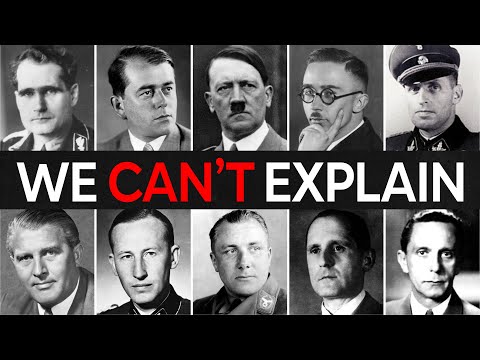
Among them, Rudolf Hess, who in 1941 flew solo to Scotland on a moonlit May evening. Why? Officially, to negotiate peace. But Hess wasn’t mad—not yet. He had a map, a contact, and a parachute. Churchill called him a medical case, yet he was interrogated for years behind closed doors. Did he act alone? Was he sent with Hitler’s blessing? Or plausible deniability? Why was he imprisoned for life while others were released? Even declassified files raise more questions than answers. Perhaps that was the point.
Next: who truly knew about Operation Barbarossa? Before the tanks rolled, warnings were everywhere—intelligence leaks, border activity, intercepted messages. Who knew it was coming? Goebbels claimed shock. Göring acted as if inevitable. Some generals insisted they were just following orders; others later claimed they tried to stop it. Was the silence born of ignorance, fear, or complicity? Or all three? Even as German soldiers advanced, many claimed surprise—raising the question: was it a shock, or just a performance?
And speaking of silence, there’s one order we’ve never heard spoken aloud. If you’re still with us, wondering who knew what and when, subscribe. This gets deeper. Share your comments: where are you watching from? What time is it now?
Three: the full chain of responsibility for the Final Solution. There was no single moment when it was all declared. No grand speech, no document signed in blood and bureaucracy. The Holocaust didn’t begin with one order—it was a slow boil of euphemisms, bullet points, and unrecorded gestures. We have scattered orders, logistical memos, and coded language like “special treatment” and “final solution.” But the smoking gun—the moment mass murder became official policy—is missing. Historians have tried to trace it. Was Hitler at the center, pulling strings? Was Himmler’s machine ahead of the Führer’s words? Or did the system itself metastasize as each cog competed to be the most loyal, the most brutal, the most useful? The Wannsee Conference of 1942 is often cited, but even that seems like a follow-up. Who gave the final order if no one had to say it?
And speaking of unspoken endings, let’s talk about a man whose end came with a single bite and more questions than answers.
Four: the last days of Heinrich Himmler and the cyanide moment. By April 1945, Himmler was a man watching his empire collapse. Architect of the SS, the camps, the cold bureaucratic terror that defined the Reich’s darkest chapters, Himmler had long styled himself as the quiet alternative to Hitler’s theatrical rage. But in the final weeks, that quiet cracked. With Berlin burning and Hitler sealed in his delusion, Himmler made a strange turn. Peace talks, behind Hitler’s back. Contact with the Allies through intermediaries, trying to position himself as the leader of a post-Hitler Germany. But the British didn’t believe him. Neither did Hitler when he found out. Himmler was expelled from the Nazi Party. His fall was sealed by the same Führer he had once worshipped as a dark godfather.
After the surrender, British forces arrested him in disguise. And here’s the mystery. While in custody under heavy guard, Himmler somehow took cyanide. But how? He had been searched, supposedly thoroughly. Had he hidden a capsule in a tooth cavity all along? Was there complicity, or deliberate blindness, or one last trick from a man who had mastered deception? Yet his death only erased the man, not the corruption he helped build. And that leads us to the next man whose death raised similar doubts, and far more brutal consequences.
Five: the aftermath of Reinhard Heydrich’s assassination. If Himmler was the SS’s mastermind, Heydrich was its sharp edge. Cold, calculating, terrifying even to his peers, Heydrich was the type who made other Nazis nervous. By 1942, he ruled occupied Czechoslovakia with brutal efficiency, and few doubted he was done climbing the Reich’s pyramid. Then came the resistance. A team of Czech agents, trained by the British, attacked Heydrich’s car in the streets of Prague. He died days later. So far, it seems clear. But what followed was not.
The Nazi reprisal, the aftermath of Operation Anthropoid, was a storm. Entire villages were razed, thousands executed. Yet amid this massacre, some historians whisper of internal conflicts. Was Heydrich’s security unusually lax? Did someone want him gone? Not just the Allies, but someone from within? Himmler immediately took over Heydrich’s duties, expanding his grip. The files from that period are strangely incomplete. Witness testimonies contradicted. And the speed of the retaliations raises uncomfortable questions. How much was already in motion before the assassination? Was the attack used as a pretext? Or was it partly welcomed in the shadows? Death on paper may end a life. But what about death rooted in ambition? It tends to multiply. Especially when the next mystery reveals how death was not always so quick or so final.
Six: the true fate of Martin Bormann and the sequence of events. By spring 1945, Berlin was a ghost city, and Martin Bormann was trying to become one of them. As Hitler’s private secretary and silent guardian, Bormann was less a man than a presence—always near, rarely speaking, always listening. He controlled access to Hitler, shaped the power dynamics in the bunker, and knew more than almost anyone about the regime’s final days. When Hitler died, Bormann was last seen fleeing the bunker, wearing an SS uniform and carrying, it is said, classified documents. Then he vanished for decades.
Rumors spread. Bormann escaped to Argentina. Lived under a false identity in South America. Was captured by the Soviets and hidden. Died in the rubble, or escaped and was killed later. Conflicting sightings and dubious testimonies kept the legend alive. Then in 1972, skeletal remains were found near Berlin’s railway lines, later confirmed by DNA to be Bormann. But even that wasn’t without gaps. When exactly did he die? Who buried him? And why did some intelligence agencies continue to track him for years after 1945? He may have died in Berlin, but the questions surrounding him lingered, much like the man at the center of our next story.
Seven: the real story behind Hitler’s health decline. In the final years of the war, Adolf Hitler was no longer the rigid theatrical figure of early propaganda films. Those close to him described a man physically exhausted, increasingly isolated, and surrounded by a vast array of medications. But what exactly was he suffering from, and how much it mattered, remains frustratingly unclear. Some accounts describe tremors, digestive problems, chronic fatigue, and sudden mood swings. Others dismiss the symptoms entirely, portraying them as natural reactions to the stress of a leader overseeing a collapsing empire.
The problem is that almost all sources are suspect. Personal doctors protected their reputations. Subordinates rewrote memoirs to justify failure. Enemies exaggerated the decline to suggest it was inevitable. And the medical records themselves are incomplete, selective, or filtered through post-war agendas. Then there are the drugs—stimulants, sedatives, painkillers—often administered simultaneously. Was Hitler a chemical addict, or was he merely propped up to function longer than he should have? Did his rule erode gradually, or was it always shielded by ideological rigidity and confirmation bias? Historians argue over whether his increasingly erratic decisions were medical, psychological, or simply the logical outcome of an extreme worldview colliding with reality.
What makes this mystery persist isn’t just curiosity about one man’s health, but what it implies. If physical and mental decline played even a minor role, it reframes the war’s final phase as less a strategic defeat and more a slow collapse led by a man no longer fully connected to reality. And if that’s true, the details of his final hours become all the more important—and disturbing.
Eight: the exact circumstances of Hitler and Eva Braun’s final hours. The outline is familiar: a bunker beneath Berlin, a ruined city, a private farewell hidden from the world. Yet when historians try to reconstruct the precise sequence of events during those last hours, the narrative fractures into contradictions and gaps. Who was present? Who left? What was said, and when? It all relies on testimonies given later by people with every incentive to protect themselves. Witnesses disagreed on timing, on actions, on who entered the room and who didn’t. Even the handling of physical evidence was complicated by hasty decisions and incomplete documentation. Soviet investigators controlled much of the initial narrative, but their reports were shaped by secrecy and political theater. Western intelligence relied on secondhand accounts and fragmented records. And somewhere between these two sources, the details dissolved.
What remains consistent is the atmosphere: isolation, exhaustion, and a almost theatrical insistence on controlling the end. Hitler, who had choreographed his public image for decades, seemed determined to deny his enemies any symbolic victory. Eva Braun, largely absent from political history, suddenly became the center of attention in its final moments. Yet their private conversations, the emotional reality of those hours, are almost entirely lost. This ambiguity isn’t just a minor historical detail—it feeds the industry of myth, denial, and speculation that never ends. When an event is symbolically massive and poorly documented, it becomes a vacuum that stories rush to fill. And that vacuum didn’t close with the bunker’s disappearance; it extended outward to rumors of resistance and survival, of a Reich that refused to die entirely.
Nine: the disappearance of Hans Kammler. Hans Kammler was the type of engineer who built nightmares. As an SS general, he oversaw construction projects like Auschwitz, as well as the most advanced German weapons programs—from V-2 rockets to jet aircraft, and even alleged wonder weapons. When the Third Reich collapsed, Kammler did what many Nazis did: he vanished. But the difference is that his disappearance was multifaceted. Multiple last sightings, conflicting death reports, contradictory testimonies, and a suspicious silence from Allied intelligence for decades. Some records suggest he died of cyanide poisoning in May 1945, while others say he was shot. Then there’s another account: that he surrendered to American forces and secretly joined Operation Paperclip, the U.S. program that brought Nazi scientists into service during the Cold War. If true, Kammler may have traded atrocities for asylum, and weapon plans for freedom.
He had extensive knowledge of V-2 rockets, underground facilities, and a project called “Project Riese”—a massive underground complex in the Owl Mountains with no clear purpose and no complete map. He wasn’t just a regular officer; he replaced Wernher von Braun at one point. Had Kammler survived, he could have written the true history of Nazi superweapons. But perhaps someone didn’t want that book published. And speaking of illusions turned real, let’s look at the final days in Hitler’s bunker.
Ten: Hitler’s final decision-making in April 1945. By April 1945, Berlin was collapsing, but paper orders kept coming. Hitler, half-buried in concrete beneath the Chancellery, was still issuing commands to divisions that no longer existed. He moved armies like chess pieces on a board that was already half on fire. The question isn’t whether he had lost touch with reality, but how far his leadership structure followed him into fantasy. Some orders seemed designed to defend a phantom Reich. Others showed strange flashes of tactical logic, as if he believed certain alliances or forces or betrayals were still in play. But where was he getting his information? Some historians blame a toxic feedback loop: staff afraid to tell the truth, intelligence officers showing Hitler what he wanted to hear, and loyalists filtering reality to maintain morale. Was this delusion? Perhaps. But reality may have been strategic. Then there’s the possibility that Hitler knew it was over and issued irrational orders to destroy everything with him—a slow-motion tantrum, a scorched-earth policy disguised as military doctrine.
The bunker was a closed world, and only fragments of its texts remain. What we don’t know is what wasn’t written down. But this is a recurring pattern, because some Nazi plans were never meant to be written at all.
Eleven: the ultimate fate of the Amber Room. It was once called the Eighth Wonder of the World—a lavish chamber of amber, gold leaf, and mirrors, gifted from Prussia to Russia, then looted by the Nazis during their invasion of the Soviet Union. The Amber Room was dismantled in 1941, shipped to Königsberg, and displayed in a museum. Then came the final chaos of war: air raids, fires, evacuations. And after 1945, the room vanished. Soviet investigators claimed the Nazis destroyed it. German witnesses said it was evacuated in time. Others believed it was lost at sea on a transport ship that sank. Over decades, search teams tunneled through mountains, combed ruins, and even drained lakes. All they found were fragments—a carved panel here, a missing piece there. Enough to prove the room existed. But not enough to bring it back.
What makes the Amber Room story enduring isn’t just its beauty, but its symbolic weight: a masterpiece passed between empires, seized by force, and consumed by war. Every theory about its fate reflects deeper questions about memory, loss, and historical theft. Was it destroyed by accident, or was it hidden and protected, never meant to be found again? And if the Amber Room traveled by train, that opens another tunnel entirely—because many of the Reich’s final trains never reached their destination, or never officially existed at all.
Twelve: the fate of the Reich’s final special trains. In the last months, the Nazis sent trains—some carrying soldiers, some civilians, but others loaded with mysterious cargo under labels like “priority transfer” or “secret transport.” Gold, stolen archives, art, or experimental weapons? Some vanished in the chaos; others were found, emptied, or sabotaged. The deeper mystery is structural: how were so many movements undocumented? Who authorized them? And why do survivor accounts, intercepted messages, and post-war lists contradict so starkly?
Thirteen: how much did Nazi leadership know about the real military situation in 1944–45? By 1944, Germany was bleeding on all fronts, yet within Hitler’s inner circle, the language of victory persisted. Was this delusion genuine or performance? Diaries and post-war testimonies offer conflicting evidence. Some claimed they knew the war was lost after Stalingrad; others insisted they believed in a last-minute turn. Both answers are politically convenient.
Fourteen: the full extent of internal power struggles within the SS. To the outside world, the SS was monolithic. Internally, it was a maze of rivalries, suspicions, and bureaucratic warfare. Positions were gained not just through loyalty but through sabotage, rumors, and carefully planned disappearances. As defeat loomed, power struggles intensified. Some factions sought to negotiate with the West, others planned purges, most focused on survival.
Fifteen: the Nazi Bell, “Die Glocke.” A secret device shaped like a bell, made of heavy alloys, tested in underground facilities in Silesia. Witnesses described it humming, glowing, and lethal to those nearby. Was it an anti-gravity engine, a time machine, or a Nazi atom-smasher? No photos, no confirmed blueprints. Mainstream historians dismiss it as post-war myth, but its persistence is hard to ignore—especially when linked to Nazi scientists absorbed into American and Soviet space programs.
Sixteen: the final missions of German U-boats with unclear cargo. In the war’s last weeks, German submarines slipped into the Atlantic with secret orders, many bound for unspecified destinations, carrying undocumented cargo. U-530 and U-977 surfaced in Argentina months after the war ended. Their crews claimed mechanical issues, course deviations, even sightseeing. Investigators weren’t convinced. Gold? Documents? Individuals? Some intelligence reports noted unusual shipments; others dismissed the whole story as cover for rogue crews avoiding Soviet capture.
Seventeen: what happened to Gestapo chief Heinrich Müller? Last seen in the Führerbunker in May 1945, then nothing. No trial, no grave, no confirmed body. For a man who ran the Gestapo, signed execution orders, and knew every secret worth knowing, his post-war trail is a black hole. Soviets claimed capture; Americans denied finding him; West German intelligence suspected he joined the other side. Rumors placed him with Soviet intelligence or in Latin America. Some speculated he worked for the Americans as a highly valued—or too dangerous to reveal—intelligence asset.
Eighteen: what exactly happened to Joseph Goebbels’ family remains a puzzle. The official story: they died in the bunker, bodies partially burned. But Soviet reports contradicted themselves over the years. Were the bodies not Goebbels’ at all? Did dental evidence not match? Children’s remains were later found under suspicious circumstances. Deliberate misdirection? Bureaucratic chaos? Strategic manipulation of symbols?
Nineteen: to what extent did the July 20 plot infiltrate state mechanisms? The bomb exploded close enough to kill, but not close enough to succeed. How far did the conspiracy truly reach? Many arrests, some trials, some executions. But many names quietly disappeared into bureaucratic folds. The line between complicity and secret resistance became a shield, raising the question: how many others were quietly preparing not to resist, but to vanish entirely when the time came?
Twenty: who really knew about Hess’s mission beforehand? The idea that Hitler’s top deputy could simply take off unnoticed seems implausible. Who looked the other way? Some historians point to hidden accomplices within the Nazi hierarchy who hated the Eastern Front and wanted peace with Britain. Others suggest darker possibilities: that Hess was set up, sent on a mission designed to fail, used as a pawn in a game he didn’t understand. The British handled it with extreme caution, isolating him for life.
Twenty-one: the true fate of many camp records and transport lists. The Nazis were obsessed with record-keeping—until the camps, especially in the chaotic final months, when the trail suddenly breaks. Some records were deliberately destroyed; others seized by Allies and sealed for decades. Then there’s a third category: documents referenced, expected to exist, but never found. Entire transport lists, administrative records, death registers vanished without explanation. In some camps, post-liberation documents were pieced together from fragments. Survivor testimonies often filled the gaps, but they remained.
Twenty-two: lingering questions about specific massacres and who gave local orders. Not all war crimes resulted from written orders. In many towns across Eastern Europe, entire communities were wiped out by mobile killing units, improvised militias, or retreating soldiers. For dozens of these massacres, a key question remains unanswered: who gave the specific local order? Command responsibility is a legal and moral cornerstone, but in the chaos of occupied zones, lines of authority blurred quickly.
Twenty-three: unknown locations of artworks. Men were sent to rescue cultural heritage from the rubble, tracking stolen art, protecting historic sites, recovering what the Nazis tried to hoard or erase. They succeeded in ways that still seem miraculous. But for every successful recovery, there were leads that went nowhere. Entire caches that should have existed didn’t. Tunnels appeared empty. Inventory lists pointed to storage sites completely emptied or sealed off. Some intelligence was promising but led to nothing.
Twenty-four: what some Nazi scientists and engineers were really working on in the final months. The official historical narrative likes to end things neatly: Allies won, villains lost, scientists surrendered or were captured. But the truth is messier. In the final months, Nazi scientists and engineers didn’t stop working; they simply stopped documenting clearly. Many projects disintegrated into fragments. Work was moved, renamed, or handed off to unknown parties. After the war, both the U.S. and USSR rushed to collect this intellectual stockpile. Operation Paperclip is the most famous example, bringing figures like Wernher von Braun to America. But many other names were quietly integrated into post-war programs.
Twenty-five: the full picture of cooperation, coercion, and resistance within Nazi institutions. In the post-war fog, many German officials claimed they were just doing their jobs—signing papers, organizing train schedules, allocating resources—without realizing what those jobs truly meant. Others portrayed themselves as secret resisters, forced to wear the uniform but never embracing the ideology. The third group, perhaps most disturbing, insisted they had no choice at all. But history isn’t a confession booth. It’s a jigsaw puzzle with half the pieces missing and the other half rearranged for convenience.
Within Nazi institutions, the lines between loyalty, coercion, and passive compliance weren’t just blurred—they were actively managed. Oaths to Hitler became legal shackles. Promotions were tied to ideological purity. Silence was safer than scrutiny. And when the war ended, those same institutions dissolved into memoirs, courtroom testimonies, and reconstructed career paths. Who believed? Who obeyed? Who resisted? And when did they decide it was worth the risk? The truth is murky and shifting. Some collaborators posed as resisters. Some resisters signed the orders anyway. And almost all of them rewrote their roles once the dust of war settled.
That’s what keeps us here, staring into the final mystery—not through documents or timelines, but through a mirror. Because the hardest thing to explain about the Nazi system isn’t how it worked, but how many people were willing to help it work. So ask yourself: in their shoes, would you have signed, resisted, or simply looked away? Share your thoughts below.






