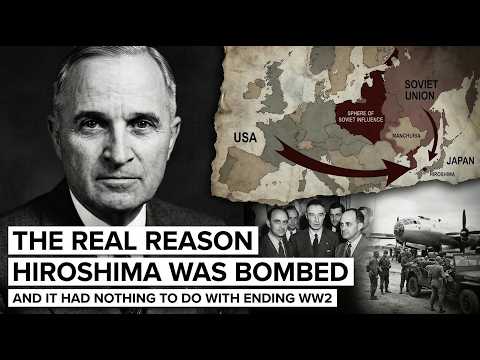
On the morning of August 6, 1945, the residents of Hiroshima woke to a clear summer sky. An air raid siren had sounded at 8:09 AM, but it was quickly called off. The city’s watchers had spotted only three aircraft—a small formation, nothing threatening. People stepped back into the streets, children walked to school, workers opened their shops, farmers tended their fields on the outskirts. At 8:15 and 17 seconds, the Enola Gay released its payload from 31,000 feet above. The bomb, nicknamed Little Boy, fell for 43 seconds before detonating 1,900 feet above the Shima Surgical Clinic in the heart of the city. At the epicenter, temperatures reached between 3,000 and 4,000°C—roughly two-thirds the temperature of the sun’s surface. Everything within a half-mile radius was simply vaporized. People walking to work in the open air were reduced to shadows burned into stone. Their outlines, the only trace they had ever existed. Buildings collapsed in a millisecond. A wave of pressure moving at supersonic speed flattened everything in its path. A firestorm followed, sucking oxygen from the air and incinerating entire neighborhoods in minutes. By the end of 1945, somewhere between 90,000 and 140,000 people had died in Hiroshima. The range itself is a testament to the chaos left behind.
Three days later, a second bomb, Fat Man, fell on Nagasaki and killed somewhere between 60,000 and 80,000 more. Most of the dead were civilians. They were shopkeepers and teachers and mothers and children who happened to live in the wrong city in the wrong year. And then Japan surrendered. That is the story almost every American learns in school. The bombs ended the war. The bombs saved lives. The invasion of the Japanese home islands would have cost more than a million American casualties, maybe more. Two terrible weapons were the lesser of two terrible evils. Truman made a hard decision, and it was the right one, and now we can all move on. This narrative has been repeated so consistently and so confidently that most people never stopped to question it.
But there are layers to this story that most textbooks quietly skip. Layers that historians have argued over for decades, often in bitter and personal terms. The closer you look at the summer of 1945, the more complex and unsettling the picture becomes. And the most unsettling questions are not about whether the bombs were wrong. The most unsettling question is a simpler one. Were they primarily about Japan at all?
Let’s go back to the beginning. When most people think of the Manhattan Project, they think of it as an American story, and in many ways it was. But the spark that started it was lit across an ocean in the laboratories of Europe by scientists who were fleeing for their lives. By the late 1930s, Hitler had driven much of Europe’s Jewish intellectual community into exile, and many of the world’s greatest physicists ended up in Britain and the United States. Among them was a Hungarian-born physicist named Leo Szilard, who had already conceived of the nuclear chain reaction as early as 1933, and understood, in a way that almost no one else did at the time, exactly what it meant. In 1939, Szilard convinced Albert Einstein to co-sign a letter to President Franklin Roosevelt warning that it might be possible to construct an atomic bomb, and that Germany might be working on exactly that. Roosevelt took the threat seriously and authorized a research program. By 1942, that program had become the Manhattan Project, a classified operation of breathtaking scale. It would ultimately cost over $2 billion, equivalent to about $28 billion in today’s money, and at its peak employed more than 125,000 people simultaneously across over 30 secret facilities scattered across the United States, Canada, and the United Kingdom. Most of the people working on it had no idea what the whole project was, only their small piece of it. The secrecy was absolute.
The scientific brain at its center was J. Robert Oppenheimer, a theoretical physicist who assembled at Los Alamos, New Mexico, arguably the most concentrated gathering of scientific genius in history. Niels Bohr, Enrico Fermi, Hans Bethe, Richard Feynman. These were some of the greatest minds of the 20th century working around the clock in a remote desert facility. The military counterpart was General Leslie Groves, a hard-driving, politically astute army officer who understood that the project was not just a scientific endeavor, but a geopolitical one. On July 16, 1945, the Trinity test detonated the world’s first nuclear device in the New Mexico desert. The yield was equivalent to about 21,000 tons of TNT. The shockwave was felt 100 miles away. Oppenheimer, watching the fireball from a bunker, reportedly quoted the Hindu scripture, the Bhagavad Gita, “Now I am become death, the destroyer of worlds.” Whether or not he actually said it at the moment, the sentiment was real and shared. Several scientists present wept. Others fell silent. Everyone understood that the world had just changed.
When the news was relayed to President Harry Truman, who was at the time attending the Potsdam conference in Germany, a senior official noted in his diary that Truman was, in his words, “tremendously pepped up.” He came to that afternoon’s meeting with Stalin, according to Winston Churchill, as a different man, more confident, more assertive. “He told the Russians just where they got on and off,” Churchill noted. Something had shifted. Truman did mention the new weapon to Stalin that evening, telling him the United States had developed a new weapon of unusual destructive force. Stalin’s reaction was famously flat. He smiled and said he hoped they would make good use of it against the Japanese. But back at his own quarters, Stalin immediately told his top advisers to accelerate their own nuclear program. The Soviet leader had known about the Manhattan Project through his spy network for years. He simply chose not to let on. And right there, in that charged exchange at Potsdam, you can already begin to see the second story running beneath the official one.
Let’s look at what was actually happening in Japan in the summer of 1945, because this is where the conventional narrative starts to get complicated. By the middle of 1945, Japan was in a catastrophic condition. Its navy had been effectively destroyed. Its air force was a shadow of what it had once been. American submarines had strangled its merchant shipping to the point where the country’s merchant fleet, which had stood at over 5 million tons at the start of the war, was down to just 557,000 tons by August 1945. The civilian economy was collapsing. Food shortages were becoming severe. The 1945 rice harvest was the worst since 1909. American firebombing raids had devastated 64 Japanese cities, killing hundreds of thousands of civilians, and leaving millions homeless. The single firebombing attack on Tokyo in 1945 alone killed more than 80,000 people in a single night. Japan, in a military sense, had already lost. Everyone on both sides knew it. The question was not whether Japan would eventually surrender. The question was when and on what terms.
And within Japan’s own government, a deep and dangerous split had formed between two camps. On one side was the so-called peace faction, civilian leaders and some court officials who wanted to find a path out of the war through negotiation. On the other side was a military faction that wanted to fight a final defensive battle on the Japanese home islands, the strategy known as Ketsu-Go, with the hope that they could inflict such catastrophic casualties on invading forces that the allies would agree to more favorable terms. Emperor Hirohito himself was caught between these factions, publicly maintaining the fiction of continued resistance while privately acknowledging the situation was hopeless. His closest advisor, Marquis Kido, had presented him in June 1945 with a proposal to seek a negotiated settlement through Soviet mediation. The plan involved Japan giving up its overseas territories and accepting a period of disarmament while preserving the emperor’s throne and avoiding occupation of the Japanese mainland. This peace effort was real. It was also, by any objective measure, doomed.
The reason Japan chose the Soviet Union as its potential mediator is one of the most darkly ironic strategic miscalculations of the entire war. By early 1945, the Soviets were the only major neutral power left. Japan had ended its peace efforts in Switzerland and Sweden and placed all its diplomatic chips on Moscow. What Japan’s leaders either did not know or refused to accept was that the Soviet Union had already secretly committed at the Yalta Conference in February 1945 to declare war on Japan within 3 months of Germany’s defeat. Stalin was stringing Japan along with false hope of mediation specifically to buy time to move his forces from the European theater to the Far East. The United States government knew all of this. American cryptographers had cracked Japan’s diplomatic codes through a program called Magic. And American leaders were reading the intercepted messages between Japanese diplomats and their government. They knew about the peace feelers. They knew Japan was looking for a way out. They also knew, and this is important, that Japan’s peace overtures were not an offer of unconditional surrender. Japan’s military leadership was still insisting on terms. No occupation, no external war crimes trials, preservation of the Imperial system. These were conditions the United States government was not prepared to accept.
This is where the official narrative and the revisionist arguments start to collide. The traditional school of thought, what historians call the traditionalist position, argues that Japan was not yet ready to surrender, that the military faction would have fought to the last man, woman, and child on the home islands, and that the atomic bombs were necessary to shock the Japanese leadership into accepting reality. Secretary of War Henry Stimson wrote in 1947 that military planners estimated the invasion of Japan could cost over a million American casualties. Truman and his advisers concluded, this argument goes, that two bombs and hundreds of thousands of Japanese civilian lives were a lesser evil than an invasion that would kill many times more people on both sides. The revisionist argument, which began taking shape in the 1960s and has grown considerably more sophisticated since, goes something like this. The bombs were not primarily about ending the war with Japan. They were about managing the Soviet Union. The man most associated with this argument is historian Gar Alperovitz, who in 1965 published a book called Atomic Diplomacy and has spent decades refining his thesis. Alperovitz and the scholars who followed him argued that by the summer of 1945, American policymakers, and particularly Secretary of State James Byrnes, had come to see the atomic bomb less as a weapon for use against Japan and more as what Byrnes himself reportedly called “a diplomatic hammer.” A way to make the Soviet Union more manageable in post-war negotiations, to limit Soviet expansion in Eastern Europe and Asia, to establish American dominance in the post-war order before anyone else could challenge it.
Truman had only been president for a few months when all of this was happening. He had not been part of Roosevelt’s inner circle and had only learned about the Manhattan Project after taking office. But he was surrounded by men who had very specific ideas about what the bomb meant and what it should be used for. Byrnes was the most explicit. He reportedly told the physicist Leo Szilard in May 1945 that the bomb would put the United States in a position to dictate its own terms at the end of the war, not just Japan’s terms, everyone’s terms. This matters because of the Soviet dimension. Throughout the latter part of World War II, the United States had actually wanted the Soviet Union to enter the war against Japan, and Stalin had promised at both Yalta and Tehran to do so within 3 months of Germany’s surrender. That deadline fell in August 1945. When the Trinity test succeeded on July 16th, American thinking about Soviet entry shifted dramatically. Suddenly, American leaders no longer needed Soviet help to defeat Japan. And more than that, Soviet entry into the Pacific War, which was now imminent, would give the Soviets a seat at the post-war table in Asia. It would give them leverage and territory and influence in a region America wanted to dominate alone. So, the race to end the war quickly before the Soviets could enter it and claim their share of the spoils became a driving concern.
Historian Tsuyoshi Hasegawa, who spent years in both American and Soviet archives before writing his influential book, Racing the Enemy, argues that it was the Soviet declaration of war on August 8th, not the atomic bombing of Hiroshima two days earlier, that was actually the decisive shock to Japan’s leadership. His argument is that Japan had built its entire end-of-war strategy around Soviet neutrality, and when that collapsed, the foundation of resistance collapsed with it. Both things may be true simultaneously. The bombs accelerated Japan’s surrender. The Soviet entry may have been equally decisive, and the timing and targeting of the bombs may have been calculated at least in part to limit Soviet influence in the post-war world. History rarely offers clean answers, and this case is no exception.
What is harder to dismiss is the behavior of Truman and Byrnes in the weeks before the bombings. Truman deliberately delayed the Potsdam conference until after the Trinity test, a detail historians have debated extensively. He told an aide in May 1945 that he wanted to wait until the bomb was ready before meeting with Stalin. Whether that delay was primarily about the bomb’s potential as a diplomatic tool is contested, but the intent to use the bomb’s existence as leverage in dealings with the Soviets was explicit and documented in multiple accounts from the period. After the Trinity success, Truman’s aide wrote that the president was a changed man in his dealings with the Soviets. He became more assertive, less willing to compromise. The bomb was not yet deployed, its shadow was already reshaping diplomacy. And then there’s the question of what was not tried.
Among the many arguments that complicate the official narrative, perhaps the most persistent is this: why was no non-combat demonstration seriously considered? A group of scientists in Chicago, including James Franck, submitted a report in June 1945 arguing for exactly that. They warned that using the bomb on a populated city without prior warning would initiate an international arms race and permanently damage America’s moral authority. The Interim Committee considered the idea and rejected it, concluding that a demonstration in an unpopulated area would not be sufficiently convincing and would waste one of the only two bombs they had ready.
Leo Szilard circulated a petition among his fellow scientists in July 1945 arguing that the United States should not use the bombs on civilian populations without first publicly announcing surrender terms. The petition was signed by roughly 70 scientists at the Chicago Metallurgical Laboratory. General Groves ensured it moved through official channels so slowly that Truman never saw it before Hiroshima was bombed. It was not declassified until 1961. “A nation which set the precedent of using such weapons for purposes of destruction,” Szilard wrote, “might have to bear the responsibility of opening the door to an era of devastation on an unimaginable scale.”
He was correct. The Soviet Union tested its first nuclear device in 1949, just four years after Hiroshima. The arms race that followed brought the world, on at least one occasion, to within minutes of nuclear annihilation. The scientists who built the bomb and then tried to stop its use on civilians understood something the political and military leadership was perhaps too focused on strategy to fully absorb: that the bomb would not just end a war, but open a door that could never again be closed.
There is one more dimension rarely given the prominence it deserves—the racial one. The Pacific War had a quality of racial hatred the European theater largely did not. American propaganda portrayed Japanese people in ways that would have been unacceptable when applied to Germans or Italians. A Gallup poll taken in December 1944 found that 13% of Americans said they wanted all Japanese killed. The dehumanization of the enemy was systematic and thorough. Nazi POWs held in American camps were routinely allowed to attend movies and visit local restaurants. Japanese prisoners were treated with considerably less humanity. Some American soldiers in the Pacific sent home the skulls of Japanese soldiers as trophies. In 1944, a congressman presented President Roosevelt with a letter opener reportedly made from the arm bone of a Japanese soldier.
The question raised most pointedly by African-American intellectuals in the days immediately after Hiroshima was the one Langston Hughes posed in a column for the Chicago Defender: Why Japan and not Germany? The commonly accepted answer is that Germany was no longer a target when the bomb was finally ready. That is true as far as it goes. But historians like John Dower have documented extensively how the racial dehumanization of Japanese people made it psychologically and politically easier to use the bomb on Japanese cities than it might ever have been to use it on a European one. The firebombing campaign against Japanese cities had generated far less domestic political resistance in the United States than the bombing of European cities did.
Does this mean racism caused the bombing? That is too simple an answer to a question that has no simple answer. The military and strategic factors were real. But the racial dimension was also real, and it shaped the cultural environment in which these decisions were made. A decision that might have required extensive moral justification when targeting a European city was much easier to make when targeting a Japanese one. That is worth acknowledging rather than dismissing.
Ultimately, what the full historical record reveals is not a simple story of military necessity, but a complex convergence of factors. Japan’s catastrophic military situation and incomplete willingness to surrender on American terms was real. The genuine concern about invasion casualties was real. The desire to end the war before the Soviets could enter it and claim influence in Asia was also real. The belief that demonstrating the bomb’s power would make the Soviet Union more cooperative in post-war negotiations was real. The racial hatred that made it easier to deploy weapons of mass destruction against a Japanese city than against a German one was real. All of these things were simultaneously true, and they combined to produce a decision of enormous historical consequence.
What is remarkable is how quickly and completely the official narrative closed around a single justification. Once the bombs were dropped and Japan surrendered, the story of the million American lives saved became the story. Alternative framings—the Soviet angle, the demonstration angle, the racial angle—were not suppressed exactly, but they were pushed to the margins. The Szilard petition was classified until 1961. The more complicated revisionist arguments were treated, especially during the early Cold War, as dangerously unpatriotic. To question whether the bombs were necessary was to question the moral standing of the United States at a moment when the United States very much needed that moral standing to justify its confrontation with the Soviet Union.
And here is one of the more remarkable ironies buried in this whole affair. Stalin saw through the official narrative immediately. He interpreted the bombing of Hiroshima not as an act of military necessity against Japan, but as a hostile signal aimed directly at the Soviet Union. Two weeks after Hiroshima, Stalin signed a decree establishing a special committee on the atomic bomb charged with accelerating the Soviet nuclear program. His public reaction was measured. His private calculation was clear. If the United States believed it could use atomic weapons to dictate the terms of the post-war world, the Soviet Union needed to develop the same capability as quickly as possible.
The advisers around Truman had believed the United States would enjoy at least a decade of nuclear monopoly, giving them leverage over Soviet behavior throughout the critical early post-war period. The Soviets tested their first bomb in August 1949. The monopoly lasted four years. Far from making the Soviet Union more manageable, the bomb convinced Stalin that only nuclear parity would protect Soviet interests. The arms race that followed produced arsenals capable of destroying human civilization multiple times over. The mutual assured destruction doctrine that defined the Cold War for decades. The Cuban missile crisis that brought the world to the edge of nuclear war in 1962. The proxy conflicts that killed millions in Korea and Vietnam and elsewhere. All of this flows in some direct or indirect way from the events of August 1945. The scientists who signed Szilard’s petition had warned exactly this would happen. They were right. The door was opened. It has never closed.
There’s also one more piece of this puzzle rarely discussed, and it has to do with momentum. By the summer of 1945, the Manhattan Project had consumed $2 billion, taken three years, and become the largest single scientific and industrial undertaking in human history. Its sole purpose was to build a bomb and deliver it. The infrastructure that had been built—the factories, the delivery systems, the trained bomber crews, the carefully scouted target cities—was all pointing in one direction. Truman had been president for only a few months. He was making decisions under enormous pressure with incomplete information in the middle of an ongoing global war. And everywhere around him, the apparatus of a project that had consumed American treasure and ingenuity for years was oriented toward a single outcome.
Historian Alex Wellerstein has described the momentum of the Manhattan Project as one of the under-appreciated factors in the bombing decision. By mid-1945, he argues, the structures and assumptions that had been built up over years of effort made it genuinely difficult to stop—not impossible, but difficult. The question was never really whether to use the bomb. It had always been when and where. The idea of not using it, of spending $2 billion and employing 125,000 people to build a weapon and then deciding not to deploy it in an active war, was psychologically and politically almost inconceivable to the people making the decision. This is not a defense of what happened, but it is an honest account of how institutions and momentum shaped decisions that we prefer to imagine were made in pure moral clarity.
What does all of this mean for how we should understand August 1945? It means the bombs were not a single thing. They were at once a military weapon, a diplomatic signal, a demonstration of power, a product of racial dehumanization, a result of unstoppable bureaucratic momentum, and a turning point that began an arms race nobody could control. Truman’s public justification—ending the war and saving lives—was real. It was also not the whole truth. The desire to limit Soviet expansion, the desire to close the war before Soviet entry could complicate the post-war settlement, the belief that atomic power would give the United States a dominant position in post-war diplomacy—these were not secondary considerations. For men like James Byrnes, they may have been primary ones.
And perhaps the most haunting thing about this entire story is the question of what was not seriously attempted. Japan’s military situation in the summer of 1945 was catastrophic. Its peace faction was real, if fragmented and politically outgunned by the militarists. A modification of the surrender terms, specifically an explicit guarantee that the emperor would be allowed to remain as a figurehead, might have opened a path to surrender that avoided both the atomic bombings and an invasion. Some senior American officials, including Secretary of War Stimson, had proposed adding such a guarantee to the Potsdam Declaration. Byrnes rejected the idea, reportedly on the grounds that he did not want to make any deals with Japan. That decision, or rather that non-decision, may have been as consequential as any other made that summer. After Japan surrendered, the United States did in fact allow Hirohito to remain on his throne. The guarantee Stimson proposed was ultimately extended anyway, just after two cities had been destroyed and somewhere between 150,000 and 246,000 people had died.
There is no clean moral at the end of this story. There rarely is at the end of stories about real power and real war. What there is is a reminder that the official explanation for a momentous decision is usually the simplest one. And simplicity is rarely the whole truth when states are involved. The men who made this decision were not monsters. They were politicians and generals and scientists operating under enormous pressure in a world that was being rebuilt from the ruins of the deadliest conflict in human history. They had their own interests, their own fears, their own blind spots, and their own capacity for self-deception about the purity of their motivations. The bombs ended the war. They also began the next one. They saved some lives, they ended others. They gave America a dominance it could not sustain. They convinced the Soviet Union to build the same weapons as quickly as possible. They opened a door to a world where any future superpower conflict carries the possibility of species-level annihilation.
That is the full weight of what happened in August 1945—not just the mushroom clouds over Hiroshima and Nagasaki, but every consequence that followed them across the decades. The silos buried in the American plains, the submarines prowling the ocean depths, the thousands of warheads pointed in every direction, all of them legacies of that summer when the world’s most expensive secret was revealed. Not just to Japan, but to the Soviet Union and to every ambitious state that would come after. The story of the bomb is not over. It is still being written one geopolitical crisis at a time.
Think about what was actually set in motion in those three days in August 1945. Before Hiroshima, nuclear weapons were a theory and then a secret project and then a single test in the New Mexico desert. After Hiroshima and Nagasaki, they were a demonstrated reality. Every government on Earth had to reckon with the fact that a single airplane could now erase a city in less time than it takes to boil water. The entire architecture of global power—alliances, deterrence, the logic of war itself—had to be rebuilt around that reality. The nuclear arms race that followed was not just a competition in numbers. At its peak, the United States and Soviet Union together possessed tens of thousands of nuclear warheads, many of them far more powerful than the bombs dropped on Japan. The hydrogen bombs developed in the 1950s made Little Boy look like a firecracker. A single modern thermonuclear warhead carries a yield measured in megatons—millions of tons of TNT equivalent—capable of destroying not a city block, but an entire metropolitan region.
The doctrine that emerged from this insanity was called mutual assured destruction, and its acronym, MAD, was not accidental. The logic was that if both sides knew that any nuclear attack would result in their own annihilation, neither side would fire first. The world would be kept safe by the certainty of its own destruction. This was the system that Truman and his advisers built, probably without fully understanding what they were building. The men who made the decision to bomb Hiroshima believed they were ending a war. They did end a war. They also created the conditions for a 45-year standoff between two nuclear-armed superpowers in which the entire human population lived, whether it knew it or not, under the threat of extinction.
There were close calls, many of them. In 1983, a Soviet early warning satellite system falsely detected five incoming American intercontinental ballistic missiles. A Soviet lieutenant colonel named Stanislav Petrov decided, against protocol, that it was a false alarm and did not pass the warning up the chain of command. He was right. If he had followed orders, Soviet doctrine called for an immediate retaliatory strike. In October 1962, during the Cuban Missile Crisis, a Soviet submarine commander believed his vessel was under attack and very nearly launched a nuclear torpedo before his second-in-command refused to authorize it. In 1979, an American technician accidentally loaded a training tape simulating a full-scale Soviet nuclear attack into the real world warning system, sending American forces briefly to the highest alert level. These incidents are not widely known. They are buried in declassified documents and in the memoirs of people whose names most of us will never hear. The world was saved from nuclear war on multiple occasions, not by the wisdom of its leaders, but by the individual decisions of relatively junior officers who chose, in moments of extreme pressure, to pause before the unthinkable. That is an uncomfortable truth. The system built on the back of Hiroshima and Nagasaki depended for its survival not on policy or deterrence theory, but on human fallibility pointing, by chance, in the right direction.
And all of this traces back to that specific decision made in the summer of 1945 by a president who had been in office for less than four months, surrounded by advisers with competing agendas in a world where the stakes of every choice had never been higher. The bombs were not just a weapon used against Japan. They were a statement made to the Soviet Union. They were the opening move in a contest that would define the second half of the 20th century. They were the product of $2 billion and three years and 125,000 people working toward a single purpose. They were the result of racial dynamics that made some deaths easier to authorize than others. They were the consequence of a peace process that might have succeeded if given a little more time and a slightly different diplomatic approach. They were all of these things simultaneously, and the story we tell ourselves about them has consequences. Because the countries that possess nuclear weapons today still justify their possession partly on the logic established in August 1945—that deterrence works, that having the bomb prevents catastrophe, that the alternative is worse. And that logic was built on a foundation that, if you look at it honestly and in full, is a great deal shakier than the official history suggests.
So here is the question that refuses to go away, the one that historians will still be arguing about long after we are gone: if the official story is only the simplest version of the truth, what responsibility do we bear for the world those three days created—and what would it take, now, to finally close the door that was opened in August 1945?






