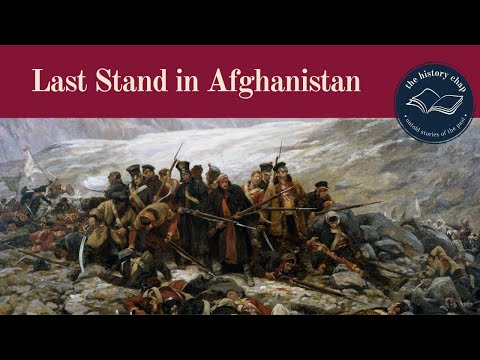
The cold was a living thing. It gnawed through boots, through wool uniforms, through skin and bone, down to the marrow. On the morning of January 13, 1842, what remained of the British army in Afghanistan—twenty officers and forty-five European soldiers, mostly from the 44th Foot Regiment—crouched behind a low stone wall on a rocky outcrop near the village of Gandamak. They had no food, no water, and only a handful of rounds left for their Brown Bess muskets. Below them, thousands of Afghan tribesmen swarmed like wolves closing in for the kill.
This was the end of a retreat that had begun six days earlier with 4,500 soldiers and 12,000 civilians. Now, only these sixty-five men were left. They had walked through snow drifts stained with blood, past frozen bodies of women and children, past soldiers who simply sat down and waited to die. And now, here, on this barren hill, they would make their final stand.
The story of how it came to this began not in the mountains of Afghanistan, but in the dusty offices of the British East India Company in Calcutta. In 1838, the British were obsessed with a single fear: Russia. The Russian Empire was expanding southward through Central Asia, and when Russian and Persian forces besieged the Afghan city of Herat, the British saw it as a direct threat to their prized colony of India. Their solution was to invade Afghanistan, depose its ruler, Dost Mohammad, and install a puppet king, Shah Shuja.
It was a plan built on arrogance and ignorance—a fatal combination.
By 1841, the British occupation of Kabul had turned into a nightmare. The money to bribe tribal leaders had run out. The puppet king was busy settling old scores. And the British garrison, camped in a indefensible position outside the city, was led by Major General William Elphinstone—a 60-year-old veteran of Waterloo whose best days were far behind him. He was indecisive, in poor health, and utterly unsuited for command.
When an Afghan mob stormed the house of a senior British officer and hacked him to death, and when Elphinstone’s political agent was lured into a trap and murdered, the British decided to cut their losses. They negotiated a withdrawal with the Afghan leader Akbar Khan. On January 6, 1842, the column set out from Kabul: 4,500 soldiers (only 690 of them European) and 12,000 wives, children, and servants. Their destination was Peshawar, 284 miles away.
They never made it.
The retreat was a death march from the first day. Afghan fighters picked off stragglers from the hills. The cold killed more than bullets. In the Kord Kabul Pass, a five-mile-long funnel of sheer rock, tribesmen opened fire from above, and 3,000 fell in a single afternoon. Elphinstone, paralyzed by indecision, agreed to surrender hostages—married men and their families—then agreed to surrender himself. The column disintegrated.
By January 13, only the men on that rocky outcrop remained. Captain Thomas Suter wrapped the regimental flag around his body, hoping to protect it—or perhaps to make himself a target. They fought with bayonets when the ammunition ran out. Wave after wave of tribesmen rushed them. When the end came, 66 men lay dead on the stones. Nine were taken prisoner, including Suter, who survived captivity and died in 1848.
Only one European escaped: Dr. William Brydon, who rode into Jalalabad that afternoon with a sword cut to his head and a story that would become legend. An entire army had been wiped out in seven days. It was the greatest military disaster Britain suffered in Asia until the fall of Singapore a century later. And it all began with a fear of Russia and a refusal to understand Afghanistan.
The road from Gandamak to Jalalabad was still thirty-five miles of frozen wilderness, and every one of those miles was hunting ground. Brydon’s horse stumbled through the snow, and behind him the tribesmen did not pursue—there was no need. They had their victory, their plunder, their revenge. The lone rider was no longer a threat; he was a message.
When Brydon reached the walls of Jalalabad that afternoon, the sentries almost shot him. His head was wrapped in a blood-soaked rag, his uniform was shredded, and his face was so blackened by frost and powder that he looked more corpse than man. But he raised a hand and called out, and they opened the gates. The garrison gathered around him in silence as he told them what had happened. The army was gone. All of it.
Inside Jalalabad, the news landed like a hammer blow. There were women and children in that column—wives of soldiers, families of officers—and now they were either dead in the snow or in the hands of Akbar Khan. The garrison commander, Sir Robert Sale, had held Jalalabad against siege for months, but this was different. This was a wound that would not close.
Meanwhile, in Kabul, Akbar Khan was consolidating his power. He had destroyed an empire’s army with little more than muskets, knives, and the Afghan winter. But he was not a fool. He knew the British would come back—not for Afghanistan, but for revenge. And so he did something unexpected: he sent word to the British hostages that they would be treated well, fed, and kept alive. Hostages, after all, are worth more breathing than dead.
Among those hostages was Captain Thomas Suter, the man who had wrapped the 44th’s colors around his body on the hill at Gandamak. He had been dragged from the rocks half-dead, his uniform torn away, the flag seized. Now he sat in a mud-walled room in Kabul, wondering if he would ever see England again. He would—but not for years, and not before watching his regiment’s honor become a legend.
Back in Calcutta, the news arrived like a thunderclap. Lord Auckland, the governor-general who had ordered the invasion, was stunned. The East India Company’s directors in London were horrified. An entire army—their army—had been annihilated. The reputation of British invincibility, built over a century since Clive’s victory at Plassey, lay in ruins. And in India itself, millions of subjects were watching, whispering, wondering: if the British could be destroyed in Afghanistan, could they be destroyed here too?
The answer, though no one knew it yet, was yes. Fifteen years later, the great mutiny would erupt, and the fear sown at Gandamak would bear bloody fruit. But that was still in the future. For now, there was the immediate question of what to do next.
Lord Auckland ordered a new army assembled—the so-called Army of Retribution. Its purpose was threefold: to punish the Afghan tribes, to rescue the hostages, and to restore British honor. But honor, once lost in the snow of the Kord Kabul Pass, is not easily recovered. And as the new force began its slow, deliberate march toward Afghanistan, the men who marched in it knew they were not avenging a defeat. They were chasing a ghost.
The Army of Retribution crossed into Afghanistan in the spring of 1842, and it did so with a swagger that the men of Elphinstone’s column would have recognized. Major General George Pollock commanded the relief force, and unlike his predecessor, he was decisive, cautious, and—crucially—willing to listen to his officers. He understood that Afghanistan was not a country to be conquered by arrogance. It was a country to be survived.
Pollock’s first task was to relieve Jalalabad, where Sir Robert Sale’s garrison had been under siege for months. When the British column appeared on the horizon, the defenders could hardly believe it. They had held out on half-rations, on hope, and on the grim certainty that no help was coming. Now help had arrived, and with it came the chance to strike back.
The combined force then moved toward Kabul, retracing the route that Elphinstone’s doomed column had taken. They passed the frozen corpses of the retreat—still unburied, still scattered along the road. Soldiers recognized faces. Some recognized friends. The Army of Retribution buried what it could and marched on, and the mood was not one of triumph but of cold, deliberate fury.
At the Kord Kabul Pass, the tribesmen tried the same tactics that had destroyed Elphinstone. They occupied the heights, ready to rain fire down on the column below. But Pollock was not Elphinstone. He sent his infantry up the slopes before the column entered the pass, driving the tribesmen from their positions with bayonets and disciplined volleys. The pass that had swallowed an army was cleared in hours.
When Pollock’s army reached Kabul, Akbar Khan did not stay to fight. He fled the city, taking the hostages with him. But the hostages were not the same people who had been captured seven months earlier. They had been treated with a strange, calculating courtesy—fed, sheltered, and kept alive. Akbar Khan understood that living hostages were leverage. Dead ones were merely corpses.
Among them was Captain Thomas Suter, who had spent months in captivity nursing his wounds and his pride. He had watched the Afghan winter pass from a mud-walled room, wondering if the flag he had wrapped around his body had survived. It had—seized as plunder, displayed as a trophy, but not destroyed. In a strange way, the colors had done their job. They had made him a prize worth keeping alive.
The negotiations for the hostages’ release were tense and drawn-out. Akbar Khan demanded money, guarantees, and safe passage. The British, still burning with the humiliation of Gandamak, wanted to refuse—but Pollock knew that punishing the tribes would not bring back the dead. What mattered now was getting the living home.
And so, in the autumn of 1842, the hostages were released. They walked out of captivity in ragged clothes, thinner and older than when they had entered. Suter carried with him the memory of the hill at Gandamak and the knowledge that he had survived what nearly everyone else had not. The flag, or what remained of it, was eventually recovered—a stained, torn relic of a disaster that would never be forgotten.
The Army of Retribution did not stay in Afghanistan. It had achieved what it could: Jalalabad had been relieved, the hostages had been freed, and Kabul had been briefly occupied and then abandoned. The British had made their point—but the point was a bloody one, and it changed nothing. Dost Mohammad, the ruler the British had originally deposed, returned from exile in India and reclaimed his throne. He would rule Afghanistan for another twenty years, and the country would remain as independent and as ungovernable as ever.
As the British army withdrew from Kabul for the second time, the soldiers looked back at the city and the mountains beyond. They had marched in with banners and drums. They were marching out with the memory of an entire army dead in the snow. The Duke of Wellington’s warning had been proven true in the most brutal way imaginable: it was easy to get into Afghanistan. The problem was getting out again.
In the end, the British learned nothing. They had marched into Afghanistan to check Russian expansion and marched out having achieved nothing but a body count. Dost Mohammad, the emir they had deposed, was back on his throne, ruling a country that had humiliated the greatest empire on earth.
Captain Suter returned to England a broken man, haunted by the screams on the hill at Gandamak. He died in 1848, just as another disaster—the great mutiny—was brewing in India, fueled by the belief that the British could be beaten.
The flag he had wrapped around his body became a relic in a regimental museum, a stained reminder of an army that vanished in the snow. And the question that haunted every soldier who survived was the one Wellington had asked years before: “It’s easy to get into Afghanistan—the problem is getting out again.”
But what if the real problem wasn’t getting out—but why they went in at all?






