Two men lie on a hillside in southern Afghanistan. They are 1,700 meters beyond what their rifles are officially designed to do. That’s not a rounding error—it’s more than a mile past the manual. They will fire together on a countdown. Neither bullet is likely to land on its own. In six seconds, a man nearly three kilometers away will fall without hearing a sound. And in the records of the world’s longest shots, the line for this one contains the country, the date, the distance. Where the name should be, there is nothing. This is the story of that empty line.
Before we go to the hide, before we watch the count, before we follow the two bullets through the six seconds they spend in the air, we need to read the list. Because that’s the only way to see what’s strange about this shot. Not the distance—the silence. Read the list aloud and you’ll hear it.
The list begins in Vietnam, 1967, on a hill somewhere north of a place the Marines called “Duck Foot.” A gunnery sergeant named Carlos Hathcock lies behind a heavy machine gun—a Browning .50 caliber M2, a weapon designed for aircraft and jeeps and unarmored trucks, not for a single man. Hathcock has mounted a telescopic sight on it, a scope made by a company called Unertl. The tripod is braced with sandbags. A Viet Cong fighter pushes a bicycle loaded with ammunition along a trail. Hathcock estimates the range at 2,500 yards—about 2,286 meters. He fires once, misses. The bicycle keeps moving. The man bends to pick something up, maybe to clean his teeth, and Hathcock fires again. The bullet arrives. The rifle is originally a machine gun. The record is Hathcock’s, and it will stand for 35 years. Read his name in the list. Carlos Hathcock. Say it aloud.
The list waits a long time after that. Then in March 2002, in a valley in eastern Afghanistan called Shahi Kot, five Canadians from the 3rd Battalion Princess Patricia’s Canadian Light Infantry move through thin cold air above 2,500 meters. It’s Operation Anaconda. They spend nine days and nine nights on the ridgelines, and eventually two of the five break records that have stood for a generation. First, Corporal Aaron Perry hits a fighter at 2,310 meters. It’s the new world record. He doesn’t hold it long. A few days later, his teammate Corporal Rob Furlong, using a McMillan bolt-action .50 caliber rifle, hits a man carrying a Soviet machine gun at 2,430 meters. His first shot misses. His second hits the man’s backpack. His third pierces his chest. At that distance and altitude, each bullet stays in the air for nearly four seconds. Read their names. Aaron Perry and Rob Furlong, both awarded the U.S. Bronze Star by the following December, along with the rest of their team.
The list stays still for seven years. Then in November 2009, in Helmand Province, south of a village called Musa Qala, a British cavalryman named Craig Harrison is escorting a convoy. He’s a cavalryman by trade, a soldier in the Blues and Royals—a regiment more accustomed to horses and ceremony than to Afghan hillsides. A Taliban machine gun team opens fire on the vehicles ahead of him. Harrison is carrying an Accuracy International L115A3, a British sniper rifle in a smaller magnum caliber. It’s a beautiful weapon, as tools can be beautiful. He ranges the machine gun team at 2,475 meters. By his account, it takes nine shots to walk the rounds onto the target. Nine shots. The first eight tell him about the wind, the altitude, the slow slight drift of the bullet. The ninth hits. It strikes the first gunner in the stomach. He works the bolt and fires again. The second gunner falls too. A third shot destroys the machine gun itself. Each bullet spends nearly five seconds in the air. A British Apache helicopter later flies over the site and confirms the distance with a laser rangefinder. The record is Harrison’s, and everyone knows it. He gives interviews. He writes a book. He calls it “The Longest Kill.” His photo appears in newspapers across three continents. There are TV appearances. There are documentaries. The rifle he used, the L115A3, sells better because of him. Read his name. Craig Harrison, Corporal of Horse, the Blues and Royals. Say it aloud.
Now, keep that in mind. Hathcock, Perry, Furlong, Harrison. Four names, four rifles, four countries, four newspapers. Then read the next line in the list. Australia, 2012, 2,815 meters. And where the name should be, nothing.
To understand why that line is empty, we have to walk to a hide in a place called the Kajaki district. Kajaki sits in northern Helmand Province, a stretch of dry mountain ranges and river valleys around a dam that powers the south. It’s the kind of place where a lot of the Afghan war happened without ever really making the news back home. In April 2012, an Australian task force is operating in the area. Two sniper teams from the 2nd Commando Regiment move through the field as part of a broader special operations task group. Their work is not the kind that gets described afterward. It rarely is. We’ll refer to the two men who fired the rifles as Man One and Man Two. That’s what they’ll be in this text from beginning to end. There are no names to give them. That’s not evasion. That’s the point.
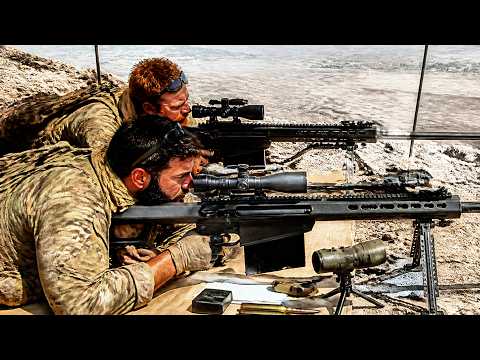
Man One lies behind a Barrett M82A1, a semi-automatic anti-materiel rifle weighing about 13 kilograms empty. Man Two lies behind another Barrett M82A1. The rifles are nearly identical. Each is loaded with the same ammunition, a .50 caliber round, 12.7 by 99—the same ammunition the Americans have been firing from heavy machine guns since Carlos Hathcock’s grandfather was a young man. Each rifle is fitted with a high-magnification scope. Each has a heavy muzzle brake to tame the recoil. Each has been carefully zeroed over a long training season. A third man is with them, the commander. He does the observing. He carries a spotting scope, a laser rangefinder, and a small handheld ballistic computer—the thing that has turned sniping over the past ten years into a branch of applied mathematics. In one team, a lance corporal is behind the trigger and a corporal is spotting. In the other team, a private is behind the trigger and another private is spotting. But the commander spots for both. He watches what they cannot see for themselves. He watches the ground between them and their target.
The target is a Taliban commander who appears through the optics at a distance the naked eye cannot resolve. They have established his identity. There is a group of men around him. There is movement, hand signals, the small rituals of leadership that reveal a man at any distance. If you watch them long enough—and snipers watch for a long time. There’s no hurry. Observation is what snipers do. It’s most of the work. The public imagination of the sniper is the shot. But the sniper is a pair of eyes long before he is a pair of hands.
On this morning, the two men and their commander have been in the field for hours, maybe longer. The details are not announced. What is announced from every other operation of this kind ever described is that the firing itself takes seconds, and everything before the firing takes an entirely different scale of time. Hours of watching, days of watching, in some cases, without movement, without eating, or eating so slowly and quietly that eating stops being eating. Drinking through a tube, urinating into a bottle. The mind doesn’t wander, because a wandering mind means the target moved in the seconds you weren’t paying attention, and you find yourself watching an empty piece of ground. The hide is not comfortable. Nothing in it is designed to be. The purpose of the hide is not the man inside it. The purpose is the ground around it and the way the ground swallows that man. If someone standing where the target stands looked back through his own optic, he should see nothing. That’s the whole point.
There is a process. It has a name in the Australian Defence Force and in the broader coalition. The details of that name don’t matter. What matters is that a positive identification has been made, and permission to engage has been requested and granted. This is not a story about a man on a hill making a decision alone. It’s a story about a system, taking minutes and sometimes hours and sometimes longer, to decide that a particular individual in a particular place at a particular time is a legitimate target under the rules of engagement in effect that day. Only when that process ends does the math begin.
The commander lasers the target. The number appears. 2,815 meters. No one says anything for a moment. That number is a problem. The Barrett M82 rifle the men are carrying has an official effective range of 1,800 meters. That’s not just a marketing number. It’s what the manufacturer stands behind. What the training manuals teach, what the ammunition officers sign off on. 1,800. Beyond that, the world changes. 2,815 is that number plus nearly half again. It’s more than 1,000 meters beyond what the rifle was designed for.
To understand what that means, you have to look at what happens to a bullet over three kilometers of open air. A .50 caliber round leaves the muzzle at nearly 850 meters per second. That’s more than twice the speed of sound. It’s faster than any sound the rifle will make. The first thing the bullet does when it exits the barrel is begin to fall. Gravity pulls at it from the moment it leaves the muzzle. At 100 meters, the drop is a few centimeters and doesn’t matter. At 300 meters, it’s a few tens of centimeters and can be dialed into the scope. At 1,800 meters, the drop is measured in meters. At 2,815 meters, the drop is enormous. To hit a target at that range with a rifle, you don’t aim at the target. You aim at the sky above and behind it. You let the bullet take a curved path like a mortar shell, like a thrown stone.
The second thing that happens is the wind. Wind pushes the heavy bullet sideways. Not much per meter. But over nearly 3 kilometers, a wind you can barely feel on your face will move the bullet several meters left or right of where you aimed. That’s why snipers don’t talk about wind speed. They talk about wind values in narrow bands at multiple points along the bullet’s path. Because the wind at the muzzle is not the wind halfway to the target, and it’s not the wind at the target. Over that distance, the bullet crosses wind fields that behave like different countries.
Then there’s the air. Air is a fluid, and a moving bullet loses speed constantly. Like an aircraft burning fuel, the less dense the air, the less speed the bullet loses. High altitude and heat mean thinner air. Cold and low mean more of it. On the day of the shot, the snipers are in a windless morning. The air is thin and still and very quiet. There’s spin. The bullet rotates on its axis at tens of thousands of revolutions per minute. That spin keeps it stable the way a top stays upright. But it also causes a slight sideways drift in the same direction every time over 3 kilometers. And that spin drift is not small. It’s a number you have to know.
There’s the Coriolis effect. Yes, the Coriolis effect. The one we learned in geography class. The Earth rotates beneath the bullet while it’s in the air. In six seconds, the Earth has moved a little, but enough. At 2,815 meters, the Coriolis effect on a bullet traveling roughly east to west is measurable. And it’s calculated. It goes into the ballistic computer alongside everything else. You don’t do these calculations in your head. You do them on a small computer and you cross-check them against printed data tables you carry in a bag. And you cross-check them against a mental model you’ve built over years of watching your bullets go where you didn’t expect. You do it together. Three men bent over the same numbers, whispering. The sniper school teaches this by hand before it teaches it by machine. Every long-range shooter has sat at some point with a pencil and a small pocket book and tables, and worked out elevation corrections up and down on paper. The reason isn’t romantic. The reason is that if the computer dies or the battery runs out or the moment doesn’t allow for looking at a screen, you have to be able to do the math roughly in your head.
The men on the hillside know this. All three of them. They’ve done it in classrooms, on ranges, on exercises. They’ve done it in the dark. But this morning, they have the computer. And the computer, once the number 2,815 is entered into it, along with temperature and pressure and wind and barrel twist rate and muzzle velocity and the ballistic coefficient of the ammunition, will output an elevation correction that is exceptional by any measure. They’re silent for a while. The wind won’t help them. It’s a windless morning. That’s a gift, and they know it. But the target is 2,815 meters away, and the rifle is designed for 1,800. Then one of them—we don’t know which—has an idea. Two rifles, one shot. The idea isn’t new. It’s been discussed before. It’s been passed around in bars and barracks and long tea breaks on ranges from Puckapunyal to Fort Bragg. At extreme range, a single shot is unlikely to land. The dispersion is too great. But firing two shots at the same instant doubles the probability of a hit. Two rifles in overlapping cones of dispersion. Two men breathing the same air. Two triggers pulled for the same calculation. If one bullet drifts a meter, the other might not. And if both drift the same way, well, you’ve learned something and you fire again. If one hits, that’s the shot. It’s a matter of percentages.
They talk about it briefly. There isn’t much to talk about. The calculations are the same for both rifles. The wind is the same wind. The Coriolis is the same. Everything the computer tells them, they will dial onto both scopes. The elevation is huge. The rifles are pointed at the sky at an angle far higher than they should be. If you stood behind the two men, you’d think they were firing at a low-flying aircraft. The muzzles are not pointed at a man on a distant hill. They’re pointed at an empty patch of sky above and behind him, where the bullet should roughly come down. Three kilometers away, six seconds from now if things go as planned.
Man Two checks his sight picture. Man One checks his sight picture. The commander watches the target. The target doesn’t know he’s being watched. No one has ever been shot at from three kilometers before. Not with a rifle. He stands still or nearly still among a group of other men. He doesn’t move in a way that would upset the calculations. The commander gives the signal. Three, two, one. The two triggers move at the same time. Two bullets leave two muzzles. Two flashes of light. Very small from this distance. Invisible to the target. Invisible to anyone else on the hill. Two clouds of dust puff from the muzzle brakes. Two men absorb the recoil into their shoulders. The rifles buck back at them like living things. The bullets are in the air now. Six seconds. You have to think about those six seconds. Six seconds is a long time in a gunfight. Six seconds is enough for a man to change direction away from you, or duck, or step out of a doorway, or raise a weapon. Six seconds is enough for the wind to shift. Six seconds is enough for you, behind the scope, to feel that the bullet has already missed, even though nothing has happened yet. Because your body can’t believe that a shot is still in the air after all this time.
After one second, the two bullets have traveled together, side by side, nearly 700 or 800 meters. They are supersonic. They are rising, still rising, because the muzzles were pointed high above the target, so the bullets gain altitude in the first part of their arc, curving like small thrown stones. Behind them on the hillside, the sound of the two rifles hasn’t reached the target yet. It has barely reached the space next to the shooters. After two seconds, the bullets have passed the midpoint, about 1,500 meters toward the target. They are still faster than the sound they made when they left. They are slowing the whole time. Gravity has begun to pull them down toward the earth. They are approaching the top of their arc, in air thinner than the air at the shooters. And thinner than the air at the target. The two men on the hillside are still holding their gaze through the scopes. Their bodies are still. Their heart rates are as low as they can be. The commander watches the target through his spotting scope. The target hasn’t moved.
At three seconds, the bullets cross the invisible line where they lose their supersonic speed. This matters. When a bullet drops below the speed of sound, its behavior changes. Small imperfections in the bullet and deformations in its shape are magnified as it slows through the transonic range. Some bullets wobble, some settle. A .50 caliber round, heavy and blunt and brutally effective, is generally stable through this transition, but its path becomes more chaotic than it was when it was flying faster than sound. This is one of the reasons the manufacturer’s effective range is 1,800 meters. Beyond that, you’re firing a bullet that is no longer precisely predictable.
At four seconds, the bullets have covered three-quarters of the distance. They are still very fast. Still faster than a man can run. They are slowing. At five seconds, they are almost there. On the ground, three kilometers from the men who fired, the target still knows nothing. He doesn’t know because there is nothing to know. No sound has reached him. No visual warning has come. The rifles can’t be seen at this range without magnified optics. And he isn’t carrying magnified optics pointed at that hill at that particular moment. He is living the moment he is in now. Talking, standing, thinking about something that won’t happen now. At six seconds, the bullets arrive. One hits, the other misses, and the target falls.
We don’t know which bullet did it. That’s the strange truth of this record. Two men, two triggers, two rifles, two bullets, one hit, and no way then or now to know whose bullet it was. You can imagine trying to work it out. You can imagine the two shooters looking at each other later in their hide, quietly, breathing. You can imagine someone later in a briefing tent drawing lines on paper, calculating angles of attack, trying to reconstruct where the bullet entered and where it exited. You can imagine an argument. Quiet, professional, but three kilometers away with two rifles firing at the same second from positions a few meters apart at a target who fell and was not subjected to a detailed forensic examination. There’s no logical way to be certain. Both men fired. One man hit, and no one can say which one. That didn’t stop the achievement from being recorded as a successful shot. But it stopped it from being attributed to a particular person. And that changed the nature of what this record means.
Think about that for a moment. A record is usually attached to a person. The record for the 100-meter dash belongs to the runner who ran it. The record for the high jump belongs to the athlete who cleared the bar. The record is the person, in the way numbers usually work. You know the name and the number together, or you don’t really know either. Here there is a number, but no person. There is a shot, but no singular shooter. There are two shooters, and it’s not about credit for both. It’s about credit for neither, because the math of two bullets arriving at the same target at the same second doesn’t allow you to know which one hit. Some records are set by teams. This case is not that. This is one bullet that hit and one that didn’t. And there’s no way to know which was which. It’s closer to a lottery than a competition, except that the two men who bought the ticket are the same two men who aimed at the same point at the same second for the same reason.
In the moments after the bullet arrives, the target’s body falls. The men around him hear nothing. They hear nothing because sound travels at about 340 meters per second, and the rifles are 2,815 meters away. It will take the sound of the two shots about eight and a quarter seconds to reach them. From their perspective, a man they were standing next to fell for no reason. Two seconds later, the crack of the shots reaches them. Two seconds after the fall, two dry reports, softened by distance. Distant enough to be confused with something else. A door slamming somewhere. The backfire of a vehicle. Anything. Not a rifle. Not a rifle they might look for. They scatter. They look around. They can’t see the shooters. The shooters are three kilometers away, already leaving their position or lying quietly still, doing what snipers do after the shot, which is to blend back into the earth.
On the hillside, Man One and Man Two don’t celebrate. There’s nothing to celebrate at this scale. There’s only a slight movement from the commander as he confirms what happened through the spotting scope. Yes. Confirmed, target down. Confirmation will come later from another element in a ground clearance force. There’s talk in one account of the shot later, referring to three observers from three separate sources who confirmed the hit. The paperwork in modern war, even for something as traditional as a long-range shot from a hill, is precise and reviewed and extensive. They pack up their gear. They go home. They report what they did. Somewhere at headquarters, someone writes it down. 2,815 meters. 2 April 2012. 2nd Commando Regiment. Confirmed by GPS. One hit, no name.
Then near-total silence. No press release. No photograph. No television appearance. No book called “The Longest Shot.” For nearly a year, this shot didn’t exist in public. It existed in the closed, narrow world of coalition special forces snipers, in emails and briefings and the stories told on courses. In that world, it wasn’t really a secret. The people who needed to know knew. The rest of the world didn’t know and didn’t think to ask.
Then in the autumn of 2012 in the Northern Hemisphere, a British newspaper called The Daily Telegraph published a short report. Two Australian snipers, Barrett M82A1 rifles, six seconds in the air, 2,815 meters. It’s not clear which one fired the lethal round. The article notes that the Australian Defence Force declined to comment. That’s because the Australian Defence Force doesn’t comment. Compare that for a moment to what happened when Craig Harrison broke the record in 2009. Newspapers across three continents. Interviews, photos, documentaries, a book. That’s how such a thing is usually handled in Britain, in Canada, in the United States. There is a sniper and he is celebrated. He isn’t necessarily paraded, but he has a name and a face and is allowed to keep them. The Australian shot is different. It was given no face at all. The names of the two men didn’t appear in news reports. They wouldn’t appear later either. Australian Special Operations Command doesn’t disclose them. It doesn’t disclose much of anything about the 2nd Commando Regiment, especially regarding identifiable individuals. There are reasons for that. Operational security is one. The safety of the men and their families is another. The nature of the work, which involves people with long memories and wide reach, is a third. The men who fired the shot continue their careers. They train. They deploy again. They come home. They leave the army or they stay. Some of them, if asked, might quietly tell the story to a small audience. Some might never mention it. Most, in keeping with the traditions of the Australian special operations community, will simply do the job and not talk about it, and leave this shot in the mental drawer where they keep such things. There is no line in the records for either of them. There is a line for the shot that includes the country, the date, the distance, the type of rifle, and the name field is blank.
Now, honesty requires a pause here. Not everyone believes the shot happened the way it was described. The most detailed public skepticism came from a former U.S. Marine sniper named Steve Reichert, himself an expert in long-range shooting calculations. Reichert had previously made a confirmed kill from over 1,600 meters in Iraq from atop an oil tank using a .50 caliber rifle to save the lives of trapped Marines below. He knows the math well. When the Australian shot was reported, Reichert sat down to study the math, wondering if it was actually possible. His concerns, which are worth reading in his own words, boil down to two things. The first is how much elevation adjustment the rifle scope would have needed. The second is the size of the target at that distance. Using optics and ammunition he believed were most commonly used, he concluded that the elevation adjustment required for a shot at 2,815 meters far exceeded the internal range available in many common sniper scopes. He calculated that at that distance, one minute of angle—the unit snipers use for adjustment—equals about 80 centimeters of movement on the target. That means at that range, the smallest normal adjustment your rifle can make with most scopes is about a meter wide. Reichert was careful. He didn’t say the shot didn’t happen. He said, in effect: here are the calculations. Let others decide what they see.
There were counterarguments from people who pointed out that the Australian rifles might have been set up differently. Some suggested the use of an inclined scope base, a way of building extra elevation into the rifle itself so the scope doesn’t have to do all the work. Some noted that the 2nd Commando Regiment had access to Schmidt & Bender scopes with specific reticles that allow the shooter to aim directly above the target without needing additional elevation adjustment. Some pointed out that the ground clearance force, made up of more than one nation, had confirmed the hit occurred. While others simply noted that the shot was taken in near-perfect conditions with light wind and high altitude, and that everything was set up for a first-round hit that might not be repeatable in other conditions. The honest position, the one you should keep in mind as you listen, is that the shot is officially confirmed and widely accepted. That the math isn’t straightforward, and that some of the world’s most experienced long-range snipers have stated publicly that it sits at or beyond the limits of what should have been possible with the equipment described. It’s a record and it’s also an open question. Both things are true.
And so it remained. The record itself stood for just over five years. It was set in April 2012. And in the summer of 2017, it was broken. The breaking came far from Helmand. It happened in the ruins of a city called Mosul in northern Iraq. A four-man Canadian sniper team from Joint Task Force 2 was operating in the city, providing cover as Iraqi forces fought their way through streets held by fighters of the group that calls itself Islamic State. Over several days, the Canadian team pushed their range further and further, firing into the city whenever targets appeared. One day, from a high position on the roof of a tall building, a Canadian sniper looked through his scope at a target more than two miles away. Light wind, no mirage, and a static human shape leaning against a wall. The rifle was a McMillan TAC-50, the same family of weapon Rob Furlong had used in Afghanistan 15 years earlier. The spotter did the math. The sniper fired. The bullet stayed in the air for between nine and ten seconds. It hit the target. The target fell. A camera recorded it. The distance the Canadian round traveled was 3,540 meters. That’s more than 700 meters farther than the Australian shot. It broke the record by nearly half a mile. The justification he later gave to a Canadian newspaper was that the shot actually prevented an engagement. The target was about to launch an attack on Iraqi security forces. A precise shot from over two miles away stopped that attack without dropping a bomb, without endangering civilians in the nearby streets, and without anyone on the target’s side even knowing where the shot came from. That’s the argument for the modern long-range sniper in urban war. It’s quiet. It’s precise. It solves a specific problem and then goes back to watching. But the record itself was the story.
In Canada, it sparked a political debate about what Canadian special forces were doing in Iraq, whether they were advising or fighting, and whether the country was in a war it hadn’t acknowledged. That debate played out in the Canadian Parliament. It went on for weeks. The pace didn’t slow, and the sniper’s name wasn’t disclosed. It was never going to be. The Canadian sniper was also unnamed. It has become the pattern. Contemporary special forces snipers from countries that do a lot of this are almost never named. But the story of the Canadian shot was told. It was carried by newspapers, discussed in politicians’ offices, and debated in the Canadian Parliament, where opponents questioned whether it meant Canada was engaged in a combat role in Iraq that it had denied. There were articles and editorials. There was analysis. The shot became public even though the identity of the man remained classified. The Australian shot never really became public in that way. It was known a little, then overtaken by events, then slid down the list.
Today, if you look at any of the standard lists of the longest recorded sniper kills in history, you’ll see the Canadian shot at the top. Below it, until recently, you’d see British Corporal Craig Harrison at 2,475 meters. And in third place currently, you’ll see an unnamed Australian sniper or snipers from the 2nd Commando Regiment at 2,815 meters. Some lists place the Australian shot ahead of Harrison’s based on distance, considering it second. Some lists put a small asterisk next to the Australian shot and leave the individual record to Harrison. There’s a dispute about it. That dispute will go on for a long time. But the line in every list has the same shape. Country, date, rifle, distance, and where the name should be, nothing.
Think about that. Think about all the ways men have wanted their names attached to a shot like this. Think about Hathcock, who quoted the moment a Viet Cong fighter bent over his bicycle for the rest of his life. Think about Craig Harrison in front of cameras telling the British public how it took nine shots to adjust his sights. Think about Rob Furlong, who is still giving interviews about a shot he took in 2002. Their names are attached to their bullets. Their names are attached to their rifles. Their names are in books. And think about the two men who lay on a hillside in the Kajaki district on 2 April 2012. Think about Man One behind his Barrett M82A1. Think about Man Two behind his. Think about the commander with his spotting scope. Think about the numbers read from the small computer and whispered from the center to the sides. Think about the count: 3, 2, 1. Think about the six seconds. Think about the two bullets side by side in air that no one else moved through, in a silence that no sound related to their firing broke. Think about the fall. Think about the two-second delay. Think about the men around the target hearing echoes softened by distance, arriving after everything they explained had already happened. Think about the debrief that followed. Someone must have written something down. Someone must have signed something. There are papers somewhere. Think about that small, quiet, professional argument about which of the two bullets hit. The one from Man One, and the one from Man Two, both fired within the same second. Both aimed at the same patch of sky. One made history, and the other didn’t. No one knows which was which. Then think about that. The two men return to their unit, to do whatever they did next. They deploy again, maybe watch another line of hills. They watch another group of men through optics, watch an identification and verification and permission process unfold or not unfold, and take whatever shot the field offers. No one then calls them by their names in connection with what they did. Finally, think about the record. Think about the moment the Canadians broke it in Mosul. Think about a small group of Australians hearing the news. Some still in the army. Some out. Man One, Man Two, the commander. Wherever they were that day, reading the story, maybe on a news site, 3,540 meters, McMillan TAC-50, a rooftop in Mosul, a Canadian, unnamed. The Canadian shot, whatever else it did, moved the Australian shot from the top of the list to the middle. But it also, in a way, confirmed what was already true. The pattern of no names held. The Canadian was unnamed too. That’s how it will be from now on.
You could say, if you wanted to be generous, that the Australian shot set the template for the modern long-range record. The template is this. There is a country. There is a date. There is a rifle. There is a distance. Sometimes there is a story about a target who fell, about a bullet that took a number of seconds to reach him. And where the name should be, nothing.
There were two men, probably still alive, now in their forties, who fired two shots that morning in the Kajaki district. They know who they are. Their unit knows. Their families know, or some of them know. The people who work with them or worked with them know, but the list doesn’t. The list contains a country and a date and a rifle and a distance. It has a blank space where the letters of two names would go if this kind of record included names. That blank space is not an accident. That blank space is a deliberate choice. It was a choice made by the Australian Defence Force in the days and weeks after the shot. It’s a choice that has been made and renewed every year since. It was a choice applied to the Canadian in Mosul. And it’s likely to be applied to whoever breaks the Canadian’s record later. The other men on the list had their names put in public. Hathcock on his hill in Vietnam swatting flies. Perry and Furlong at Shahi Kot receiving Bronze Stars, and Harrison under the lights of a British TV studio 20 years after his shot. Still telling the story of the day the machine gun opened fire on his convoy. He took his time, aimed, and broke the record. All of them named, all of them known, all of them part of the public legacy of what the rifle can do. But in the Australian line, a profound silence.
It’s strange to think about. It’s strange to set a record and not put your name on it. It’s strange to leave the line blank on purpose. But that’s what happened. In April 2012 in the Kajaki district of Helmand Province, two men from the Australian Army’s 2nd Commando Regiment fired two rifles at the same instant. Six seconds later, three kilometers away, a man they had been watching for a long time fell to the ground. Two seconds after that, the men around him heard the shots. Somewhere, a piece of paper was signed. GPS coordinates were written down. 2,815 meters. Confirmed hit. And in the record where the name goes, nothing.
Read the list one last time. 1967. Vietnam. M2 Browning. 2,286 meters. Carlos Hathcock. 2002. Afghanistan. McMillan TAC-50. 2,310 meters. Aaron Perry. 2002. Afghanistan. McMillan TAC-50. 2,430 meters. Rob Furlong. 2009. Afghanistan. Accuracy International L115A3. 2,475 meters. Craig Harrison. 2012. Afghanistan. Two Barrett M82A1s. 2,815 meters. Say it. Names and records and men who left the line blank. Names and dates and rifles and distances and a brave silence for these men who did the thing and didn’t need to write their names down to feel they had done it. Names and records and one asterisk in one list in one column where the letters would go if they had been offered. Two men, two rifles, six seconds, and one hit.
The silence that followed the Australian shot was not an ending. It was a beginning of a different kind of story. The two men returned to their unit, their names known only to a few. They trained, deployed, and lived their lives, carrying the weight of a record that belonged to neither of them alone.
Years later, when the Canadian shot broke the record, the Australians heard the news. Some were still in uniform, others had moved on. They read the distance—3,540 meters—and perhaps they smiled, knowing the pattern would hold.
**The Canadian was unnamed too. The blank line was no longer an anomaly; it was the new standard.** The Australian shot had set the template: country, date, rifle, distance, and nothing where the name should be.
And so the list grows, each line a silent testament to the men behind the trigger. The record stands, not as a monument to an individual, but as a quiet nod to the anonymous few who do the job without seeking glory.
But what of the two men on that hillside? They know who they are. Their unit knows. Their families know. And the list, with its deliberate emptiness, knows too—in its own way. **The blank space is not an erasure; it is a choice, a shield, a legacy of silence.**
In a world that craves names and faces, the Australian shot remains a ghost, a whisper in the annals of sniper history. And perhaps that is the most powerful statement of all: that some achievements transcend the need for recognition, and some heroes prefer the shadows.
What do you think? Does anonymity diminish the record, or does it make it more profound? Share your thoughts below.






