The roar of engines, the clatter of tracks, and the thunder of guns—World War II was a crucible that forged legends. Among the chaos, one question has sparked endless debate among historians and enthusiasts alike: What was the best medium tank of the war? The contenders are fierce, each with its own strengths and flaws. But only one can claim the crown.
In this deep dive, we pit three iconic machines against each other: the American M4 Sherman, the German Panzer IV, and the Soviet T-34. Each tank tells a story of its nation’s ingenuity and desperation. Each has its champions. And each has its critics.
The Sherman, with its reliable design and ease of maintenance, was a workhorse that could be produced in staggering numbers. It excelled at infantry support, but later variants like the Firefly proved it could hunt heavy tanks too. Yet, some argue it was a death trap against superior German armor.
The Panzer IV, Germany’s adaptable warrior, started as an infantry support vehicle but evolved into a potent tank killer. Its versatility was unmatched, but by 1944, it was outclassed by newer designs like the Panther. Was it a relic of a bygone era?
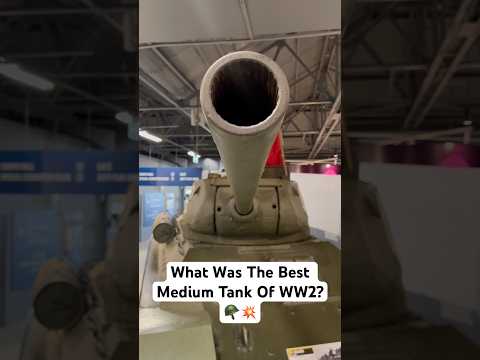
Then there’s the T-34, the Soviet steel beast that shocked the Wehrmacht. With its sloped armor, powerful gun, and exceptional mobility, it was a revolutionary design. Mass production churned out tens of thousands, overwhelming the enemy with sheer numbers. But was it truly the best, or just the most numerous?
Each tank has its advocates, and the debate rages on. The Sherman’s reliability, the Panzer IV’s adaptability, the T-34’s raw power—all have merits. But which one rises above the rest? The answer might surprise you.
As we delve into the details, consider this: the best tank isn’t just about stats; it’s about how it shaped the battlefield. And in that regard, one tank stands out. But we’ll get to that.
Stay tuned as we dissect each contender, compare their combat records, and reveal the ultimate medium tank of World War II. The verdict is coming.
To understand why the Sherman ultimately edges out its rivals, we need to look beyond the gun barrel and the armor plate. The real battlefield is logistics, and here the American tank dominated in ways the others could only dream of. It was designed for mass production, yes, but also for mass repair. A broken Sherman could be fixed in the field with basic tools, while a damaged Panther or T-34 often required a trip back to a specialized depot.
Consider the crew. The Sherman was roomy by WWII standards, with a turret basket that allowed the gunner and loader to work efficiently. Ergonomics save lives, and the Sherman’s crew survival rate was notably higher than that of its Soviet counterpart. The T-34, for all its sloped armor genius, was a claustrophobic nightmare. Its transmission was crude, and shifting gears required a hammer—literally, in some cases.
The Panzer IV, meanwhile, was a victim of its own success. Its chassis was stretched to the limit by 1944, and the long-barreled 75mm gun made it nose-heavy. Germany’s obsession with wonder weapons meant the Panzer IV was left behind, its production lines starved of resources as the Panther took priority.
But here’s where the Sherman truly shines: it was everywhere. From the deserts of North Africa to the jungles of the Pacific, from the beaches of Normandy to the frozen fields of the Bulge. It fought on every front, in every climate, and it kept coming. The T-34 was a superb defensive weapon, but the Sherman was an offensive tool—a tank designed to push forward, to exploit breakthroughs, and to keep the enemy retreating.
And let’s not forget the Firefly. With its 17-pounder gun, it could punch through the frontal armor of a Tiger at range. That’s not just infantry support—that’s a tank killer. The Germans learned to fear the Firefly, and some accounts suggest they targeted it first in any engagement.
So when we weigh reliability, crew survivability, adaptability, and sheer industrial might, the Sherman pulls ahead. But the T-34 has one argument left—one that’s hard to ignore. It won the war on the Eastern Front, where the Wehrmacht broke its back. Without the T-34, there would have been no Normandy, no Sherman rolling through France.
Which brings us to the crux of the debate. Is the best tank the one that fights best, or the one that enables victory? The answer, as we’ll see, depends on where you draw the line between tactics and strategy.
Let’s drill into that Eastern Front argument, because it’s the strongest card the T-34 holds. Operation Barbarossa collided head-on with a tank nobody was ready for. When German panzer crews first encountered the T-34 in 1941, their 37mm and short 50mm guns simply bounced off its sloped hull. The shock was visceral—one German general famously called it “a wonder weapon.”
But a wonder weapon that couldn’t see out of its own turret. The T-34’s two-man turret left the commander doubling as gunner, unable to scan the field while engaging targets. In a real firefight, that split attention cost lives. The Sherman’s dedicated commander, with a vision cupola and a radio in every tank, could coordinate a whole platoon while the T-34 crew shouted hand signals over a broken intercom.
Then there’s the matter of radios. Early T-34s often lacked them entirely, forcing commanders to signal with flags—flags on a battlefield thick with smoke and shellfire. The Sherman was a networked weapon; the T-34 was a lone brawler. Numbers can overwhelm, but coordination wins engagements.
Now, the Panzer IV deserves its moment before we dismiss it. It was the only German tank to fight from Poland to Berlin, a testament to how far its chassis could be pushed. The Ausf. F2 with the long 75mm was a genuine leap, capable of killing a T-34 at range before the Soviet tank could close.
But here’s the fatal flaw: Germany built roughly 8,500 Panzer IVs across the entire war. The United States alone churned out nearly 50,000 Shermans. The Soviets, over 84,000 T-34s. In a war of attrition, the Panzer IV was a precision instrument thrown into a contest of mass.
And precision instruments break. Its final drives were notoriously fragile, its suspension overloaded by the heavier gun, and by 1944 it was being outgunned and out-armored on every front. It was a good tank asked to do an impossible job—hold the line against enemies who could replace losses it never could.
So we return to the central question with sharper focus. The T-34 had the armor and the numbers. The Panzer IV had the pedigree. But the Sherman had something subtler—the ability to be everywhere, repaired by anyone, crewed by men who lived to fight another day. That combination is what turns a good tank into a war-winning one.
Yet before we crown a champion, there’s one more angle we haven’t fully explored. The one that historians argue about over whiskey and late-night forums: what the crews themselves said. And their verdict might just overturn everything we’ve assumed.
The crews, after all, are the ones who climbed into the steel boxes and drove toward the guns. Ask a Sherman crewman and he’d tell you about the escape hatch—a floor hatch that let men out when the tank brewed up. Ask a T-34 survivor and he’d tell you about the turret hatch that jammed, or the driver who couldn’t see past the open vision port.
Surveys of veterans tell a quiet story. American tankers praised their radios, their room, their repairability. Soviet tankers loved the T-34’s speed and hated its gearbox. German crews respected the Panzer IV’s optics but cursed its thin side armor. The men who fought in them rarely agreed on a single ‘best’—they agreed only on what kept them alive.
So let’s render a verdict, knowing no answer satisfies everyone. The T-34 wins the argument for revolution. Its sloped armor and mass production changed tank design forever. The Panzer IV wins the argument for adaptability, a chassis that stretched from 1939 to 1945. But the Sherman wins the argument for the war itself.
It was reliable when reliability meant the difference between a breakthrough and a stall. It was repairable when factories were an ocean away. It was survivable when its crews were the scarcest resource of all. And it was there—on every front, in every climate, in numbers that never stopped.
That’s why, after all the stats and the debates, the Sherman edges out the T-34 and the Panzer IV. Not because it was the fastest or the most heavily armored. Because it was the tank that won the war it was built to fight.
But history is never that clean. Put a T-34/85 against a Sherman Firefly on a dusty plain, and the outcome depends on who spots whom first. Put a Panzer IV Ausf. H against a plain M4A3, and the German crew might just win the day. The ‘best’ tank is always the one that survives the engagement.
So here’s the question I’ll leave with you, the one that’s fueled a thousand barroom arguments: if you had to climb into one of these three and drive toward the enemy tomorrow, which would you trust with your life—the reliable Sherman, the revolutionary T-34, or the adaptable Panzer IV? Let me know in the comments below.






