On May 5, 1945—just three days before the end of the war in Europe—a 27-year-old American tank lieutenant from Norwich, New York, was about to issue an order that no American officer had ever given before, and none has since. He was about to command a German Wehrmacht major, and that German major was going to obey. Together, they would defend a medieval castle filled with French prisoners against a battalion of SS troops sent to slaughter everyone inside before the Americans arrived.
This was the only battle in U.S. Army history where American and German soldiers fought side by side. It happened on the final morning of the war. And for fifty years, almost no one knew it had happened at all.
The night before that battle, a man on a bicycle was racing down a mountain road in the Austrian Tyrol. His name was Andreas Krobot. A cook in his thirties, thin from years of captivity, he wore the ragged clothes of a kitchen servant at a medieval castle that had never been designed to be a prison. He pedaled as fast as his legs could manage—and his legs were not strong. He hadn’t eaten well in weeks.
The road was steep. The lamp on his handlebars was covered with tape, leaving only a thin beam of yellow light. The valley below was dark. The sky above was dark. Somewhere in the woods on either side, armed men hunted deserters. In his pocket, wrapped in oilcloth, was a letter—a short letter, written in three languages, begging whoever found it to come quickly. It was signed by men whose names had been on the front page of every newspaper in Europe two years earlier. Now they were just signatures on a smuggled message, carried by a cook on a bicycle into a valley crawling with SS patrols under orders to shoot anyone they didn’t recognize.
Krobot pedaled harder. He didn’t know if the war was ending or beginning. All he knew was that the people he had been feeding for two years would die at sunrise if he didn’t reach the town below before the wrong man stopped him on the road.
To understand why a Czech cook was risking his life on a mountain bike in the last week of World War II, you have to go back just two years—and up to the rocky outcrop of Schloss Itter. It had stood on that ledge above the village since the 13th century. Though the structure you see today was rebuilt in 1878, and most of what makes it look like a fortress is just decoration, the real walls are old, and the site is older still. The road up to it is narrow and steep, easy to defend by men with rifles above. The Nazi regime noticed.
In late 1940, the castle was leased from its owner, an Austrian named Franz Grüner, who ran it as a hotel. In February 1943, on direct orders from Heinrich Himmler, the SS seized it outright. By April of that year, Itter was formally annexed to the Dachau concentration camp system as a satellite facility. But it was not an extermination camp. It was something stranger: a Sonderlager—a special camp—a place for what the regime called Ehrenhäftlinge: honor prisoners. The wealthy kept these people alive for the same reason a gambler keeps his last chip. They were currency. They might be useful at the negotiating table when things went bad in the war. They were too valuable to kill and too dangerous to release. So they were sent to a castle in the mountains and put under guard.
By spring 1945, the people inside that castle were among the strangest collection of human beings ever assembled in a single prison. Paul Reynaud was 66. He had been prime minister of France in May 1940 when the German army rolled through the country and tore it apart in six weeks. He refused to sign the armistice. He wanted to fight on from North Africa. He was overruled, arrested, handed over to the Germans, and locked in this castle to wait out the war he had failed to win.
In the next room, separated by a stone wall and a bitterness that had not faded in five years, was the man who had preceded him as prime minister: Édouard Daladier, 60, the man who signed the Munich Agreement in 1938, the man who stood beside Neville Chamberlain and tried to buy peace with Czechoslovakia, and who had been called a coward ever since. He and Reynaud were bitter enemies. They had been enemies before the war, enemies during it. Now, confined in adjacent rooms of the same prison, they refused to speak to each other.
Down the hall lived two generals. Maxime Weygand, 78, had been commander-in-chief of the French forces during the disaster of 1940. He was recalled from retirement at the last moment to save a war that was already lost. His wife, Marie Weygand, was imprisoned with him. They had grown old together, grown old in this castle. Maurice Gamelin was 72. He was the man Weygand had replaced. The man often blamed in French books and newspapers for the speed of the collapse. He and Weygand refused to speak.
There were others. Marie-Agnès Cailliau, 55, the elder sister of General Charles de Gaulle himself, arrested for her work in the Resistance and sent here as leverage against her brother. Michel Clemenceau, 71, son of the legendary prime minister who had led France through World War I. Léon Jouhaux, 65, leader of France’s largest trade union, imprisoned with his partner, Augusta Bruchlen. Years later, he would win the Nobel Peace Prize. None of that was visible yet from inside the castle.
François de La Rocque, 59, a political figure with a complicated past—collaborator with the enemy and liaison with the Resistance, depending on which month you asked. Christiane Mabire, Paul Reynaud’s personal secretary and partner, who shared his confinement. And Jean Borotra, 46, a man who had won Wimbledon twice in the 1920s and who was still, by every surviving account, in extraordinary physical condition. He had served briefly in the Vichy government before defecting. He was arrested while trying to flee France. He ended up here.
These were the prisoners of Castle Itter. They had failed publicly. They had failed in ways history was still measuring. They blamed each other. They argued in the corridors. They sat at the long wooden table during meals and did not look at one another. And the SS guards who watched them learned to read the silence in that room more carefully than any spoken word.
This was what the cook on the bicycle was riding to save.
Three miles down the mountain in the town of Wörgl, there was a man who had spent the past year lying to almost everyone he knew. His name was Josef Gangl. Though his men called him “Sepp,” he was 34 years old. He was a major in the Wehrmacht, commanding what remained of the 25th Panzer Grenadier Regiment in Nieblung—which was no longer a regiment in any real sense by May 1945.
It was survivors. A few dozen men with empty supply trucks and dwindling ammunition, the sad soldier’s look on their faces, men who understood exactly how the war would end and had decided not to die pointlessly in its final moments.
Gangl was a decorated combat officer. He had served in France in 1940, served on the Eastern Front, and had been awarded the Iron Cross for bravery in combat. He had done the things officers were asked to do in those campaigns, and he had been promoted for doing them well. But somewhere in the past year, something in him had changed.
He had begun, quietly and carefully, to make contact with the Austrian Resistance. There was a man in Wörgl named Rupprecht Hagleitner who ran a small underground cell, and Gangl had started feeding him information. He had started protecting his own soldiers from orders he considered suicidal. When SS units in the area began executing Austrian civilians for hanging white bedsheets from their windows, Gangl had posted his men in the town to discourage those executions.
He had not fled. He had not deserted. He had done something more dangerous. He had stayed in uniform, using it as cover. Every morning he issued orders in the name of a regime he had decided to betray. Every evening he waited to see whether the next knock on the door would be the Gestapo coming to arrest him.
By May 4, 1945, his position had become impossible. The town of Wörgl was surrounded by roving SS units that no longer answered to any central command. The Wehrmacht had effectively ceased to exist as a coordinated force in the region. Gangl had only twenty men he trusted. He had decided to surrender to the Americans the moment they reached the town.
He was waiting—and then the local Resistance brought him a Czech cook on a bicycle, exhausted and drenched in sweat, carrying in his pocket a letter signed by Édouard Daladier, Paul Reynaud, and Maxime Weygand.
Gangl read the letter. He understood its meaning immediately. The SS would never allow those prisoners to be liberated. They would kill them first. There were units in the area capable of doing it. He had no time to deliberate. He decided to go to the Americans himself.
Five miles north, in the town of Kufstein, a 27-year-old American officer named John Lee was waiting for the war to end. He was a first lieutenant in the 23rd Tank Battalion of the 12th Armored Division, attached to the XXI Corps of the U.S. Army. His friends called him Jack. The men who served under him later described him as energetic, profane, fearless, and somewhat reckless. He chewed cigars without lighting them and swore constantly.
He had fought across France and Germany, survived the Battle of the Bulge, crossed the Rhine, and by early May 1945 he was sitting in a Tyrolean village with his Sherman tank parked outside and nothing to do. The German army in front of him had effectively stopped existing. Villages were surrendering without a shot fired. The 36th Infantry Division was on its way to relieve him. He was exhausted. His men were exhausted. The war was three days from over, and everyone knew it.
He had no idea that a Wehrmacht major was at that moment driving toward him, raising a white flag improvised from tinfoil paper on a small jeep, with the names of French statesmen written on a piece of paper in his coat pocket.
Lee was about to receive the strangest order of his military career. And he was going to receive it from an enemy.
Lee listened as Gangl laid it out: the castle, the prisoners, the SS battalion coming to kill them all. He asked one question—would Gangl drive him there now? Gangl said yes.
They went together, an American lieutenant in the passenger seat, his pistol on his lap, a German major at the wheel. Lee saw the walls, the single road, the windows. He returned to Kufstein and got five Shermans and a company of infantry from the 142nd.
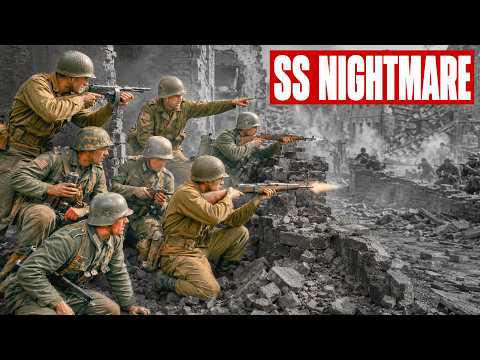
Only one tank could cross the old wooden bridge. So 26 men—Americans, Wehrmacht veterans, one tank named “Jenny”—climbed the mountain. They fought side by side against the SS until reinforcements arrived at four in the afternoon.
Gangl was killed that morning, pulling Paul Reynaud from a sniper’s line of fire. He was the only defender to die. The prisoners were liberated hours later. The war in Europe ended two days after.
For fifty years, almost no one knew. No manual covered it. No category held it. Just men who chose, in the war’s last light, who to stand beside.
So tell me—if the world had already decided you were on the losing side, would you still have climbed that mountain?






