The crack of a single rifle shot shattered the humid afternoon air. It was October 3, 1993, and in the dusty streets of Mogadishu, Somalia, a routine snatch-and-grab mission had just gone horribly wrong. Within minutes, what should have been a swift operation spiraled into a chaotic battle that would claim the lives of 18 American soldiers and leave hundreds wounded. The world watched in shock as two U.S. Black Hawk helicopters were shot down, their crews trapped behind enemy lines. This is the story of the Battle of Mogadishu—a fight that would redefine modern urban warfare and leave an indelible mark on American military history.
But to understand how a humanitarian mission turned into a deadly firefight, we must go back to the beginning. In 1992, Somalia was a nation in ruins, ravaged by civil war and famine. The international community, led by the United States, launched Operation Restore Hope to deliver food and aid to millions on the brink of starvation. What began with hope and goodwill soon descended into a quagmire of clan warfare and bitter resentment. When the U.S. decided to hunt down the warlord Mohamed Farrah Aidid, they underestimated the fierce resistance that would follow. The stage was set for a confrontation that would test the mettle of America’s elite forces and expose the limits of military power in a hostile urban environment.
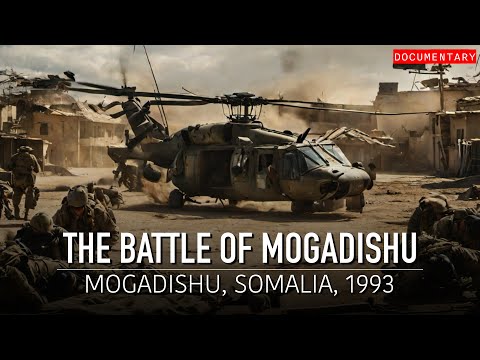
As the sun rose on October 3, the men of Task Force Ranger—an elite coalition of Army Rangers, Delta Force operators, and Navy SEALs—prepared for yet another mission. Intelligence had located two of Aidid’s top lieutenants in a compound near the Bakara Market. The plan was simple: fast-rope from helicopters, secure the targets, and be back at base within an hour. But in war, no plan survives first contact with the enemy. The streets of Mogadishu were a labyrinth of narrow alleys and crowded markets, and the Somali militia, armed with assault rifles and rocket-propelled grenades, knew the terrain far better than the Americans.
The operation began at 3:30 PM. Black Hawks and Little Bird helicopters swooped over the city, dropping troops into the target area. The assault team quickly secured the compound and captured 24 prisoners. But as they prepared to load the detainees onto convoy trucks, the situation deteriorated. Ranger Private First Class Todd Blackburn fell 70 feet from a helicopter, sustaining critical injuries. The convoy, already under heavy fire, was now tasked with evacuating him. Meanwhile, the streets filled with angry Somalis, many of them armed, converging on the Americans from all directions.
Then came the first devastating blow. A rocket-propelled grenade struck Black Hawk Super 6-1, sending it spiraling into a building. Chief Warrant Officer Cliff “Elvis” Wolcott and his co-pilot were killed instantly. The crash site became a magnet for Somali fighters, and the Americans on the ground were now fighting for their lives. A second Black Hawk, Super 6-4, was shot down minutes later, its crew trapped in a hostile neighborhood. The battle had become a desperate struggle for survival.
As the sun set, the situation grew even more dire. The ground convoy, battered and lost in the maze of Mogadishu’s streets, could not reach the crash sites. A Quick Reaction Force was assembled at the airport, but it too was ambushed and forced to retreat. For the soldiers pinned down at the first crash site, the night was a blur of gunfire, explosions, and the agonizing wait for rescue. Ammunition and water were running low, and the wounded were in desperate need of evacuation. The battle was far from over, and the worst was yet to come.
But the most harrowing chapter was still being written in the dusty alleyways surrounding the second crash site. As Super 6-4’s wreckage smoldered in the street, a crowd of hundreds of Somali militia and civilians swarmed toward it, intent on overrunning the survivors. It was here that two Delta Force snipers, Master Sergeant Gary Gordon and Sergeant First Class Randy Shughart, made a decision that would echo through military history. They requested permission three times to be inserted into the crash site, and three times they were initially denied. The commanders knew the odds of survival were virtually nil, but Gordon and Shughart insisted. Finally, with the words “We’re going in,” they were dropped into the maelstrom.
What followed was a display of courage that would earn both men the Medal of Honor, posthumously. They fought with rifles and pistols, holding back wave after wave of attackers while attempting to protect the injured pilot, Chief Warrant Officer Michael Durant. When Gordon was killed, Shughart picked up his weapon and continued the fight alone, handing Durant his own sidearm so the pilot could defend himself. Within minutes, Shughart too was dead, and the crash site was overrun. Durant was beaten and taken captive, but his life was spared by a militia leader who saw him as a valuable bargaining chip.
Back at the first crash site, the surviving Rangers and Delta operators had formed a desperate defensive perimeter. They were running low on ammunition, and the wounded, including Corporal Jamie Smith, were fading fast. A daring resupply attempt by Black Hawk Super 6-6 was met with such intense fire that the aircraft was nearly shot down, and the evacuation of Smith had to be abandoned. Smith would later die of his wounds, one of the 18 Americans killed that day.
As midnight approached, a massive rescue convoy was finally assembled at the airport, this time including Malaysian and Pakistani armored vehicles and tanks. The two-mile-long column fought its way through the city, using main guns to blast roadblocks and suppress enemy fire. By 2:00 AM on October 4, the convoy reached the first crash site, and the exhausted survivors—some of whom had been fighting for over 12 hours—climbed aboard. The relief was palpable, but the ordeal was not yet over.
The convoy still had to make the perilous journey back to the stadium, and in the chaos of the withdrawal, several soldiers became separated from their vehicles. They were forced to run on foot through the hostile streets, using the vehicles as cover, in what became known as the “Mogadishu Mile.” By 6:30 AM, the battle was over. The Americans had suffered 18 dead and 73 wounded, but they had held off an estimated 2,000 Somali fighters.
News of the battle hit the American public like a thunderbolt. The images of dead U.S. soldiers being dragged through the streets of Mogadishu were broadcast around the world, shocking a nation that had believed its military was invincible. President Bill Clinton immediately ordered an end to all operations targeting Aidid and announced that U.S. forces would withdraw from Somalia by March 1994. The battle had become a political firestorm, and the lessons learned would shape American military policy for decades to come.
The political fallout was swift and brutal. Secretary of Defense Les Aspin resigned under intense pressure, taking the blame for the refusal to deploy armored vehicles and AC-130 gunships that many believed could have prevented the disaster. In Congress, lawmakers demanded answers, and the Clinton administration found itself scrambling to contain the damage. The image of America as a benign superpower had been tarnished, replaced by the specter of a military that had stumbled into a trap and paid a terrible price.
Yet for all the recriminations, the men who fought that day had performed with extraordinary valor. Two Medals of Honor were awarded posthumously to Gordon and Shughart, while dozens of other soldiers received Silver Stars, Distinguished Flying Crosses, and Purple Hearts. Their actions—holding off thousands of fighters, protecting their wounded, and refusing to leave a fallen comrade behind—became the stuff of legend within the close-knit special operations community.
But the story was far from over for the man at the center of it all. Mohamed Farrah Aidid, the warlord whose capture had been the mission’s objective, remained at large. He declared himself president of Somalia in June 1995, only to be assassinated fourteen months later in a clan feud. His death brought no peace to a country that had already been shattered by years of war and famine.
For the United States, the Battle of Mogadishu became a cautionary tale. The military learned hard lessons about urban combat, the limits of technology, and the importance of intelligence and armored support. Many of the young officers who survived that day—men like Captain Mike Steele and Lieutenant Colonel Danny McKnight—went on to senior commands, where they passed on the hard-won knowledge to a new generation. When American forces entered Fallujah and Ramadi a decade later, the ghosts of Mogadishu were never far from their minds.
The battle also changed how America viewed its role in the world. The doctrine of humanitarian intervention, so popular in the early 1990s, gave way to a deep skepticism about sending troops into conflicts without clear national interests. When the Rwandan genocide erupted just six months later, the memory of Somalia hung over the deliberations in Washington, contributing to the international community’s shameful failure to act.
Yet the men who fought in Mogadishu refuse to let their story be defined solely by politics. For them, October 3, 1993, was about something simpler: brothers-in-arms who stood together when everything went wrong. As Ranger Keni Thomas later wrote, “We were not heroes. We were just soldiers who did our job and tried to bring everyone home.” It was a job that cost them dearly, but one they performed with a courage that continues to inspire.
The Black Hawk Down incident remains one of the most studied battles in modern military history. Its lessons echo in every urban operation conducted since, and its heroes are remembered in memorials and ships’ names. But perhaps its most enduring legacy is the reminder that war, no matter how noble the cause or precise the plan, is always unpredictable, always costly, and always human.
For the families of the fallen, the years that followed brought a quieter kind of battle—one fought in living rooms and at memorial services, far from the cameras. Every October 3rd, the survivors gather at Fort Benning, Georgia, to honor the men who never came home. They share stories, shed tears, and reaffirm a bond forged in the fire of Mogadishu.
Michael Durant, the pilot held captive for eleven days, eventually returned to the cockpit and later wrote a book about his ordeal. He has said that he thinks of Gordon and Shughart every single day, and that their sacrifice is the reason he is alive. Their names now grace Navy ships, and their story is taught to every new generation of special operators.
The battle also left a complicated legacy in Somalia itself. Aidid’s death did not end the clan warfare, and the country remained fractured for decades. Yet the humanitarian mission did save hundreds of thousands from starvation, a fact often lost in the shadow of the firefight. In 2013, a new Somali government finally began to stabilize the nation, a fragile hope born from the ashes of 1993.
Today, the Black Hawk Down incident is remembered as both a tragedy and a testament to human courage. It reminds us that even in the darkest moments, ordinary soldiers can rise to extraordinary heights. Their sacrifice was not in vain—it shaped a generation of military leaders and taught America hard truths about war.
As the sun sets over Mogadishu, the ghosts of that day still linger in the dusty streets. But so does the memory of men who fought not for glory, but for each other. Their story endures, a haunting reminder of the cost of intervention and the price of valor.
What do you think—was the Battle of Mogadishu a necessary sacrifice or a tragic miscalculation? Share your thoughts in the comments below.






