On the morning of D-Day, as the sun began to rise over the Normandy coastline, Tech Sergeant Don Malarkey found himself face to face with an enemy who felt strangely familiar. The air was thick with the chaos of war, but for a brief moment, a conversation about home—Oregon, of all places—bridged the gap between two soldiers on opposite sides. But that moment of humanity was shattered when Lieutenant Ronald Speirs allegedly raised his Thompson submachine gun and executed the prisoners, leaving Malarkey in shock. Was this brutal act real, or just another piece of Hollywood fiction?
The scene in Band of Brothers is gripping: Malarkey, amused by a German prisoner’s perfect English, asks where he’s from. “Eugene, Oregon,” the prisoner replies, stunning Malarkey, who is from Astoria. They bond over shared memories of working in factories back home. But as Malarkey walks away, Speirs approaches the group, hands out cigarettes, and then guns them down. It’s a chilling introduction to Speirs’ character—but according to Malarkey himself, it never happened that way.
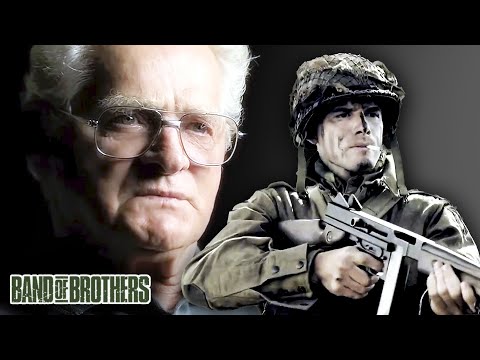
In reality, Malarkey’s encounter with the German prisoner was indeed based on a true story, but the details were altered for the screen. The prisoner was from Portland, not Eugene, and it was another soldier who asked the question. Malarkey and the prisoner discovered they had worked at factories right across the street from each other—a coincidence so remarkable that the filmmakers thought audiences wouldn’t believe it. So they changed it. But the biggest deviation? Ronald Speirs never executed those prisoners on D-Day.
Malarkey recalled the real event in his book Easy Company Soldier. The encounter happened about a mile inland from the coast, where about 20 German prisoners were being held. After the friendly conversation, Malarkey simply said, “You take care,” and walked away. There was no Speirs, no cigarettes, no execution. The scene was fabricated to introduce Speirs as a fearsome killer, a reputation that followed him throughout the war.
But why did the series take such liberties? In a 2012 talk, Malarkey emphasized that while Speirs was indeed a tough soldier, the execution likely happened later, during the attack on Carentan, France. “I don’t know that he really shot these guys down,” Malarkey said. “But later on as we were attacking Carentan, we could hear a bunch of Tommy gun firing going on… and the report came back that they told the story about Ronald Speirs having these Germans that came up out of the ditches and surrendered.” So the brutal act was probably transplanted to D-Day for dramatic effect.
So what became of the German American prisoner from Oregon? Did he survive the war? Did Malarkey ever try to find him? The answers are as elusive as the man himself. Malarkey expressed hope that the prisoner survived, but without a name, tracking him down would have been nearly impossible. Perhaps he returned to Germany, or perhaps he stayed in America. We may never know.
But one thing is certain: the real story is more human than Hollywood’s version. Two men, brought together by the strange circumstances of war, shared a moment of connection before parting ways—no execution, just a simple goodbye. And sometimes, that’s the most powerful story of all.
Yet the story of the German prisoner from Oregon doesn’t end with that parting on the road to Sainte-Marie-du-Mont. In the decades after the war, as Band of Brothers became a cultural phenomenon and veterans of Easy Company were thrust into the spotlight, Malarkey’s encounter took on a life of its own. Fans of the series, history buffs, and amateur researchers alike began to wonder: could the man have been identified? Did he leave a trail?
The answer, frustratingly, is no. No surviving records from the Volksdeutsche conscription rolls list a soldier from Eugene, Oregon, captured on D-Day by American paratroopers. The German military’s documentation was, in many cases, destroyed or lost in the chaos of the war’s final months. And even if a name had survived, the man himself might have vanished into the postwar shuffle—one of millions displaced by conflict.
But Malarkey never forgot him. In interviews, his voice would soften when the topic arose. “I hope he made it,” he said more than once. “I hope he went home and lived a good life.” There was no anger in his recollection—only a quiet, lingering curiosity about a man who had shared a cigarette, a laugh, and a memory of Oregon with him before the war swallowed them both.
What makes the story so enduring isn’t the violence that Hollywood added—it’s the humanity that was already there. Two men, one in an American uniform and one in a German one, discovered they had worked a stone’s throw from each other in Portland. They had breathed the same rainy air, walked the same streets, perhaps even passed each other on the sidewalk without a second glance. And then history had hurled them across an ocean and set them against each other.
Malarkey summed it up best in his memoir: “The guy trying to kill you and that you’re trying to kill could be somebody who once worked in an American defense plant across the street from where you later worked. Strange thing, war.” It’s a line that captures the absurdity and tragedy of conflict better than any scripted scene ever could.
As for Speirs, the real man was far more complex than the cold-blooded killer the series introduced in that fabricated moment. He was a capable, sometimes ruthless officer, but also a leader who earned the respect of his men through competence and courage. The execution of prisoners—if it happened at all—was an act of war’s grim logic, not a character-defining flourish. By transplanting it to D-Day, the filmmakers sacrificed truth for narrative economy, giving audiences a villain to fear and a hero to admire in the same breath.
But the German prisoner from Oregon? He remains a ghost. A young man who answered a call to a fatherland he’d never known, only to find himself on the wrong side of a road in Normandy, talking to a stranger from home. Maybe he survived. Maybe he didn’t. The not-knowing is its own kind of wound—one that Malarkey carried quietly, along with so much else.
And perhaps that’s why the story resonates. Because in war, the enemy is never truly a stranger. He is a mirror. He is a neighbor. He is a man who once worked across the street.
But there’s a detail that often gets lost in the retelling—one that Malarkey himself only mentioned in passing during his 2012 talk in Salem. After the prisoner confessed that he thought he’d made a big mistake returning to Germany, Malarkey didn’t just walk away. He hesitated. For a moment, the two men simply looked at each other, the absurdity of their situation settling over them like the morning fog rolling in from the coast.
“Well, now what do you think about that decision now to return to your homeland?” Malarkey had asked him. The prisoner’s answer—“I think I made a big mistake”—hung in the air between them. It was the kind of confession that soldiers rarely spoke aloud, and Malarkey never forgot it.
What happened next in real life was far less dramatic than the series, but somehow more poignant. Bill Guarnere—yes, that Bill Guarnere, the fiery Philadelphian who had already lost a brother in the war—called out to him from down the road. “Malark, let’s go!” His voice carried a sharp edge of impatience, maybe even disgust. Fraternizing with the enemy was one thing; lingering over it was another.
Malarkey turned back to the prisoner one last time. He didn’t offer a cigarette. He didn’t offer a speech. He simply nodded and said, “You take care.” Then he jogged off to rejoin Easy Company, leaving the German American from Portland standing in the road with his hands loosely at his sides.
That was it. No gunfire. No execution. Just two men parting ways on a dirt road in Normandy.
But here’s the part that haunts the story even more: the prisoner’s confession. “I think I made a big mistake.” Think about what that meant. In 1939, he had been working at Schmidt Steel Company in Portland, Oregon, living the life of an ordinary American. Then Hitler called, and he answered. He packed up his life and crossed the Atlantic to fight for a country he’d never lived in, for a cause he may not have fully understood.
By the morning of June 6, 1944, he was standing on the wrong side of the English Channel, wearing a German uniform, surrounded by American paratroopers who could have shot him on sight. And there was Malarkey—a guy from Astoria, just a hundred miles from Portland—looking at him like a mirror image of a life unlived.
What did the prisoner do after that? Did he fight on? Did he surrender again later, hoping for another American who might recognize the name of a street he once walked? Or did he simply fade into the chaos of a collapsing Reich, one of millions of men whose stories were never recorded?
Malarkey never knew. But he thought about it. In his later years, when the memories of Bastogne and the Bulge crowded his mind, he would sometimes circle back to that morning in Normandy—not to the gunfire or the fear, but to the conversation. “I’d only been at war a few hours,” he wrote, “and already I was learning stuff I hadn’t been taught in training.”
The lesson wasn’t about killing. It was about recognizing. The enemy wasn’t a faceless monster. He was a guy who worked across the street. He was a guy who made a mistake and knew it. He was a guy who might have been Don Malarkey, if history had nudged him a few degrees in another direction.
And that, perhaps, is the real reason the filmmakers changed the story. Not because audiences wouldn’t believe the coincidence of the factories, but because the truth was too complicated. Too human. It didn’t fit neatly into the arc of a television episode. It didn’t introduce a fearsome lieutenant or provide a shocking twist.
It just sat there, in the middle of a road in Normandy, two men saying goodbye.
So the prisoner walked on, nameless and unrecorded, into the smoke of a war that had already asked too much of him. Maybe he surrendered again that afternoon, or the next day, or the next. Maybe he slipped into a POW camp in England and spent the rest of the war listening to rain on a tin roof, thinking about a steel company in Portland and a street he’d never walk again.
Malarkey went on to Bastogne, to the frozen foxholes and the artillery that never seemed to stop. He came home, married, raised a family, and for decades said almost nothing about any of it. But the man from Oregon stayed with him—a quiet ghost at the edge of memory.
“Strange thing, war,” he wrote. And it was. Strange that two men could share a street in Portland and a morning in Normandy and then vanish from each other’s lives forever.
Perhaps the prisoner did make it home. Perhaps he stood in a kitchen somewhere, decades later, and told his grandchildren about the American who asked where he was from. Perhaps they didn’t believe him.
What do you think happened to the German soldier from Oregon—did he survive the war, and would you have wanted Malarkey to find him? Share your thoughts in the comments below.






