You invite them into your living room every week. They make you laugh, they make you cry, they become part of your family. But behind the comforting glow of the television screen, some of the most beloved stars of classic TV were hiding something far more sinister. What if the man who played your favorite father figure was accused of unspeakable acts? What if the tough guy on your favorite cop show had a real-life body count? The line between performance and reality can blur in the most terrifying ways, and for these twelve actors, the darkness they portrayed on screen was nothing compared to the darkness they lived.
From Oscar winners to sitcom dads, from Hollywood legends to forgotten icons, the stories you are about to read are not tabloid gossip. They are drawn from court records, police reports, and the testimony of those who were in the room. These are the classic TV stars who were actually secretly psychopaths.
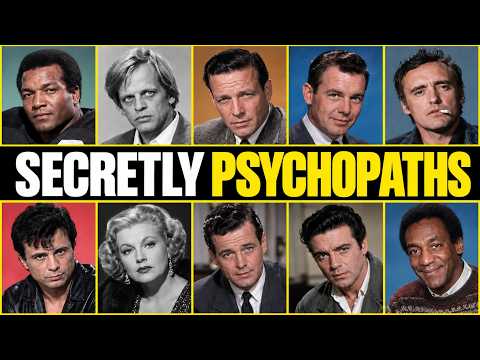
Take Tom Neal, for instance. To film noir fans, he was the doomed everyman in Detour, a victim of fate. But in 1965, a jury heard a very different story when his wife was found shot in the back of the head. Or consider Bill Cosby, America’s Dad, whose legacy of laughter was shattered by dozens of women describing a pattern of drugging and assault that dated back to the very year he became a star. The charming smile that sold pudding pops hid a deposition where he admitted to obtaining Quaaludes for young women.
Then there’s the case of Gig Young, who won an Oscar for playing a man who drives couples to exhaustion. Nine years later, police found him dead beside his new bride, a gun in his hand, and no note to explain why. The evidence was clear, but the motive remained a mystery.
These stories are not just about crime; they are about the masks we wear. Rip Torn, the gruff boss from Men in Black, once attacked Norman Mailer with a hammer on camera and later broke into a bank convinced it was his own home. Robert Blake, beloved as the tough cop Tony Baretta, was acquitted of murdering his wife but later held liable for her death in civil court. The legal system may have cleared him, but the shadow never lifted.
And then there are those whose violence was an open secret. Mayo Methot, Humphrey Bogart’s third wife, was so volatile that the press dubbed them the Battling Bogarts. She stabbed him, threatened him with a gun, and drank herself to death. Lawrence Tierney, who played Dillinger, was arrested so many times for brawling that he lost count. He fired a gun at his own nephew and terrorized co-stars on the set of Seinfeld.
These twelve stars remind us that the line between art and life can be fatally thin. As we delve into each of their stories, you will see how the same charisma that made them famous also enabled them to hide in plain sight. The question is not whether they were capable of monstrous acts, but how the world chose to look the other way for so long.
But the story that most defies belief is the one that begins not in Hollywood, but in the dusty streets of Dodge City, Kansas. Dennis Hopper, the counterculture icon who directed Easy Rider, was a man whose off-screen life was as chaotic and violent as any film he ever made. His marriage to Brooke Hayward, the daughter of actress Margaret Sullavan, began as a glamorous Hollywood romance and ended in what one biographer called “an abusive, drug-stoked disaster.”
Hopper’s drug use was legendary. By the early 1980s, he was consuming three grams of cocaine a day, washed down with around thirty beers. “The cocaine problem in the United States was really because of him,” he once claimed, and it was not entirely a joke. His behavior grew so erratic that he once lay down in a coffin wrapped in dynamite and set it off at an art event in Houston. The explosion was real, the danger was real, and somehow, he survived.
His relationship with Rip Torn, the actor who had walked away from Easy Rider after a bitter argument with him, curdled into a decades-long feud. In 1994, Hopper went on The Tonight Show and told a story about Torn pulling a knife on him. Torn sued for defamation, and the court believed Torn. Hopper was ordered to pay $475,000, and then another $475,000 on appeal. The man who had made a career out of playing dangerous characters was, in real life, just as dangerous to be around.
If Hopper was a tornado, then Klaus Kinski was a volcano. The German actor, famous for his collaborations with director Werner Herzog, was described by Herzog himself as “one of the greatest actors of the century and also a monster.” The stories from their five films together are the stuff of legend. While shooting Aguirre, the Wrath of God in the Peruvian jungle, Kinski fired three shots into a hut full of extras because their card game was too loud. One extra lost the tip of his finger. When Kinski threatened to walk off the picture, Herzog told him he would shoot him and then himself.
But the most disturbing allegations came after Kinski’s death. In 2013, his daughter Pola published a memoir accusing him of sexually abusing her from the age of five until she was nineteen. Her half-sister, the actress Nastassja Kinski, backed the claims, saying their father had held her in a sexual way when she was four or five. Kinski had been dead for over two decades by then, and no court ever ruled on any of it. But the women who knew him best had spoken, and the portrait they painted was of a man who was not just difficult, but truly monstrous.
And then there is Jim Brown, the football legend turned movie star. Brown was arrested at least seven times for assault, most of the cases involving women. In 1965, he was charged with assaulting an eighteen-year-old woman in a Cleveland motel room and was acquitted. In 1968, a model was found lying on the ground beneath his balcony, and the charges were dropped when she refused to cooperate. In 1975, he was convicted of misdemeanor battery for beating and choking his golf partner. In 1999, he was found guilty of vandalism for smashing his wife’s car with a shovel. He refused to complete his domestic violence counseling and went to jail for it.
Yet Brown also founded a program to help gang members turn away from violence and helped broker a truce between rival gangs in Watts. He was never found guilty of a major crime, but the pattern of violence was undeniable. The man who could run through a defensive line without fear seemed unable to stop himself from hurting the people closest to him.
The stories of these twelve stars are not just about crime and punishment. They are about the masks we wear and the secrets we keep. They are about the uncomfortable truth that the same charisma that makes someone a star can also make them a predator. And they are about the way the world chooses to look the other way, until it no longer can.
But the most chilling thing about these men is not the violence itself. It is how long the world refused to see it. Tom Neal beat Franchot Tone nearly to death in a front yard and still found work in Hollywood for a time. Lawrence Tierney was arrested a dozen times in seven years and kept getting cast as a tough guy because that was not acting. The industry did not tolerate their behavior; it profited from it.
Consider the case of Paul Kelly. In 1927, he beat a man to death over an affair with the man’s wife. He served twenty-five months in San Quentin. And when he walked out, he did not slink into obscurity. He became a movie star. He played gangsters, cops, and soldiers for two decades. He won a Tony Award. He even played the warden of San Quentin in a film. He adopted the daughter of the man he killed and raised her as his own. The child grew up calling the man who murdered her father “Daddy.”
That is not a story about justice. That is a story about a system that forgives its leading men almost anything, as long as the box office receipts keep coming in.
And then there is the question of what happens when the cameras stop rolling and the audience goes home. For Robert Blake, the answer was a lifetime of legal battles and a $30 million civil judgment he could never pay. For Gig Young, it was a murder-suicide in a New York apartment with no note and no motive. For Mayo Methot, it was a bottle and a lonely death in Portland at forty-seven.
The pattern repeats itself with almost mechanical precision. The charisma that draws people in becomes the weapon that keeps them close. The talent that earns forgiveness becomes the excuse that enables the next act of cruelty. And the public, hungry for entertainment, learns to separate the art from the artist in ways that are convenient and comfortable and deeply, profoundly wrong.
Anthony Franciosa hit stuntmen for real on set and was fired from a prestige television show because of his temper. His own wife said nobody had ever taught him to control it. That is not an excuse. That is an indictment of everyone who saw the warning signs and decided the performance was worth the price.
These twelve stars were not secret psychopaths in the way a thriller movie might imagine. They were not hiding in shadows or wearing masks. They were hiding in plain sight, on soundstages and in courtrooms and in the pages of fan magazines. The world knew. The world always knew.
What the world did not do was care enough to stop them.
And that is the real story here. Not the twelve names on this list, but the machine that kept them working. The studio fixers, the publicists, the directors who looked away, the fans who bought the tickets. Every one of them was a part of it.
Tom Neal swore none of it was his fault, and he died in his bed. Lawrence Tierney said he threw away seven careers through drink, and he kept getting hired anyway. Bill Cosby sold pudding to children while a deposition sat on file describing the pills. The pattern never broke because nobody wanted it to break.
These men are gone now. Neal in 1972, Young in 1978, Kelly in 1956, Kinski in 1991, Methot in 1951, Franciosa in 2006, Hopper in 2010, Torn in 2019, Brown in 2023. But the question they leave behind is not about them.
It is about us. Would we have looked away too?
What do you think — should a performer’s private violence change how we watch their work, or does the art really stand apart from the man? Tell us in the comments below.






