On May 21, 1945, at a checkpoint in Northern Germany, a group of former Soviet prisoners of war captured three German soldiers trying to escape. Among them, one man stood out—his head shaved, an eye patch covering one eye. His documents identified him as Sergeant Hinrich Hitzinger. The prisoners passed through several camps before being taken to Civil Interrogation Camp No. 31 near Lüneburg. There, British Captain Thomas Sylvester began routinely questioning the sergeant. Then, Hitzinger removed his eye patch, put on small circular glasses, and asked to speak to either American General Eisenhower or British Montgomery. Before Sylvester’s astonished gaze, he revealed his true identity: his name was Heinrich Himmler.
If true, Allied officials had in their hands the most wanted Nazi leader after Hitler’s suicide. Himmler had been a central figure in the Nazi Party since its inception, and even during the last months of the war, he had played a leading role in the fight against the Soviets. However, the imminent fall of the Third Reich turned Himmler into an erratic and incompetent man who tried to negotiate a belated peace with the Allies and ended up being declared a traitor by Hitler himself. How were the last weeks of this Nazi leader? Don’t leave your screen, because in the next few minutes we’ll tell you everything about the end of Heinrich Himmler. Are you ready? Let’s get started.
Himmler’s importance in the Third Reich cannot be underestimated. Since his appointment as Reichsführer-SS in 1929, he grew the Nazi forces from a battalion of 290 men to thousands upon thousands. Under his rule during World War II, the Reichsführer-SS, renowned for his organizational skills, directly oversaw the creation of concentration camps and the Holocaust, essentially directing the mass murder of millions. Simultaneously, he filled his role as head of the SS and played a leading role in the war of annihilation in Eastern Europe.
However, by 1945, the situation was radically different. The Third Reich found itself increasingly hemmed in by the advances of the United States from France and the Red Army in the East. After failing to stop the Americans as commander-in-chief of Army Group Upper Rhine in January 1945, Himmler was appointed commander-in-chief again, this time of Army Group Vistula, with the aim of stopping the Soviet Union that was relentlessly approaching Berlin.
In retrospect, Hitler’s decision proved to be wrong. Himmler did not have sufficient military experience to face a mission of such importance. At the same time, this loyal Nazi dignitary grew less and less convinced of Nazi Germany’s ability to win the war. However, he obeyed his orders and established his command center at Schneidemühl, using his special train, the Sonderzug Steiermark, as its headquarters.
During these weeks of futile planning, Himmler began to behave more and more erratically. He rarely left his train, which was far from properly equipped for the mission—it only had a telephone line and no proper maps or radio to communicate with the front. He also showed little interest in work in general, seeing it as a futile endeavor. He worked only four hours a day, and only after receiving a massage every morning, followed by lunch and a long nap. The lack of leadership was evident in the performance of the German Army on the Eastern Front.
On April 20th, with the imminent fall of the Third Reich very close, Himmler met Hitler for the last time in the Reich Chancellery in Berlin to celebrate the Führer’s birthday. There, Himmler swore allegiance to his leader to the end. This was far from the truth. In fact, since the arrival of spring, he had been negotiating peace with the Allies behind Hitler’s back.
Just one day after the Führer’s birthday, Himmler met with Norbert Masur, the Swedish representative of the World Jewish Congress, to agree on the liberation of several concentration camps. Seeking to save himself, the Nazi leader brazenly stated that the gas chambers were only used to burn the corpses of victims of typhus epidemics and that the percentage of survivors in Auschwitz was very high—despite the fact that the camp had already been liberated and that the Allies knew of the atrocities committed by the Nazis there, although perhaps not the true scale.
Days later, Himmler met with the president of the Swedish Red Cross, Folke Bernadotte, informed him that Hitler would be dead in the next few days, and asked him to contact Dwight Eisenhower to discuss the terms of the German surrender. Although Himmler tried to keep this entire negotiation secret, on April 28th a BBC bulletin broke the news. Hitler, feeling betrayed by whom he considered his second most loyal supporter after Goebbels, exploded into a rage. He declared Himmler a traitor and dismissed him from the Nazi Party and all charges against him. Just two days later, the Führer would commit suicide in his bunker.
Just as Himmler had promised, the Allies responded. However, Eisenhower completely repudiated the belated peace proposal and declared Himmler Nazi Germany’s greatest war criminal. The once extremely powerful Nazi leader stood alone at the end of the war—totally doomed, considered a traitor by the new German administration of Admiral Karl Dönitz, and as the most wanted man by the Allies.
Out of options, Himmler fled to Flensburg in Northern Germany, where he hid for days. On May 20th, as the Allies closed in on the city, he, along with a small group of German soldiers, attempted a desperate escape. He shaved off his trademark mustache, removed his glasses, shaved his head, and donned an eye patch. Wearing military police uniforms, they tried to escape to the South, but the escape plan was cut short just two days later when they were detained by former Soviet prisoners.
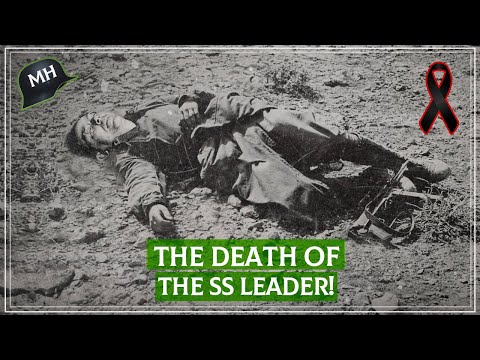
After revealing his real name to reach an agreement with the major of the detention camp, Himmler was taken to the doctor for tests to confirm his identity. While doing the routine, the doctor noticed a black object in the lower jaw of the Nazi criminal. He immediately tried to remove it but was unsuccessful. Himmler bit into the cyanide capsule, and seconds later, he dropped dead despite vain attempts at resuscitation.
Shortly after, he was buried in an undisclosed location in Lüneburg. He was survived by his family, including his daughter Gudrun Burwitz, who dedicated herself to following in her father’s footsteps in national socialism and even denied the Holocaust, maintaining that her father, the great Heinrich Himmler, had not committed suicide but had been killed. Beyond this, all information and studies conclude that the official version is true and that one of the great responsible for so much death and destruction left this world without facing trial and punishment for his actions.
We come to the end of the video, and we want to ask you: do you think that if they had chosen another commander-in-chief other than Himmler, the Third Reich would have had a chance to stop the Red Army, or was it already doomed? Leave your answer in the comment box below, and don’t forget to subscribe to our channel to learn about many more military events that left their mark on history. Thank you very much for joining us until the end, and stay tuned for our next video.
But the story of Himmler’s final days did not end with that shallow grave in Lüneburg. The circumstances surrounding his capture and death raised troubling questions that would linger for decades. How had the architect of the SS, a man who once commanded hundreds of thousands, been reduced to wandering the countryside with a handful of exhausted soldiers? And why had he chosen to reveal his identity so readily to a British captain, rather than attempt to disappear among the millions of displaced persons flooding postwar Germany?
Some historians have suggested that Himmler’s erratic behavior in the final weeks was not merely incompetence, but a symptom of deep psychological unraveling. The man who had once coldly orchestrated the murder of millions now believed he could negotiate his way out of accountability. His offer to the Allies—releasing concentration camp prisoners and surrendering the German armies in the West—was not born of remorse, but of a desperate delusion that he could position himself as a necessary partner in the postwar order.
Captain Sylvester, for his part, could scarcely believe what he was hearing. He had been trained to process routine prisoner interrogations, not to receive the surrender of one of history’s greatest criminals. He immediately summoned his superiors, and word raced up the chain of command. Within hours, Himmler was no longer a nameless sergeant in an eye patch—he was the most significant captive the British Army had taken in the entire war.
The decision was made to move him to a more secure facility. Himmler was stripped, searched, and given a British uniform to wear. The search was thorough—or so the guards believed. What they failed to find, hidden in a small gap in the lining of his clothing, was a second cyanide capsule. He had carried two, anticipating that one might be discovered.
At the interrogation camp near Lüneburg, the medical examination proceeded as protocol demanded. The doctor, a young British army physician, noted the prisoner’s nervous demeanor and the way he kept clenching his jaw. When he asked Himmler to open his mouth, the Nazi leader hesitated for a fraction of a second. Then, with a sudden, violent motion, he bit down hard.
The crack of the capsule was audible. Himmler’s face contorted, his body convulsed, and he collapsed to the floor. The doctor and guards rushed forward, but it was already too late. The cyanide had done its work in seconds. Despite frantic attempts at resuscitation—the doctor later admitted he had never tried so hard to save a life he found so monstrous—Himmler was pronounced dead within minutes.
The news spread rapidly through the camp. Soldiers who had heard rumors of the prisoner’s identity now gathered in stunned silence. Some felt cheated—deprived of the chance to see him stand trial at Nuremberg. Others felt relief that the man responsible for so much suffering had met a swift end, however undeserved.
But the questions only multiplied. Why had Himmler been so careless? Was it arrogance, or had he simply run out of the will to live? Some of his captors recalled that during the journey to the camp, he had spoken of a higher destiny and of how history would judge him kindly. Even in defeat, he remained convinced of his own twisted legacy.
The burial was conducted in secret, the location deliberately obscured to prevent his grave from becoming a shrine for remnants of the Nazi movement. The British authorities understood that even in death, Himmler’s name carried a dangerous power. They were determined that his final resting place would never become a rallying point for those who still clung to the ideology he had helped create.
Yet the absence of a known grave only fueled the conspiracy theories that would swirl for generations. Claims that Himmler had escaped, that a double had died in his place, that he had been smuggled to South America—all found willing believers among those who could not accept that such a powerful figure could simply vanish into an unmarked grave.
The Allied investigators, however, were satisfied. The identification was conclusive: fingerprints, dental records, and the testimony of those who had known him confirmed beyond doubt that the dead man was indeed Heinrich Himmler. The Reichsführer-SS, the man who had built the machinery of genocide, had died not in battle or on the gallows, but by his own hand in a small interrogation room in northern Germany.
For the survivors of the camps, the news brought mixed emotions. Some felt a sense of closure; others, a bitter disappointment that he would never have to answer for his crimes in a courtroom. The world had been denied a full accounting of his atrocities, but the man himself was gone.
In the years that followed, the name Heinrich Himmler would become synonymous with the banality of evil—a man who had been meticulous in his cruelty, who had preached racial purity while orchestrating mass murder, and who had ultimately chosen the coward’s way out rather than face the judgment of his fellow men.
Yet one question still gnaws at those who study his end: what if the cyanide had been found before he could bite down? Would Himmler have stood in the dock at Nuremberg, forced to hear the full litany of his crimes read aloud?
We will never know. The architect of the Holocaust cheated the gallows by seconds, leaving only a shallow grave and a daughter who spent her life defending the indefensible.
History’s verdict is clear—but the debate over his final moments is not. Do you believe Himmler’s suicide was an act of cowardice to escape justice, or did he truly believe his own twisted myth to the very end? Share your thoughts below.






