Most 20th-century dictators were destroyed by their enemies. Hitler shot himself in a bunker. Mussolini was hung upside down by partisans in Milan. Saddam was pulled from a hole in the ground. But Joseph Stalin, the man who killed more people than any of them, died peacefully in his bed at 74. And here’s where it gets strange: three years later, his own party stood up and publicly destroyed his legacy. No other dictator of the modern era was ever buried by his own movement.
Stalin wasn’t just a worse dictator than the others. He was a different kind of dictator entirely.
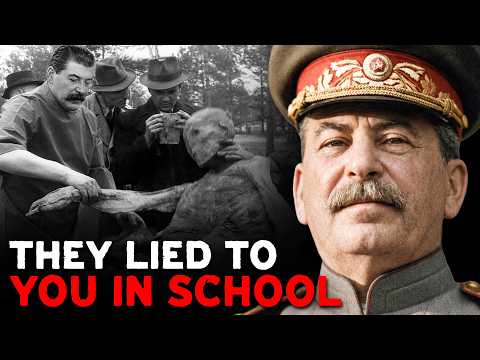
Stalin didn’t seize power the way you’d expect. He didn’t out-speech anyone. He didn’t out-charm anyone. In a room with Leon Trotsky, the brilliant orator, or Nikolai Bukharin, the party’s favorite intellectual, Stalin was the quiet one in the corner taking notes. That was the point.
While the famous Bolsheviks gave speeches in Moscow halls, Stalin took the job nobody else wanted: General Secretary of the Communist Party. On paper, it was paperwork. Personnel files, regional appointments. Who got transferred where? Who got promoted? Who got handed the empty desk in some forgotten province? In practice, it was the entire skeleton of the Soviet state.
By the time the rivals noticed, Stalin had personally placed thousands of loyal officials into every level of the party machinery. The brilliant men were giving speeches to audiences that had already been handpicked by a bureaucrat. Trotsky, who had commanded the Red Army during the Civil War, was outmaneuvered, isolated, exiled, and eventually murdered with an ice ax in Mexico. Bukharin, who had been Lenin’s favorite, was forced into a public confession at a show trial and shot.
The men with the famous names lost. The man with the filing cabinet won every round.
Lenin himself saw it coming. On his deathbed in 1923, weakened by a series of strokes, he dictated a warning about Stalin: “Too rude, too concentrated of power, should be removed from the post of General Secretary before he caused real damage.” That document, known as Lenin’s testament, was quietly suppressed by the Central Committee. The very man it warned against helped decide whether the party should read it. The party decided not to.
Every other 20th century dictator climbed onto a stage. Hitler had the beer halls. Mussolini had the balcony. Stalin had a filing cabinet. And the filing cabinet won.
Here is where the comparison to every other tyrant in modern history breaks down completely. Mobutu Sese Seko ran Zaire for 32 years and walked away with a personal fortune estimated somewhere between 4 and 15 billion dollars. He built 11 palaces, kept a yacht on the Congo River, and chartered the Concorde for shopping trips to Paris. Ferdinand Marcos and his family pocketed up to 10 billion from the Philippines. His wife, Imelda, left behind 3,000 pairs of shoes.
When Stalin died on the 5th of March, 1953, his deputy, Lavrentiy Beria, walked into the dacha to inventory his personal possessions. The complete list, written down in Beria’s own hand, came to this: a few worn shirts, a single pair of trousers, one pair of boots, six smoking pipes, and a savings account containing 900 rubles. That was it. No jewelry, no foreign bank accounts, no hidden vaults.
His salary as general secretary came to 10,000 rubles a month, enough to buy a Soviet Pobeda car if he had wanted one, and he never did. The dachas he used belonged to the state. The clothes he wore were repaired rather than replaced. When he died, his children inherited essentially nothing.
This is the structural mystery at the center of Stalin. Every other dictator of the 20th century looted his own country. Stalin didn’t. He had absolute power over the wealth of one of the largest nations on Earth, and he died owning six pipes, which raises a much darker question. If he wasn’t doing it for the money, what was he doing it for?
The answer was steel. In 1928, Stalin launched the first five-year plan, an attempt to drag a peasant empire into the 20th century at a speed no government had ever attempted. Coal output rose by 84%. Oil production climbed 90%. Electricity output jumped 168% in the first plan alone. Entire industrial cities were conjured out of nothing. Magnitogorsk, on the eastern slope of the Urals, went from open steppe and mud to a smoky horizon of blast furnaces in less than a decade.
Workers lived in tents through Russian winters. Foreign engineers were imported by the trainload. Factories that should have taken a generation to build were thrown up in 18 months by men working 60-hour shifts. The wealth Stalin didn’t pocket went straight into steel, coal, electricity, and tanks. He was building a state, not a personal fortune.
But the bill came due somewhere else. The countryside paid it.
To feed the new factories, Stalin needed grain. And to extract grain at scale, he needed to dismantle the small peasant farms that had fed Russia for centuries. The policy was called collectivization. Peasants were forced to merge their plots into vast state-run farms. Those who resisted were labeled kulaks, a vague term that came to mean anyone the regime wanted gone. They were deported to Siberia, shot in the fields, or simply left to starve.
By 1932 and into 1933, famine swept across Ukraine, Kazakhstan, and the Volga region. Livestock had been slaughtered rather than handed over to the state. Seed grain had been seized from the villages. Whole communities emptied as people walked toward cities that turned them back at the gates with armed guards. Reports reached Moscow of villagers eating bark, boiled leather, and worse. Border guards were posted on internal roads to stop starving peasants from crossing into the cities.
Millions died, not from a natural disaster, not from a failed harvest, but from a policy decision being executed exactly as designed. And the terror that became standard practice in those villages — the quotas, the denunciations, the loyalty tests — became the operational template for what was coming next.
In August 1937, the killing changed shape. The Great Terror, as it came to be known, ran for roughly 15 months and produced over 1.5 million arrests and approximately 800,000 executions. At its peak, the Soviet state was shooting around 1,700 people a day.
Most accounts stop there, at the body count. But there is a detail in the archival record that almost no one surfaces, and it changes the entire picture. Most dictators purged their rivals. Stalin purged his loyalists. The NKVD officers carrying out the killings were themselves arrested and shot in waves. The men who shot the men who shot the men. Whole generations of secret police leadership were turned over in under two years.
Genrikh Yagoda, the NKVD chief who orchestrated the first wave of purges, was himself arrested, tried, and executed. His replacement, Nikolai Yezhov — the man whose name the worst phase of the terror is still known by — was arrested in turn, tortured in the cells he had filled, and shot in 1940. The system was cannibalizing its own enforcers.
And here is the strangest part of all. The killing was being driven from below. NKVD order number 00447, signed in July 1937, set initial execution quotas for each region: roughly 76,000 to be shot, 193,000 to be sent to the camps. But regional officials, eager to demonstrate productivity to Moscow, began writing letters back asking for their quotas to be raised.
In July 1938, Sergey Gorbach, the NKVD chief in Omsk, sent the Politburo a request for thousands of additional executions because his men had already met their plan. Stalin personally approved the request and promoted Gorbach to a larger district. The Altai Territory Party Committee filed a similar petition and received a supplement of 4,000 first category and 4,500 second category sentences — first category meaning execution, second meaning the Gulag. Mass killing as a negotiated administrative target, sometimes initiated from the provinces, rubber-stamped from Moscow, rewarded with a promotion.
Which raises a question that has split historians for 40 years. If the killing was running upward from the regions, who was actually in charge?
This is where the simple picture of Stalin as the all-seeing tyrant directing every detail starts to come apart. A serious school of historians now argues that Stalin was, paradoxically, a weak dictator. Not weak in cruelty — the documented record makes that case unmistakable. Weak in control. The bureaucracy he had built was generating its own momentum. Regional party bosses, terrified of being denounced themselves, invented enemies to look productive. Information bottlenecks meant Moscow often did not fully know what its own machine was doing in the provinces, only what its own machine was choosing to report back.
This matters because every other major 20th-century dictator ruled by personal will. Hitler personally ordered the broad strokes of the war and the Holocaust. Mao personally launched the Cultural Revolution. Mussolini personally directed Italy’s adventurism abroad. They were the engines of their own regimes. Stalin may be the only one whose machine was running him almost as much as he was running it. The most powerful man in Eurasia riding on top of an apparatus he had built, and that he could no longer fully see into. He signed the orders. He approved the lists. The system kept moving regardless.
And meanwhile, on the streets, the country was a parade. Newsreels showed mass dances in Red Square. Banners hung in every factory. Children sang songs about the harvest. On the 17th of November, 1935, Stalin appeared at the first all-union conference of Stakhanovites and delivered the line that would define a decade: life had improved, life had become more joyous, and when life was joyous, the work went well.
The phrase was set to music. Banners reproduced it on factory walls. Privately, ordinary Soviets turned it into a bitter joke whispered between trusted friends. Two realities ran in parallel. The official one was singing. The private one was counting how many of its neighbors had disappeared overnight.
On the 22nd of June, 1941, Hitler invaded. And here the brutal bet Stalin had made in the 1930s paid off in steel. The factories built at unimaginable human cost — Magnitogorsk, the Ural complexes, the plants shipped beyond the Volga — were now producing T-34 tanks faster than the Wehrmacht could destroy them. Through Stalingrad, through the long counteroffensive, the system ground forward to the rubble of Berlin in May 1945.
Victory transformed him into something the Soviet Union had never seen: the closest thing the 20th century produced to a living god emperor. Statues in every square, his face on every wall, schoolchildren memorizing poems about him before they memorized arithmetic. When he died on the 5th of March, 1953, mourners poured into central Moscow in such numbers that people were crushed to death in the streets, and the official press refused to report the casualties.
The cult looked like it would outlive him by a century. It did not outlive him by three years.
On the 25th of February, 1956, Nikita Khrushchev — Stalin’s own protégé, a man complicit in the Ukrainian repressions — stood before a closed session of the 20th Party Congress and delivered a four-hour speech that dismantled the entire cult. He named the killings. He named the show trials. He named the personality cult by name. Some delegates fainted in their seats. Others sat completely still, staring at the floor.
The speech was supposed to be secret. It leaked within weeks. By summer it had reached communist parties around the world. Protests broke out in Poland. By October, Hungary was in open revolution. The long ideological fracture that would eventually take down the Soviet Union itself had begun — inside the very building where Stalin’s loyalists used to applaud him.
Think about what that means. Hitler’s myth ended when his regime ended. Mao’s reputation was protected by the men who came after him. Mussolini fell to his enemies and was hung in a square. Stalin is the only major 20th-century dictator whose own movement, three years after his death, stood up in front of itself and publicly tore him down.
The boring man with the filing cabinet won everything — and his victory was undone not by his enemies, but by the system he had built. The strangest dictator in modern history, condemned by his own machine.
So here is the question worth sitting with: if a tyranny can be dismantled from the inside by the very people who built it, what does that say about the myths we still tell ourselves about power — and about who, in the end, gets to write the final page? Tell us in the comments below.






