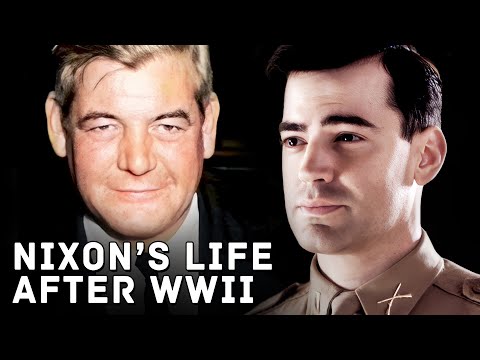
Captain Lewis Nixon, the hard-drinking intelligence officer of Easy Company, survived World War II without firing a single shot in combat. But the war inside him was far from over. After the guns fell silent, Nixon returned home to a life of wealth, family drama, and a battle with alcoholism that would define his postwar years. This is the story of what happened to the man Richard Winters called his closest friend.
Born into privilege, Lewis Nixon seemed destined for a life of ease. His family owned a successful chemical company, and he had attended Yale and traveled Europe before the war. But the war changed him. “Nixon was the most brilliant staff officer I knew,” Winters later wrote, praising his friend’s sharp mind and cool head under fire. Yet behind that calm exterior, Nixon was fighting his own demons.
After the war, Nixon invited Winters to work at his family’s business, Nixon Nitration Works. Winters accepted and worked there for six years, but the environment was toxic. Nixon’s father, Stanhope, was a heavy drinker who once pointed a gun at Winters while drunk. “I wanted to quit because of the family drama,” Winters recalled. Eventually, Winters left the company, but his friendship with Nixon endured.
Nixon’s personal life was equally turbulent. His first marriage ended in divorce, with drunkenness cited as the reason. He remarried an Englishwoman named Irene Miller, but that union also struggled. “Lewis’s drinking was a factor,” Winters noted. Despite the challenges, Nixon found some stability when he met Grace Umezawa, a Japanese-American woman who had been interned during the war. They married in 1969, and by all accounts, she brought him true happiness.
But the road to peace was not smooth. Nixon lost his mother, father, and sister within a decade, and his inheritance became a source of conflict. His sister Blanche left him a fortune, but his marriage to Irene deteriorated, and they separated in 1961. “Until Lewis met and married Grace, he had never found true love,” Winters wrote. Grace’s love and care, he believed, kept Nixon alive for many years.
Nixon’s wartime service was marked by bravery and dedication. He jumped into Normandy, Holland, and even with the 17th Airborne during Operation Varsity. “He never showed fear,” Winters said. Once, Nixon ran three miles under fire to deliver a map of German artillery positions, a move that likely saved lives. Such devotion was never forgotten by the men who served with him.
After the war, Nixon struggled with diabetes and eventually died of complications from the disease in 1995. At his funeral, Winters gave the eulogy, honoring a man who had been both a brilliant officer and a flawed friend. “Nixon was always there for me,” Winters said. “He kept me from second-guessing myself.”
Lewis Nixon’s story is one of courage, friendship, and redemption. He was far from perfect, but he was a man who gave everything for his country and found peace in the love of a good woman. As Winters put it, “Nix probably needed me as much as I needed him.” Their bond, forged in war, remained unbroken until the end.
But the story of Lewis Nixon does not end with his death, nor with the eulogy his best friend delivered in a Los Angeles chapel. It continues in the quiet ways that a life well-lived echoes forward, long after the man himself has gone.
Grace Nixon, who had been Lewis’s anchor through his final decades, never remarried. She lived on in their Sherman Oaks home, surrounded by the same music and the same memories that had filled their years together. She became the keeper of his story, and in doing so, she became a bridge between the man Winters knew and the world that would come to know him through a television screen.
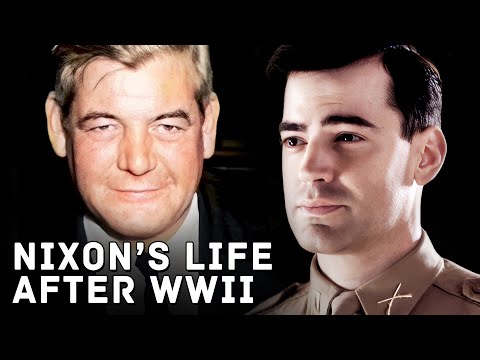
When the HBO miniseries Band of Brothers premiered in 2001, Grace was there. She sat beside Ron Livingston, the actor who had brought her late husband to life, and watched as a new generation discovered the men of Easy Company. “Lewis would have been so proud,” she reportedly said, though those who knew him best suspected he might have shrugged it off with the same dry indifference he had shown in combat.
Richard Winters, too, kept the flame alive. In the years after Nixon’s death, he continued to attend Easy Company reunions, often speaking of his friend with a tenderness that surprised those who knew only the stern commander. “Nix was a character,” Winters would say with a rare smile. “But he was my character.”
The Winters-Nixon friendship, forged at Fort Benning and tested in the hedgerows of Normandy, had outlasted the war, the company, and the bottle. It was, by Winters’s own admission, the most important relationship of his life outside his marriage. “We understood each other,” he wrote. “That’s all there is to it.”
Grace passed away in 2016 at the age of 94, having lived long enough to see her husband’s legacy cemented in books, documentaries, and the memories of the men who served beside him. She had been his peace, his partner, and his salvation. In the end, she was also his voice, ensuring that the world remembered Lewis Nixon not as a drunk or a prick, but as a brilliant officer who loved his friends fiercely and found redemption in the arms of a remarkable woman.
Theirs was a story of second chances. Nixon had been given one by Grace, and by extension, by the men who never gave up on him. In the annals of Easy Company, he remains an enigma, a man of contradictions whose courage was matched only by his capacity for self-destruction, and whose redemption came not on a battlefield but in a quiet California living room, listening to music with the woman who saw past the uniform to the man beneath.
Yet for all the warmth of that redemption, there remained a side of Lewis Nixon that the miniseries never fully explored. After his separation from Irene and before Grace entered his life, Nixon drifted through a period that friends described as his darkest. He bounced between addresses, leaned heavily on the bottle, and at times seemed to be living off the remnants of the family fortune rather than building anything of his own.
It was during these years that some of the Easy Company men quietly wrote him off. Buck Compton, who never hid his disdain, reportedly called him “a prick” and meant it. Others simply lost touch, too absorbed in their own postwar struggles to reach back for a man who seemed determined to burn every bridge.
But Nixon had one bridge he never burned, and that was the one that led to Richard Winters in Pennsylvania.
The letters between them grew sparse in the lean years, but they never stopped. Winters, tending his farm and raising his family, would occasionally receive a postcard from a far-flung corner of the world—South Africa, Tibet, Japan—signed with Nixon’s unmistakable scrawl. The messages were short, almost cryptic, but their very existence was the point. Nixon was still out there, still moving, still alive.
What Winters understood, perhaps better than anyone, was that Nixon’s restlessness was not wanderlust. It was flight. The man who had once run three miles under fire to deliver a map had spent his whole life running toward something—duty, danger, a bottle—and away from the quiet that threatened to let the memories catch up.
Grace changed that. When the postcards began to arrive with her name alongside his, the tone shifted. “Grace sends her love,” Nixon would write, and Winters could almost hear the contentment in the words. The man who had never found true love had finally, improbably, found it in a woman whose own life had been torn apart by a war she had no part in fighting.
In the final years, the two old soldiers spoke less of the war and more of everything else—the raccoons that raided the Nixon yard, the migrating ducks that returned each year like clockwork, the music that filled the Sherman Oaks house. Winters would hang up the phone and tell Ethel, “That was Nix,” and she would know from his voice that the call had done him good.
When the end came in January 1995, Winters made the trip to Los Angeles without hesitation. He stood before the gathered family and veterans, and he spoke not of the alcoholic or the prick, but of the man who had walked one or two steps behind him on the left side, a token of respect from a soldier who understood what loyalty meant.
After the funeral, Grace pressed a small box into Winters’s hands. Inside were a handful of the postcards he had sent Nixon over the years, saved and stored like relics. “He kept everything you ever sent him,” she said. Winters held them for a long moment and said nothing at all.
He understood, in that quiet chapel, that the story of Lewis Nixon was not one of a man saved by a woman or a friend. It was the story of a man who had been given every advantage and every reason to fall apart, and who had chosen, again and again, to walk on.
Winters returned to Pennsylvania with the box of postcards and placed it in a drawer he rarely opened. He didn’t need to. The memories were already there, worn smooth by years of use. “Nix was the best combat officer I ever worked with,” he told an interviewer once, and then fell silent for a while, as if the words had cost him something.
The men of Easy Company aged. Reunions grew smaller, then sparser, then stopped altogether. Winters lived to be ninety-two, dying peacefully in 2011, and when his obituaries mentioned Lewis Nixon—as they always did—they described him as Winters’s closest friend. That, more than any medal or citation, was the legacy Nixon would have wanted.
Grace outlived them both, tending the memory of a man who had been, in her words, “so brave, so kind, and so stubborn.” She never tired of telling the story of the boy from a silver-spoon family who had jumped into Normandy, who had refused a month’s leave to stay with his men, who had found peace at last in a quiet California living room. “He never complained,” she would say. “He always had a smile for me.”
And perhaps that is the truest ending to the story of Lewis Nixon—not the drinking, not the divorces, not the demons, but the smile. The man who never fired a shot in combat, who was terrified of nothing and of everything, who walked one step behind his best friend out of respect and love.
What do you think—was Lewis Nixon saved by Grace, by Winters, or by something quieter inside himself that refused to quit?
Report this article
Select a reason for reporting:






