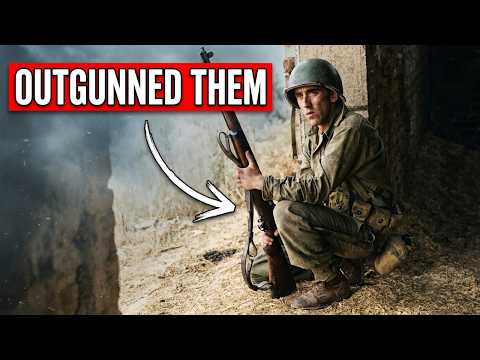
In the frozen forests of the Ardennes, German soldiers heard a sound that defied belief. From American positions came a volume of fire so relentless, so continuous, that they were certain they had stumbled into a nest of machine guns. They ordered their men to ground, called for heavy weapons support—only to discover, sometimes too late, that there were no machine guns. There were only riflemen. And each one carried a weapon that could fire eight rounds in the time it took a German soldier to chamber three.
This was not a single dramatic incident. It was a pattern repeated from the jungles of Bataan to the hedgerows of Normandy, a misjudgment so profound that it changed the way the world thought about infantry firepower. The weapon was the M1 Garand, and it gave the American soldier an advantage no other army could match.
The story begins not on the battlefield, but in a quiet brick armory in Springfield, Massachusetts. There, a Canadian-born immigrant named John Cantius Garand labored for seventeen years on a design that would become the stuff of legend. Born in 1888 in a small farming community in Quebec, Garand spoke no English when his family moved to Connecticut after his mother’s death. He learned the language sweeping floors in a textile mill, and his formal education ended at twelve. Every piece of engineering knowledge he acquired, he taught himself.
“He was a quiet man,” observers said—average build, average appearance, the shyness of an absorbed technician. But his mind was anything but ordinary. By his late teens, he had patented a screw jack and an automatic bobbin winding mechanism. By his twenties, he was working as a machinist for the precision tool maker Brown and Sharpe. Target shooting was his hobby; designing guns was his obsession.
When the United States entered World War I, Garand submitted a design for a light machine gun. To the surprise of established arms designers, the War Department selected his concept. The war ended before his weapon could reach production, but the government brought him on as an engineer. By 1919, he had been transferred to Springfield Armory—the oldest federal armory in the United States, founded under George Washington himself. There, he would spend the rest of his working life.
The task assigned to him was simple to describe and almost impossible to accomplish: design a semi-automatic infantry rifle robust enough for combat, light enough for a soldier to carry all day, accurate enough to replace the bolt-action Springfield M1903, and reliable enough to be trusted with a young man’s life. Every other major nation had tried. Every other major nation had failed.
The work consumed seventeen years. His first prototype, the Model 1919, used a primer-actuated blowback system. It worked mechanically, but new propellants made the design unsuitable. Garand abandoned it and switched to a gas-operated mechanism. By 1924, he had built twenty-four prototypes for testing. In 1925 at Fort Benning, his rifle competed against designs from John Pedersen, John Thompson, and others. No clear winner emerged. The Ordnance Board ordered him to refine the design.
For nearly a decade, the Army wavered on a fundamental question: what caliber should the new rifle fire? Garand had developed his weapon to use a smaller, lighter cartridge designated .276. So had his great rival, John Pedersen. By 1931, the .276 Garand had decisively beaten the Pedersen rifle in trials. A meeting on January 4, 1932, recommended the lighter caliber for adoption. The decision seemed final.
Then the Army Chief of Staff stepped in. His name was General Douglas MacArthur. The day after the successful conclusion of the trials, MacArthur personally disapproved any caliber change. The reason was practical, not theoretical. The United States held vast stockpiles of .30-06 ammunition left over from the First World War. The country was in the depths of the Great Depression. Money was scarce. Replacing every existing round of rifle ammunition was an expense the nation could not stomach.
On February 25, 1932, the Adjutant General of the Army formally issued the order: all work on .276 caliber would cease. Immediately. Completely. Garand was to redirect every resource toward making his rifle work in .30-06. He did.
By August 3, 1933, the redesigned rifle had earned a new designation: semi-automatic rifle, caliber .30, M1. Field trials in 1934 exposed problems. Modifications followed. On November 7, 1935, the rifle was cleared for procurement. And on January 9, 1936, after seventeen years of work by a Canadian-born immigrant who had taught himself engineering by sweeping mill floors, the United States Army officially standardized the M1 Garand as its new service rifle.
John Garand, by the terms of his civilian employment, signed over every patent right to the United States government. He received no royalties—not a single dollar in licensing fees, no matter how many millions of his rifles were eventually built. A bill was introduced in Congress to grant him $100,000 in appreciation for his service to the nation. It failed to pass. By 1942, Garand was earning $8,000 per year as chief engineer at the armory. Compared to the men who built fortunes selling weapons to the Allies, his compensation was almost insulting. He never publicly complained. He simply went back to his workbench.
Production began at Springfield in September 1937 at a rate of ten rifles per day. By January 1941, production had climbed to 600 per day. At the wartime peak in January 1944, Springfield Armory turned out 122,001 rifles in thirty-one days—roughly 4,000 rifles every working day from one factory. By June 1945, Springfield had produced 3,526,922 M1s. The Winchester Repeating Arms Company added another 513,880. The wartime total came to 4,040,802 rifles. The unit cost at the start of the war was about $85; by 1945, mass production had driven that cost down to $31. America was building rifles the way Detroit built cars—and selling them to itself for the price of a good winter coat.
To understand what made the M1 Garand so dangerous on the battlefield, one has to understand what every other infantryman on the planet was carrying. In Germany, the standard rifle was the Karabiner 98k, a bolt-action refinement of the Mauser Gewehr 98. It was accurate, beautifully made, rugged—and slow. The German soldier had to manually cycle the bolt between every shot, breaking his sight picture and reacquiring his target. Five rounds in an internal magazine, about fifteen aimed rounds per minute under combat conditions. In the Soviet Union, the Mosin-Nagant Model 1930 was also bolt-action, also five rounds, also slow. In the United Kingdom, the Lee-Enfield No. 4 was a faster bolt-action with a ten-round magazine, but still operated by hand. In Japan, the Type 99 Arisaka. In France, the MAS 36. Every major military on Earth in 1939 sent its infantry to war with rifles whose basic operating principle had not fundamentally changed since the 1890s.
The United States was the lone exception. The American soldier did not have to work a bolt between every shot. He pulled the trigger, the rifle cycled itself, and another round was ready. Eight rounds in an en bloc clip loaded from the top fed into the action one after another with nothing more required of the man behind the stock than aim and squeeze. A trained American infantryman could deliver forty to fifty aimed rounds per minute. The German soldier, no matter how skilled, could manage about fifteen. That gap—that simple mathematical gap of three to one in pure rate of fire—would echo across battlefields from the jungles of Bataan to the hedgerows of Normandy.
The Germans understood the problem. They were not blind to the advantage a self-loading rifle would give their infantry. The trouble was that they came to the realization too late, and they tied their hands with bad design requirements. In 1941, the German Army Weapons Office issued specifications for a new semi-automatic rifle. The requirements forbade drilling any holes in the barrel for gas operation. They forbade exposed moving parts. They demanded that the new rifle be capable of being operated as a bolt-action if its self-loading mechanism failed. These requirements forced the designers at Mauser and Walther to use an awkward muzzle gas trap—the very system the Americans had abandoned in 1940. The result was the Gewehr 41. The Mauser version was a near total failure. The Walther version was more successful, but still notoriously unreliable. They fouled. They jammed. The German soldier did not trust them.
By 1943, the Walther engineers had improved the design by copying the gas system of a captured Soviet rifle, the SVT-40. The new weapon was designated the Gewehr 43. It was better. It was reliable enough to be useful. It even had a detachable ten-round box magazine, more modern in some respects than the Garand. But it came too late, and it came in numbers too small. By the end of the war, total Gewehr 43 production had reached about 402,713 rifles. To put that figure in perspective: for every one Gewehr 43 the Germans produced, the United States produced fifty Garands.
There was one more German answer, and it was the most revolutionary weapon of the entire war: the Sturmgewehr 44. It was the world’s first mass-produced assault rifle, firing an intermediate cartridge from a thirty-round detachable magazine, capable of fully automatic fire. Adolf Hitler initially opposed the project and forbade its development. The designers continued anyway, disguising the program as a submachine gun to slip it past him. When Hitler finally saw battlefield reports of its effectiveness in 1944, he reversed himself and personally chose the propaganda name Sturmgewehr—storm rifle. He authorized production of 30,000 per month. Total production reached only about 425,977 by the end of the war. The Sturmgewehr would shape every infantry rifle made in the second half of the twentieth century. It would directly inspire the Soviet Kalashnikov. But it could not save Germany. It came too late, in too few numbers, alongside a logistical chain that could not be retooled in the middle of a two-front war.
Through all of this, the German workhorse remained the Karabiner 98k. Over fourteen million were produced between 1934 and 1945. The German soldier who stormed Poland in 1939 and the German soldier who surrendered in Berlin in 1945 carried essentially the same rifle. The American soldier of the same period carried a self-loading weapon that fired three times as fast.
The first time the Garand spoke in anger was not in the European hedgerows that most Americans imagine. It was in the jungles and rice paddies of the Philippines in the bleak winter of 1941 and the early months of 1942. American forces and the elite Philippine Scouts had been issued M1 rifles before the war began. When the Japanese landed in December of 1941, those rifles met them on the beaches and on the Bataan Peninsula. Lieutenant Colonel Philip Fry, commanding the third battalion of the 57th Infantry Regiment of the Philippine Scouts, would later write a single sentence that captured what the Garand brought to the fight: “The firepower of a battalion armed with modern weapons is something. The Garand rifle is beyond my descriptive powers.”
At the Battle of Quinauan Point on Bataan, an American officer recorded that the Scout riflemen built up a tremendous volume of fire with M1 rifles, machine guns, and even pistols until it was impossible to hear anything but the roar of the guns. Japanese soldiers in those engagements reported that they believed every American was carrying a machine gun. They were not. They were carrying rifles. The volume of fire was simply that much greater than anything the Japanese had encountered before.
By February of 1942, the news had reached the home front. American newspapers and magazines ran articles praising the new rifle’s performance under fire on Bataan. General Douglas MacArthur—the same officer who had insisted on keeping the .30-06 caliber a decade earlier—sent a report to the Ordnance Department that under combat conditions the rifle operated with no mechanical defects and when used in foxholes did not develop stoppages from dust or dirt and had been in almost constant action for as much as a week without cleaning or lubrication.
The men holding those rifles, however, were doomed. Bataan fell on April 9, 1942. Corregidor fell on May 6. By the time the campaign ended, more than 20,000 American troops and tens of thousands of Filipino soldiers had been killed, wounded, or taken prisoner. The Garand had proven itself in defeat.
The first Garand fire in the European theater came on August 19, 1942, when fifty men of the First United States Army Ranger Battalion accompanied British and Canadian troops on the disastrous raid at Dieppe on the French coast. The Rangers were attached to commando units and went ashore among them. The raid was a catastrophe, but somewhere on the rocky beach, an American Ranger fired the first M1 round in anger on the European continent.
Across the Pacific, on August 7, 1942, the United States Marines went ashore on the island of Guadalcanal. Most of them carried the older bolt-action M1903 Springfield. A small number of M1 Garands were carried by men of the Third Defense Battalion, the First Marine Raider Battalion, and elements of the Second Marine Regiment and the Eleventh Marines. The Marine Corps had only officially adopted the Garand by Commandant’s order on June 26, 1942—six weeks before the landing. The first United States Army unit to fight on Guadalcanal, the 164th Infantry Regiment, a federalized North Dakota National Guard unit, arrived on October 13, 1942, fully equipped with M1s. They were thrown into the brutal fighting along the Matanikau River and at Henderson Field. Marine Lieutenant General Lewis “Chesty” Puller watched these Midwestern farm boys hold the line against repeated Japanese attacks and was reported to have praised them, saying in effect that those farm boys could fight as well as anyone he had seen. The 164th was awarded the Navy Presidential Unit Citation for its service at Henderson Field, and its members were authorized to wear the patch of the First Marine Division.
In North Africa, in November of 1942, in the chaos of Operation Torch, the Garand again went to war. At the Kasserine Pass in February of 1943, where green American troops took their first beating from veteran German forces under Field Marshal Erwin Rommel, the M1 Garand was already proving clearly superior to the bolt-action K98k Mauser carried by the German foot soldiers. The American troops had been outmaneuvered, outgunned in armor, and outgeneraled at Kasserine. But man for man, in the rifle squad, they had the better weapon—and they would learn to use it.
By the invasion of Sicily in July of 1943, the Garand had become visibly dominant in photographs of American infantrymen. By the landings in Italy at Salerno, at Anzio, in the meat-grinder fight at Monte Cassino, the M1 was the standard. Many non-commissioned officers and field-grade officers, originally issued the lighter M1 carbine, swapped them out for full Garands once they understood that real combat in built-up European terrain demanded the heavier rifle’s penetration through cover.
Then came Normandy. On the morning of June 6, 1944, in the gray channel light before dawn, more than 150,000 Allied soldiers prepared to land on the Norman coast. The American assault troops of the 1st and 29th Infantry Divisions, the 4th Infantry Division at Utah Beach, the 82nd and 101st Airborne Divisions dropping in darkness behind the beaches—almost all of them carried the M1 Garand. Many of them wrapped their rifles in waterproof bags made by the Goodyear Rubber Company before climbing down the cargo nets into landing craft. Paratroopers like O.B. Hill of the 1st Battalion, 508th Parachute Infantry Regiment, 82nd Airborne, jumped into the dark Norman countryside with their Garands strapped across their bodies. Hill would later write that on the jump into Normandy, he landed in water, and his rifle got wet. Although it was wet, it worked just fine.
In the hedgerow country beyond the beaches, the Garand revealed both its strengths and its limits. The thick Norman bocage—ancient earth banks topped with dense tangles of brush—reduced visibility to a few yards. Rifle fights happened at close range. The Garand’s eight-round semi-automatic capability was decisive in those engagements, but the rifle was long, and swinging it in a hedgerow gap was slower than swinging a submachine gun. American squads adapted, as soldiers always do, mixing Garands with Thompsons and Browning Automatic Rifles for layered firepower.
Then came September of 1944 and the dark woods on the German border called the Hürtgen Forest. The fight there would last from September of 1944 into February of 1945. It was the longest battle the United States Army has ever fought. Visibility in the spruce and pine was sometimes only a few feet. Artillery rounds detonated in the canopy overhead, raining shrapnel and wood splinters on the men below. American casualties exceeded 33,000. The Garand worked in those woods, but men died there at a rate that no rifle could change. The lesson of Hürtgen, like the lesson of every infantry battle, was that a better rifle does not save you from bad ground.
The Garand’s hour of greatest defensive value came in the snow and freezing fog of the Ardennes in the German offensive that began on December 16, 1944. Hitler had thrown the last reserves of the German army into a desperate gamble to split the Allied front and capture the port of Antwerp. American units were caught off balance. Some were overrun. Others held. At places like Saint Vith, at Bastogne, at Elsenborn Ridge, at Malmedy, American riflemen with M1 Garands poured fire into advancing German formations at rates the German infantry could not match.
In the Pacific, the Garand continued its work. On the black volcanic sands of Iwo Jima, beginning February 19, 1945, Marines carried the Garand into one of the most savage battles of the entire war. Private First Class Donald J. Ruhl of Company E, 2nd Battalion, 28th Marines, single-handedly attacked a group of eight enemy soldiers who had been driven from a blockhouse, killing one with his bayonet and another with his rifle. Two days later, on February 21, he threw himself on a Japanese grenade to save his platoon sergeant. He was awarded the Medal of Honor posthumously. On Okinawa, beginning April 1, 1945, the Garand fought through the largest amphibious assault of the Pacific War. The fighting on Okinawa lasted eighty-two days, into the late June heat, and cost over 12,000 American lives. Marine and Army riflemen used their Garands in cave-clearing assaults, in close-quarters fights against deeply entrenched Japanese soldiers, and in defense against the great mass charges that defined the final days of the campaign.
Across both theaters, the rifle proved itself in conditions its designers had never imagined. In the Pacific, men dropped their rifles into salt water during landings, then waded ashore and fired them with sand still clinging to the action. In Burma and the Southwest Pacific, soldiers carried Garands through monsoon rains for weeks at a time. In the freezing Aleutian Islands, in the campaign to retake Attu and Kiska in 1943, the rifle fired in conditions that froze regular machinery solid.
American soldiers grumbled about the rifle’s weight on long marches, complained about how the en bloc clip system meant they had to fire all eight rounds before they could top off the magazine without effort, and griped about the way an empty clip could pinch a careless thumb during reloading—an injury so common that it earned its own nickname among the troops: the Garand thumb. They griped, and then they fought, and then they handed the rifle to the next man on the line.
There is one famous story about the M1 Garand that almost every documentary repeats, and it deserves an honest accounting. The story is the legend of the ping. When the eighth and final round in the en bloc clip is fired, the empty steel clip is automatically ejected upward from the rifle’s open action. It makes a distinctive metallic ringing sound as it leaves the rifle. The legend says that German and Japanese soldiers learned to listen for that ping in combat and that they would rush an American soldier in the brief seconds it took him to reload, knowing his rifle was empty. American soldiers, the legend continues, learned to fight back by sometimes throwing empty clips against a rock to fake the sound and lure their enemies into the open.
The truth is more interesting than the legend. Combat is loud. Battlefield noise from artillery, machine guns, screaming men, and the soldier’s own rifle muffles almost everything else. Post-war interviews with German veterans by American researchers found that most of them had never heard a Garand clip eject in combat at all. Those who had heard it considered the idea of charging an empty rifle laughable, because the rest of the American squad was always ready to fire. A formal study published by the Operations Research Office in 1952, surveying veterans of the Korean War, asked whether the ping was a liability or an asset. Of 315 soldiers questioned, 85 thought it might help the enemy. 187—more than twice as many—said the sound was actually useful as a personal cue to reload. There is no documented case of an American soldier killed because of the ping. The myth is largely a myth, but it is a myth that soldiers themselves believed, and it tells us something about how seriously they took the question of when their rifle was loaded and when it was not.
There is a wider truth, often forgotten, about how the M1 ended up in American hands while no other major army had anything like it. It came from a peculiar gift of geography and time. The United States, in the 1920s and early 1930s, was a nation protected by two oceans, focused inward during the Roaring Twenties, and then turned still further inward by the catastrophe of the Great Depression. There was no immediate war. There was no rush. Springfield Armory could afford to spend seventeen years getting the design right. The European powers had no such luxury. Germany was forbidden by the Treaty of Versailles from large-scale rearmament, and Adolf Hitler began openly defying those restrictions in stages between 1933 and 1935. From the moment the regime was sprinting to rebuild a modern army from scratch, the path of least resistance was to refine the existing K98k rather than develop a wholly new weapon. The Soviet Union faced internal purges in the 1930s and then the catastrophe of Operation Barbarossa in 1941, which destroyed millions of weapons and forced a fallback to the simpler, faster-to-produce Mosin-Nagant. Britain and France judged, reasonably enough by the standards of the time, that their existing bolt actions were good enough. Only the United States—secure behind its oceans, with Springfield Armory’s tradition of careful incremental development, with a patient civil servant from Quebec willing to spend half his working life on a single problem—had the conditions in which the Garand could be born and matured before war broke out.
By the time war did break out, the rifle was already there, already in production, already in soldiers’ hands. There was one additional advantage that the United States possessed, and it became decisive: industrial capacity. Before Pearl Harbor, Springfield Armory employed roughly 1,500 people. By Pearl Harbor, it employed 7,500. The armory ran three shifts a day. Winchester added another major production line. A Detroit auto industry that could turn out a Ford every minute had no trouble adapting to rifle manufacture. Germany, by contrast, was simultaneously trying to build tanks for the Eastern Front, U-boats for the Atlantic, fighter aircraft for the Reich, and supply Italy and the rest of Axis Europe. There was simply no industrial slack to retool twelve million bolt-action rifles into a new standard semi-automatic. The same forces that made America’s economy unbeatable in the long run also made America’s rifle unmatchable.
It is in this larger context that General George Patton’s famous letter takes on its full meaning. On January 26, 1945, on the letterhead of Headquarters, Third United States Army, Office of the Commanding General, Patton wrote to Major General Levin H. Campbell Jr., Chief of Ordnance of the United States Army. Patton’s letter began with a sentence that has been quoted ever since: “In my opinion, the M1 rifle is the greatest battle implement ever devised.” He went on to praise the machine guns, the mortars, the artillery, and the tanks of the United States Army, but the rifle came first. The rifle came at the top of the page. The rifle, in the judgment of the most aggressive American field commander of the war, was the foundation of everything else. Patton was a hard man, and not given to soft compliments. His regard for the rifle was genuine, and it was earned in combat by men under his command against the enemy he was charged with destroying.
The Garand’s war did not end in 1945. When North Korean forces crossed the 38th parallel in June of 1950, the M1 was still the standard rifle of the United States Army. American soldiers carried it through the Pusan Perimeter, through the landing at Inchon, into the freezing nightmare of the Chosin Reservoir in November and December of 1950. There, in temperatures that fell as low as thirty-five degrees below zero Fahrenheit at night, Marines discovered that their rifle lubricant was thickening into a useless paste. They stripped the lubricant off entirely and ran the rifles bone dry. The Garand kept working. It always kept working.
To meet the demand of a second war, the Department of Defense placed new contracts. International Harvester produced 337,623 rifles between 1953 and 1956. Harrington and Richardson produced 428,600 between 1953 and 1956. Springfield Armory itself made an additional 637,420 between 1952 and 1957. The total all-time production of the M1 Garand reached 5,468,772 rifles.
In May of 1957, the United States Army officially type-classified the rifle that would replace the Garand: the M14. The new rifle was, in essence, an improved Garand with a twenty-round detachable magazine, a select-fire option, and the new 7.62 by 51-millimeter NATO cartridge. The transition was slow. The first M14s did not reach the regular army until July of 1959. The 101st Airborne was the first Army unit fully equipped at the end of 1961. The active-duty transition was not complete until 1965.
John Garand had retired in 1953. At his retirement ceremony at Springfield Armory, the Secretary of the Army, Robert Ten Broeck Stevens, presented him with a commemorative Garand rifle to mark his service. He went home to his quiet house in Springfield, Massachusetts, where he lived another twenty-one years with his wife Nellie and his children. He passed away on February 16, 1974, at Wesson Memorial Hospital in Springfield at the age of eighty-six. He was buried at Hillcrest Park Cemetery in Hampden County, Massachusetts. In 1973, near the end of his life, the United States Army Ordnance Corps inducted him into its Hall of Fame. The plaque carries a simple line: “Due to his initiative and instinctive inventive genius, the United States soldier possessed a firepower advantage during the Second World War.”
On June 6, 1994, the fiftieth anniversary of D-Day, the Garand Collectors Association unveiled a bronze bust of John Cantius Garand at Springfield Armory National Historic Site. The plaque beneath it identifies him by name and years of life, 1888 to 1974, and reads: “A quiet genius who gave to his adopted country the greatest battle implement ever devised, the M1 rifle.”
The legacy of the Garand is broader than its own service life. In Italy, the Beretta company used machine tools shipped from Winchester after the war to produce a license-built version of the rifle, the Model 1952, then evolved it into the BM 59, a Garand modernized with a detachable twenty-round magazine and selective fire. South Korea, West Germany, Japan, Denmark, Greece, Turkey, Iran, the Philippines, and a dozen other nations received surplus M1s as part of post-war military aid. South Korea alone is documented to have received roughly 470,000 rifles during and after the Korean War. The rifle armed the early Cold War.
In modern America, the Garand has become something stranger than a museum piece. It has become an heirloom. The Civilian Marksmanship Program, chartered by act of Congress, sells surplus M1s to qualified American citizens. In 2018, the program received 90,000 Garands shipped back from the Philippines. In 2025, the program announced and began taking pre-orders for newly manufactured commercial M1s in partnership with a private company, with first deliveries projected for 2026. The rifle that General Patton called the greatest battle implement ever devised is now passed across kitchen tables from grandfather to grandson. The drill teams of the United States Marine Corps Silent Drill Platoon still carry it. The Air Force Academy Honor Guard still carries it. Reserve Officer Training Corps cadets still carry it. The His Majesty the King’s Guard drill team in Norway still carries it. The Greek Presidential Guard still carries it. The walnut and steel of the Garand has outlived everyone who carried it into combat in the Second World War.
To understand what the M1 Garand truly was, it helps to step back and look at history. There have been a few moments in the long story of warfare when one weapon, in the hands of one army, has given that army a per-soldier advantage their enemies could not close. At the Battle of Agincourt in October of 1415, a small English army defeated a much larger French army largely because of the longbow, a weapon the French could not match. At the Battle of Königgrätz in July of 1866, the Prussian army crushed the Austrian army in part because every Prussian infantryman carried the Dreyse needle gun, a breech-loading rifle that could be fired from a prone position five times faster than the Austrian muzzle-loaders. The result of Königgrätz was the unification of Germany. The M1 Garand belongs in that company.
It did not win the Second World War by itself. No single weapon ever wins a war. American victory was the product of Allied cooperation, industrial might, the courage of the Soviet soldier holding Stalingrad, the British holding the Atlantic, the millions of unnamed people who built ships and planes and tanks and shells in factories from Detroit to the Urals. But in the rifle squad, where American boys met German boys and Japanese boys at ranges of fifty to three hundred yards, the M1 gave the American the firepower of three soldiers in his own hands. That advantage, multiplied by every squad in every platoon in every company in every division, mattered. It mattered in defense, when a thin American line in the snow at Bastogne could deliver fire that made it look like a thicker line. It mattered in attack, when an American squad clearing a Norman farmhouse could put more rounds through a doorway in less time. It mattered in jungle ambushes on Pacific islands, where the difference between life and death was whether you could get the second shot off before your enemy could.
This is the lesson John Garand’s rifle leaves behind. The greatest weapons are rarely the products of a single moment of genius. They are the products of patience. Of nearly two decades of careful refinement in a single Massachusetts armory, of one immigrant from a Quebec farm village who taught himself engineering by reading and tinkering. Of a nation that, by accident of geography and history, had the time to get the design right before the war that would test it. Of an industrial system that, when the moment came, could put four million of those rifles in the hands of young men in less than four years.
By the time of his retirement in 1953, John Garand was sixty-five years old. He had spent more than three decades in the same brick armory in Springfield. The machines that built his rifle had produced over five million weapons and armed soldiers on every continent. And the man whose name was on every one of those rifles walked away with a salary, a commemorative rifle from the Secretary of the Army, and the quiet satisfaction of work well done. He had received no royalties. He had never asked for any. He had given his country a weapon, and the country, decades after his death, would give him a bronze bust on a stone pedestal in the armory where he had labored.
Look at any photograph of an American infantryman in the Second World War, in the Pacific or in Europe, in the snow of Bastogne or the sand of Iwo Jima. The rifle in his hands is the work of John Garand. The eight rounds in the clip, the gas piston, the walnut stock, the rear aperture sight—every part of it the result of one man’s quiet, methodical labor. The soldier who carried it home and raised a family may never have known his name. Most of those soldiers are gone now. The rifles remain. And on its racks in museums, in honor guards, and in the hands of grandsons at rifle ranges across the country, the M1 still carries the same clear, sharp voice it carried in 1944. A voice that says, “An American is here, and he is not alone.”
That voice did not fade with the men who first heard it. It echoed through Korea’s frozen hills, through the hands of honor guards, and into the kitchens where grandfathers pass walnut and steel to grandsons. John Garand never sought fame, never claimed a royalty, never asked for more than a workbench and the time to get it right.
He gave his adopted country a rifle that spoke three times louder than any enemy’s—and asked for nothing in return.
The M1 Garand was never just a weapon. It was proof that patience, not genius alone, wins wars. That a quiet immigrant with a twelfth-grade education could out-engineer the mightiest armies on Earth. That America’s true advantage was never merely industrial—it was the freedom to take seventeen years to solve one problem well.
So the next time you see a photograph of a soldier in the snow at Bastogne, or a Marine on Iwo’s black sand, look at the rifle in his hands. That is John Garand’s answer to tyranny—eight rounds, delivered without hesitation, in the hands of a free man.
What do you think—does the story of the Garand change how you see the phrase ‘the greatest generation’?
Report this article
Select a reason for reporting:






