In the chaotic hours following Israel’s declaration of independence, four powerful Arab armies launched a coordinated attack, determined to crush the newborn state. Israel, outnumbered and outgunned, faced annihilation. Desperate for weapons, they scoured the globe for anything that could fly. In a twist of fate, they found salvation in the unlikeliest of places: Czechoslovakia, where engineers had resurrected the legendary Messerschmitt Bf 109—the very fighter that had terrorized the Allies during World War II.
But this was no ordinary Bf 109. It was the Avia S-199, a Frankenstein’s monster of a plane, cobbled together from leftover German parts and a bomber engine that made it sluggish and deadly to fly. Yet, for Israel, it was the only hope.
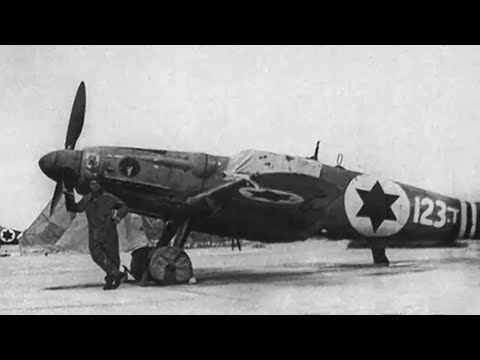
The first four Avias arrived in May 1948, just as the Egyptian army was poised to overrun Tel Aviv. The pilots of the newly formed 101 Squadron were a ragtag bunch—South African volunteers, American mercenaries, and Holocaust survivors—with barely any training. “We had no choice but to go up and fight,” recalled one pilot. “The odds were impossible, but we had to try.”
On May 29, the squadron flew its first mission. The planes were riddled with problems: guns jammed, radios failed, and the pilots had never seen the terrain. But as they swooped down on the Egyptian column, something miraculous happened. The Egyptians, stunned by the sudden appearance of enemy aircraft, panicked. “They thought we had a massive air force,” said Modi Alon, the squadron commander. “We had four planes, but they didn’t know that.”
The psychological impact was immediate. Egyptian radio transmissions, intercepted by Israeli operators, revealed that the advance on Tel Aviv had been halted. The mere presence of the Avias had turned the tide. But the cost was high. One pilot, Eddie Cohen, was killed by ground fire; another crash-landed. The squadron was down to two operational planes.
Yet the Avia’s story was far from over. In the following days, Modi Alon and American pilot Milton Rubenfeld took to the skies again, this time targeting Iraqi and Jordanian armored columns. “We were flying coffins,” Rubenfeld later said. “But we made them count.” Rubenfeld’s plane was hit, and he bailed out over the sea, but the attack sowed further chaos among the enemy.
Then came the dogfight that would cement the Avia’s legacy. Gideon Lichtman, a rookie with only half an hour of flight time, found himself face-to-face with an Egyptian Spitfire—a superior aircraft in every way. “I couldn’t even remember which switch was for the guns,” Lichtman recalled. After fumbling with the controls, he managed to fire, and the Spitfire went down. It was the Avia’s first air-to-air kill.
But the Avia was a killer in more ways than one. Several pilots went missing, and South African pilot Sid Cohen discovered why: the gun synchronizers were faulty, causing pilots to shoot their own propellers. “It was a death trap,” Cohen said. “But we had no alternative.” Maintenance issues meant that rarely more than four planes were operational at any time, and crashes were frequent.
Despite these limitations, the Avia S-199 became an unlikely icon. Its very existence—a Nazi-designed fighter in the hands of Jewish pilots—was a symbol of defiance. “It was a message to the world,” said one historian. “That we would fight with whatever we had.”
As the war raged on, the Avia continued to fly missions, often outnumbered and outclassed. But its impact was undeniable. The Egyptian advance on Tel Aviv was stopped, and the tide of the war began to turn. The Avia’s story is one of irony and resilience—a plane built by the enemy, flown by the desperate, that helped save a nation.
But the story of the Avia S-199 was not merely one of desperation. It was also a story of ingenuity, of men who learned to tame a beast that seemed determined to kill them. Every mission was a gamble, and every landing a small victory against the odds.
Ground crews worked around the clock, cannibalizing broken airframes to keep a handful of planes flying. “We had no spare parts, no manuals, nothing,” recalled one mechanic. “We improvised. We made it work.” The Avia’s reputation as a widow-maker was well earned, but the men who flew it and fixed it refused to let it fail.
Among the pilots, a strange affection for the ugly, dangerous fighter began to grow. It was slow, it was unpredictable, and it had a nasty habit of veering off the runway. Yet it was theirs. “She was a bitch,” one pilot joked, “but she was our bitch.”
The Avia’s most celebrated moment came in early June, when Modi Alon intercepted a pair of Egyptian C-47 bombers converted for combat, heading straight for Tel Aviv. With only one serviceable fighter at his disposal, Alon scrambled alone. The odds were suicidal, but he had no choice.
Climbing into the evening sky, Alon spotted the bombers and attacked. His first burst of cannon fire tore into the lead aircraft, which erupted in flames and spiraled toward the ground. The second bomber, panicked, jettisoned its payload and tried to flee, but Alon pursued it relentlessly, finishing it off with a second pass.
When he landed, the ground crew found his Avia riddled with bullet holes from the bombers’ defensive guns. “I don’t know how she stayed in the air,” Alon said afterward. “But she did.” The victory was broadcast across the country, a rare piece of good news in a war that seemed endless.
Yet the Avia’s success could not mask its fundamental flaws. The bomber engine, never designed for a fighter, was prone to overheating and stalling. The landing gear was fragile, and the aircraft had a tendency to ground-loop on landing. More pilots were lost to accidents than to enemy fire.
By the summer of 1948, the 101 Squadron had lost nearly half its original pilots. Replacements arrived—some experienced, most not—and the cycle of training, flying, and crashing continued. “We knew the risks,” said one pilot. “We flew anyway.”
The Avia’s legacy was being written in blood and steel, one mission at a time. And as the war dragged on, the question was no longer whether the fledgling Israeli state would survive, but at what cost.
The arrival of the Avia had not only stunned the Egyptians but also sent ripples through the Arab coalition. Jordanian and Iraqi commanders, already wary of the mysterious Israeli air force, began to divert troops to protect their supply lines. “We couldn’t afford to lose a single convoy,” a Jordanian officer later admitted. “We didn’t know how many planes they had, or where they would strike next.” The uncertainty alone was a weapon.
But the Israelis knew the truth: they were barely holding on. With only a handful of operational Avias, every mission had to count. The 101 Squadron’s pilots flew with a recklessness born of desperation, diving low to strafe enemy columns, then limping home in planes held together by wire and prayer. “We were fighting with one hand tied behind our backs,” said Ezer Weizman, a future commander of the Israeli Air Force. “But we made the other hand count.”
In mid-June, a fragile truce was brokered by the United Nations. Both sides used the pause to regroup, but for Israel, it was a lifeline. The truce allowed them to smuggle in more aircraft—this time, surplus P-51 Mustangs and Spitfires from abroad. The Avias, battered and patched, were finally given a rest. But the quiet would not last.
When fighting resumed in July, the Avia was no longer the only fighter in the Israeli arsenal—but it was still the most feared. Egyptian pilots, flying superior Spitfires, had learned to respect the ugly Czech-built plane. “They called it the ‘black bird,’” recalled an Israeli intelligence officer. “They believed it was a new type of German fighter, faster and deadlier than anything they had.” The myth of the Avia had grown larger than the plane itself.
On July 18, the 101 Squadron launched a daring raid on El Arish, a key Egyptian airbase in the Sinai. The mission was led by Modi Alon, who had become a legend in his own right. Flying low over the desert, the Avias caught the Egyptians off guard, destroying several parked aircraft and fuel depots. “We hit them before they even knew we were there,” Alon reported. “The Avia was slow, but she was quiet. They never heard us coming.”
But the raid came at a cost. On the return leg, Alon’s wingman, a young immigrant named David Horowitz, was hit by anti-aircraft fire. His Avia trailed smoke and began to lose altitude. “I told him to bail out,” Alon said. “He said he couldn’t—the canopy was jammed.” Horowitz crash-landed in the desert, surviving with a broken leg, but his plane was lost. It was a reminder that every victory came with a price.
By the autumn of 1948, the tide of the war had turned. The Egyptians, once poised to overrun Tel Aviv, were in retreat. The Avia, despite its flaws, had bought Israel the time it needed to build a real air force. “It wasn’t about winning air battles,” said one historian. “It was about survival. And the Avia gave them that.”
Yet the plane’s story was not over. As the war entered its final months, the remaining Avias were relegated to ground-attack missions, their airframes worn thin from months of combat. Pilots still flew them, but the reverence had faded. “We loved her, but we were also glad to see her go,” admitted one pilot. “She had done her job. We were ready for something better.”
When the war ended in 1949, the Avia S-199 was quietly retired. Of the twenty-five planes originally purchased, only a handful remained. Most had been destroyed in crashes or combat, their wreckage scattered across the Negev and the Sinai. But their legacy lived on—not in museums, but in the skies over Israel, where the next generation of fighters would take flight.
The Avia’s final chapter was written not in the skies over Sinai, but in the hangars where ground crews stripped the last serviceable airframes for parts. “We kept three flying until the very end,” recalled one mechanic. “Not because we needed them, but because we couldn’t bear to let them go.” By early 1949, the Czech-built fighters were officially obsolete, replaced by Mustangs and Spitfires that could actually dogfight without killing their own pilots.
Yet the men who flew the Avia never forgot her. Decades later, in interviews and memoirs, they spoke of the ugly fighter with a mixture of terror and affection. “She tried to kill me every time I flew her,” said Gideon Lichtman. “But she also saved my country. How do you hate a plane like that?”
The Avia’s story became a legend in the Israeli Air Force—a cautionary tale and a badge of honor. New pilots were shown the old photographs: the bent propellers, the bullet-riddled fuselages, the exhausted young faces. “This is where we started,” instructors would say. “With nothing but nerve and a broken machine.”
In the end, the Avia S-199 was never meant to be a hero. It was a stopgap, a desperate measure, a plane that should have been scrapped. But in the hands of desperate men, it became something more: proof that survival is not about having the best tools, but about the will to use whatever you have.
What would you have done, facing impossible odds with a plane that fought you every step of the way?
Report this article
Select a reason for reporting:






