The desert sun burned white against the sky as the Messerschmitt closed in for the kill. Wing Commander James Francis Edwards, a skinny farm boy from Saskatchewan, had only seconds to act. His P-40 Kittyhawk was outclassed, outgunned, and outmaneuvered by the German fighter behind him. The enemy pilot was Otto Schulz, a Luftwaffe ace with over 50 victories. Edwards was supposed to die that day over North Africa. Instead, he kicked the right rudder, skidded sideways, and watched the Messerschmitt overshoot. One short burst. The German plane erupted in flames. Edwards flew 373 combat missions and never got shot down. He lived to be 100. This is not a story about luck. It’s a story about men who refused to die.
But Edwards was just one of ten. From the burning deserts of Africa to the frozen forests of Russia, from the skies over Pearl Harbor to the final days of Berlin, these pilots faced suicide missions and somehow survived. They flew crippled aircraft, crawled through snow with broken legs, and charged into walls of flak that should have torn them apart. They were not supposed to live. The statistics said they were dead before they ever climbed into the cockpit. Yet they came home.
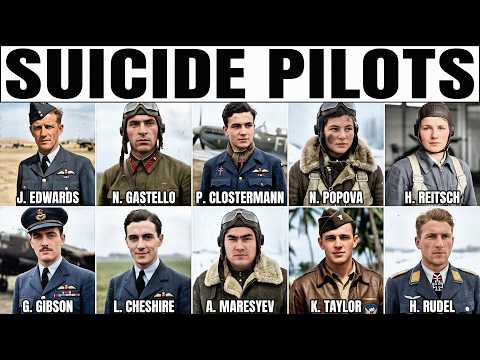
Take Nikolai Gastello, a Soviet bomber pilot who, on the fourth day of the German invasion, deliberately flew his burning aircraft into a column of German tanks. He died in the explosion, but his act became a legend. Hundreds of Soviet pilots followed his example. Most died. A few survived. Gastello’s final act of defiance was so total that for the next 50 years, Soviet schoolchildren learned his story before they learned arithmetic.
Then there was Pierre Clostermann, a Free French ace who flew 432 combat sorties, attacked V-1 rocket sites, and intercepted Me 262 jet fighters. He was shot in the leg by flak in the last weeks of the war and survived. Charles de Gaulle called him the first French fighter. William Faulkner called his memoir the finest aviation book to come out of the war.
And Nadezhda Popova, a Soviet pilot who flew 852 combat missions in a wooden biplane built of canvas and plywood. The Germans called her a Night Witch. She once landed with 42 bullet holes in her aircraft. She flew 18 sorties in a single night. She survived the war and earned the title Hero of the Soviet Union. She was shot down multiple times, but she never stopped flying.
These pilots faced impossible odds. They flew outdated equipment, faced overwhelming enemy fire, and watched friends die around them. Yet they lived. They came home. They built lives, raised families, and carried the memories of those who didn’t make it.
But not all of them were heroes. Some served the wrong cause. Hans-Ulrich Rudel, the most decorated Nazi pilot, flew 2,530 combat missions and destroyed 519 Soviet tanks. He was shot down 32 times, had his leg amputated, and returned to combat six weeks later. He survived the war and never expressed regret. He helped Nazi war criminals escape to South America. He was a true believer until the day he died.
This is the story of ten pilots who flew suicide missions and somehow survived. Some were heroes. Some were villains. All of them defied the odds. Their stories are a testament to human endurance, skill, and sometimes, sheer luck. But above all, they are a reminder that in war, the line between life and death is often thinner than a razor’s edge.
As we delve into each of their stories, ask yourself: What would you have done? Would you have flown into the fire? Would you have crawled through frozen forests with two broken legs? Would you have taken off in a rickety biplane against the might of the Luftwaffe? These pilots did. And they lived to tell the tale.
But the desert had not finished with Edwards yet. In late 1942, ground fire tore through his Kittyhawk during a strafing run, and he nursed the dying aircraft into a crash landing in open sand. No road. No water. No shade. He walked for miles until his boots filled with sand and his lips cracked, until British troops spotted him stumbling toward their lines. Within weeks he was flying again. Within months he had more victories to his name.
By 1944 he was a squadron leader at 23, commanding men older than himself. He flew top cover over the Normandy beaches on D-Day, then led four Spitfire squadrons across France, Belgium, and into Germany itself. He held the rank of wing commander at 24 and finished the war with 373 missions and not a single shootdown to his name. He retired in 1972 and died in 2022, three weeks short of his 101st birthday. He outlived almost everyone he flew with, and almost everyone he fought against.
Hannah Reitsch’s war ended differently. In the final days of April 1945, she flew a tiny Fieseler Storch into a Berlin already encircled by Soviet troops, landing on a boulevard near the Brandenburg Gate while shells burst around the wings. She dragged the wounded General von Greim into Hitler’s bunker on foot. There she found the Führer she had worshipped shrunken, trembling, and raging at fate. He handed her a cyanide capsule and told her she belonged to those who would die with him.
She accepted it. She meant it. But Hitler ordered her out—one last mission, to arrest the traitor Himmler. She protested. She wanted to die in the bunker. He refused. She flew out through anti-aircraft fire and surrendered to the Americans weeks later.
They held her for fifteen months. She told them everything she had seen and admitted she had no regrets except that Germany lost. Her family was already gone—her father had murdered her mother, her sister, and her sister’s children rather than let them fall into Soviet hands, then killed himself. She kept Hitler’s cyanide capsule for the next thirty-four years.
After her release she returned to flying, setting more glider records, founding schools in India and Ghana, befriending Indira Gandhi and visiting the Kennedy White House. But she remained a Nazi to the end—wearing her Iron Cross, visiting SS veterans, corresponding with exiles in South America. In August 1979 she wrote a final letter to the British test pilot Eric Brown. It ended with the words: \”It began in the bunker, and there it shall end.\” Within weeks she was dead. No autopsy. Brown believed she had finally used the capsule, completing a suicide pact delayed by thirty-four years.
Two pilots, two deserts—one of sand and one of ideology. Edwards walked out of his and never looked back. Reitsch carried hers to the grave. And the war was not finished producing such people.
On the other side of the world, another pilot was about to write his name into the first paragraph of the American war effort. Kenneth Taylor and George Welch were still in their tuxedo trousers when the first Japanese bombs fell on Pearl Harbor. They had spent the night drinking and playing poker. They had been asleep for less than ninety minutes when the world exploded.
They raced eleven miles down strafed Hawaiian roads in a Buick driven at 100 mph, Japanese fighters strafing the car with cannon fire. They reached Haleiwa Auxiliary Airfield, where two P-40s sat fueled and armed—but only partially. The .50-caliber machine guns had no ammunition. Only the .30-calibers worked. They took off anyway, without orders, into the heart of the attack.
They found the second wave near the mooring mast field: twelve Japanese dive bombers. Two American pilots. They dove in. Taylor shot one down. Welch shot down another. They circled back and kept firing until their ammunition ran out. They landed, rearmed, and took off again—Taylor with ammunition boxes still partly attached to his wings. By the end of the morning, they had shot down at least six Japanese aircraft between them, possibly as many as ten. They were the first American pilots to score air-to-air victories in the Second World War.
Both were nominated for the Medal of Honor. Both were denied—because they took off without authorization. They received the Distinguished Service Cross instead. Taylor, wounded in the arm and leg by shrapnel, also received the Purple Heart. He lived to be 86. Welch became a test pilot and may have broken the sound barrier weeks before Chuck Yeager. He died in a crash in 1954.
In the frozen forests of northwestern Russia, another kind of survival was being written. Alexei Maresyev’s Yak-1 was shot down in April 1942, and he crawled for eighteen days through snow with two shattered legs. He ate tree bark, pine needles, ants, and half a lizard. He dragged himself east by the sun and stars, his legs turning black with gangrene. By the time Soviet villagers found him, he was days from death.
Doctors amputated both legs above the knee. He was told his flying career was over. He wept. Then he read about Douglas Bader, the British pilot who flew with two artificial legs. If they could do it, Maresyev decided, so could he. He spent a year learning to walk, run, and dance on prosthetic legs. He trained his stumps to feel the rudder pedals. In July 1943, during the Battle of Kursk, he returned to combat.
In a single engagement, he and his wingman each shot down a Stuka. Then two Fw 190s attacked his wingman. Maresyev dove between them, took the fire on himself, and shot down both German fighters. Four kills in one combat with no legs. He finished the war with eleven victories, seven after his amputation. He became a Hero of the Soviet Union, the subject of a novel, a film, and an opera. He died in 2001, two days before his 85th birthday.
The war demanded everything from these pilots—and sometimes it took everything. But for a few, against every probability, it gave them back. They came home. They lived. And their stories refuse to fade.
Guy Gibson never got to choose what his survival became. He led nineteen Lancasters off the runway at Scampton on the night of 16 May 1943, and fifty-three of his men never came back. His own bomb failed to breach the Möhne Dam—so he turned his aircraft around and flew up and down the dam wall, deliberately drawing German flak away from the next crew. The fifth Lancaster finished the job.
He was 24, awarded the Victoria Cross, and dead eighteen months later in a Mosquito crash on a routine raid over the Netherlands. The war was patient with Gibson. It waited until his greatest hour had passed.
Leonard Cheshire survived 103 missions, watched the atomic cloud rise over Nagasaki, and spent the next forty-seven years building homes for the broken. Rudel survived 2,530 missions and spent his years helping war criminals escape justice. Same fire. Same sky. Opposite souls.
Ten pilots. Ten sets of impossible numbers. The statistics said they were dead before they ever climbed into the cockpit—and every single one of them broke the statistics.
So tell me: did this list get it right? Should Rudel be number one despite who he was—or should the top spot belong to Cheshire, or Gibson, or Edwards?
Report this article
Select a reason for reporting:






