The sky over Burma was a hellscape of smoke and fire. Second Lieutenant Owen Baggett, copilot of a B-24 bomber, had just bailed out of his crippled aircraft, his parachute deploying as the jungle canopy rushed up to meet him. But the nightmare was only beginning.
Japanese Zero fighters, having shredded the bomber formation, now turned their guns on the helpless men dangling beneath silk canopies. It was a slaughter. Baggett watched in horror as his comrades were strafed mid-air, their bodies going limp. Then, one Zero circled back—straight for him.
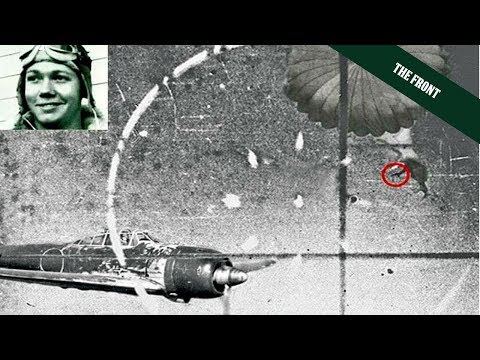
Baggett knew the drill. Playing dead might buy him a few seconds, but this pilot was not just passing by. The Zero slowed, canopy sliding open, and the pilot leaned out to get a better look at his next victim. The fighter was so close Baggett could see the man’s face—a smirk of cruel satisfaction.
But the Japanese pilot made a fatal mistake: he approached nose-up, the aircraft on the verge of a stall, hanging almost motionless in the air. In that split second, Baggett acted.
He drew the M1911 pistol concealed against his leg, aimed at the cockpit, and fired four shots. The Zero shuddered. The pilot’s head snapped back—a single bullet had found its mark. The fighter stalled, spun, and plummeted toward the jungle, trailing smoke.
Baggett had just done the impossible: shot down an enemy fighter with a handgun while parachuting. But his ordeal was far from over. Even as he drifted downward, other Japanese pilots continued their strafing runs. He hit the ground hard, scrambling for cover behind a tree as bullets chewed the earth around him.
Two of his crewmates landed nearby, also surviving the initial onslaught. But their relief was short-lived. Within hours, they were captured by Burmese forces and handed over to the Japanese. What followed would test Baggett’s will to live in ways he could never have imagined.
The prison camp was a world stripped of everything but survival. Baggett and his crewmates were marched for days, beaten when they stumbled, and fed barely enough to keep a man breathing. The Burmese jungle gave way to a Japanese compound where the air smelled of rot and fear. Men around him wasted away, their eyes hollow and their spirits crushed.
But Baggett had already done the impossible once. He refused to let the jungle or the guards finish what a Zero fighter couldn’t. He learned the rhythm of the camp—when to keep his head down, when to steal a few extra bites of rice, when to whisper words of defiance to the men fading beside him.
The guards singled him out more than once, curious about the American who had supposedly shot down one of their own with a pistol. They couldn’t prove it, but they suspected. Interrogations became beatings, and beatings became a test of endurance. Baggett gave them nothing but his name, rank, and serial number, spoken through swollen lips.
Months bled into a year, then another. Dysentery swept through the camp, and men died by the dozen. Baggett lost weight until his ribs showed like piano keys, but he kept moving, kept counting the days, kept alive the insane hope that someday he’d walk out of this place.
Then, in the summer of 1945, the guards began to act strangely. They whispered among themselves, cast nervous glances at the sky. One morning, Baggett woke to find the camp commander gone and the remaining guards pacing like caged animals. The war, they realized, was coming to an end—and no one wanted to be the last Japanese soldier to shoot an American prisoner.
When the first American planes appeared overhead, dropping leaflets instead of bombs, Baggett stood in the compound yard and wept. He was not a man given to tears, but two years of filth, hunger, and grief poured out of him all at once. His crewmates, the ones who had made it this far, gathered around him in silence.
The liberation came days later. Marines pushed through the jungle, rifles raised, and the prisoners—what was left of them—stumbled into the light. Baggett weighed less than a hundred pounds. His uniform hung in tatters. But he was alive.
He was flown to a hospital in India, then home to Texas. The story of the parachuting pistol shot followed him, whispered in bars and printed in hometown papers. Officially, the Army credited him with a probable kill—the Zero’s wreckage was never found, and the pilot’s body was never recovered. But the men who were there knew the truth, and that was enough.
Baggett rarely spoke of the war in later years. He raised a family, worked a quiet job, and lived the kind of ordinary life that felt extraordinary after everything he’d endured. But sometimes, on a clear afternoon, he’d look up at the sky and remember the day he dangled beneath a silk canopy, a pistol in his hand, and a Japanese fighter spinning toward the jungle below.
He never fired a gun again.
Decades later, a young historian named Daniel Reyes sat in a dusty archive in Washington, D.C., pulling at the thread of a story that had been half-forgotten. He had heard the tale of the parachuting pistol shot in a podcast, of all places, and it had lodged in his brain like a splinter. Something about it didn’t add up—or rather, something about it added up too neatly. The Army’s official record said “probable kill,” but the men who were there swore it was certain. Daniel wanted to know why the discrepancy had never been resolved.
He began with the 7th Bomb Group’s after-action reports, yellowed pages filled with terse military prose. The mission to hit the bridge near the Japanese base was documented in cold detail: aircraft lost, crews missing, coordinates strafed. But there was no mention of a pistol, no mention of a Zero spinning out of control. Daniel frowned. Official histories, he knew, had a way of sanding down the strange edges of war.
He tracked down a surviving crewmate’s son, a retired schoolteacher in Oregon named Walter Hayes. Walter’s father had been the bomber’s tail gunner, one of the few men who made it back to base that day. The old man had died in 1998, but he had left behind a shoebox of letters and a cassette tape of his recollections, recorded in a raspy voice in his final year.
Daniel drove to Oregon and sat in Walter’s living room, a cup of coffee growing cold in his hands. Walter inserted the cassette into an old player. The voice that emerged was thin but steady.
“I saw it,” the tail gunner said. “I was hanging in my chute, maybe two hundred yards from Baggett. That Jap came in slow, canopy open, and I thought, God, he’s going to shoot him like a dog. Then I heard the pops—four of them, clear as day. The Zero nosed over and went down like a stone.”
Daniel leaned forward. “Did he say anything else? About the pilot, the plane?”
Walter shook his head. “He never saw the wreck. But he said something I never forgot. He said the Zero didn’t just fall—it shuddered first, like a man who’d been slapped. That’s how he knew Baggett hit the pilot, not the engine.”
The trail led next to Japan. Daniel found a retired archivist at the Japanese Defense Ministry who had spent years cataloging wartime loss records. The man, Kenji Mori, was courteous but skeptical. “Many American stories of the war are… embellished,” he said, smiling thinly. “We Japanese have our own legends.”
But when Daniel mentioned the date—March 31, 1944—and the location, Mori’s expression shifted. He excused himself and returned with a faded ledger. In it, a single line recorded a Zero fighter lost that day, pilot Lieutenant Hiroshi Tanaka, cause unknown. The body had never been recovered.
“It is not proof,” Mori said quietly. “But it is… a coincidence.”
Daniel pressed further. Did the Japanese records mention a parachuting American? Mori hesitated, then nodded. “There is a note in the squadron diary. It says the pilot was strafing a man in a parachute when his aircraft suddenly went into a spin. The other pilots assumed he had been struck by ground fire.” He paused. “No one considered that the man in the parachute might have fired back.”
Daniel sat back, the pieces clicking into place. The Japanese had their own version of the story, and it matched Baggett’s—except for the impossible detail. A pistol shot at that range, from a swinging parachute, was a miracle. And miracles, Daniel knew, were the hardest things to prove.
He returned to Texas, where Baggett’s daughter, Martha, welcomed him into her home. She was in her seventies, with her father’s steady eyes and a quiet way of speaking. She showed him a wooden box of her father’s possessions: his pilot’s wings, a faded photograph of the crew, and the M1911 pistol, its grip worn smooth.
Daniel held the gun, feeling its weight. “Did he ever talk about it?”
Martha smiled. “Only once. I was about twelve, and I asked him if the story was true. He looked at me for a long time, then said, ‘I didn’t shoot to be a hero. I shot because I was angry. And anger, sweetheart, is a terrible thing to waste.’“
She paused, her eyes glistening. “Then he went out to mow the lawn and never mentioned it again.”
Daniel thanked her and drove back to his hotel, the Texas sun setting behind him. He had enough for an article, maybe even a book. But as he sat in his car, he realized the story was still unfinished.
Because there was one question no one had answered: what happened to the Zero’s wreckage? If the plane had truly spun into the jungle, there might be something left—a fragment of metal, a rusted engine, something that could turn a legend into fact.
And Daniel, like Baggett before him, was not the kind of man to let a question go.
Six months later, Daniel found himself hacking through Burmese jungle with a local guide named Aung, a metal detector strapped to his back and a GPS unit in his hand. The coordinates were rough—based on the tail gunner’s estimate and the Japanese squadron diary—but it was the best lead he had.
For three days they found nothing but spent shell casings and the rusted hulk of an American bomber. Then, on the fourth morning, the detector screamed.
Beneath a tangle of vines and decades of leaf rot lay a twisted piece of aluminum, painted with the faded green of a Japanese Zero. Daniel’s hands shook as he and Aung pulled it free. There was more—a bent propeller blade, a shattered instrument panel, and, half-buried in the mud, a rusted Type 97 machine gun.
But the find that made Daniel’s breath catch was a small metal plate, stamped with a serial number. He photographed it and sent it to Kenji Mori in Tokyo. The reply came within hours: “Serial number matches Lieutenant Hiroshi Tanaka’s aircraft. You have found him.”
No body was ever recovered—the jungle had claimed that—but the wreckage told its own story. The plane had not been hit by ground fire. The bullet hole in the cockpit canopy, preserved in the corroded metal, was small and round: a pistol caliber.
Daniel stood in the clearing, sweat dripping from his brow, and thought of Baggett dangling beneath that silk canopy, angry and terrified and utterly defiant. The Army had called it a “probable kill.” The jungle had just called it confirmed.
He wrote the article. It was published in a military history journal, then picked up by a national magazine. The story of Owen Baggett—the man who shot down a Zero with a pistol—finally had its ending. Martha Baggett read it in her Texas home and wept, not for the war, but for her father, who had carried that impossible moment in silence for sixty years.
And somewhere, in the quiet of a Burmese jungle, a rusted piece of aluminum still lies where it fell—proof that sometimes, the most absurd stories are the truest ones.
What’s the most unbelievable war story you’ve ever heard from your own family?
Report this article
Select a reason for reporting:






