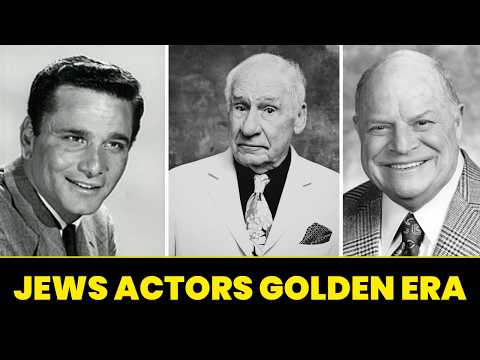
You know their faces. You’ve quoted their lines. But did you know that some of the most iconic stars of Hollywood’s Golden Age carried a secret that shaped their art, their humor, and their very souls? From the quick-witted Marx Brothers to the powerful Kirk Douglas, their Jewish heritage was more than a footnote—it was the bedrock of their brilliance.
Behind the glitz and glamour, these actors navigated a world of prejudice and stereotype, yet they rose to become legends. Their stories are not just about fame; they are about resilience, identity, and the courage to embrace who they truly were.
Take Groucho Marx, born Julius Henry Marx in 1890 to a Jewish family of German descent. His father, Sam, and mother, Minnie, raised their children in a modest New York home where laughter was the currency of survival. Groucho may not have been devout, but his heritage was a wellspring of humor. “I don’t want to belong to any club that would accept me as one of its members,” he famously quipped—a line that echoed the outsider status Jews often felt, even in the entertainment capital of the world.
Then there’s Kirk Douglas, born Issur Danielovitch, the son of Russian Jewish immigrants. His family practiced Orthodox Judaism, and his father’s grueling work as a ragman left an indelible mark on young Issur. Douglas’s journey from poverty to stardom was fueled by a fierce determination rooted in his Jewish upbringing. He never hid his roots, writing candidly about them in his autobiography. “I am a Jew,” he declared, “and I am proud of it.”
But the story doesn’t end with the famous names you know. Consider Ray Mala, one of Hollywood’s earliest indigenous stars. Born in Alaska in 1906 to a Jewish father and an Iñupiat mother, Mala’s unique heritage set him apart. He rose to prominence in Eskimo (1933), the first film shot in Alaska, which won an Academy Award for editing. His blended identity was a quiet revolution in an industry that rarely celebrated diversity.
And who could forget Danny Kaye? Born David Daniel Kaminsky to Ukrainian Jewish immigrants, he grew up in Brooklyn surrounded by music, humor, and storytelling. His comedic timing and musical talent dazzled audiences in classics like The Secret Life of Walter Mitty and White Christmas. Kaye’s Jewish upbringing infused his performances with a warmth and charm that transcended cultural barriers.
These stars, and many more, navigated a delicate balance between assimilation and authenticity. Some anglicized their names, like Tony Curtis (born Bernard Schwartz) and Stan Lee (born Stanley Martin Lieber). Others, like Eli Wallach, who grew up speaking Yiddish in Brooklyn, brought the richness of their culture to every role. “My Jewish roots gave me resilience,” Wallach once said—a sentiment echoed by countless others.
The stories of these Golden Age actors are a testament to the power of heritage. Their Jewish identity wasn’t just a detail; it was the invisible thread that wove through their performances, their humor, and their lives. And as we delve deeper, we’ll uncover how their faith and culture shaped not only their careers but also the very fabric of Hollywood itself.
Stay tuned as we explore the remarkable journeys of these legends—and the legacy they left behind.
But the Golden Age wasn’t just about the stars in front of the camera. Behind the scenes, Jewish immigrants and their children were building an empire. The studio system itself was largely the creation of Jewish visionaries—men like Louis B. Mayer, Adolph Zukor, and the Warner brothers—who transformed a sleepy California town into the dream factory of the world.
These moguls understood the outsider experience intimately. They had fled pogroms and poverty in Eastern Europe, and they channeled that hunger into building studios that would define American entertainment for generations. Yet they also faced a painful paradox: to succeed, they often had to downplay the very heritage that drove them.
Consider Walter Matthau, born Walter John Matthow to Lithuanian Jewish immigrants in New York’s working-class neighborhoods. His mother, Rose, raised him with a sharp sense of humor that became his trademark. Before Hollywood, Matthau honed his craft in Yiddish theater—a world where Jewish stories, jokes, and sorrows were performed nightly for immigrant audiences hungry to see their own lives reflected on stage.
That same Yiddish theater tradition shaped Jerry Stiller, whose parents were Polish and Austrian Jewish immigrants. Stiller’s comedic genius, later immortalized as Frank Costanza on Seinfeld, was built on a foundation of culturally rich humor. “My father was a funny man,” Stiller recalled. “He taught me that laughter was how we survived.”
Then there was Sammy Davis Jr., the Rat Pack’s triple threat who converted to Judaism after a near-fatal car accident in the 1950s. Davis’s embrace of his new faith was radical—especially for a Black entertainer in an era of widespread racial and religious prejudice. “I’m a one-eyed Black Jew,” he’d joke, turning pain into punchline. His conversion wasn’t a career move; it was a spiritual homecoming that gave him strength during his recovery and beyond.
And what about Peter Sellers, the comedic chameleon behind the Pink Panther films? His mother’s Jewish ancestry played a subtle but undeniable role in shaping his uncanny ability to inhabit different personas. Sellers could mimic any accent, embody any character—a skill that reflected the adaptability Jewish performers had long cultivated to survive in a hostile world.
The legacy of these Jewish entertainers wasn’t just about breaking barriers—it was about redefining what it meant to be American. They brought the rhythms of Yiddish theater, the cadences of synagogue chant, and the resilience of their ancestors into the mainstream. Every laugh they earned was a quiet victory over the prejudice that had followed their families across oceans.
But their influence extended far beyond comedy and drama. In the next chapter, we’ll explore how Jewish actors shaped some of Hollywood’s most beloved genres—from the Western to science fiction—and how their faith continued to guide them through the darkest moments of the twentieth century.
Think of Leonard Nimoy, the son of Ukrainian Jewish immigrants in Boston, whose parents spoke Yiddish at home and observed Orthodox traditions. When Nimoy crafted the Vulcan salute for Star Trek, he drew directly from the priestly blessing he had witnessed as a boy—fingers parted in the shape of the Hebrew letter shin. “It was a secret I kept for years,” he admitted. That single gesture, born of ancient liturgy, became one of the most recognized symbols in science fiction.
His co-star William Shatner, raised in a Yiddish-speaking Montreal household, brought a different kind of Jewish energy to Captain Kirk—restless, improvisational, forever questioning authority. Neither man preached from the pulpit, but both carried their heritage into the final frontier.
And then there was Gene Wilder, born Jerome Silberman in Milwaukee to Russian Jewish immigrants. Wilder’s comedic timing—that delicate balance of sweetness and hysteria—came straight from the storytelling traditions of his childhood. “I’m culturally Jewish,” he said. “It’s not about going to synagogue. It’s about how you see the world.” That worldview gave us Willy Wonka’s melancholy and the Frankenstein monster’s tenderness.
But the Golden Age’s Jewish story wasn’t confined to performers. Consider Stan Lee, born Stanley Martin Lieber to Romanian Jewish immigrants. Growing up in a cramped Washington Heights apartment, Lee learned early that imagination was a form of escape. “My parents taught me that storytelling could change lives,” he said. Spider-Man, the neurotic Everyman from Queens, was a direct descendant of that Jewish sensibility—the perpetual outsider who carries guilt and responsibility like a second skin.
Then there’s the darker chapter. Harvey Keitel, raised in Brooklyn by Polish Jewish immigrants who survived the Holocaust, brought an almost unbearable moral weight to roles like Taxi Driver‘s Sport. His parents’ resilience haunted and inspired him. “They never spoke of the camps,” Keitel recalled. “But I felt it in everything they did.”
And Kirk Douglas, again—because his story demands returning to. In 1991, long after his stardom was secured, Douglas stood at the edge of the Grand Canyon and recited the Shema, the central Jewish prayer. He had returned to the faith of his father, the ragman. “I wanted to die as a Jew,” he wrote. It was a full-circle moment that no Oscar could ever capture.
The 1950s brought a new challenge: the blacklist. Jewish actors and writers, already navigating the minefield of assimilation, now faced accusations of communism. Zero Mostel, the brilliant comedian and Tony-winning star of Fiddler on the Roof, was blacklisted for years. He survived by performing in Yiddish theaters and Catskills resorts—the very venues that had nurtured his art. “They couldn’t take away my Jewishness,” he said. “It was the one thing they couldn’t blacklist.”
That resilience echoed through the decades. Dustin Hoffman, raised in Los Angeles by Ukrainian Jewish parents, channeled his grandparents’ immigrant stories into The Graduate‘s Benjamin Braddock—a young man adrift, searching for meaning. “I grew up surrounded by ghosts,” Hoffman said. “My grandparents’ stories were my acting school.”
That same search for meaning defined Barbra Streisand, the girl from Brooklyn who refused to change her name or her nose. She sang in temple choirs before she sang on Broadway, and when she starred in Yentl—a film she directed, produced, and fought for—she brought a Jewish woman’s story to the world. “I wanted to honor my father,” she said, “and all the fathers who never got to see their daughters pray.”
And Mel Brooks, born Melvin Kaminsky, turned the Holocaust itself into comedy with The Producers—a musical about a scheme to make money from a flop called “Springtime for Hitler.” Some called it tasteless. Brooks called it revenge. “Humor is the only weapon that doesn’t wound,” he said. “It heals.”
Then there was Larry David, who brought the Jewish neurotic everyman to prime time with Seinfeld and Curb Your Enthusiasm. His characters argued about nothing, obsessed over social rules, and found disaster in every holiday dinner—a comedy of anxiety that felt unmistakably Jewish. “I’m not a religious Jew,” David admitted. “But I’m a professional Jew. I get paid for it.”
These stars proved that Jewish identity wasn’t a limitation—it was a lens. Through it, they saw the absurdity of life, the pain of exile, and the stubborn hope that kept their ancestors alive. They didn’t just entertain; they carried a people’s story into the mainstream, one laugh and one tear at a time.
So the next time you watch Annie Hall, Star Trek, or The Producers, listen closely. You’ll hear the echoes of Yiddish theater, the cadence of synagogue chant, and the resilience of generations. Their legacy isn’t just in the films they made—it’s in the culture they preserved and transformed.
What’s your favorite performance by a Jewish actor from Hollywood’s Golden Age—and did knowing their heritage change how you see it?
Report this article
Select a reason for reporting:






