The Pacific sky turned black with the roar of engines and the smell of death. On October 25, 1944, Lieutenant Yukio Seki led five aircraft in a near-vertical dive toward the USS St. Lo. His plane slammed directly into the carrier, followed moments later by another kamikaze striking the exact same spot. The ship sank rapidly, taking more than 140 lives. This was not just another battle—it was the terrifying debut of a weapon that would redefine naval warfare: the kamikaze.
But how did Japan, facing inevitable defeat, turn its own pilots into guided missiles? And how did one British ship, the HMS Sussex, survive a direct hit that should have sent it to the bottom? The answer lies in a story of desperation, duty, and incredible luck.
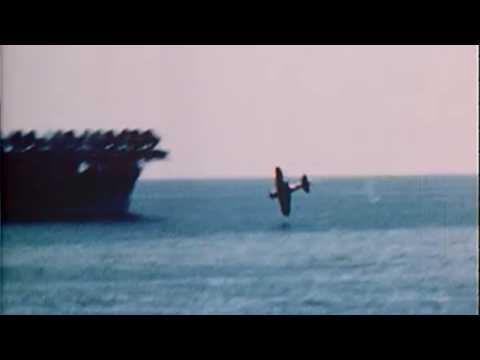
By 1944, the Pacific War had swung sharply against Japan. Allied fleets crept closer to the home islands, and conventional tactics failed. Japanese commanders, facing dwindling resources and an invincible enemy, turned to drastic measures: special attack units. These pilots, many in their teens, were not all brainwashed fanatics. Some volunteered out of duty, others to protect their families from invasion. Their planes—stripped of radios, armor, and parachutes—became human missiles.
The first official kamikaze mission took off from Mabalacat airfield in the Philippines. Lieutenant Yoshiyasu Kuno, leading three aircraft, vowed to find a target or fly to Leyte Gulf. He never returned. Yet, in a lesser-known twist, many kamikaze pilots returned safely if they couldn’t find a target. The image of an inevitable one-way flight is a misconception. But on October 25, Seki’s unit changed everything.
As the war raged, kamikaze tactics evolved. They flew in groups, then split into smaller formations to overwhelm radar operators. They changed altitude and direction to confuse defenses. The US Navy countered with radar picket destroyers, proximity fuses, and the “circling the wagons” tactic—destroyers forming a screen around carriers, pouring ordnance into the air. James Fahey, a sailor, recalled: “It looked funny to see the tanker all by itself in the center as the ships circled it without guns blazing away as the planes tried to break through. It was quite a sight, better than the movies.”
Ship after ship was hit: the USS Franklin, the Belleau Wood, the Intrepid, the Essex, the Saratoga. Each time, damage control crews fought fires and patched decks, returning to action. But amidst the chaos, one ship’s story stands out.
On July 26, 1945, during Operation Livery off Malaya, the British HMS Sussex was targeted by a kamikaze. The plane struck the hull, but instead of exploding, it left only superficial damage—and a bizarre, almost perfect imprint of the aircraft. The outline matched a Mitsubishi Ki-51 Sonia, a light bomber. Witnesses saw the pilot raise his hands before impact. The plane likely clipped the water, lost momentum, and struck at low speed. The Sussex was lucky.
That same day, the HMS Vestal was not so fortunate. Struck by a kamikaze, she suffered 20 killed and was scuttled—the only British warship sunk by kamikaze. Two ships, same operation, opposite fates. The Sussex’s survival is a testament to the unpredictable nature of these attacks.
From October 1944 to August 1945, thousands of kamikaze missions were launched. Around 4,000 pilots died, sinking or damaging hundreds of Allied ships and causing over 7,000 casualties. Vice Admiral C.R. Brown described the hypnotic fascination of watching a plunging kamikaze: “We watched each plunging Kamikaze with a detached horror of one witnessing a terrible spectacle rather than as the intended victim.” Yet behind each attack was a human being, like Ichizo Hayashi, who wrote to his mother: “I cannot say that the wish to die for the emperor is genuine coming from my heart. However, it’s decided for me that I do die for the emperor.”
The kamikaze campaign was a desperate gamble that left an indelible mark on history. But how did it begin, and what drove these young men to their deaths? The answer lies in the final months of the war, where desperation met duty, and the skies became a graveyard.
The story of the kamikaze did not begin with a grand strategy. It began with a single man who believed he had no other choice. In the summer of 1944, as American forces closed in on the Philippines, Captain Motoharu Okamura, commander of the 341st Air Group, spoke plainly to his superiors. “In my opinion, there is only one way of assuring that our meager strength will be effective to a maximum degree,” he said. “That is to organize suicide attack units.” The men around the table fell silent. Okamura pressed on, his voice steady. “I would like to be the first to die.”
The idea was not entirely new. Japanese pilots had already rammed Allied aircraft in moments of desperation, and the word kamikaze—meaning “divine wind”—carried ancient weight, recalling the typhoons that had once scattered Mongol invasion fleets. But formalizing suicide as a tactic was another matter entirely. It required commanders to look at their own young pilots and decide that their lives were worth less than the damage they could inflict.
By late 1944, Vice Admiral Takijiro Onishi arrived in the Philippines with orders to defend the archipelago at all costs. His air force was a shadow of its former self—a handful of serviceable aircraft, barely enough fuel, and pilots who could scarcely land on a carrier deck. Onishi gathered his surviving commanders and made his case. “We must become human bombs,” he told them. The men listened. Some wept. None objected.
What followed was not a mass conversion but a quiet, bureaucratic process. Pilots were not dragged to their planes. They were asked. Sometimes they were asked in groups, and the shame of refusal was enough to ensure no one refused. Other times, the request came with a smile and a cup of sake, as if it were an honor rather than a death sentence. The word “volunteer” hung over every mission, but the pressure to step forward was immense.
Seiichi Kariya was twenty years old when he received his orders. He had been a student at Tokyo Imperial University, studying literature, when the draft notice arrived. Like many of his classmates, he had been told that Japan was fighting for its survival. Now he was told to die for it. In his diary, he wrote: “I am not afraid of death. But I am afraid of what my death will mean. Will it save Japan? Or will it only add another name to a list of the lost?” He never found out. His plane disappeared over the East China Sea on his first and only mission.
Not every pilot accepted his fate with stoic resolve. Some drank heavily the night before. Others wrote letters to their parents that were carefully censored by officers before being mailed. One pilot, whose name has been lost to history, scrawled a message on the fuselage of his aircraft before takeoff: “I go to die for a country that has already died.” The ground crew painted over it before he returned—if he returned.
The training itself was brutal and brief. Pilots who had once dreamed of mastering the skies now learned only how to dive, how to aim, and how to die. They practiced on outdated trainers, often with barely enough fuel for a single pass. They were not taught to land. There was no point. The final flight was the only flight that mattered.
Back in Washington, American intelligence officers began to piece together the picture. Reports of Japanese aircraft diving directly into ships—not strafing, not bombing, but deliberately crashing—were dismissed at first as isolated acts of fanaticism. But the pattern was unmistakable. By November 1944, the US Navy had issued a stark warning to its captains: “The enemy is employing suicide tactics. Expect attacks from any direction, at any altitude. Do not assume a damaged aircraft is out of the fight.” The war had entered a new and terrible phase.
The men who carried out these attacks were not the only ones changed by them. On the other side of the gun sights, young American sailors found themselves confronting an enemy who seemed to want to die. Radar operators, who had once tracked formations of bombers with clinical precision, now watched single blips separate and dive, each one a life ending in real time. Some described a strange guilt at shooting down planes that never tried to evade.
The kamikaze also forced a revolution in how the Navy thought about survival. Damage control teams, once focused on firefighting and flooding, now drilled for a new nightmare: an aircraft crashing through the flight deck and detonating in the hangar below. Steel plates were bolted over vital spaces. Sandbags piled around gun mounts. Crews slept in life jackets. The lessons were written in blood, ship by ship.
Yet the most haunting legacy belonged to the pilots themselves. Many left behind poems, diaries, and letters that revealed not zealotry but exhaustion. One young ensign wrote: “The sky is the same blue it has always been. I wish I could see it tomorrow.” Another sketched a picture of his mother’s face on the inside of his flight helmet. These were not monsters. They were sons, students, and brothers, caught in a machine that had run out of options.
Back in the Philippines, the campaign that began at Mabalacat had grown into something far larger than Captain Okamura could have imagined. By early 1945, the Japanese had established a dedicated kamikaze airfield network, complete with hidden revetments and fuel caches scattered across the countryside. Pilots waited in grass huts, playing cards and writing farewell notes, while mechanics stripped every ounce of weight from their aircraft. Radios were removed. Guns were removed. Even the rear gunner’s seat was torn out. Every pound saved meant another gallon of fuel for the final dive.
The Americans, meanwhile, had learned to dread the sight of a single plane. A lone aircraft approaching from high altitude was more terrifying than a formation of fifty bombers. It could be anything—a decoy, a spotter, or a bomb with wings. Fighters were vectored to intercept, but often too late. Anti-aircraft gunners learned to fire short, disciplined bursts, conserving ammunition for the moment when a plane turned toward the ship.
One gunner aboard the USS Missouri later recalled: “You didn’t aim at the plane. You aimed at the pilot. You tried to kill the man before he could push the stick forward.” It was a grim calculus, and it weighed on every crew that survived.
As spring turned to summer in 1945, the kamikaze attacks intensified around Okinawa. The radar picket stations, those lonely destroyers far from the main fleet, bore the brunt. Station 14, a single destroyer on the edge of the screen, was attacked by more than fifty Japanese aircraft in a single afternoon. The crew fought until their guns melted and their ammunition ran dry. When the smoke cleared, the ship was still afloat—barely. The men who survived never spoke of it without their voices breaking.
And yet, even as the attacks grew more desperate, the Japanese high command knew the war was lost. The kamikaze were not a strategy for victory anymore. They were a strategy for honor—a way to make the enemy pay for every inch of ocean. Each sinking was a bargaining chip, a message that invasion would cost rivers of blood. The message was received. The planned invasion of Japan, Operation Downfall, would have been the bloodiest campaign in human history.
But the war ended before that invasion could come. On August 15, 1945, the Emperor’s voice crackled over radios across Japan, announcing surrender. For the surviving kamikaze pilots, the news brought a strange and bitter relief. Some had been in the air, circling, waiting for orders that never came. Others sat in cockpits on the tarmac, engines warm, when the stand-down was broadcast.
One pilot, who had written his farewell letter three times, wept openly when he was told he would live. “I had already died in my heart,” he later said. “Now I had to learn how to live again.” Many never did. Some took their own lives after the surrender, unable to face the shame. Others vanished into civilian life, carrying secrets they never shared with their families.
The kamikaze left scars on both sides of the ocean. American veterans spoke of the hypnotic horror of watching a plane dive, knowing a man was inside. Japanese families received boxes of ashes and letters that had been carefully censored. The tactic had changed warfare forever—but it had also revealed something deeper: the terrible things men will do when they believe there is no other choice.
Today, the imprint on the HMS Sussex has faded, but the story remains. Two ships, same day, opposite fates. A pilot who raised his hands before impact. A letter to a mother that admitted the truth. History remembers the kamikaze as a weapon, but they were also young men who wished they could see tomorrow.
So here is the question that lingers, decades later: if you had been in that cockpit, with your country collapsing and your family’s future uncertain, would you have volunteered—or would you have found another way?
Report this article
Select a reason for reporting:






