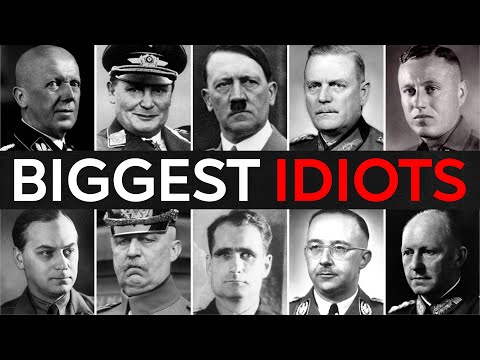
What if history’s most terrifying regime wasn’t just evil, but also painfully stupid? Behind the uniforms and speeches was a clown car of delusional generals, corrupt bureaucrats, and self-declared geniuses who couldn’t win a coin toss without rigging it and still losing. This is not a story of masterminds. It’s a parade of miscalculations, ego-driven disasters, and ideological face plants that helped doom the Nazi regime from within.
These are the 33 biggest idiots in Nazi history. And somehow they still thought they were the master race.
Before we dive into the absurdity, take a second to hit that subscribe button—especially if you enjoy watching history unravel in slow motion. Let us know in the comments where you’re tuning in from and what time it is as you’re watching. Midnight, lunch break, somewhere in between. We won’t judge, but history might.
One. Adolf Hitler.
For a man who styled himself a military genius, Adolf Hitler had an almost supernatural gift for making the worst possible decision at every critical juncture. He didn’t just ignore his generals. He actively punished them for being competent. In his paranoid mind, retreat meant weakness, and weakness was treason. So rather than adjust tactics when the Red Army surrounded his troops, Hitler insisted they stand and die heroically. Entire armies were swallowed in snow and silence because the man at the top thought honor was better than logic.
He declared war on the United States out of what can only be described as ego. No strategic reason, no material gain, just vibes and a death wish. His invasion of the Soviet Union timed so poorly even Napoleon winced from the grave. Hitler’s instinct was less strategic genius and more dice roller in a haunted casino. Still, if you thought he was delusional, wait until you meet the man who thought airplanes could win the Eastern Front.
Two. Hermann Göring.
Hermann Göring was the kind of man who could promise the moon, deliver a dead flashlight, and still demand applause. A morphine-addicted art thief in a velvet uniform, he strutted through the Third Reich with the self-confidence of a man who’d never been right once in his life. But his most legendary blunder came at Stalingrad, where he assured Hitler that the Luftwaffe could keep 250,000 encircled German troops supplied by air in winter in Soviet airspace with fuel they didn’t have.
The logistics were pure fantasy, like trying to resupply a submarine with a carrier pigeon. When it predictably failed, the Sixth Army starved, froze, and was annihilated. But Göring just kept floating around in silk robes, puffing cigars like nothing had happened. He wasn’t just incompetent, he was flamboyantly incompetent. And yet somehow the next man was even more unqualified for his role and decided to start commanding armies anyway.
And hey, if you’ve made it this far, you’re clearly not just here for the headlines. Go ahead and subscribe for more deep dives into the disasters history tried to sweep under the rug. While you’re at it, drop a comment. Where are you watching from, and what time is it on your end right now? We’re genuinely curious who’s out there unraveling the madness with us, whether it’s 3 p.m. or 3:00 a.m.
Three. Heinrich Himmler.
Heinrich Himmler had the charisma of a damp sock and the tactical mind of a lawn chair. But in the final years of the war, this chicken farmer turned police state overlord decided he was also a military genius. Despite having zero battlefield experience, Himmler demanded command of army groups because why not? Hitler was desperate. The generals were dead or disgraced. And Himmler liked uniforms.
Naturally, his leadership led to instant disaster. His troops didn’t follow orders. His strategies were incoherent. His retreats were panicked and sloppy. He didn’t command battles. He hosted slow-motion train wrecks. Even when not commanding armies, he found new ways to sabotage the regime. In the final stretch of the war, he prioritized the Holocaust over actual military logistics. He rerouted trains meant for supplies or troop movement to ship victims to death camps, crippling Germany’s war effort from within. The SS’s obsession with genocide took precedence over saving itself.
Still, diplomatic idiocy was its own special category. Just ask the man who thought Britain would just sit this one out.
Four. Joachim von Ribbentrop.
Joachim von Ribbentrop had the diplomatic instincts of a toddler with a megaphone. As Hitler’s foreign minister, he was less an architect of Nazi foreign policy and more like a demolition expert with no training and too much confidence. Before World War II even began, Ribbentrop famously assured Hitler that Britain would never dare to fight over Poland. According to him, the British ruling class was too soft, too old-fashioned, too addicted to afternoon tea to care.
Unfortunately, they did care and declared war. He also believed France would crumble diplomatically before a single German tank rolled in. Instead, Europe exploded. Ribbentrop didn’t just misread the room. He burned the room down and blamed the furniture. His version of diplomacy was so detached from reality that even Hitler reportedly stopped listening to him. But if Ribbentrop’s failures were diplomatic, the next man’s mistakes were theatrical. Enter the spin doctor of self-destruction.
Five. Joseph Goebbels.
Joseph Goebbels was the master of lies. But like most compulsive liars, he eventually got high on his own supply. As the Reich Minister of Propaganda, Goebbels flooded Germany with slogans, films, and speeches designed to conjure a fantasy world where the Reich was invincible. But Goebbels’s great tragedy—beyond the human cost—was his inability to adapt. He believed his own hype. While bombs fell on Berlin, his broadcasts claimed everything was going according to plan.
He waited until 1943, after the disaster at Stalingrad, after the Allied bombings, after the war was visibly unwinnable, to finally call for total war. A bit late for heroics. His propaganda also backfired abroad—so deranged and cartoonishly evil, it made foreign resistance stronger, not weaker. But if Goebbels was a manipulator who deluded millions, the next idiot simply deluded himself in a solo flight of fantasy that would have embarrassed a Bond villain.
Six. Rudolf Hess.
Rudolf Hess was the kind of man who took “trust your gut” to a clinically unhinged level. In 1941, without telling anyone—not even Hitler—he got in a Messerschmitt and flew solo to Scotland, hoping to negotiate peace with the British. His plan: convince the British aristocracy that the Nazis and the UK should unite against the Soviets. His evidence: mostly his own vibes and some vague letters. Instead, he crash-landed, got arrested, and became the world’s most high-profile diplomatic laughingstock.
Hitler disowned him. The Allies interrogated him. And the rest of the Nazi leadership awkwardly pretended they’d never liked him anyway. No mission, no deal, no plan B. Just one man in a plane chasing delusions across the North Sea. Yet somehow the man who took over Nazi industry from here managed to make factory production into its own hall of mirrors.
Seven. Albert Speer.
Albert Speer liked to present himself as the reasonable one in the Nazi hierarchy, an educated technocrat trapped among loud, unhinged ideologues. But history is not that kind. As Minister of Armaments, Speer promised miracle solutions like a salesman pitching malfunctioning blenders. He inflated production numbers to keep Hitler happy, massaged statistics to hide shortages, and insisted victory was still possible long after the German economy was collapsing like wet cardboard.
His factories became temples of denial, pretending order existed where only chaos reigned. He championed vast construction schemes and emergency programs that were so over-ambitious they actually reduced output. A man obsessed with efficiency spent his final years overseeing a system built on inefficiency. And yet the next figure somehow managed to exceed Speer’s talent for unrealistic promises by rubber-stamping every disastrous idea that crossed his desk.
Eight. Wilhelm Keitel.
Wilhelm Keitel wasn’t so much a military leader as he was a human signature machine. Hitler issued a ridiculous order. Keitel approved it. A suicidal offensive? Approved. A stand-and-die directive that ignored every principle of military strategy? Approved with enthusiasm. His fellow officers nicknamed him “Lakeitel,” meaning lackey Keitel, because his main skill was saying yes louder than everyone else in the room.
Under Keitel’s watch, entire German armies were encircled and destroyed simply because retreat was politically inconvenient. He carried out Hitler’s fantasies without hesitation, even when they contradicted basic logistics, terrain, or reality. Strategy became theater, and Keitel was always ready to set the stage. But if Keitel excelled at obedience, the next man perfected the art of planning battles that existed only on paper and collapsed instantly in the real world.
Nine. Alfred Jodl.
Alfred Jodl, Hitler’s operations chief, had a remarkable talent for designing plans the same way a child draws a maze: confidently, enthusiastically, and with no understanding of actual consequences. His invasion strategies routinely ignored supply limits, terrain obstacles, weather conditions, and the enemy. He wanted results that aligned with Hitler’s dreams, not with the sober math of actual warfare.
Jodl predicted the Soviet Union would collapse in weeks. He forecast the Western Allies would never dare a landing in France. He insisted on offensives Germany lacked the fuel to launch. Every time reality disagreed, he blamed the weather, fate, or his favorite excuse: “unexpected enemy resistance,” as though resistance in war were somehow a surprise. Still, if Jodl lived in a fantasy battlefield, the next man lived in a fantasy universe altogether—one where cruelty magically produced stability.
Ten. Ernst Kaltenbrunner.
Ernst Kaltenbrunner wasn’t just cruel. He was catastrophically short-sighted. As head of the Reich Main Security Office, he operated under the delusion that brutality alone could maintain control, especially as the war turned against Germany. His answer to every problem was mass arrests, executions, and repression on a scale that was not only morally bankrupt but also tactically disastrous.
Resistance didn’t shrink under his reign. It exploded. His logic seemed to be, “If force isn’t working, use more of it and faster.” By the late stages of the war, Kaltenbrunner was personally pushing for escalations that drained resources and shattered internal stability. In his mind, fear was a permanent solution. In practice, it fueled chaos. But where Kaltenbrunner weaponized terror, the next man made himself a target through sheer arrogant overreach and paid the ultimate price for it.
Eleven. Reinhard Heydrich.
Reinhard Heydrich was terrifyingly competent—until he wasn’t. Known for his brutal efficiency, he was often described as “the man with the iron heart.” But like many Nazi officials, his fatal flaw was hubris. After being appointed governor of occupied Bohemia and Moravia, Heydrich decided to rule with unapologetic terror. Mass arrests, executions, and collective punishments were routine. He believed crushing dissent required only force, and that fear alone would keep the region quiet.
Instead, his policies radicalized the local population. Czech resistance solidified, and soon British-trained operatives were planning his assassination. The operation, Operation Anthropoid, succeeded—triggering massive Nazi reprisals, but also turning Heydrich into a cautionary tale. In trying to dominate, he detonated his own power. Still, strategic delusion wasn’t limited to the secret police. It was alive and well in the minds of generals, too, especially the ones who thought Russia would fold in a season.
Twelve. Franz Halder.
Franz Halder was chief of the German Army General Staff during the launch of Operation Barbarossa and one of the architects of its doomed assumptions. He believed—or at least pretended to believe—that the Soviet Union would collapse in two to three months. His planning reflected this fantasy: short supply lines, no winter gear, and unrealistic timetables that assumed the Red Army would simply evaporate once the panzers rolled in.
In internal memos, Halder referred to Soviet forces as “a house of cards.” Unfortunately, the house was made of concrete and barbed wire. As the war dragged into the snow-covered abyss of the Eastern Front, Halder’s logistical oversights became military catastrophes. When the plan failed, he didn’t pivot. He doubled down. His short-war obsession became a long, slow disaster. But while Halder’s miscalculations were wrapped in maps and charts, the next man’s idiocy was painted in fire across an entire country.
Thirteen. Hans Frank.
Hans Frank styled himself as the legal mind of the Reich, which is ironic considering his policies in occupied Poland were lawless in every possible sense. Appointed Governor-General of the so-called General Government, Frank treated the region like a personal fief and its people like obstacles. His administration wasn’t just brutal—it was breathtakingly counterproductive.
Instead of maintaining order, Frank’s savage repression policies ignited one of the largest resistance movements in Europe. He confiscated land, deported masses, and implemented policies so violent and erratic that even some Nazi officials warned it was making occupation ungovernable. Poland, which might have been passively controlled with smarter strategy, became a boiling cauldron of partisan sabotage. Frank’s legal mind, it turned out, was more preoccupied with philosophical rants and power games than actual governance. But while Frank’s failure was rooted in cruelty posing as administration, the next official went all-in on ideology at the expense of basic competence.
Fourteen. Baldur von Schirach.
Baldur von Schirach believed that if you fed children enough slogans, they’d grow into unstoppable warriors. As head of the Hitler Youth, he created a generation of boys trained not in survival or strategy, but in blind fanaticism. His curriculum emphasized obedience over initiative, dogma over discipline, and delusion over development. The result: young men who marched with conviction and collapsed at the first sight of real war.
When these youth-aged recruits hit the battlefield, many had no idea how to operate equipment, coordinate tactics, or handle real-world pressure. They weren’t soldiers. They were ideological mascots in uniform. Von Schirach called it “building the future.” Historians call it mass-producing cannon fodder. Still, if indoctrinating teenagers was reckless, the next man’s error was even more dangerous. He genuinely believed outdated submarines could still win a war being fought from the sky.
Fifteen. Karl Dönitz.
Karl Dönitz was a submariner at heart—and unfortunately in his head as well. As admiral of the Kriegsmarine and later Hitler’s designated successor, Dönitz clung to the belief that U-boats were the key to defeating Britain, even as Allied anti-submarine warfare rendered them nearly obsolete. He poured resources into wolf packs that were increasingly getting hunted instead of hunting.
Dönitz refused to accept that radar, sonar, and air patrols had changed the nature of naval warfare. His obsession with submarine superiority became a dangerous form of nostalgia. Each sunken Allied ship was framed as a turning point, while the sinking of his own vessels was brushed off as bad luck. His naval strategy resembled a gambler chasing losses until the casino burned down. And yet, for all Dönitz’s denial, the next man took military ideology to an even darker place by injecting extremism straight into the chain of command.
Sixteen. Walter von Reichenau.
Walter von Reichenau was once considered a rising star among the Wehrmacht generals—until he opened his mouth and started writing manifestos. A staunch believer that war was as much ideological as it was strategic, Reichenau issued the infamous Severity Order, a declaration that essentially turned frontline troops into political enforcers. His logic: soldiers should not only fight battles but carry out ideological cleansing.
This instantly blurred the line between military professionalism and fanaticism. His directives didn’t just poison morale. They actively undermined military cohesion. Discipline gave way to ideological zeal, leading to disorganization, infighting, and war crimes that inflamed resistance. Where strategy should have ruled, dogma took the reins. Reichenau, in trying to bind the Wehrmacht to the Nazi cause, helped tear it apart from within. But if Reichenau’s ideological meddling was corrosive, the next official went beyond corrosion. He practically set fire to his entire region.
Seventeen. Erich Koch.
Erich Koch ran Reichskommissariat Ukraine like a medieval tyrant with a bureaucratic title. Appointed by Hitler to oversee one of the most strategically vital occupied territories, Koch had a golden opportunity. Many Ukrainians initially welcomed the Germans as liberators from Stalin’s rule. But Koch—brutal, racist, and absurdly arrogant—squandered that goodwill with stunning speed.
Instead of stabilizing the region, he treated it as a personal colony, exploiting resources while crushing the population with draconian policies. He banned education, stripped local governance, and ruled through fear, turning potential allies into bitter enemies. Ukrainian partisans grew stronger by the week—not despite his rule, but because of it. What might have been a geopolitical advantage became a self-inflicted insurgency. Still, Koch was only one piece of the collapsing legal farce. The next man tried to “fix” the courts and managed to make justice itself a punchline.
Eighteen. Otto Thierack.
Otto Thierack was appointed Reich Minister of Justice with a single goal: to align the courts with Nazi ideology. What he actually created was a theater of cruelty masquerading as law. Thierack didn’t just rewrite the rules. He turned the courtroom into a stage where verdicts were predetermined and justice was performance art. His idea of judicial reform was mass death sentences and handing “unworthy” prisoners directly to the SS.
By removing any pretense of impartiality, he obliterated public trust in the judiciary—even among Nazi supporters. Thierack’s obsession with optics and political messaging made legal decisions more about party loyalty than evidence. In his system, truth became irrelevant. In trying to control chaos through fear and theater, he turned the Nazi legal system into a twisted parody of itself. But if Thierack sabotaged the courts, the next man embarrassed the regime in a way few could match—by being too unhinged even for them.
Nineteen. Julius Streicher.
Julius Streicher was so fanatical, so unfiltered, and so consistently absurd that even other Nazis found him embarrassing. A rare accomplishment in that crowd. As the publisher of Der Stürmer, Streicher spewed out propaganda that was so grotesque and deranged, it bordered on surrealist fiction. He turned conspiracy theory into a full-time aesthetic, drawing cartoons that made no political sense and printing stories so hysterical they often undercut their own message.
Instead of persuading anyone, his newspaper functioned more like a grotesque parody of Nazi ideology. Internationally, his antics made Nazi propaganda easier to mock. Domestically, many in the party hierarchy considered him a liability. At one point he was stripped of official duties because his behavior became too chaotic even for Hitler. And yet they never fully disowned him—because ideologues like Streicher were baked into the system. But where Streicher failed in subtlety, the next man failed in physics by building defenses that looked impressive but worked like a sieve.
Twenty. Fritz Todt.
Fritz Todt is remembered for building a lot of things: roads, bunkers, fantasies. As the head of Nazi engineering and later Minister of Armaments, Todt had a grand vision for Germany’s future—monumental infrastructure, sleek highways, and vast fortresses. But when war arrived, his obsession with scale often trumped strategy. Todt poured enormous resources into mega-projects like the Atlantic Wall, massive coastal fortifications that, while visually intimidating, were riddled with weaknesses and left large areas undefended.
Even when Todt realized the war was unwinnable, he kept designing as if it were a civil engineering contest. He privately told Hitler that Germany was doomed, then returned to sketching impossible blueprints as though he could pave his way out of reality. His projects were less about defense and more about ego. Still, if Todt’s fantasies were carved in concrete, the next man’s were etched into policies so dysfunctional they made entire regions ungovernable overnight.
Twenty-One. Albert Forster.
Albert Forster had a gift for turning already difficult situations into complete disasters. Appointed Gauleiter of Danzig and later tasked with Germanizing parts of occupied Poland, Forster believed he could transform entire populations through paperwork and pressure. His approach to ethnic cleansing wasn’t just immoral. It was bureaucratically incoherent. He classified people as German or non-German based on wildly inconsistent criteria, often changing definitions mid-policy.
The result: total administrative confusion. Resistance grew. Local cooperation collapsed. And the occupying authorities began to trip over their own rules. Forster’s policies were so erratic that even other Nazi officials started quietly avoiding him. His forced assimilation campaigns created exactly what they were meant to suppress: ethnic tension, local sabotage, and widespread resentment. Forster showed that even within a system defined by cruelty, sheer administrative stupidity could still make things worse. And yet, the next man managed to outdo him by turning an entire country’s resistance into his own personal creation.
Twenty-Two. Arthur Seyss-Inquart.
Arthur Seyss-Inquart was a bureaucrat with a law degree and the instincts of a pyromaniac. When placed in charge of the Nazi occupation of the Netherlands, he inherited a country known for its pragmatism and civil organization. What he did with it was a masterclass in how to turn a governable region into a war zone. Instead of maintaining some illusion of order, Seyss-Inquart implemented a reign of terror with all the subtlety of a sledgehammer.
Deportations, arbitrary executions, and sweeping crackdowns didn’t pacify the Dutch. They radicalized them. Resistance groups multiplied. Sabotage operations intensified. Civilians who might have stayed neutral joined underground networks. In his quest to demonstrate absolute control, Seyss-Inquart triggered a political and logistical nightmare. His policies were so tone-deaf they disrupted even the parts of Dutch society that had grudgingly tolerated occupation. What could have been manageable became unsustainable. Still, even Seyss-Inquart’s mess couldn’t match the raw administrative disaster that followed when the Nazis gave power to a man best known for being bad at everything except mass corruption.
Twenty-Three. Odilo Globocnik.
If you gave a job to Odilo Globocnik, you could almost guarantee it wouldn’t get done—unless the job involved cruelty and embezzlement. As one of the key figures in Operation Reinhard, he was nominally in charge of organizing death camps. But his real specialty was losing vast sums of government money, infuriating his superiors, and turning every administrative task into a scandal. He bungled logistics so badly that Berlin frequently had to send others in just to clean up the fallout.
Even among his SS peers, Globocnik had a reputation for being spectacularly disorganized. Supplies vanished, infrastructure collapsed, and whatever wasn’t stolen outright was misused or misallocated. His districts were models of dysfunction. The man couldn’t even run a paper trail properly, and yet he was repeatedly promoted because he remained ideologically useful. But incompetence in office was one thing. The next figure made things worse by turning government into a perpetual turf war, complete with legal chaos and policy pileups.
Twenty-Four. Wilhelm Frick.
Wilhelm Frick was supposed to bring order to the legal and governmental mess that was the Third Reich. Instead, he made it worse. As Reich Minister of the Interior, Frick tried to reshape the German legal system to reflect Nazi ideology. But he did it with such clumsiness that he created a bureaucratic free-for-all. Ministries overlapped. Laws contradicted each other. Entire branches of government duplicated efforts or canceled each other out.
In his attempt to centralize power, he unleashed a storm of administrative chaos. Frick’s reforms often looked efficient on paper but became incomprehensible in practice. Regional leaders ignored him. Other Nazi officials rewrote his directives. And Hitler routinely bypassed him. By trying to nazify the legal system too quickly and without coordination, Frick built a house of cards out of policy and then acted surprised when it fell over. Still, Frick’s bureaucratic disaster would be surpassed by a recruiter whose greatest talent was assembling the worst possible army units imaginable.
Twenty-Five. Gottlob Berger.
Gottlob Berger was given one job: expand the Waffen-SS by recruiting foreign fighters. What he delivered was a patchwork army of misfits, ideologues, opportunists, and outright liabilities. Berger’s recruitment strategy was less “qualified soldiers” and more “whoever says yes.” He built SS divisions out of captured POWs, conscripts from hostile regions, and volunteers from countries that had little stake in the Nazi cause.
Predictably, these units were undisciplined, poorly trained, and militarily useless. Berger’s obsession with quantity over quality led to formations that collapsed under pressure, defected at critical moments, or simply refused to fight. His foreign legions required more supervision than they were worth, and their failures on the battlefield damaged the already strained reputation of the SS. Even other Nazi officials began questioning whether Berger was expanding the military or just creating chaos in new uniforms. But if Berger’s contribution was unreliable soldiers, the next man helped build an economy that looked solid until the floor caved in.
Twenty-Six. Hjalmar Schacht.
Hjalmar Schacht was the so-called financial wizard of the early Nazi era—the man credited with reviving the German economy with smoke, mirrors, and IOUs. As Minister of Economics, Schacht engineered a recovery based not on sustainability, but on deferred disasters. His infamous MEFO bills—essentially secret promissory notes—allowed Germany to rearm massively without immediate financial collapse. But it wasn’t a miracle. It was a ticking time bomb.
The entire system relied on hiding debt and assuming future victories would pay it off. When war came, the economic foundation began crumbling under its own weight. Inflation pressures, resource bottlenecks, and trade isolation made Schacht’s schemes unsustainable. He was eventually sidelined, but the damage lingered. In the end, his “genius” turned out to be creative accounting wrapped in authoritarian optimism. Still, if Schacht built a mirage, the next figure simply set his credibility on fire with every drunken, slurred speech he gave while pretending to run a labor force.
Twenty-Seven. Robert Ley.
Robert Ley ran the German Labor Front like a man who’d never held a calendar, a budget, or a coherent thought. Appointed to replace labor unions with a Nazi-controlled alternative, Ley promised to turn workers into loyal citizens of the Reich. What he delivered was a chaotic mess of graft, slogans, and mandatory marching. His speeches were infamous even among fellow Nazis—rambling, off-topic, and frequently laced with embarrassing gaffes.
He wasted enormous resources on vanity projects like Strength Through Joy, which promised cheap vacations to factory workers while factories were falling apart. The organization was so bloated and corrupt that even Hitler’s inner circle mocked it. Ley’s offices became synonymous with mismanagement, drunken outbursts, and paperwork—no one understood. While pretending to lead a labor renaissance, Ley instead showcased how fast a regime could rot from the inside. Yet even his incompetence pales next to the man who made coordination his job title and still managed to coordinate nothing at all.
Twenty-Eight. Hans Lammers.
Hans Lammers held one of the most theoretically powerful positions in the Nazi regime: chief of the Reich Chancellery. His job was to coordinate the dizzying mess of agencies, ministries, and personalities orbiting Hitler. In practice, Lammers was less a coordinator and more a glorified mailman who got buried under his own inbox. His strategy for managing Nazi bureaucracy was simple: let everyone do everything at once and hope no one noticed.
Instead of streamlining decision-making, Lammers presided over an administrative free-for-all where party officials, military officers, and SS leaders issued overlapping, contradictory orders. Laws were passed twice. Initiatives collapsed from infighting. And policymaking became a surreal game of telephone. His failure to establish clear lines of authority allowed Hitler’s divide-and-conquer leadership style to thrive and turned the Reich into a bureaucratic spaghetti bowl. Still, Lammers was a symptom. The cause lay earlier—in the man who gave Hitler his first dose of mystic ego.
Twenty-Nine. Dietrich Eckart.
Dietrich Eckart didn’t live long enough to see World War II, but his fingerprints were all over the early ideological blueprint of Nazi madness. As a mentor to Hitler during the 1920s, Eckart helped transform him from an angry nobody into a self-styled messianic leader. A failed playwright with a flair for the dramatic, Eckart combined nationalism, mystical nonsense, and personal cult-building into one toxic stew—and Hitler drank deep.
Eckart wasn’t a military man or strategist. His real talent was in projection—casting Hitler as the savior of Germany and building a mythology around a man who at the time had done nothing but rant in beer halls. By elevating charisma over competence, Eckart helped shape the delusional leadership culture that would later consume the Reich. His legacy wasn’t in policy. It was in ego inflation. But where Eckart built a myth, the next man built an entire worldview—one so incoherent it collapsed under the weight of its own contradictions.
Thirty. Alfred Rosenberg.
Alfred Rosenberg fancied himself the intellectual heart of the Nazi regime. Unfortunately, his ideas were a tangled mess of pseudoscience, historical revisionism, and racial theorizing that changed with the political wind. As chief ideologue, he was responsible for drafting the Nazi vision of a new world order—one based on ethnic purity, cultural domination, and barely readable philosophical ramblings. His book, The Myth of the 20th Century, tried to explain it all and instead explained nothing.
Rosenberg’s racial hierarchy contradicted actual strategic needs, declaring Slavs subhuman even as Germany needed their labor. His plans for occupied territories ignored logistics and cultural realities, making administration nearly impossible. Even within the Nazi party, few took his work seriously. He was tolerated, not respected—a man who wrapped dangerous nonsense in academic language and called it policy. And yet, for all Rosenberg’s metaphysical blunders, the next figure brought an older, more stubborn failure to the table by handing the Nazis their favorite excuse.
Thirty-One. Erich Ludendorff.
Erich Ludendorff wasn’t technically a Nazi, but without him, the Nazis might never have existed in the first place. A World War I general turned radical conspiracy theorist, Ludendorff helped craft one of the most enduring lies in modern German history: the stab-in-the-back myth. According to him, Germany hadn’t lost the war on the battlefield. It had been betrayed by internal enemies—conveniently defined as socialists, liberals, and Jews.
This fantasy wasn’t just wrong. It was politically nuclear. By spreading the myth through speeches, writings, and his post-war cult of personality, Ludendorff provided the emotional scaffolding for Hitler’s entire movement. His rantings about secret cabals and hidden enemies turned national defeat into personal vendetta. The military elite, eager to dodge blame for their failures, embraced his narrative. So did the public. And from that collective denial came a hunger for scapegoats—one the Nazis were more than happy to feed. But if Ludendorff gave them the excuse, the next man gave them the thuggery and turned party politics into a back-alley brawl.
Thirty-Two. Christian Weber.
Christian Weber was the kind of political enforcer who made every room feel smaller the moment he walked in. An early associate of Hitler and a leader in the Munich Nazi scene, Weber operated less like a politician and more like a mob boss with a uniform. His main contributions to the movement were intimidation, street brawls, and the sort of internal power plays that gave even other Nazis pause. He didn’t do policy—he did muscle.
When the Nazis were still clawing their way to power, Weber helped manage Munich through threats, payoffs, and factional infighting. Once the party took over, he shifted into luxury corruption mode—amassing wealth, silencing rivals, and turning his local rule into a personal empire of vanity projects and vendettas. His leadership style was less administrative and more chaotic tyranny. But if Weber was an opportunist who thrived on brute force, the next man was a general who should have known better and still charged head-first into disaster.
Thirty-Three. Sepp Dietrich.
Sepp Dietrich fancied himself a warrior-poet of the Waffen-SS. In reality, he was more of a tactically reckless hammer who occasionally got lucky—until he didn’t. Dietrich wasn’t without talent in short, brutal engagements, but his leadership consistently suffered from one fatal flaw: impulse control. He had a habit of throwing elite SS divisions into battles they had no chance of winning, burning through men and equipment in operations driven more by emotion than calculation.
Nowhere was this clearer than during the Ardennes Offensive, Germany’s last-ditch gamble in the winter of 1944. Dietrich commanded the Sixth SS Panzer Army and was tasked with breaking through Allied lines in a desperate blitz. Instead, he squandered precious momentum and fuel in poorly coordinated attacks, bogging down in terrain he didn’t prepare for and facing resistance he hadn’t anticipated. His forces faltered quickly, and the offensive collapsed. His legend didn’t die there, but the myth of Nazi military genius did.
And that, fittingly, is how the Third Reich ended—not just in evil, but in failure, dysfunction, and incompetence on a world-historic scale. The regime that promised a thousand-year empire barely lasted twelve years, undone as much by its own staggering stupidity as by the armies that crushed it. So here’s the question: if you had to pick the single most catastrophic act of self-sabotage in Nazi history, which one would it be—and why do you think so many of these men kept getting promoted despite being so spectacularly bad at their jobs?
Report this article
Select a reason for reporting:






