The noon sun blazed over the Gulf of Patras, casting a merciless light on the two fleets poised for annihilation. Ottoman Grand Admiral Ali Pasha, his eyes fixed on the Christian line, gave the order: “Forward! No retreat!” He was determined to crush the Holy League, to shatter their hopes and cement Ottoman dominance over the Mediterranean. But as his galleys surged into the fire of the massive Christian galliases, the sea erupted in thunder and splintered wood. The Battle of Lepanto had begun—and the world would never be the same.
This was no ordinary clash. It was the largest naval battle in the Mediterranean for centuries, a confrontation between two titans: the Ottoman Empire, whose seemingly unstoppable expansion had terrorized Christendom for decades, and the Holy League, a fragile alliance of Catholic powers united only by their fear and faith. Over 250 Ottoman ships faced 206 galleys and 6 floating fortresses—the galliases—that would prove to be the battle’s decisive weapon.
For years, the Ottomans had seemed invincible. They had conquered Cyprus, ravaged Christian coasts, and defeated every fleet sent against them. The failed Spanish counterstrike at Djerba in 1560 and the brutal siege of Malta in 1565 had only reinforced the myth of Ottoman invincibility. Pope Pius V, desperate to rally Europe, finally succeeded in 1571 when Venice, Spain, Genoa, and the Papal States forged the Holy League. Their goal: relieve Famagusta, reconquer Cyprus, and halt the Ottoman advance. But by the time the fleet assembled, Cyprus had already fallen—and the news of Famagusta’s horrific surrender, where the Venetian commander Bragadin was flayed alive, only hardened their resolve.
Commanding this uneasy coalition was Don John of Austria, a 24-year-old illegitimate son of Emperor Charles V. Inexperienced but charismatic, he was admired by his men and respected by his commanders—yet his authority was constantly tested. The Venetians, who contributed the most ships, bristled under Spanish leadership. Tensions exploded when Venetian general Sebastiano Venier hanged three Spanish soldiers without consulting Don John, who nearly ordered Venier’s execution in retaliation. Only the diplomacy of Marc Antonio Colonna, the papal admiral, kept the alliance from fracturing before it could face the enemy.
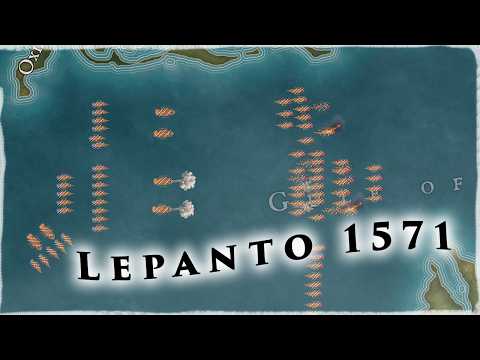
On the morning of October 7, 1571, the lookout’s cry shattered the dawn: “Armed vessels at the mouth of the gulf!” The Ottoman fleet, having left its base at Lepanto the night before, was arrayed in a shallow crescent, hoping to outflank the Christians. Don John’s fleet, emerging from behind the island of Oxia, slowly formed its line of battle. For once, both sides agreed on the numbers: the Ottomans had roughly 250–275 ships, mostly galleys and smaller galliots, carrying 30,000 soldiers. The Holy League had 206 galleys and 6 galliases, with 35,000 soldiers. The Ottomans had more ships, but the Christians had superior firepower—and the galliases, floating fortresses with guns on all four sides, would become their trump card.
Don John made two critical decisions before the battle. First, he had the prows of his galleys removed or reduced, allowing them to fire at a flatter angle directly into the enemy hulls. Second, he mixed the nationalities of his ships, welding the fractious allies into a single armada. As the fleets closed, preparations aboard were frantic: decks cleared, arms prepared, cannons checked. On the Ottoman ships, slaves pulled the oars; on the Christian galleys, professionals and freed convicts—promised freedom in exchange for victory—took their places. All past quarrels vanished as the drums beat and the galleys advanced side by side.
Around noon, the Ottoman center opened fire first, hoping for a quick victory. But the four galliases, positioned a mile ahead of Don John’s line, answered with a devastating volley. According to historian Geoffrey Parker, that opening barrage alone sank more than 70 Ottoman galleys. The pashas cursed their scout, Kara Koza Ali, who had assured them there would be no heavy gunfire. But there was no turning back—the only way was forward, through the fire, to close with the Christian ships and board them.
Then the wind shifted. What had restricted the Holy League’s formation in the morning now blew east, slowing the Ottoman advance and giving the galliases ample time to continue their bombardment. The sea was soon covered with ship parts, weapons, and drowning men. On the northern flank, Mehmed Sirocco tried to outflank the Christian left wing, but Agostino Barbarigo blocked him, his galleys packed so tightly that they almost formed a single platform. The fighting was ferocious. Barbarigo took an arrow to the eye, but his men fought on, capturing and beheading Sirocco. The Ottoman wing was shattered.
In the center, the two flagships—Don John’s Real and Ali Pasha’s Sultana—sought each other out. Ali Pasha had 300 janissaries and 100 crossbowmen; Don John had 400 arquebusiers. The Ottomans initially boarded the Real, but Don John’s men threw them back and counterattacked. Only when Colonna’s flagship arrived did the Christians push through, sweeping the janissaries off the deck. Ali Pasha was killed and beheaded, his head mounted on a pike. A Christian flag rose over the Sultana, and a great cheer went up from the Holy League. The Ottoman center collapsed.
In the south, Uluch Ali, the former privateer and most formidable seaman of his time, held back, avoiding the galliases. He faced Giovanni Andrea Doria, who slowly drifted south, inadvertently exposing the Christian center’s flank. Uluch Ali seized the chance, turned his ships, and fell upon the exposed galleys near the flagship of the Knights of Malta. He overwhelmed them, killing their crews and capturing several ships. But by then, the Ottoman center had collapsed, and Don John, Venier, and Colonna could turn south. Uluch Ali, realizing the battle was lost, cut his towing ropes and fled with a portion of his ships through the channels between Koutsilaris and Oxia.
By late afternoon, the Ottoman fleet was shattered. Almost 100 ships were sunk, 117 captured, and 3,000 prisoners taken. The Holy League lost about 8,000 men; the Ottomans, 25,000. Don John abstained from pursuit as darkness fell and a violent storm swept away the traces of battle. The victory was complete—but the alliance that won it was already fraying. Days later, Venier sent a galley to Venice with news of the victory without consulting Don John, and the old resentments resurfaced. The Holy League fleet returned to Messina, unable to follow up on its triumph.
Contemporaries saw Lepanto as a miracle, a divine intervention that saved the West from doom. Modern historians are more critical: the victory was won by favorable circumstances and superior firepower, and its strategic impact was limited. The Ottomans recovered quickly, and the Holy League fell apart two years later. As Grand Vizier Sokollu Mehmed Pasha reportedly told the Venetian ambassador, “You may have trimmed our beards at Lepanto, but we have taken an arm from you by conquering Cyprus. A chopped-off arm is lost forever, but a shaved beard grows back even stronger.”
Yet something had changed. The myth of Ottoman invincibility was shattered. For the first time in decades, a Christian fleet had faced the might of the Ottoman Empire and won. The psychological blow was immense, and the battle would be remembered as one of the greatest naval clashes in history—the last great galley battle, and the dawn of a new era.
But the story of Lepanto did not end with the storm that scattered the wreckage. In the weeks that followed, the victorious fleet limped back to Messina, its decks still stained, its rowers exhausted. Don John of Austria entered the harbor to the roar of cannons and cheering crowds, yet the young commander knew the truth: the Ottoman fleet had been broken, but the Ottoman Empire had not.
In Constantinople, Sultan Selim II received the news with a silence that chilled his court. The grand vizier, Sokollu Mehmed Pasha, did not rage or weep. Instead, he ordered the shipyards to work day and night. Within a single winter, the Ottomans rebuilt their fleet—some 200 new galleys, fresh from the slipways, armed and manned. When the Venetian ambassador remarked on the speed of the reconstruction, Sokollu gave his famous reply about the shaved beard.
And yet, the beard was not merely a beard. The men who had rowed those galleys were gone. The janissaries who had fallen at Lepanto could not be replaced by timber and nails. The Ottomans rebuilt their ships, but they never again challenged the Christian powers in a great fleet battle in the Mediterranean. The initiative had passed, quietly and permanently, to the West.
For Venice, the victory was bittersweet. The Serenissima had lost Cyprus, and despite the triumph at Lepanto, it would soon sign a separate peace with the Sultan, surrendering the island formally in 1573. Venier, the old doge of the sea, returned home to a hero’s welcome, but he knew the republic’s golden age was fading. The trade routes were shifting, the Atlantic was opening, and the Mediterranean was becoming a backwater.
Spain, meanwhile, celebrated Don John as the savior of Christendom. Banners bearing his likeness were carried through the streets of Madrid, and poets composed epics in his honor. But Philip II, ever cautious, refused to press the advantage. He feared that a prolonged campaign would drain his treasury and strengthen his rivals. The Holy League, that fragile marriage of convenience, dissolved within two years, exactly as the grand vizier had predicted.
In Rome, Pope Pius V did not live to see the peace unravel. He died in May 1572, less than a year after the battle, having seen his great crusade crowned with glory. He was canonized decades later, but the league he forged was already a memory. His successor inherited a Europe still divided, still suspicious, still unable to unite against the East.
And what of the men who fought? Miguel de Cervantes, a young Spanish soldier aboard the Marquesa, took three wounds at Lepanto—two in the chest, one that rendered his left hand useless. He would later call it “the greatest occasion that past or present ages have ever seen,” and he carried the scars with pride for the rest of his life, even as a captive in Algiers and a struggling writer in Madrid.
The galley slaves who survived the battle, freed from their shackles and promised liberty, discovered that freedom was not always what it seemed. Many had no homes to return to, no trade, no family. Some reenlisted, others begged, and a few drifted into piracy, the only life they knew. The sea did not care about the glory of princes.
As the years passed, the memory of Lepanto hardened into legend. Painters depicted the battle in sweeping canvases, with angels hovering above the Christian fleet and devils dragging Ottoman galleys into the deep. Poets sang of Don John as a new Achilles, and preachers declared the victory a sign of divine favor. The messy reality—the quarrels, the missed opportunities, the political calculations—faded beneath the weight of myth.
But in the archives of Venice and Madrid and Constantinople, the truth remained. Lepanto had been a great battle, a bloody and decisive clash of arms. It had not saved Christendom, nor had it destroyed the Ottoman Empire. It had simply marked a turning point, one of those rare moments when the tide of history pauses, shivers, and changes direction.
The Mediterranean would never again see a battle like it. The age of the galley was ending, giving way to the galleon and the ship of the line, to oceans beyond the Pillars of Hercules. Lepanto was the last great cry of an older world, a world of oars and boarding pikes and holy leagues, before the map of the globe was redrawn by Atlantic winds.
And yet, on quiet nights, when the moon hangs low over the Gulf of Patras, fishermen still speak of the day the sea turned red. They tell of the great ships that clashed and burned, of the admiral whose head was raised on a pike, of the young prince who led the Christians to victory. They tell the story not as history, but as legend—the way all great battles are remembered.
The wind shifts. The sea darkens. And somewhere, far out in the channel between Koutsilaris and Oxia, the ghost of Uluch Ali’s galley slips away into the dusk, still carrying its stolen prizes, still refusing to surrender.
And yet, for all the myth-making, one truth endured: on that October noon, a young commander barely half the age of his rival had held a fractious alliance together just long enough to win. Don John’s genius was not tactics alone but the simple act of keeping quarreling men pointed at the same enemy.
The Ottoman Empire would survive for three more centuries, but it never again sailed a fleet into the western Mediterranean with the confidence of invincibility. The shaved beard grew back—but the arm it had taken, Cyprus, was the last great Ottoman conquest in that sea.
So the battle’s true legacy was not territory or treasure, but a shift in the mind: the belief, suddenly credible, that the East could be beaten. Legends do that. They change what people dare to attempt.
What do you think—was Lepanto a turning point, or merely a glorious footnote? Tell us in the comments below.
Report this article
Select a reason for reporting:






