The North Vietnamese lieutenant couldn’t stop shaking. Not from his wounds—those were superficial—and not from fear of captivity. He’d been trained for that. He was shaking because of what he’d just experienced.
When the Australian intelligence officer asked him to describe the patrol that had captured his squad, the words came out in fragments. “We set up camp, cooked rice, told stories, went to sleep. When we woke up, they were already there in the camp with us.” The officer pressed for details. How many Australians? The lieutenant shook his head. “Seven. But they were fifteen meters into our camp. Not outside. Inside. They slept with us.”
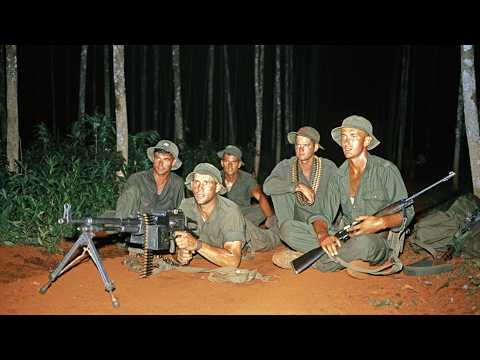
That wasn’t an isolated incident. That was doctrine. Between 1965 and 1972, Australian forces in Vietnam perfected a tactic so psychologically disturbing, so physically demanding, and so tactically effective that American commanders who observed it called it brilliant—and their own troops called it insane.
The Australians called it a close ambush. The enemy called it something else: Ma Rung Nang—the ghosts who sleep. And the reason American troops couldn’t stomach it had nothing to do with courage and everything to do with what it required a human being to endure.
Vietnam, 1966. Phuoc Tuy Province. The Australian Army’s 1st Australian Task Force had been in country for four months, and the American advisers attached to them were filing reports that made zero sense back in Saigon. The Australians were getting contact at rates that shouldn’t be possible. They were ambushing enemy units that American patrols in the same area never even detected. Their kill ratios were approaching 100 to 1 in some operations.
And their method, according to multiple confused American observers, involved something the reports kept describing as “unacceptable proximity to hostile forces.”
The terrain was a nightmare—4,500 square kilometers of dense jungle, rubber plantations, and swamp that the French had failed to control. Visibility rarely exceeded ten meters. Every step cracked something. Every breath seemed to echo. Artillery was nearly useless; shells detonated in the canopy thirty meters up, doing nothing but announcing your position.
The Americans handled this terrain the way most professional militaries would: overwhelming firepower, large-unit operations, maximum standoff distance. It was sound doctrine. It was professional. It also warned every enemy fighter within three kilometers that Americans were coming.
The Australians looked at the same jungle and came to a completely different conclusion. If the jungle made movement loud and visibility terrible, then the advantage went to whoever stayed still and quiet. If firepower superiority meant nothing when you couldn’t see the target, then maybe the answer wasn’t more firepower—maybe the answer was getting so close that you couldn’t possibly miss.
The men who would perfect this approach came from a military culture Americans didn’t quite understand. The entire Australian task force was never more than 4,500 men—tiny by American standards. But they were all volunteers. Every single one. They came from farms, cattle stations, and small towns where hunting and bushcraft weren’t hobbies. They were how you ate.
Sergeant David Kellaway was the one who would train them. He’d served in Malaya, learned from Iban trackers in Borneo, and spent seven years learning that the jungle wasn’t your enemy. The jungle was cover. The jungle was concealment. The jungle was where you lived if you wanted to kill people who thought they owned it.
In March 1966, Kellaway gathered his platoon and told them something that made half of them think he was joking. “We’re going to sleep in their camps. Not near them. In them. Close enough to hear them snore. Close enough to smell what they ate. And when the time is right, we’re going to kill them before they know we’re there.”
One of the younger soldiers asked the obvious question: “Sarge, how close is close?” Kellaway’s answer would become famous in the battalion. “Close enough that if they fart, you can identify what they had for dinner.”
That wasn’t bravado. That was the literal operational requirement.
The training started at Nui Dat and was unlike anything American observers had seen. Kellaway and the other NCOs took patrols into the jungle and taught them to stop being soldiers and start being predators. It meant moving so slowly that a five-kilometer patrol could take six hours. It meant freezing mid-step and holding that position for twenty minutes if something didn’t feel right.
Corporal James Mitchell, a bricklayer from Newcastle before the war, later described the first time Kellaway made them practice the full ambush posture. “We set up in a clearing. Kellaway put us in position and said, ‘Don’t move until I come back.’ Then he left. We sat there for eight hours. It was thirty-four degrees. Mosquitoes everywhere. My leg cramped after two hours. Didn’t matter. You moved, you failed.”
When Kellaway finally returned, he walked through their position like he was inspecting a garden. He stopped at one bloke who’d shifted slightly to scratch his leg. He didn’t say anything—just looked at him. They all knew what it meant. That twitch would have gotten them all killed.
The physical training was only half of it. The psychological preparation was worse, because the tactic required something that goes against fundamental human wiring. It required shutting down your fight-or-flight response while danger was present, not approaching. Every animal instinct says that when a threat is near, you prepare to fight or run. The close ambush doctrine required you to do neither.
Private Walsh remembered the first time Kellaway explained the full concept. “You’re going to set up your ambush at last light. You’re going to pick a position along a known enemy trail or near a known enemy camp. You’re going to get into position before they arrive. And then you’re going to wait. They might show up in two hours. They might show up in two days.”
Someone asked what happens if the enemy discovers the ambush before you’re ready to initiate. Kellaway’s answer was simple. “They won’t. Because you’re going to be so still, so quiet, so invisible that they could step on you and not know you’re there.”
The first operational test came in May 1966. Delta Company, 6RAR, inserted a patrol into the Long Hai Hills—an area so thick with Viet Cong that American units treated it as a free-fire zone and mostly stayed out. The patrol was seven men led by Sergeant Kellaway. Their mission was reconnaissance, but their real objective was to test whether the close ambush could work in actual operations.
They moved into the hills at dusk, taking four hours to cover three kilometers, until they found a trail junction that showed recent use. They set up in vegetation exactly twelve meters from the trail. Not fifty. Not thirty. Twelve. Close enough to hear whispered conversation. Close enough to identify individuals by silhouette. Close enough that if something went wrong, there was no room for error.
Then they waited. Hour one: nothing. The jungle settled into its night rhythm—insects, frogs, the occasional rustle of something moving through the canopy. The patrol didn’t move, didn’t talk, breathed through their noses, became part of the terrain.
Hour four: movement on the trail. Kellaway’s hand came up in the signal they’d practiced. The patrol didn’t even shift their eyes. They’d positioned themselves so the trail was in their natural sight line. No head movement required.
What they saw was a Viet Cong sentry walking slowly, rifle ready, checking the trail. He stopped five meters from Walsh’s position, lit a cigarette, and stood there smoking for six minutes while Walsh watched through vegetation so close he could see the sentry’s facial expression in the lighter glow.
The sentry moved on. The patrol didn’t relax, didn’t whisper about the close call, didn’t shift position. That was the test. Not how you handled the first sentry, but how you handled everything that came after.
Hour seven: the main group arrived. Fifteen Viet Cong, moving with the confidence of men who thought they were in safe territory. They stopped at the trail junction and started setting up a rest position. Two sentries posted, both facing the wrong direction—watching for threats from outside, not from inside. The others broke out rations, started a small fire, began cooking rice.
Kellaway’s patrol was twelve meters away, watching, counting weapons, identifying the leader, waiting.
The Viet Cong ate and talked. One told a joke that made the others laugh. Another complained about the heat. Ordinary human life—observed by seven men controlling every muscle, every breath, every instinct that screamed to move.
At 2:14 a.m., thirteen of the fifteen were asleep. Kellaway gave the signal. Seven SLR rifles on full automatic at twelve meters. Eleven seconds. Fifteen enemy dead. Zero Australian casualties.
The enemy never knew they were there until the shooting started.
When the Americans sent observers to witness it, they came away shaken. One adviser wrote: “These tactics require a level of stillness and self-denial that our soldiers are not trained for and likely cannot achieve without significant psychological cost.”
But the Australians kept doing it—hundreds of operations—until the NVA learned to fear the jungle itself. A captured officer later confessed: “We never knew where they were. We knew only that nowhere was truly safe.”
Private Walsh survived the war but never hunted again. “The close ambushes taught me that sometimes the cost of success is measured in pieces of yourself you can’t get back.”
So tell me—could you lie motionless for two days, watching men eat and sleep, knowing you’d kill them all? Or is that a line you could never cross?
Report this article
Select a reason for reporting:






